Severe storm · Active
Tropical Cyclone Murasu
Updated · First published
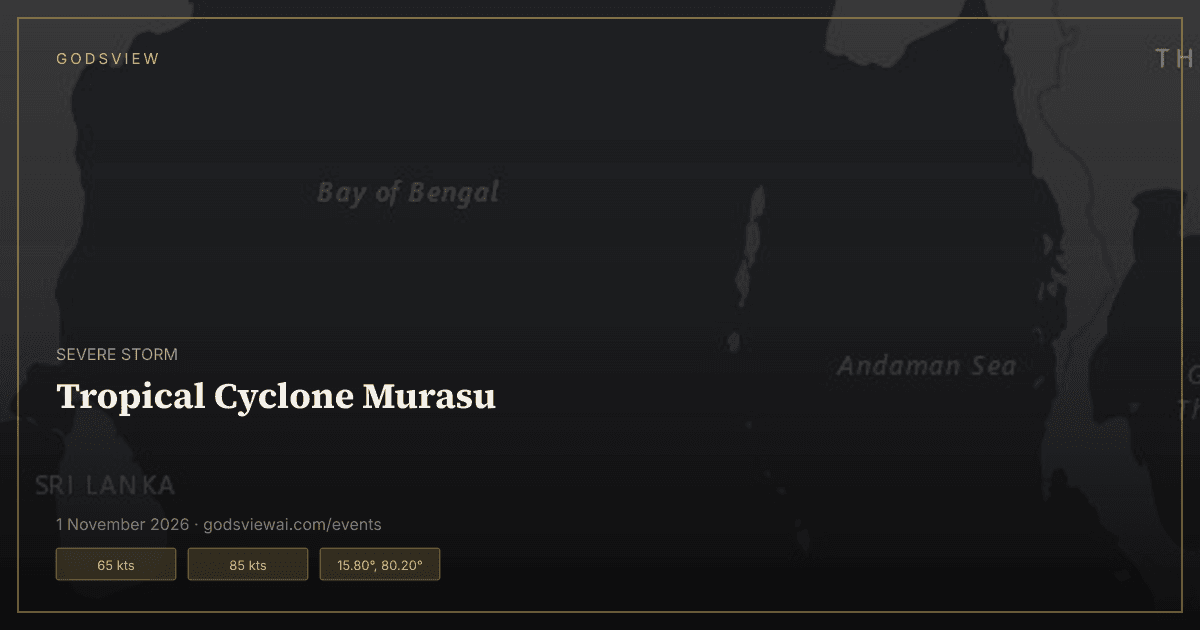
Open this location on the live map
Main page for this storm: /events/2026/11/01/tropical-cyclone-four-tc1001346.
Summary
NASA's Earth Observatory Natural Event Tracker (EONET) lists Tropical Cyclone Murasu, first observed on 1 Nov 2026, 00:00 UTC with 10 position reports.
The latest position report lists wind of 65 kts.
Key figures
- Latest wind
- 65 kts (NASA EONET)
- Peak wind in track
- 85 kts (NASA EONET)
- First observation
- 1 Nov 2026, 00:00 UTC (NASA EONET)
- Latest observation
- 3 Nov 2026, 06:00 UTC (NASA EONET)
- Position
- 15.80°, 80.20° (NASA EONET)
- Track points
- 10 (NASA EONET)
Timeline
Source times where the record has one; otherwise the time GodsView saw the change.
- — The source no longer lists the event as current.
- — The source no longer lists the event as current.
- — The source no longer lists the event as current.
- — The source no longer lists the event as current.
- — Position 15.8°, 80.2°, 65 kts (NASA EONET).
- — Position 15.5°, 80.3°, 85 kts (NASA EONET).
- — Position 15.1°, 80.5°, 85 kts (NASA EONET).
- — Position 14.7°, 80.7°, 65 kts (NASA EONET).
- — Position 14.2°, 80.9°, 65 kts (NASA EONET).
- — Position 13.9°, 81.5°, 60 kts (NASA EONET).
- — Position 13.3°, 82.6°, 60 kts (NASA EONET).
- — Position 12.9°, 83.6°, 55 kts (NASA EONET).
- — Position 12.3°, 84.8°, 40 kts (NASA EONET).
- — Position 11.4°, 86.2°, 35 kts (NASA EONET).
- — First NASA EONET observation: 35 kts.
News coverage
Questions
When did this severe storm happen?
The first source record is dated 1 Nov 2026, 00:00 UTC.
Where can I find official information?
From the original records: NASA EONET, JTWC. Links are listed under Sources on this page.
Sources
How this page is made
GodsView compiles this page automatically from public data: the U.S. Geological Survey (USGS) earthquake feeds, the Global Disaster Alert and Coordination System (GDACS) and NASA EONET. News stories are matched to the event by place, event type and publication time, and link to the original publishers. Figures are shown as the sources report them and may be revised. For warnings and safety advice, follow your local authorities.