How-to
How to Track a Flight: Flight Number, Callsign or Hex
A ticket says BA117, the map says BAW117, and the plane spotter reads a tail number off the fuselage. Here is how the identifiers fit together and which one to search for each job.
Key takeaways
- Passengers know the flight number (BA117); the radio and most live maps use the ICAO callsign (BAW117); the airframe itself is identified by its registration and hex code.
- To find a flight live, convert the two-letter IATA airline code to the three-letter ICAO designator and search that callsign.
- To follow one specific aircraft across many flights, search its registration or six-character hex code instead.
- Callsigns do not always match flight numbers, and a flight can be missing from the map for coverage or privacy reasons.
- For gate times and delays, the airline and the airport remain the authority; a live map shows where the aircraft is.
To track a flight live, search for its callsign, registration or hex code on a live flight map. If you only have a flight number from a ticket, such as BA117, swap the two-letter IATA airline code for the three-letter ICAO code (BAW) and search for BAW117. If you want one particular aircraft rather than one scheduled service, search its tail number or hex code.
That is the short answer. The longer one is worth a few minutes, because flight trackers mix four different identifiers, and choosing the wrong one is the most common reason a search comes back empty. This guide explains each identifier, how airline and airport codes work, the step-by-step method on a live map, and what to do when a flight will not show.
Everything below works on the free live flight tracker, and the same logic applies on any ADS-B based map.
The four ways to identify a flight
A single flight is described in at least four ways, each created by a different part of the aviation system.
| Identifier | Example | Who assigns it | Stays with | Best for |
|---|---|---|---|---|
| Flight number | BA117 | The airline, using its IATA code | The scheduled service | Bookings, airport boards, delays |
| Callsign | BAW117 or SPEEDBIRD 117 on the radio | The airline, using its ICAO designator | The flight on that day | Finding the flight on a live map |
| Registration (tail number) | N12345, G-XXXX | The national aviation authority | The airframe | Following one aircraft over time |
| ICAO hex code | A061D9 | The state of registry, from its ICAO block | The airframe (until re-registered) | The most reliable live search |
The first two describe the trip. The last two describe the aircraft. Once you see that split, most tracker behavior makes sense: a flight number is reused every day by different aircraft, while a hex code follows one aircraft from flight to flight.
Flight number vs callsign: the short answer
The flight number is what you see on a ticket. It starts with the airline's two-character IATA designator, the code system that IATA maintains for ticketing and schedules (IATA code search). British Airways is BA, so a ticket might read BA117.
The callsign is what air traffic control and the aircraft's transponder use. It starts with the airline's three-letter ICAO designator, published in ICAO Doc 8585 along with a spoken telephony designator. For British Airways the ICAO designator is BAW and the spoken callsign is SPEEDBIRD (SKYbrary). So on the radio you hear "Speedbird 117", and on an ADS-B map you see BAW117.
Live maps show the callsign because it is what the aircraft broadcasts in its identification message. Our guide on how ADS-B flight tracking works shows where that field sits in the message.
When the callsign does not match the flight number
Many airlines deliberately use callsigns that differ from the commercial flight number. Sequential flight numbers sound alike on a busy frequency, so carriers switch some flights to alphanumeric callsigns to reduce confusion, as SKYbrary's call sign confusion guidance describes. As a result, a flight sold under one number may fly with a callsign that mixes digits and letters and looks nothing like the ticket.
If a converted callsign returns nothing, try the airline name plus the route, or look the aircraft up by registration on the airline or airport's own flight status page and then search for that.
Airline and airport codes: IATA vs ICAO
The same two organizations also code airports, and trackers use both.
| Thing | IATA code | ICAO code | Where you see it |
|---|---|---|---|
| Airline (British Airways) | BA | BAW | Tickets vs callsigns |
| Airport (London Heathrow) | LHR | EGLL | Boarding passes vs flight plans and charts |
IATA airport codes are three letters and come from the IATA directory. ICAO airport codes are four letters and appear in flight plans, weather reports and aviation charts; Heathrow is LHR to passengers and EGLL to pilots (SKYbrary). A good tracker accepts either, so you can type LHR or EGLL and land on the same airport.
How to track a flight by flight number, step by step
Here is the routine on GodsView AI, which needs no install, no account and no API key to view the map.
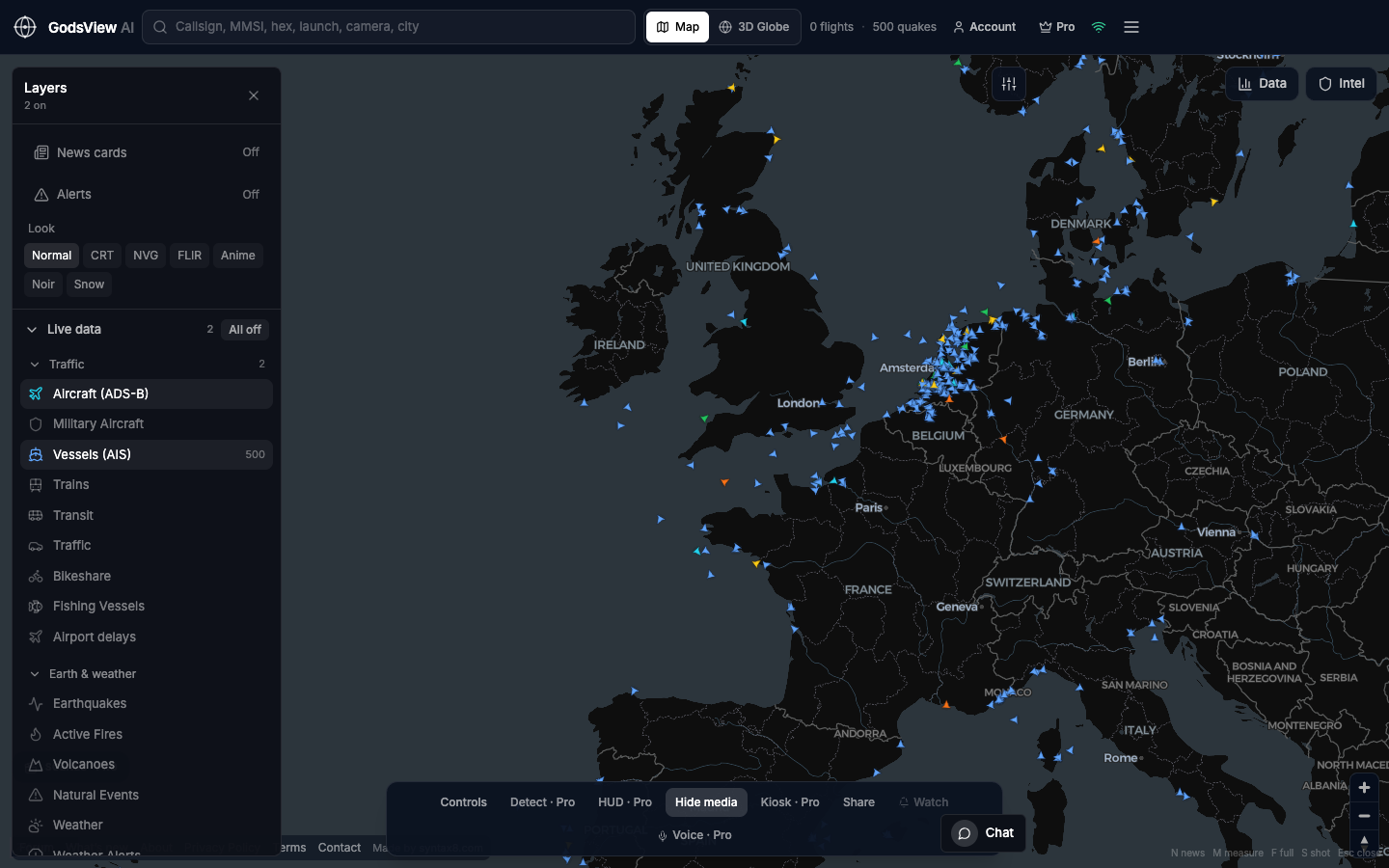
- Open the map. Go to the live flight tracker or the 3D globe. Wait a few seconds for aircraft to load; the layer refreshes about every 10 seconds.
- Convert the flight number. Replace the IATA airline code with the ICAO designator: BA117 becomes BAW117. If you are unsure of the ICAO code, type the airline name; the search box also matches airlines.
- Search. The search box accepts callsigns, airline names, aircraft models, registrations, hex codes, airports and cities. Pick the matching result and the map flies to it.
- Open the data panel. Click the aircraft to see its callsign, hex code, registration, type, altitude and speed where the data includes them.
- Keep it. Copy a share link that reopens the same view, or replay the aircraft's track from adsb.lol traces at 1× to 40× speed.
If the aircraft is still on the ground, it may not appear yet: aircraft at the gate or on the taxiway show up only where a receiver near the airport can hear them.
How to track a plane by tail number or hex code
Use the aircraft identifiers when you care about a specific airframe: a family member's charter, a historic aircraft, an aircraft you photographed, or the inbound aircraft that will operate your next flight.
The registration is painted on the fuselage and starts with a country prefix, such as N for the United States or G for the United Kingdom. The hex code is the six-character ICAO 24-bit address programmed into the transponder. For US aircraft, the FAA aircraft registry lists both: search an N-number and the result shows the Mode S code in octal and in hexadecimal. The registry's own definitions describe it as the transponder address assigned to each US registration, sometimes called the ICAO address code.
Hex is the most dependable live search because it comes straight from the transponder, while registrations and callsigns depend on databases and crew entry. If you see an unlabeled aircraft on the map, the hex code is often the only identifier you have.
Search a callsign or hex code on the globe
How to track arrivals and departures at an airport
Sometimes you do not know the flight at all; you just want to see what is landing. Center the map on the airport, or start from an airport page such as JFK or Heathrow, and watch the approach paths. Arrivals line up on the extended runway centerline and descend steadily toward the field, so the final approach is easy to pick out.
The airport tracker shows the airport view. Pro adds airport timetables, FAA airport delay information and the ATC-style radar scope, which is useful when you want the list view rather than the map.
How to read a flight once you find it
Finding the aircraft is half the job. Most trackers then show a similar set of fields, and each one answers a different question about what the aircraft is doing.
- Altitude. Usually barometric altitude in feet. Airliners begin their descent well before the destination, so a falling altitude far from the airport is normal.
- Ground speed. Speed over the ground in knots, which includes the wind. The same aircraft can show very different ground speeds eastbound and westbound over the Atlantic because of jet stream winds.
- Vertical rate. Feet per minute up or down. A steady negative number far from any airport usually means a planned descent, not a problem.
- Squawk. The four-digit transponder code assigned by air traffic control. Three codes have fixed meanings in FAA procedures: 7500 for unlawful interference, 7600 for radio failure and 7700 for an emergency (see the FAA Aeronautical Information Manual, chapter 4 and chapter 6).
- Position source. Most positions are ADS-B. Some aircraft are placed by multilateration from several receivers, which can look slightly less smooth.
- Last seen. How many seconds ago the network last heard the aircraft. A value that keeps climbing means it has left coverage.
Put together, these fields let you answer the practical questions: is it still climbing, is it holding, has it started the approach? For a deeper look at where each number comes from, see how ADS-B flight tracking works.
How to get alerts when a flight takes off or lands
Watching a map is fine for a single landing. For anything longer, set an alert. GodsView Pro offers takeoff and landing alerts, signal-lost alerts and emergency squawk alerts (7500, 7600 and 7700), delivered in-app, by browser push and by email, plus watchlists for aircraft you follow regularly. Pro costs $10.99 per month, $99.99 per year or $199.99 lifetime as of October 2026.
Alerts work on the aircraft's broadcast, so they share the same limits as the map: no coverage, no alert.
Why can I not find my flight?
The most common causes, roughly in order:
- Wrong identifier. You searched the IATA flight number instead of the ICAO callsign, or the airline uses an alphanumeric callsign.
- Not airborne yet. The flight is delayed, still at the gate, or surface coverage at that airport is thin.
- Coverage gap. The aircraft is low, remote or over an ocean outside satellite coverage. Positions resume when it comes back into range.
- Privacy programs. The FAA's LADD program filters participating aircraft from displays that use FAA data, and the Privacy ICAO Address program lets eligible US aircraft fly with a temporary hex code that is not linked to them in the public registry.
- Military or government. Many state aircraft do not broadcast or are filtered on commercial trackers. Our military aircraft tracking explainer covers why.
What a flight tracker cannot tell you
A live map shows where the aircraft is and how it is moving. It does not show gate assignments, boarding status, connection protection or the reason for a delay; those come from the airline and the airport. Estimated arrival times on any tracker are calculations from speed and distance, and holding, runway changes and spacing can move them by many minutes.
For travel decisions, use the airline's app or the airport's departures board, and use the map to see the aircraft itself. If a squawk of 7700 appears on a flight you care about, it means the crew declared an emergency (FAA AIM); contact the airline for passenger information rather than relying on a map.
Free vs paid flight tracking
You do not need to pay to track a flight. On GodsView, the map, flights, ships, satellites, weather and the news feed are free; free live viewing pauses after 30 minutes and continues when you reload. Pro removes ads and the time limit and adds alerts, watchlists and the military layer.
The large consumer trackers work on a similar free-plus-subscription model. If you are weighing them, read is Flightradar24 free?, our roundup of Flightradar24 alternatives, and the head-to-head ADS-B Exchange vs Flightradar24. The methodology page lists exactly which feeds sit behind our aircraft layer.
Where to start
Have a ticket? Convert the flight number to its ICAO callsign and search it. Know the aircraft? Search the registration or hex code. Just curious? Center the map on an airport and watch the arrivals stream in.
Keep in mind that a map shows broadcasts, not schedules: if a flight is missing, check the identifier first, then coverage, then privacy filtering.
Frequently asked questions
How can I track a flight in real time for free?
Open a free live map such as the GodsView live flight tracker, then search the flight's ICAO callsign (for example BAW117 for British Airways flight BA117), its registration or its hex code. Click the aircraft to see altitude, speed and identifiers. No account or install is needed to view the map; alerts and watchlists are paid features.
What is the difference between a flight number and a callsign?
The flight number uses the airline's two-character IATA code and appears on tickets, such as BA117. The callsign uses the three-letter ICAO designator and is what the aircraft broadcasts and air traffic control uses, such as BAW117, spoken as "Speedbird 117". Some airlines use alphanumeric callsigns that do not match the flight number at all.
Can I track a plane by its tail number?
Yes. Search the registration painted on the aircraft, such as an N-number in the US, on a live map that supports registration search. For US aircraft, the FAA registry also shows the matching Mode S hex code, which is the most reliable identifier for following one airframe across many flights.
Why does my flight not show on the flight tracker?
Usually you searched the IATA flight number instead of the ICAO callsign, or the flight has not taken off. Other causes are coverage gaps over remote areas and oceans, owners who opted into the FAA LADD or Privacy ICAO Address programs, and military or government aircraft that do not broadcast or are filtered.
Is a flight tracker's arrival time accurate?
It is an estimate based on the aircraft's current speed and remaining distance. Holding patterns, runway changes and arrival spacing can shift it by many minutes. For gate times, baggage and connections, rely on the airline and the airport, and use the map to see where the aircraft actually is.
Sources
- IATA — Airline and airport code search
- ICAO — Doc 8585, Designators for Aircraft Operating Agencies
- SKYbrary — British Airways (ICAO, IATA and callsign)
- SKYbrary — Call sign confusion
- SKYbrary — London Heathrow (EGLL / LHR)
- FAA — Aircraft registry inquiry
- FAA — Limiting Aircraft Data Displayed (LADD)
- FAA — ADS-B Privacy ICAO Address (PIA) program
- FAA — Aeronautical Information Manual, emergency procedures
Facts checked on against each provider's own site.