How-to
Is There a Meteor Shower Tonight? 2026-27 Dates and Tips
Some meteor shower is active on most nights of the year, but only a handful are worth staying up for. These are the dates for the next twelve months, the Moon on each peak night, and the small details that decide whether you see five meteors or fifty.
Key takeaways
- As of November 8, 2026, three weak showers are active: the Northern Taurids (peak Nov 12-13), the Leonids (peak Nov 17-18) and the fading Southern Taurids.
- The next big one is the Geminids, peaking on the night of December 14-15, 2026 with a 25%-lit Moon. It is usually the strongest shower of the year.
- The famous ZHR number assumes a perfect sky with the radiant overhead. Real counts are lower: from a suburb, expect a third to a half.
- Best hours are usually after midnight, when your side of Earth faces into the stream. The Geminids are the exception and are good from mid-evening.
- No telescope needed. Get away from lights, give your eyes 20 to 30 minutes, and look about 40 to 60 degrees away from the radiant.
On most nights at least one meteor shower is active, but only a few a year produce more than a handful of meteors an hour. As of November 8, 2026, the next notable peaks are the Northern Taurids (night of November 12-13), the Leonids (November 17-18) and, the big one, the Geminids on the night of December 14-15, 2026. GodsView's meteor shower calendar works out each peak, the Moon on that night and the expected rate, so you can check "is there a meteor shower tonight" in one place.
The rest of this guide covers the full calendar into 2027, what the numbers actually mean, and how to give yourself the best chance on the night.
Is there a meteor shower tonight?
Is there a meteor shower tonight?
Open the meteor showers page. The top line says which showers are active tonight and when the next peak is. On November 8, 2026 it read: "Tonight: Leonids (peak Nov 17), Southern Taurids (past peak), Northern Taurids (peak Nov 12)", with the Moon 0% lit, a new moon.
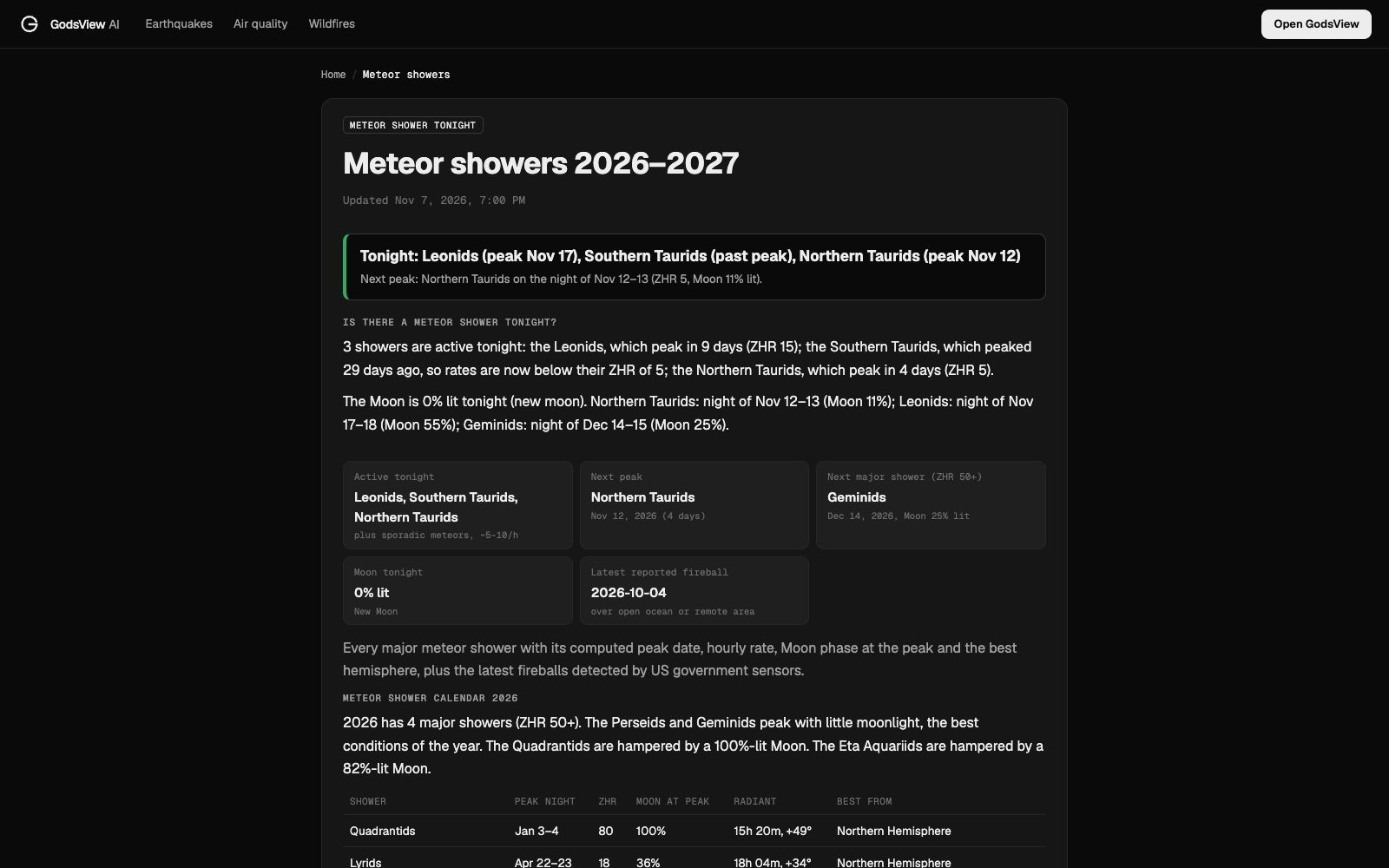
"Active" is a low bar. All three of those showers produce only a few meteors an hour, on top of the 5 to 10 random "sporadic" meteors you'd see on any dark night. A new moon helps, but on a normal November night you'll still see more sporadics than Taurids. The nights worth planning around are the major showers, the ones with a zenithal hourly rate (ZHR) of 50 or more.
Meteor shower calendar for the next 12 months
These are the peak nights GodsView calculates from the International Meteor Organization's working list (IMO), with the Moon's illumination on the peak night. "Night of Dec 14-15" means the evening of the 14th through the morning of the 15th.
| Shower | Peak night | ZHR | Moon at peak | Best from |
|---|---|---|---|---|
| Northern Taurids | Nov 12-13, 2026 | 5 | 11% | Northern Hemisphere |
| Leonids | Nov 17-18, 2026 | 15 | 55% | Northern Hemisphere |
| Geminids | Dec 14-15, 2026 | 150 | 25% | Northern Hemisphere |
| Ursids | Dec 22-23, 2026 | 10 | 98% | Northern Hemisphere |
| Quadrantids | Jan 3-4, 2027 | 80 | 12% | Northern Hemisphere |
| Lyrids | Apr 22-23, 2027 | 18 | 95% | Northern Hemisphere |
| Eta Aquariids | May 6-7, 2027 | 50 | 0% | Southern Hemisphere and tropics |
| Perseids | Aug 12-13, 2027 | 100 | 87% | Northern Hemisphere |
| Orionids | Oct 21-22, 2027 | 20 | 58% | Both hemispheres |
Two things stand out. The Geminids and the January Quadrantids both get a dark sky this season, which is a good pairing. And the Perseids in August 2027 peak under an 87%-lit Moon, so 2027 is a weak Perseid year. Each shower has its own page, for example the Perseids, Leonids and Quadrantids, with peak dates for the next three years.
What the ZHR number really means
ZHR, the zenithal hourly rate, is how many meteors one observer would see in an hour under a perfectly dark sky (stars down to magnitude 6.5 visible) with the shower's radiant straight overhead. It's a standard for comparing showers, not a forecast for your back garden.
Real counts are lower for three reasons:
- The radiant isn't overhead. Multiply the ZHR by the sine of the radiant's altitude. At 30 degrees you see half; at 63 degrees, about 90%.
- Your sky isn't perfectly dark. From a suburb, where only stars to about magnitude 4.5 or 5 are visible, expect a third to a half of the ZHR, sometimes less.
- The Moon. A bright Moon washes out fainter meteors the same way city light does.
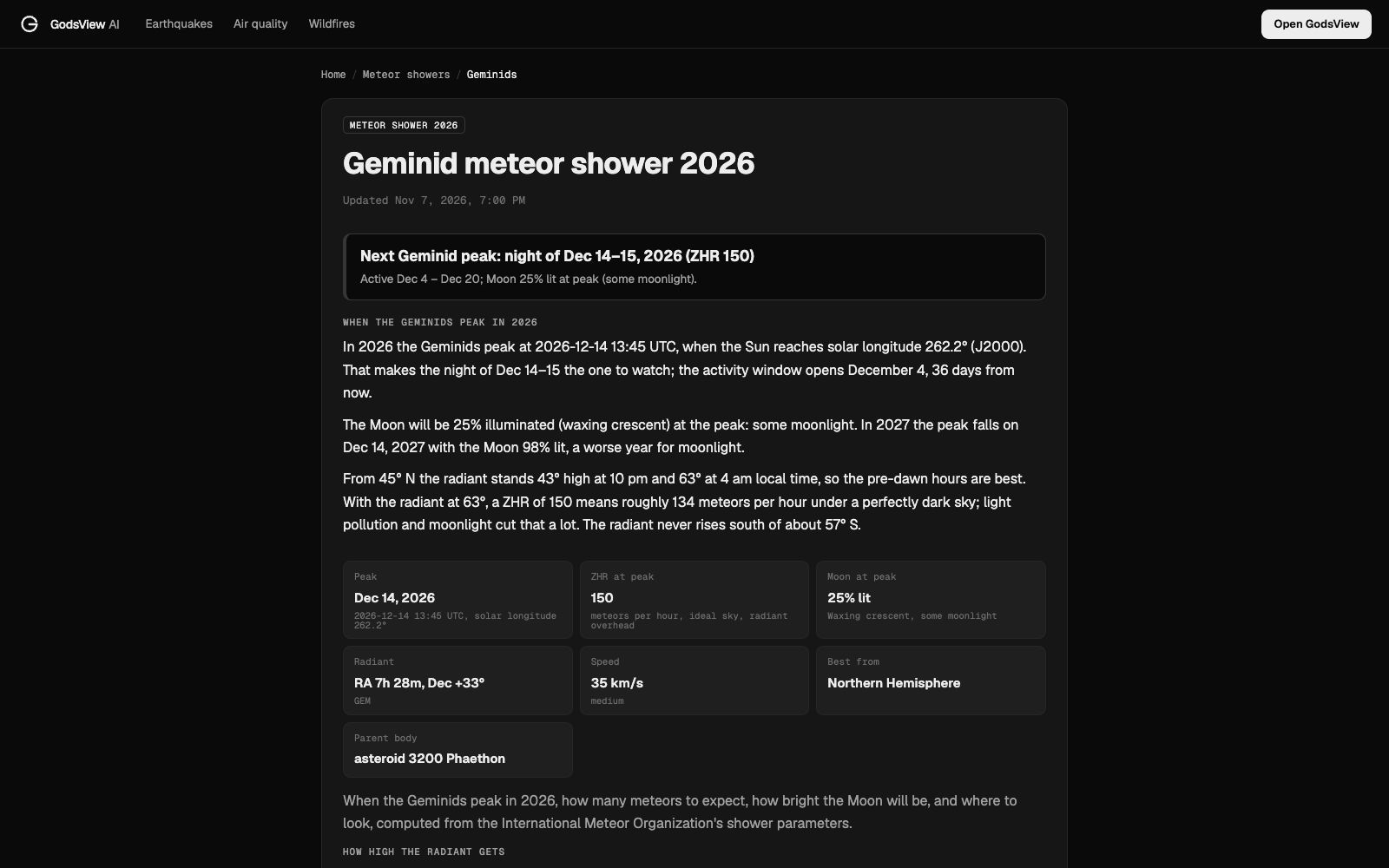
GodsView's shower pages do the first step for you. For the Geminids the page says that from 45 degrees north the radiant stands 63 degrees high at 4 am, so a ZHR of 150 means roughly 134 meteors an hour under a perfect sky. Under a suburban sky with a crescent Moon, a realistic count is more like 40 to 60 an hour at the best time, which is still the best show of the year.
How to watch the Geminids on December 14-15, 2026
The Geminids are the shower to plan for this year. According to the GodsView calculation, the peak falls at 13:45 UTC on December 14, 2026, which makes the night of December 14-15 the one to watch, and the activity window runs from December 4 to 20. The Moon will be a 25%-lit waxing crescent that sets in the evening, so the best hours after midnight are dark.
What makes the Geminids different:
- They start early. The radiant near Castor in Gemini is up by mid-evening, so unlike most showers you can see good numbers before midnight. The rate still climbs toward 2 am, when the radiant is highest.
- They are slow and bright. Geminids hit the atmosphere at about 35 km/s, roughly half the speed of the Leonids, so they leave longer, easier-to-see trails.
- Their parent is an asteroid. Most showers come from comet dust. The Geminids come from 3200 Phaethon, a rocky asteroid (NASA).
- They favour the north. From 35 degrees south (Sydney, Buenos Aires) the radiant only reaches about 16 degrees by 4 am, so southern observers see far fewer.
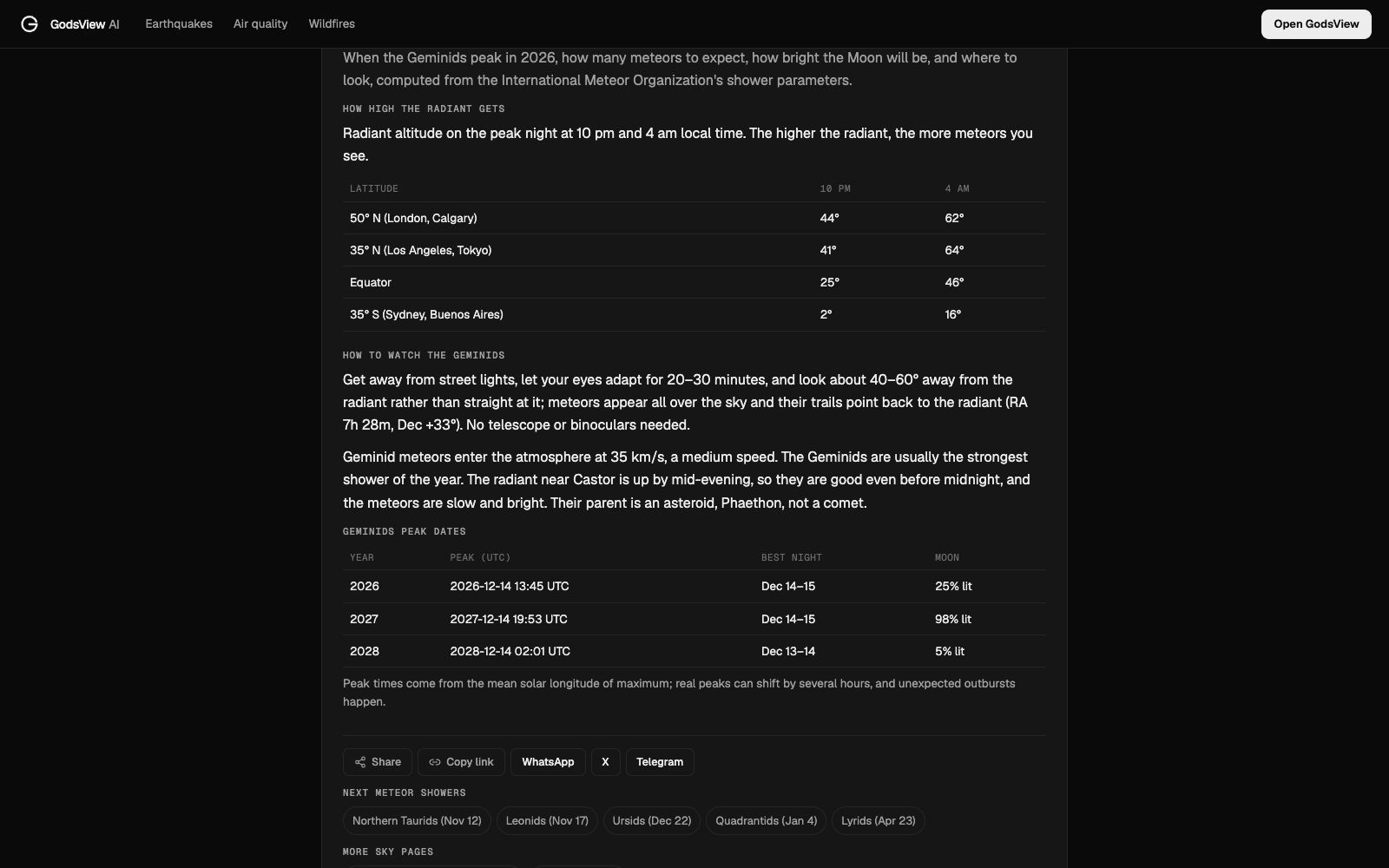
If clouds ruin the 14th, try the nights of the 13th and 15th. Rates are lower but still well above a normal night. And enjoy this one: the 2027 Geminids peak under a 98%-lit Moon.
Where meteor showers come from
Every meteor shower is Earth passing through a trail of dust left by a comet or, in a few cases, an asteroid. The grains are mostly smaller than a grain of sand. They hit the atmosphere at 11 to 72 km/s and burn up from friction and compression, lighting a short streak. Because Earth crosses each trail at the same point in its orbit every year, showers repeat on roughly the same dates.
The trails of all meteors in a shower point back to one spot in the sky, the radiant, and the shower is named after the constellation it sits in: the Perseids from Perseus, the Geminids from Gemini, the Leonids from Leo. That's a perspective effect, the same way parallel railway tracks seem to meet in the distance.
Some showers occasionally "storm". The Leonids produced thousands of meteors an hour in 1833, 1966 and the years around 2000 when Earth passed through dense, young strands of debris from comet Tempel-Tuttle. Ordinary Leonid years, like 2026, bring about 15 an hour at best.
Meteor showers from the Southern Hemisphere
Most famous showers favour the north because their radiants are in northern constellations. From Australia, New Zealand, South Africa or South America, the better choices are different:
- Eta Aquariids (early May): debris from Halley's Comet, much better from the south and the tropics. The 2027 peak on the night of May 6-7 has no Moon at all.
- Southern Delta Aquariids (late July): a broad, steady shower with a southern radiant.
- Orionids (late October): visible from both hemispheres, fast meteors, also from Halley's Comet.
- Geminids (mid-December): still worth a look from the south after midnight, but at much lower rates because the radiant stays low.
How to see more meteors, step by step
- Check the Moon and the clouds. The shower page gives the Moon; a cloud forecast for your town does the rest. GodsView's aurora forecast pages show hourly cloud cover for each dark hour, which works just as well for meteor nights.
- Get away from lights. Even a short drive out of town can double what you see. A park or a field beats a lit garden.
- Give your eyes 20 to 30 minutes. Don't look at your phone. If you must, use red light.
- Lie back and look up. A reclining chair or a sleeping mat is the single best piece of gear. Look about 40 to 60 degrees away from the radiant, not straight at it; meteors appear anywhere in the sky, and their trails point back to the radiant.
- Stay at least an hour. Meteors come in bursts and lulls. Ten quiet minutes followed by four meteors in one minute is normal.
- Dress for it. December nights are cold and you won't be moving. Bring more layers than you think.
No telescope or binoculars needed; they narrow your view and you'll miss most meteors.
Can you photograph a meteor shower with a phone?
Sometimes. Modern phones with a night mode can catch bright meteors, but each exposure only covers a few seconds of a small patch of sky. Put the phone on a tripod or a steady surface, point it at a dark part of the sky about 45 degrees up, and use an app or mode that takes repeated long exposures. You'll take hundreds of frames to catch a few meteors. A camera on a tripod with a wide lens and a timer does much better.
What about fireballs and other lights?
A fireball is simply a very bright meteor. The American Meteor Society defines it as "a very bright meteor, generally brighter than magnitude -4", about as bright as Venus (AMS). They happen during showers and outside them, and the AMS collects eyewitness reports. The GodsView calendar page also lists the latest fireballs detected by US government sensors, published by NASA JPL (CNEOS).
If what you saw was slow, steady or moving in a line with others, it probably wasn't a meteor at all. Satellites, the ISS, Starlink trains and rocket launches all get mistaken for meteors. Our guide to what that light in the sky was helps you tell them apart, and how to see Starlink satellites and the ISS tonight covers satellite passes in detail.
Frequently asked questions
Is there a meteor shower tonight?
Usually something is active, but often only at a few meteors an hour. The GodsView meteor showers page lists what is active tonight, the next peak and the Moon phase. As of November 8, 2026 the Northern Taurids and Leonids are active, peaking on Nov 12-13 and Nov 17-18.
When is the next big meteor shower?
The Geminids, peaking on the night of December 14-15, 2026, with a ZHR of 150 and the Moon 25% lit. After that, the Quadrantids peak on the night of January 3-4, 2027 under a 12%-lit Moon.
What time is best to watch a meteor shower?
Usually from midnight to dawn, when the radiant is higher and your side of Earth faces into the debris stream. The Geminids are good from mid-evening because their radiant rises early.
How many meteors will I actually see?
Fewer than the ZHR. Multiply the ZHR by the sine of the radiant height, then expect a third to a half of that from a suburban sky. For the 2026 Geminids, 40 to 60 an hour is realistic from a fairly dark suburb at the best time.
Which direction should I look?
Anywhere with a dark, open sky. Looking 40 to 60 degrees away from the radiant gives longer trails. You do not need to find the radiant to see the shower.
Do I need a telescope to see meteors?
No. Telescopes and binoculars show only a tiny part of the sky. Your eyes, adapted to the dark for 20 to 30 minutes, are the best tool.
Sources
- International Meteor Organization (IMO)
- NASA: Geminids
- American Meteor Society: Fireball FAQ
- American Meteor Society: Meteor shower calendar
- NASA JPL CNEOS: Fireball and bolide data
Facts checked on against each provider's own site.