How-to
What Was That Light in the Sky? How to Identify It Tonight
You see something odd above the rooftops and by the time you get your phone out it is gone. Most mystery lights fall into a short list, and a few details you can notice in the moment (speed, blinking, how long it lasted) will tell you which one it was.

Key takeaways
- Three questions sort most sightings: did it move, did it blink, and how long did you see it?
- A steady light crossing the sky in a few minutes with no blinking is almost always a satellite or the ISS. A blinking or coloured light is an aircraft.
- A line of evenly spaced dots moving together is a Starlink train, usually seen in the days after a launch.
- A streak lasting a second or less is a meteor. A slow, fragmenting fireball lasting tens of seconds is more likely space debris re-entering.
- A bright "star" that does not move for an hour is usually a planet, most often Venus or Jupiter.
Most lights in the night sky are one of seven things: a plane, a satellite or the International Space Station, a Starlink train, a meteor, a rocket launch, the aurora or a bright planet. Ask three questions: did it move, did it blink, and how long did it last? A steady light crossing the sky in a few minutes is a satellite. A blinking one is an aircraft. A one-second streak is a meteor. A bright point that stays put is a planet. GodsView's What's overhead page shows the planes above you right now and the space station passes for the next 24 hours, which settles most of these in a minute.
Below is a quick identifier, then each culprit in more detail, with how to check it after the fact.
Quick identifier: what did it look like?
| What you saw | Most likely | How to check |
|---|---|---|
| Steady white light, crossing much of the sky in 2 to 6 minutes, no blinking | A satellite, the ISS or China's space station | Satellite passes on What's overhead |
| Very bright steady light, brighter than any star, moving smoothly | The International Space Station | ISS tracker and overhead passes |
| A line of evenly spaced dots moving together | A Starlink train | Starlink tracker |
| Blinking red, green or white lights, maybe a steady white beam | A plane or helicopter | The live list on What's overhead |
| A streak lasting under a second | A meteor | Meteor shower calendar |
| A very bright streak, maybe green or orange, possibly breaking up | A fireball | Fireball reports (see below) |
| A glowing, expanding cloud or plume at dusk or dawn | A rocket launch | Space launch tracker |
| Green or red glow or curtains low toward the pole | The aurora | Aurora forecast |
| A bright "star" that stays in one place for hours | Venus, Jupiter or another planet | A sky app or planetarium chart |
A steady moving light: satellites and the ISS
If it moved at a steady pace, didn't blink and took a few minutes to cross the sky, you almost certainly saw a satellite. They shine by reflecting sunlight, which is why you only see them for an hour or two after sunset and before sunrise: the satellite is still in sunshine while your sky is dark. Many fade out in the middle of the sky as they pass into Earth's shadow, which looks eerie the first time you see it.
The brightest is the International Space Station. NASA calls it the third brightest object in the sky after the Sun and the Moon (NASA Spot the Station). If a steady light was brighter than every star and took about five minutes to cross, check whether the ISS passed over you at that time.
GodsView's What's overhead page lists ISS, Chinese space station (CSS) and Hubble passes for the next 24 hours wherever you are, with the time, the direction it rises and sets, and how high it climbs. Each pass is labelled Visible (lit by the sun while your sky is dark), In shadow or Daylight.
For any other satellite, the live satellite tracker puts thousands of them on the globe from public orbital elements. If you want to know how those predictions work, read how satellite tracking works.
A line of lights: Starlink trains
A string of evenly spaced lights moving together in a line is a Starlink train. SpaceX launches its satellites in batches, and for the first days after a launch they travel close together at a low altitude, catching the sunlight like a string of pearls. As they climb to their working orbit and spread out, the train breaks up and fades.
Trains are most visible shortly after dusk or before dawn, in the days right after a launch. The Starlink tracker shows the Starlink group on the globe (the Starlink layer is part of GodsView Plus), and our guide to seeing Starlink satellites and the ISS tonight covers when and where to look.
A blinking light: planes and helicopters
Aircraft carry flashing anti-collision lights (red and white strobes) and navigation lights (red on the left wing, green on the right). If it blinked, it was an aircraft. A steady, very bright white light that seems to hang in one spot is often a plane on approach with its landing lights pointed toward you; watch it for a minute and it will grow and drift.
To identify it, open What's overhead, share your location or type your town, and match it by direction and angle above the horizon. Each plane comes with its callsign, airline, type, altitude and distance. For more detail, see what's flying over my house right now. And if it's going round and round, why a helicopter is circling explains the usual reasons.
Small lights that hover, change direction sharply and are very low are usually drones. Recreational drones in the US must follow FAA rules, including flying at or below 400 feet (FAA). Drones don't appear on public flight maps.
A quick streak: meteors and fireballs
A light that zips across part of the sky and vanishes within a second is a meteor: a grain of space dust burning up, most of them roughly 75 to 100 km up. You can see a few an hour on any dark night, and many more during a meteor shower. The GodsView meteor shower calendar tells you which showers are active tonight; our meteor shower guide has the dates for the next year.
A fireball is a very bright meteor. The American Meteor Society defines it as brighter than magnitude -4, about as bright as Venus, and says several thousand happen in the atmosphere every day, though most go unseen over oceans or in daylight (AMS). Fireballs can be green or orange and sometimes break into pieces. If you saw one, report it to the AMS; enough reports let them reconstruct its path.
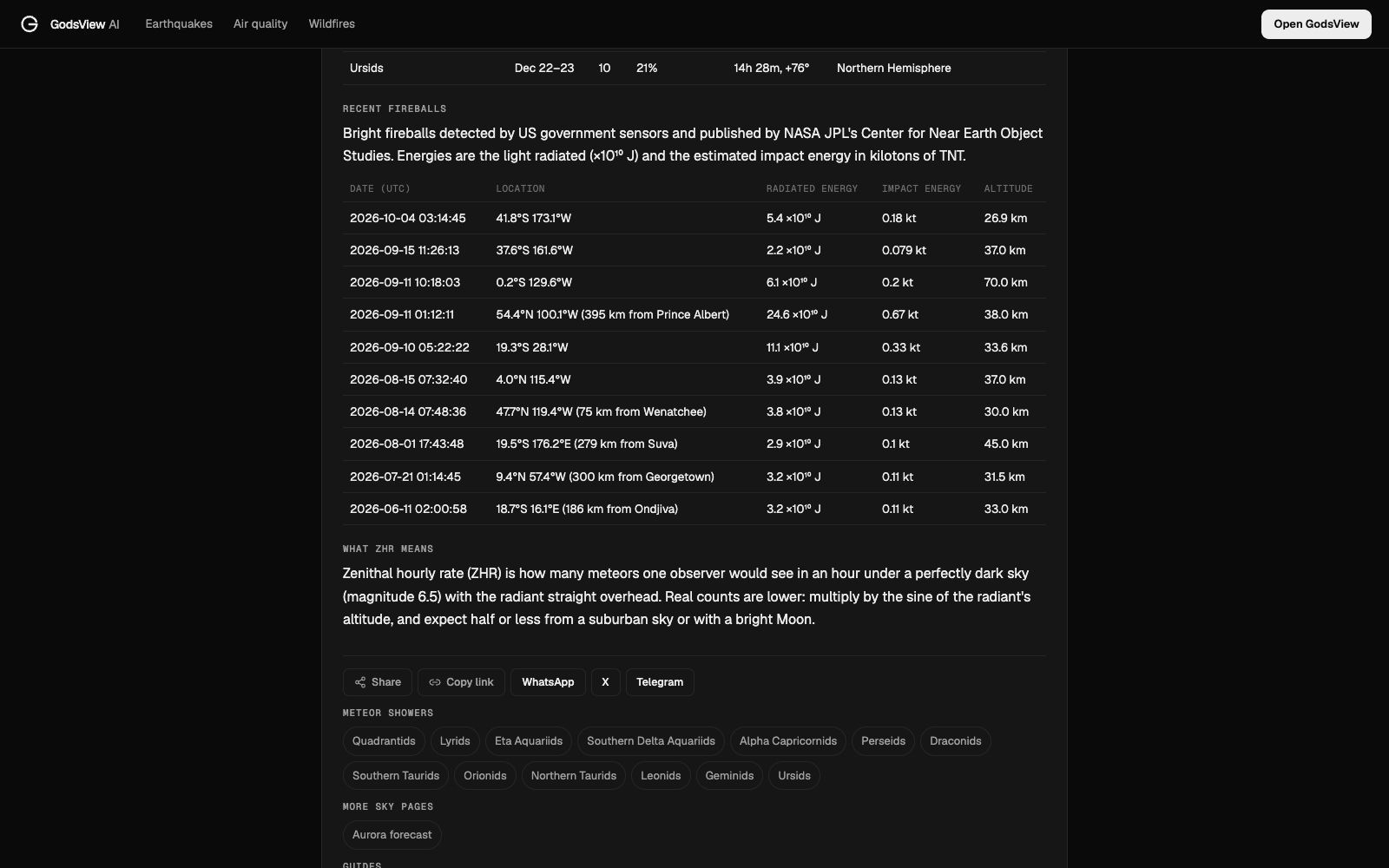
The biggest fireballs are also detected by US government sensors and published by NASA JPL's Center for Near Earth Object Studies (CNEOS). GodsView lists the latest of them on the meteor showers page.
One special case: if the "fireball" moved slowly, lasted 20 seconds or more and broke into a trail of glowing fragments, it may have been space debris or a spent rocket stage re-entering. Those are slower than natural meteors. Re-entries are reported by space agencies and in the news, not on GodsView.
A glowing cloud at dusk: rocket launches
Sometimes people describe a strange glowing cloud, a jellyfish shape or a spiral, spreading across the sky just after sunset or before sunrise. That's almost always a rocket. When a launch happens in twilight, the rocket climbs out of Earth's shadow into sunlight while you are still in darkness, and its exhaust plume lights up. These plumes can be seen hundreds of kilometres from the launch site.
To check, look at the space launch tracker, which shows upcoming and recent launches at their pads from Launch Library 2 (launches are a GodsView Plus layer on the map). If a launch from Florida, California, Texas or elsewhere lines up with the time you saw it, you have your answer.
A glow low in the sky: the aurora
A green or red glow, sometimes in curtains or rays, low over the northern horizon (southern, in the southern hemisphere) is the aurora. Strong geomagnetic storms push it far south of where people expect it. Faint aurora can look grey-white to the eye, and your phone camera often shows the colour better than your eyes do.
Check the aurora forecast for your city and space weather for the current storm level. How to see the northern lights tonight explains what has to line up.
A bright star that doesn't move: planets
If the light is very bright, doesn't twinkle much and stays in the same spot for an hour or more (slowly setting with the stars), it's probably a planet. Venus is the brightest, low in the west after sunset or the east before sunrise, depending on the time of year. Jupiter is next. People report Venus as a UFO more than almost anything else, because it can look impossibly bright and seems to "follow" you as you drive.
A free sky-chart app pointed at the light will name it.
Other things people report
A few more explanations come up often enough to mention:
- Sky lanterns drift slowly with the wind, glow orange and flicker, and often rise in groups after weddings, festivals and New Year.
- Searchlights and laser shows make moving beams or spots on low cloud, usually from a stadium, a club or an event.
- Satellite flares were once a well-known sight: the old Iridium satellites' flat antennas flashed sunlight for a few seconds. The last of those satellites was retired in 2019, so short flashes today are usually other satellites tumbling or catching the sun briefly.
- Balloons, including high-altitude research and weather balloons, can glint in the sunlight at dusk long after the ground is dark, and hang almost still for a long time.
Still not sure? A quick checklist
- Write down the time, direction and how long it lasted as soon as you can. Time is the most useful detail.
- Check What's overhead. It covers planes now and ISS, CSS and Hubble passes over the next 24 hours.
- Check launches and Starlink if you saw a plume or a line of lights.
- Check the meteor calendar for a streak, and report fireballs to the AMS.
- Check the aurora forecast for a glow toward the pole.
The GodsView iPhone app puts the same overhead list in your pocket, which helps when the light is still in the sky.
Frequently asked questions
What was the bright moving light in the sky tonight?
If it was steady, did not blink and crossed the sky in a few minutes, it was a satellite, most likely the ISS if it was brighter than any star. Check the satellite passes on What's overhead for the time you saw it.
What is the line of lights moving across the sky?
A Starlink train: a batch of recently launched SpaceX satellites travelling close together before they spread out. Trains are easiest to see just after dusk or before dawn in the days after a launch.
How can I tell a satellite from a plane?
Planes blink: they carry red and white strobes and red and green navigation lights. Satellites shine with a steady light and often fade out as they enter Earth's shadow.
What was the bright flash or streak in the sky?
A streak lasting under a second is a meteor; a very bright one is a fireball. A slow, fragmenting light lasting 20 seconds or more may be space debris re-entering.
Why is there a very bright star that does not move?
It is usually Venus or Jupiter. Planets shine steadily and stay with the stars, setting slowly over hours.
What was the glowing cloud in the sky after sunset?
Usually a rocket launch seen in twilight: the exhaust plume is lit by the sun high above while the ground is dark. Check the space launch tracker for launches at that time.
Sources
- NASA: Spot the Station
- American Meteor Society: Fireball FAQ
- NASA JPL CNEOS: Fireball and bolide data
- FAA: Unmanned aircraft systems (drones)
- NOAA SWPC: Aurora 30-minute forecast
Facts checked on against each provider's own site.