How-to
How to See the Northern Lights Tonight: A Practical Guide
A storm alert lights up your phone and the question is simple: should you go outside tonight? These are the checks in the order that saves you a wasted drive, plus what you will actually see and how to photograph it with a phone.
Key takeaways
- Four things must line up: enough activity for your latitude, a clear sky, real darkness and an open view toward the pole.
- Check the Kp forecast for tonight, then the OVATION map, which NOAA says forecasts the aurora 30 to 90 minutes ahead.
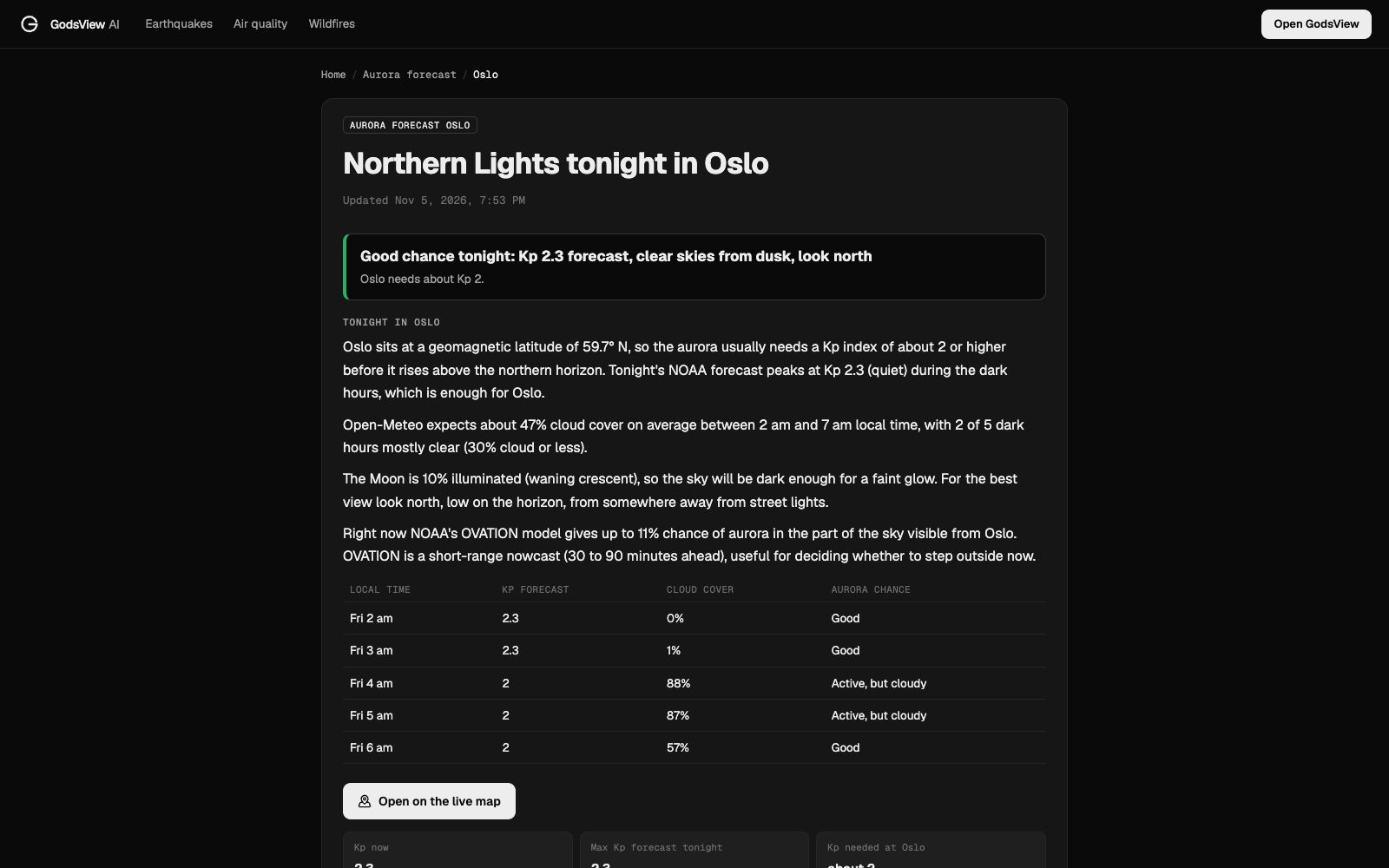
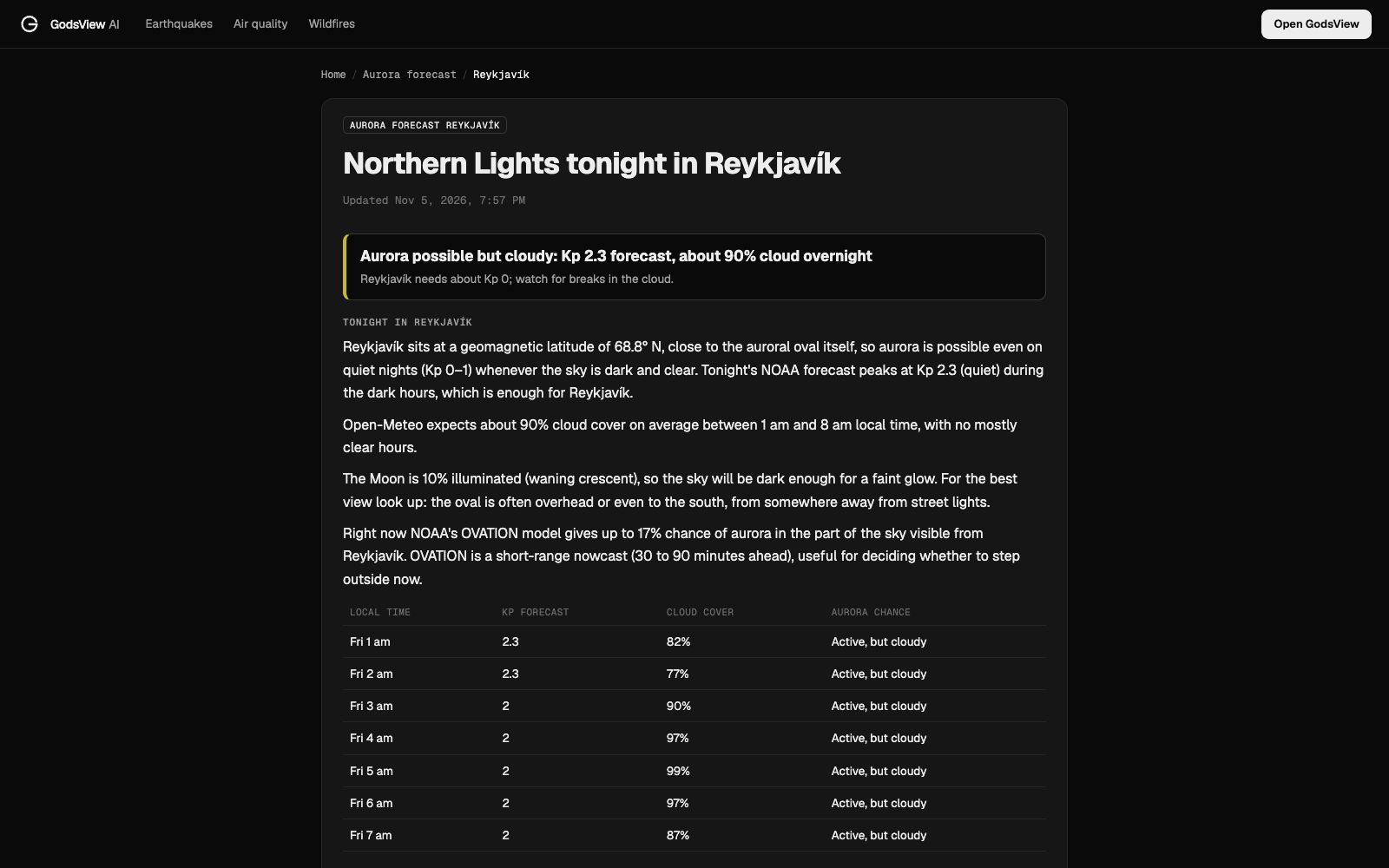
- Clouds sink more aurora nights than weak activity. On November 5 to 6, 2026, the same Kp 2.3 gave Oslo a good chance and left Reykjavík under about 91% cloud.
- The best hours are usually within an hour or two of local midnight, and the equinox months tend to be more active.
- Faint aurora often looks grey-white to the eye. A phone on a steady surface with a long exposure picks up the colour.
You can see the northern lights tonight if four things line up: the forecast Kp reaches the number your location needs, the sky is clear, it's properly dark, and you can see low toward the north (south in the southern hemisphere). Check the Kp forecast and NOAA's OVATION map first, then an hourly cloud forecast. If both look good, get away from streetlights between about 10 pm and 2 am and point your phone north on a long exposure. The camera often shows the aurora before your eyes do.
For the Kp scale in depth, read what Kp index you need to see the northern lights.
Check tonight's aurora forecast
What has to line up to see the aurora tonight?
If one of these fails, the night probably won't work.
- Activity. Is tonight's forecast Kp at or above the Kp your location needs? Is the OVATION oval reaching toward you?
- Clouds. Will the sky be clear, or at least partly clear, during the dark hours?
- Darkness. Is the Sun far enough below the horizon, and is the Moon low or thin?
- View. Can you reach a spot with a low, open horizon toward the pole and little light pollution?
GodsView's aurora city pages put all four on one screen, with an hour-by-hour row for each dark hour.
How do you check the aurora forecast? Kp, OVATION and Bz
Kp tonight. The Kp index runs from 0 to 9 and measures how disturbed Earth's magnetic field is. NOAA's Space Weather Prediction Center (SWPC) treats Kp 5 or more as a geomagnetic storm (NOAA SWPC). The forecast comes in three-hour UTC blocks, so look at the blocks in your local night, not the day's maximum. The space weather page shows NOAA's 3-day forecast.
The OVATION oval. OVATION is a model developed at the Johns Hopkins University Applied Physics Laboratory, and NOAA's product based on it "provides a 30 to 90 minute forecast of the location and intensity of the aurora" (NOAA SWPC). Use it to decide whether to step outside now. NOAA adds that bright aurora "can be observed from as much as a 1000 km away", so the oval doesn't need to sit over your head.
Bz. This is the north-south direction of the solar wind's magnetic field. When it points south, NOAA says the aurora "will become brighter, more active, and move further from the poles" (NOAA SWPC aurora tutorial). A Bz that stays negative for a while is a good sign.
Check the Kp forecast hours ahead, then OVATION and Bz just before you leave and every 30 minutes while you wait.
What Kp does your location need?
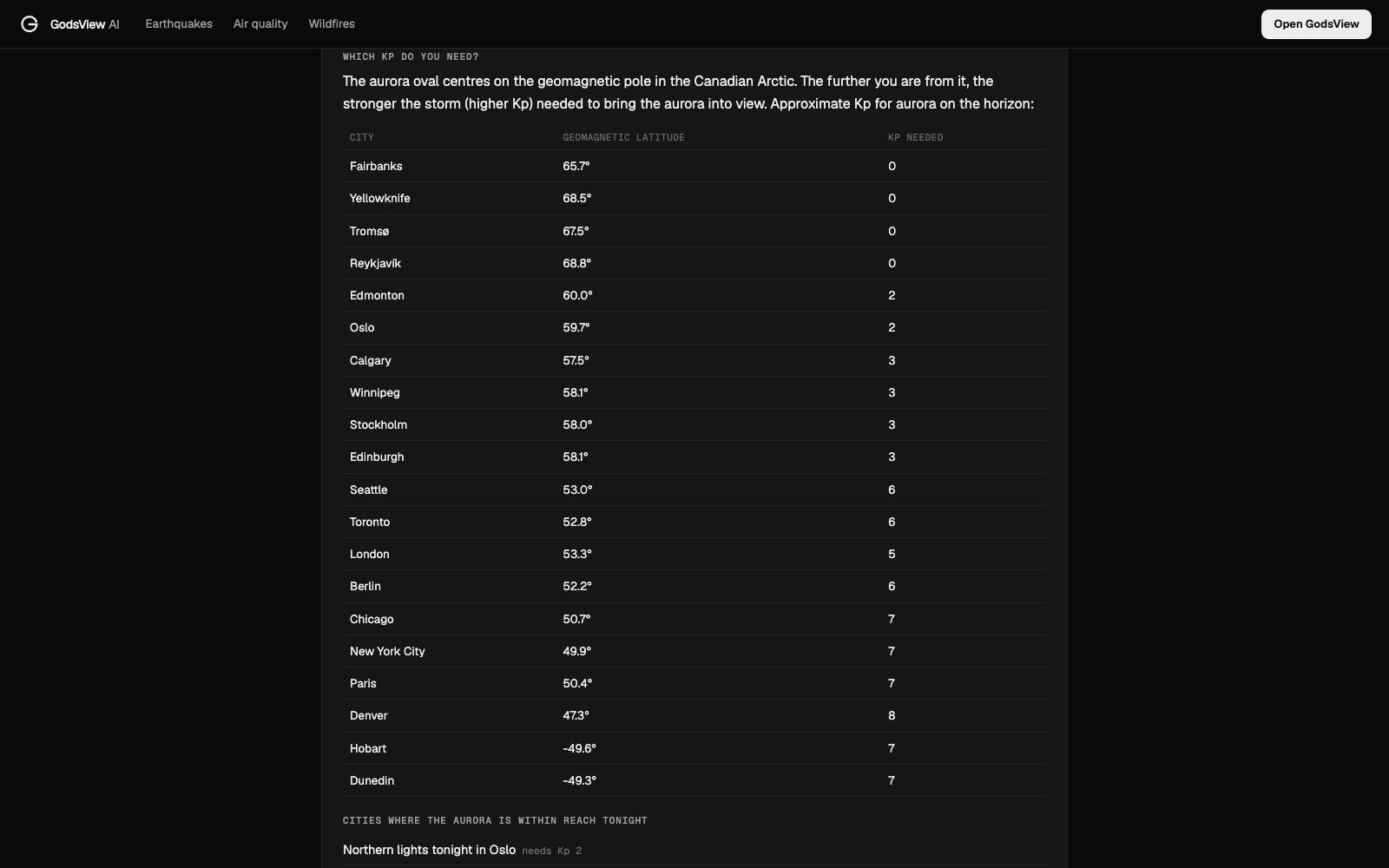
The Kp you need depends on your geomagnetic latitude, measured from the magnetic pole in the Canadian Arctic rather than the geographic pole. That's why North American cities can see the aurora further south than European cities at the same map latitude. These are GodsView's estimates for aurora low on the poleward horizon:
| Kp needed (approx.) | Example places | What to expect |
|---|---|---|
| 0 to 1 | Fairbanks, Yellowknife, Tromsø, Reykjavík | Aurora possible on most clear, dark nights |
| 2 | Oslo, Edmonton | Quiet nights can work if you get out of town |
| 3 | Edinburgh, Stockholm | Low on the northern horizon on active nights |
| 5 | London | Needs a G1 storm |
| 6 | Seattle, Toronto, Berlin | Needs a G2 storm |
| 7 | Chicago, New York, Paris | Needs a G3 storm |
| 8 | Denver | Needs a G4 storm |
For a display high in the sky rather than a glow on the horizon, add about two Kp. Look up any city on the aurora forecast page, or open one directly, such as Edmonton.
Will clouds or moonlight spoil it?
Clouds are the most common reason a good forecast turns into nothing. The aurora forms roughly 80 to 500 km up (NOAA SWPC), far above any weather, so even thin high cloud dims it. The University of Alaska Fairbanks Geophysical Institute lists partly clear skies as a requirement (UAF Geophysical Institute). Use an hourly cloud forecast, not a daily one. A short drive can sometimes reach clear sky.
Darkness matters too. NOAA's viewing tips say to get away from city lights, and that a full Moon reduces how bright the aurora appears (NOAA SWPC). GodsView city pages list the dark hours, when the Sun is at least 12° below the horizon. It's also why high-latitude summers are poor: UAF gives Fairbanks a viewing season of roughly August 21 to April 21.
Why the same Kp gave Oslo a good night and Reykjavík a cloudy one
We checked our Oslo and Reykjavík pages overnight on November 5 to 6, 2026. Both cities had the same NOAA forecast, a peak of Kp 2.3 during their dark hours, and the same 10% waning crescent Moon.
| Oslo | Reykjavík | |
|---|---|---|
| Kp needed | about 2 | about 0 |
| Kp forecast tonight | 2.3 | 2.3 |
| OVATION chance in view | 11% | 16% |
| Average cloud, dark hours | 58% | 91% |
| Mostly clear hours | 1 of 4 (3 am, 1% cloud) | none (lowest 77%) |
| Page verdict | Good chance | Possible but cloudy |
On paper Reykjavík had the better night. It sits almost under the auroral oval and OVATION gave it the higher chance, but every hour from 2 am to 7 am showed 77% to 99% cloud. Oslo barely cleared its threshold, yet its 3 am hour was almost cloudless, which made it the better bet.
Where should you go, and which way should you look?
- Leave the streetlights behind. A beach, field or hilltop outside town beats a back garden.
- Face the pole. At mid-latitudes the aurora usually sits low on the horizon, so trees and buildings to the north can hide it. Close to the oval, as in Reykjavík, it can be overhead.
- Protect your night vision. NASA suggests a red headlamp, and spare phone batteries kept warm in a pocket (NASA).
- Be patient. Activity comes in bursts. A quiet glow can brighten and start moving within minutes.
The southern lights work the same way with north and south swapped. NOAA calls the two "mirror images of each other", active at the same time, so the same Kp forecast applies. Face south from a dark site such as Tasmania or New Zealand's South Island.
What time is best to see the northern lights?
Time of night. NOAA says the best aurora is usually "within an hour or two of midnight (between 10 PM and 2 AM local time)" (NOAA SWPC). In big storms, NASA notes, the aurora can show "as early as sunset and as late as sunrise", so don't give up at 2 am if a storm is still running.
Time of year. NOAA says the best seasons are around the spring and autumn equinoxes. UAF says the chance of aurora over interior Alaska is roughly twice as high at the equinox as at the solstice.
How far south can you see the northern lights?
In a strong storm, much further than most people expect. In the G5 storm of May 10 to 11, 2024, the first since 2003 (NASA), NASA's Aurorasaurus project logged sightings as far south as Texas and Alabama (NASA Aurorasaurus). On October 10, 2024, a G4 storm (NOAA SWPC) "dazzled many across North America", according to NOAA's satellite team (NOAA NESDIS).
NOAA's storm scale says a G5 can bring aurora as low as Florida and southern Texas (NOAA space weather scales). Storms like these are rare. On most nights the Kp table above is a better guide than the headlines.
What does the aurora look like, and how do you photograph it with a phone?
Faint aurora looks grey or white to the eye, because night vision "first picks out brightness without distinguishing color" (NOAA SWPC aurora tutorial). At mid-latitudes it can pass for a pale cloud that doesn't drift. Brighter displays turn green, sometimes with red or pink. If you see a pale glow to the north, take a quick long exposure: if it comes back green or pink, it's the aurora.
Phone settings that work:
- Steady the phone on a small tripod, or wedge it against a wall, car roof or rock.
- Use night mode, which lengthens the exposure once the phone is still. In a manual or pro mode, the Met Office suggests ISO 1600 to 3200 and 8 to 15 seconds as a start (Met Office).
- Turn the flash off and set focus to infinity, or tap on a bright star.
- Use a 3-second self-timer so your tap doesn't shake the shot.
Tonight's checklist
- Kp forecast for your local night is at or above your city's number on the aurora forecast.
- OVATION shows the oval reaching toward you, and Bz has turned south.
- The hourly cloud forecast shows clear or partly clear hours while it's dark.
- The Moon is low or thin, and you know when darkness starts.
- You have a dark site with an open view toward the pole, warm layers, a charged phone and something to rest it on.
If you'd rather not keep checking, the GodsView iPhone app is free on the App Store, and push alerts for saved places come with Plus. To choose between aurora apps, see our comparison of aurora forecast apps. On clear nights without aurora, try the meteor shower calendar, and the methodology page explains where our numbers come from.
Frequently asked questions
Can I see the northern lights tonight?
You can if tonight's Kp forecast reaches the Kp your location needs, the sky is clear during the dark hours, and you can get away from city lights with a view north. The aurora forecast page shows all three for your city.
What is the best time to see the northern lights?
NOAA says the best aurora is usually within an hour or two of midnight, between about 10 PM and 2 AM local time. The best seasons are around the spring and autumn equinoxes, when geomagnetic activity tends to be stronger.
Which direction should I look for the northern lights?
Look north in the northern hemisphere and south in the southern hemisphere. Further from the poles, the aurora usually appears low on the horizon, so pick a spot with an open view in that direction.
How do I photograph the northern lights with my phone?
Keep the phone completely still, turn the flash off, use night mode or a manual exposure of several seconds, and use the self-timer. In manual mode the Met Office suggests ISO 1600 to 3200 and 8 to 15 seconds as a starting point.
How far south can the northern lights be seen?
It depends on the storm. During the G5 storm of May 10 to 11, 2024, NASA logged aurora reports as far south as Texas and Alabama. NOAA's scale says a G5 storm can bring aurora as low as Florida and southern Texas, but such storms are rare.
Why is the forecast good but I can't see the aurora?
Usually it's cloud, moonlight or city light rather than the forecast. Kp and OVATION describe activity above the clouds, not your sky. Check the hourly cloud cover and dark hours for your city as well.
Sources
- NOAA Space Weather Prediction Center: Tips on viewing the aurora
- NOAA Space Weather Prediction Center: Aurora 30-minute forecast (OVATION)
- NOAA Space Weather Prediction Center: Aurora tutorial
- NOAA Space Weather Prediction Center: Planetary K-index
- NOAA Space Weather Prediction Center: Space weather scales (G1 to G5)
- NOAA SWPC: G4 (Severe) geomagnetic storm levels continue to be observed (October 10, 2024)
- NOAA NESDIS: Severe geomagnetic storm causes visible aurora in North America
- NASA: How NASA tracked the most intense solar storm in decades
- NASA: Aurorasaurus roars during historic solar storm
- NASA: Guide to finding and photographing auroras
- Met Office: Auroras
- University of Alaska Fairbanks Geophysical Institute: Aurora forecast
Facts checked on against each provider's own site.