How-to
How to See Starlink Satellites and the ISS Tonight
A row of evenly spaced lights gliding silently across the evening sky is almost always a fresh batch of Starlink satellites. You can predict when the next one, or the next ISS pass, will cross your sky, but only if you look at the right time of day.
Key takeaways
- A "train of lights" is usually a Starlink batch launched in the last few days, still flying in single file before it spreads out.
- Satellites shine by reflected sunlight, so you see them in the hours after sunset or before sunrise, when they are sunlit and your sky is dark.
- For the ISS, use NASA Spot the Station. For Starlink trains and other satellites, use Heavens-Above, N2YO or Find Starlink, and check again on the day.
- Satellites move steadily, never blink, and often fade out mid-sky as they enter Earth's shadow. Planes blink, meteors last a second, drones hover and turn.
A straight line of lights moving slowly and silently across the sky, one after another, is almost always a Starlink "train": a batch of SpaceX satellites launched in the last few days, still bunched together. To see one, or the International Space Station, look in the first couple of hours after sunset or before sunrise, on a night when a pass prediction tool says one is coming over you.
For the maths behind pass predictions, read how satellite tracking works.
What is the line of lights in the sky?
A Starlink train is a group of newly launched Starlink satellites flying close together along the same orbit. A Falcon 9 launch releases a whole stack at once, and for the first days they travel almost nose to tail, crossing the sky a few seconds apart.
It doesn't last long. Space.com explains that the satellites are released low, then use their thrusters to climb to their working altitude over days and weeks, separating as they go. Working altitudes are shifting too: in January 2026 SpaceX said it would move about 4,400 satellites from around 550 km to around 480 km during the year (RCR Wireless).
So the best Starlink show is in the first few days after a launch. After a week or two the line breaks up, and single Starlink satellites look like any other faint, moving star.
Why can you only see satellites at dusk and dawn?
Satellites don't have lights you can see from the ground. You see them because they reflect sunlight, which needs two things at once:
- Your sky is dark. The sun has set (or not yet risen) where you are.
- The satellite is still in sunlight. Hundreds of kilometers up, it still catches the sun after it has set for you.
That overlap happens after sunset and before sunrise. NASA says all ISS sightings "occur within a few hours before or after sunrise or sunset" (NASA Spot the Station). Starlink follows the same rule.
In the middle of the night, a satellite overhead is usually inside Earth's shadow. That's also why one can fade out halfway across the sky: it has just flown into the shadow. A steady light that vanishes mid-sky with no cloud in the way was almost certainly a satellite.
Our city pages show the rule at work. On the evening of November 5, 2026, planes over New York listed six ISS passes over the city in the next 24 hours, including one at 8:17 pm peaking 38° high in the southeast. None was marked visible, because none happened while the sky was dark and the station was sunlit. A high, well-placed pass can still be invisible.
Season matters too. Around midsummer at higher latitudes, satellites stay lit and passes run through the night. In winter the windows are shorter.
Which apps tell you when Starlink passes tonight?
These free tools predict every visible pass for your location.
| Tool | Best for | What you get |
|---|---|---|
| NASA Spot the Station | The ISS | Sighting list for your location, plus an app with notifications |
| Heavens-Above | ISS, bright satellites, Starlink batches | 10-day predictions, daily bright-satellite lists, Starlink passes per launch |
| N2YO | Any satellite in the catalog | Live tracking, pass predictions and email or SMS alerts |
| Find Starlink | Starlink trains | Upcoming flybys rated by visibility, with direction, elevation and brightness |
They all list roughly the same things for a pass. NASA's sighting table is a good template:
- Time: when the pass begins, local time.
- Above the horizon: minutes in view.
- Maximum height: the highest point in degrees, from 0° (horizon) to 90° (overhead). Above about 40° is a good pass.
- Appears and Disappears: the compass directions where it enters and leaves.
Check again on the day: a fresh batch is still maneuvering, so its predictions drift. And since Find Starlink follows only the lead satellite of each group, keep watching the same path after the first one.
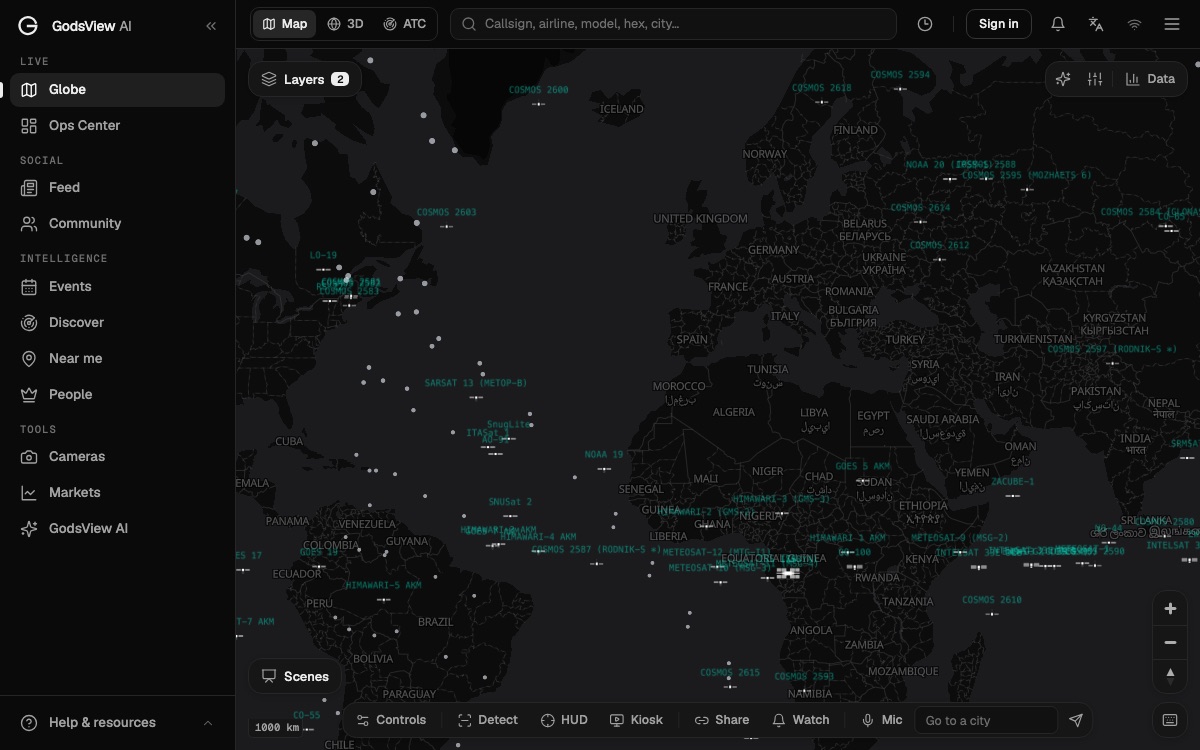
On GodsView, the live satellite tracker shows where satellites are right now, and the ISS tracker and Starlink tracker focus on those two. The Starlink and ISS pass layers are part of GodsView Plus ($10.99 a month or $99.99 a year). For the next batch, check the space launch tracker: a Starlink launch is your cue to look for a train over the next few evenings.
How do you see the ISS tonight?
The ISS is the brightest satellite and the easiest to see. NASA describes it as looking like "an airplane or a very bright star moving across the night sky, except it does not have flashing lights or change direction" (NASA). At about 28,000 km/h (17,500 mph), it crosses from horizon to horizon in a few minutes.
- Look up your location on Spot the Station and pick a pass with a high maximum height.
- Go out five minutes early and face the Appears direction.
- Look for a bright, steady light rising from there. It won't blink.
- Follow it. It may turn orange and vanish before the horizon as it enters Earth's shadow.
You don't need binoculars, and city light isn't a problem. Some stretches have no visible pass at all, as in New York on November 5; another run of evening or morning passes comes round within days or weeks.
How bright are Starlink satellites?
Brightness is measured in magnitudes. As Find Starlink puts it: "The smaller the number, the brighter it is." The tools above show a magnitude for each pass.
A fresh train is at its brightest because the satellites are still low. At working altitude, single Starlink satellites are much fainter: under a dark sky some are visible to the naked eye, but from a light-polluted city you may see nothing. Newer satellites use a mirror film and black paint that send sunlight away from Earth. Sky & Telescope reported in 2023 that, adjusted to a distance of 1,000 km, mitigated second-generation Minis averaged magnitude 7.9 against 5.1 for unmitigated ones, about 12 times fainter (Sky & Telescope). The ISS, by contrast, outshines every star on a good pass.
Was it a satellite, a plane, a meteor or a drone?
Watch how it moves for a few seconds.
| What you see | Most likely | Why |
|---|---|---|
| Several steady lights in a line, evenly spaced, moving silently together | Starlink train | A fresh batch flying single file |
| One very bright steady light crossing in a few minutes | ISS | Brightest satellite, no flashing lights |
| One faint steady light, sometimes fading out mid-sky | Other satellite | Entering Earth's shadow |
| Red, green or white lights that blink, often with engine noise | Plane | Anti-collision and navigation lights |
| A streak lasting a second or less | Meteor | Space dust burning up |
| A light that hovers, stops, reverses or changes height | Drone | Satellites and airliners can't do this |
How do you rule out a plane?
If the light blinks or you can hear it, rule out planes first. Over a big city at satellite-watching time, the sky is full of them. At 7:59 pm on November 5, 2026, our New York page showed 21 aircraft within 25 km of the city centre and 68 within 60 km, 26 of them below 3,000 ft and three of them helicopters. A light low over New York that evening was far more likely a plane climbing out of or descending into one of the city's airports than a satellite.
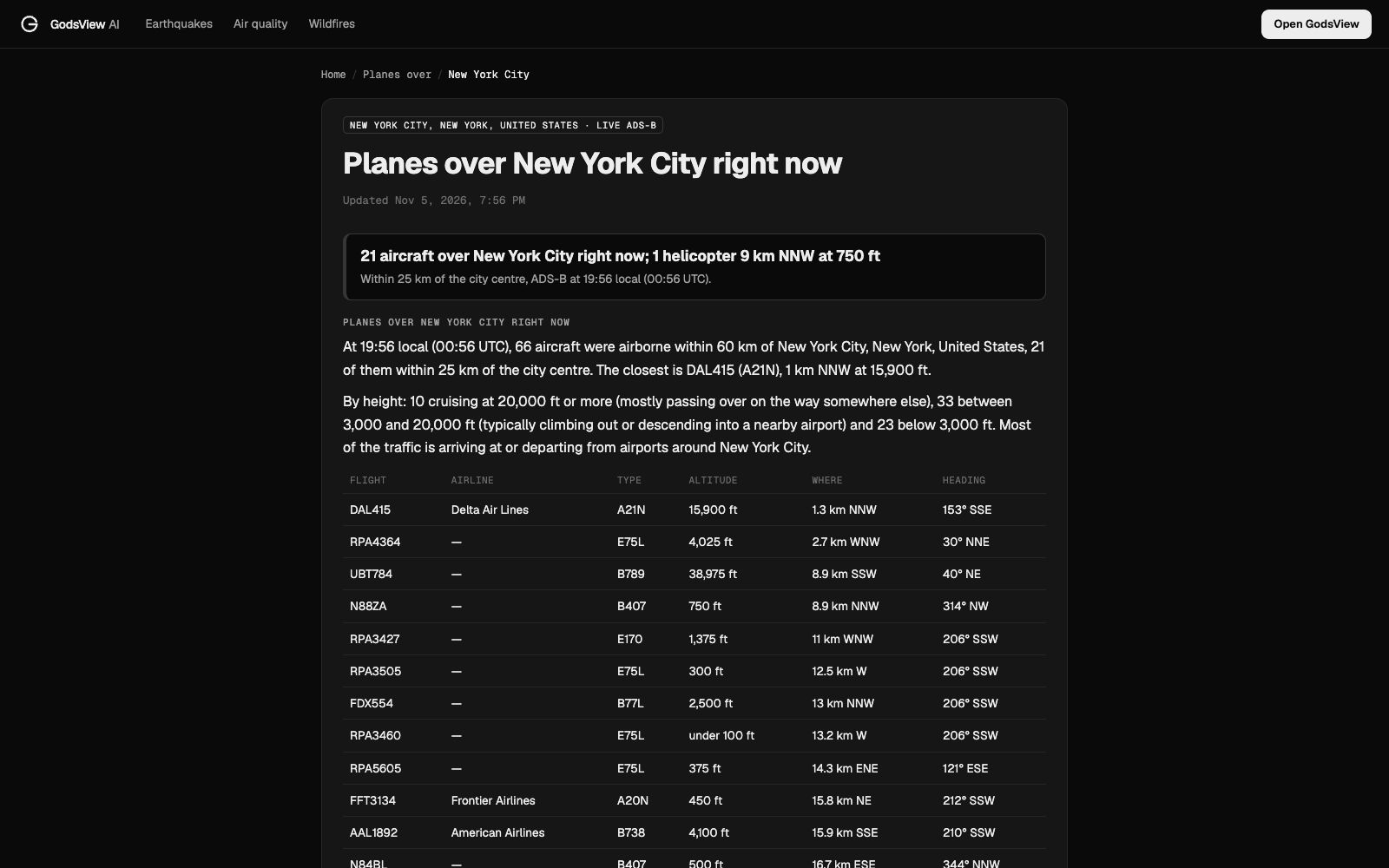
Open the page for your city, such as planes over London, or "what's overhead" with your location, and see whether an aircraft sits in that part of the sky. What's flying over my house explains how to match a plane on screen to the one above you, and why a plane circles covers the ones that loop for an hour.
A quick streak was a meteor. On November 5, 2026, our meteor shower calendar listed the Northern Taurids peaking on November 12–13 (ZHR 5) and the Leonids on November 17–18 (ZHR 15).
How many Starlink satellites are in orbit?
About 11,214, of which 11,200 are working, out of 13,096 launched. That's the count from astronomer Jonathan McDowell, who tracks every Starlink launch and reentry, in his Starlink statistics last updated on November 2, 2026. It changes weekly, which is why under a dark sky after dusk you can often see several satellites in a few minutes.
Why are astronomers worried about Starlink?
The sunlight that makes a train fun to watch is a problem for telescopes. Satellites leave bright streaks across long-exposure images, and wide-field survey telescopes are hit hardest.
The International Astronomical Union's Centre for the Protection of the Dark and Quiet Sky has set brightness guidelines. A 2025 study by Anthony Mallama and Richard Cole found that nearly all Starlink, OneWeb, BlueBird, Qianfan and Guowang satellites exceed the magnitude 7 limit for interference with professional research, and most are brighter than the magnitude 6 reference for spoiling the naked-eye sky (arXiv). Radio astronomers worry about the transmissions too. SpaceX has worked with astronomers on mitigation, but several companies plan thousands more satellites.
Checklist for seeing Starlink tonight
- Check the space launch tracker for a Starlink launch in the last few days.
- Get tonight's passes from Spot the Station (ISS), Heavens-Above, N2YO or Find Starlink.
- Pick a high pass in the hour or two after sunset or before sunrise.
- Go out five minutes early and face the direction it appears from.
- After the first satellite, keep watching the same path.
- If something blinks, check the planes overhead first.
You can also follow satellites on the 3D globe or in the free GodsView AI iPhone app.
Frequently asked questions
What is the line of lights moving across the sky?
It is almost always a Starlink train: a batch of SpaceX satellites launched in the last few days, still flying in single file. They shine by reflected sunlight, so you see them soon after sunset or before sunrise.
How do I know if Starlink satellites are visible tonight?
Enter your location in Find Starlink, Heavens-Above or N2YO, which list upcoming passes with time, direction, height and brightness. A launch in the last few days gives the best chance of a full train; check the space launch tracker.
How can I see the ISS tonight?
Get the sighting times for your location from NASA Spot the Station. Pick a high pass, go out a few minutes early, face the direction it appears from, and look for a bright, steady light crossing in a few minutes. Its live position is on the ISS tracker.
Why can I only see satellites after sunset or before sunrise?
You can only see satellites when they are sunlit and your sky is dark, which happens in the hours after sunset and before sunrise. They have no visible lights of their own. Later at night most are in Earth's shadow.
How many Starlink satellites are there?
There were 11,214 Starlink satellites in orbit and 11,200 working in Jonathan McDowell's data updated November 2, 2026, out of 13,096 launched. The count changes weekly.
How do I tell a satellite from a plane?
Planes have blinking colored lights and you can often hear them; satellites are steady, silent points that may fade out mid-sky. To be sure, check a live flight map such as planes over New York for aircraft in that part of the sky.
Sources
- NASA: Spot the Station
- Jonathan McDowell: Starlink statistics (data updated 2026 Nov 2)
- Space.com: Starlink satellite train, how to see and track it
- Heavens-Above
- N2YO: real-time satellite tracking and predictions
- Find Starlink
- RCR Wireless: Starlink to descend satellites for space safety (Jan 2026)
- Sky & Telescope: The newest and largest Starlink satellites are also the faintest (2023)
- Mallama and Cole: Satellite constellations exceed the limits of acceptable brightness established by the IAU (2025)
Facts checked on against each provider's own site.