Guide
Earthquake in Delhi Today: How to Check It and Delhi's Quake Risk
Fans swaying in Delhi, Noida or Gurugram usually set off the same question on every phone: was that an earthquake, and where? Here is how to check in a minute, where Delhi's tremors come from, and what the city's seismic zone means for you.
Key takeaways
- To check an earthquake in Delhi today, use the National Center for Seismology (NCS), the Government of India's nodal agency for earthquake monitoring, or GodsView's earthquakes near Delhi page, which lists every M2.5+ quake within 150 km from the USGS catalogue.
- Delhi feels two kinds of quakes: small ones on local faults in and around the NCR, and larger ones from the Himalaya hundreds of kilometres away.
- The Delhi Disaster Management Authority says Delhi is in seismic Zone IV, with fairly high seismicity, and that the Delhi-Haridwar ridge and the Delhi-Moradabad fault can generate quakes of intensity up to VIII.
- The 2025 revision of the national seismic code, IS 1893 (Part 1):2025, is listed by the Bureau of Indian Standards as withdrawn, so the 2016 code and its zones remain in use as of November 2026.
- NCS advice: during shaking, take cover under a desk, table or bed or against an inside wall, away from glass, and do not rush out of the building.
To check whether there was an earthquake in Delhi today, open the National Center for Seismology (NCS), the Government of India's nodal agency for earthquake monitoring, which posts the latest quakes on its RISEQ portal, its mobile app and social media. For a quick local answer, GodsView's earthquakes near Delhi page says whether an M2.5+ quake struck within 100 km in the last 24 hours and lists every quake within 150 km in the past 30 days, with time, magnitude, distance and depth from the USGS catalogue. For a quake in the Himalaya or Afghanistan that was felt in Delhi, the earthquakes in India page and the worldwide earthquakes today list are the places to look.
This guide shows where to check first, why Delhi feels both nearby and distant quakes, what "Zone IV" means after the 2025 code was withdrawn, and what NCS asks you to do.
See earthquakes near Delhi today
Was there an earthquake in Delhi today?
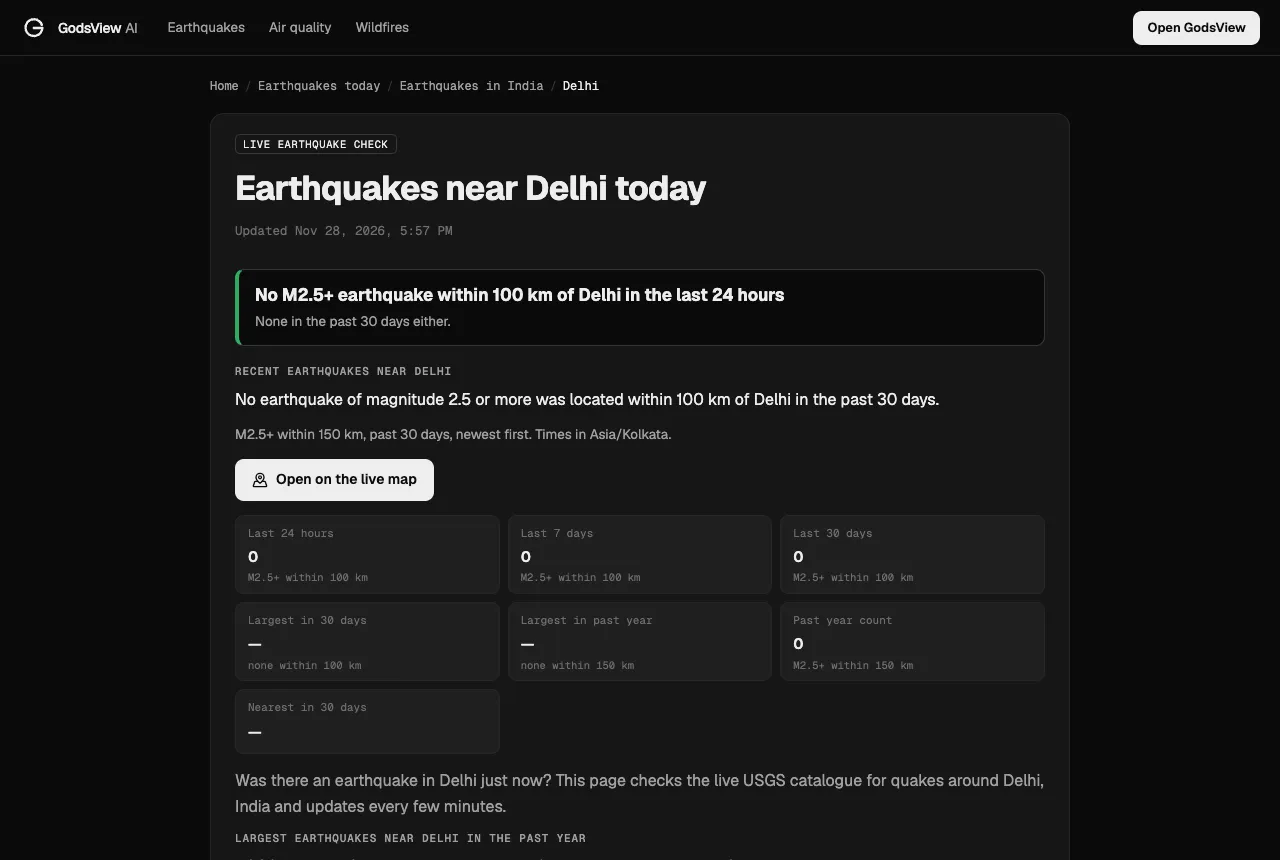
When we captured GodsView's Delhi page on November 28, 2026, its answer was "No M2.5+ earthquake within 100 km of Delhi in the last 24 hours", with the note "None in the past 30 days either".
A quiet month is common for Delhi. Felt tremors in the city come in bursts: a small local quake every so often, and occasional swaying from a large quake far away. If you felt something and the Delhi page shows nothing nearby:
- Check the distance. Open the India page or the earthquakes today list and look for a larger quake in Nepal, Uttarakhand, Himachal Pradesh or the Hindu Kush.
- Check NCS. It records smaller quakes than the M2.5+ USGS list shows, and publishes its own magnitude.
- Check again in a few minutes. New quakes take a little time to be located and published.
Where to check: NCS, USGS and GodsView
| Source | What it gives you | Best for |
|---|---|---|
| National Center for Seismology (NCS), seismo.gov.in | Official quake reports from a national network of more than 170 stations, monitored 24/7; RISEQ portal; mobile app; a "Felt an Earthquake?" form | The official Indian magnitude and location |
| USGS | M2.5+ quakes with depth and felt reports | Cross-checking, regional context |
| GodsView Delhi page | 100 km yes or no, 150 km list for 30 days, past-year count and largest quake | "Was that near me?" |
| GodsView NCR pages | Noida, Gurugram, Faridabad, Ghaziabad | Your own part of the NCR |
| GodsView India page | Every M2.5+ quake in India today, this week and this year | Himalayan quakes felt in Delhi |
Expect the numbers to differ slightly. NCS and the USGS use different stations and methods, so magnitudes can differ by a few tenths and the depth of small quakes in particular can vary. Use NCS for the official figure.
Small local quakes: what shakes the NCR
The Delhi Disaster Management Authority (DDMA) names two major lineaments that pass through the territory, the Delhi-Haridwar ridge and the Delhi-Moradabad fault, "both having potential of generating earthquakes of magnitude upto MSK VIII" (VIII here is an intensity on the MSK scale, a measure of shaking and damage, not a magnitude).
The USGS catalogue shows what this looks like in practice: a steady trickle of small quakes within about 150 km of the capital: since 2000 it lists more than 30 of M3.5 or larger, mostly between M3.6 and M4.7, many of them to the west in Haryana. Some recent examples:
| Date (IST) | Location (USGS) | Magnitude (USGS) |
|---|---|---|
| February 17, 2025, 05:36 | 10 km SSE of Nangloi Jat, Delhi | M4.2 |
| July 10, 2025, 09:04 | 8 km NNE of Jhajjar, Haryana | M4.5 |
| July 11, 2025, 19:49 | 10 km NW of Kharkhauda, Haryana | M4.1 |
| June 2, 2017, 04:25 | 16 km NW of Kharkhauda, Haryana | M4.7 |
| March 5, 2012, 13:11 | 11 km SSE of Rohtak, Haryana | M5.1 |
The February 17, 2025 quake, just before dawn, was located within Delhi itself, which is why so many people in the city woke up asking what had happened.
Big Himalayan quakes felt in Delhi
The second source of shaking is the Himalaya. The USGS explains that the India plate is converging with Eurasia at about 45 mm a year along the Main Himalayan Thrust, and that this boundary has a long history of large and great quakes, from the M8.0 Nepal-Bihar earthquake of 1934 to the M7.8 Nepal earthquake of April 25, 2015.
The DDMA warns that "Delhi is prone not only to damaging earthquakes in or near Delhi, but due to its peculiar geological setting it could also sustain strong shaking due to a large earthquake in the Himalaya". It gives an example: the 1999 Chamoli earthquake (M6.5), about 280 km away, caused non-structural damage to buildings in Delhi.
Himalayan quakes are frequent: NCS published a preliminary report on an M5.3 earthquake in eastern Nepal on November 24, 2026, just days before this guide. For quakes closer to the mountains, see our guide on Uttarakhand earthquakes and Dehradun and the earthquakes in Nepal page.
Delhi's history of damaging earthquakes
The DDMA lists several damaging quakes in Delhi's history:
- 1720: an earthquake that caused intensity IX damage in Delhi.
- 1825: intensity VII.
- 1956, Khurja (M6.7): 23 people killed in nearby areas.
- 1966, Moradabad: 14 people killed in Delhi.
- 1999, Chamoli (M6.5): about 280 km away, non-structural damage to Delhi buildings.
None of these was a great earthquake, but each shows that moderate shaking, from near or far, has caused real damage and deaths in and around Delhi.
What "Zone IV" means, and the 2025 code
India's earthquake design code, IS 1893 (Part 1) from the Bureau of Indian Standards (BIS), divides the country into seismic zones that set how strongly buildings must be designed. Under the 2016 code, India has four zones, II to V.
The DDMA says "Delhi is located in zone IV which has fairly high seismicity where the general occurrence of earthquakes is of 5-6 magnitude, a few of magnitude 6-7 and occasionally of 7-8 magnitude".
You may have seen headlines in late 2025 about a new national seismic map with a new highest zone. That revision, IS 1893 (Part 1):2025, is now listed by BIS as withdrawn. It was rolled back in March 2026 after the Ministry of Housing and Urban Affairs objected to construction cost increases in Zones V and VI, and the 2016 standard is back in force. So, as of November 2026, Delhi's design zone remains Zone IV.
What that means for you:
- Check how your building was built. Ask whether it was designed and built to the earthquake code; NCS advises following safe building codes and upgrading poorly built structures.
- Ask about retrofitting if you own or manage an older building; the DDMA stresses the need to retrofit buildings and enforce the rules.
- Secure heavy objects at home. NCS advises keeping heavy objects, glasses and cutlery on lower shelves and not keeping flower pots on parapets.
What to do in an earthquake in Delhi
The NCS do's and don'ts, in short:
During the shaking
- Keep calm and reassure others.
- If you are indoors, take cover under a desk, table or bed, or against an inside wall, and stay away from glass doors, windows and outside doors. Do not rush out of the building, to avoid a stampede.
- If you are outside, move away from buildings and power lines, and stay in the open until the shaking stops.
- If you are driving, stop as quickly as possible and stay in the vehicle.
After the shaking
- Be prepared for aftershocks.
- Close the gas valve if it is on, and do not use open flames or electrical switches if you suspect a gas leak.
- Do not spread or believe rumours: check NCS and the GodsView Delhi page for the facts.
- Help the injured and inform the hospital.
Earthquake today near Noida, Gurugram and the rest of the NCR
Each GodsView city page works the same way: a 100 km answer for the last 24 hours, then a 150 km list for the past 30 days and a count for the past year.
- Delhi: Delhi, New Delhi
- Uttar Pradesh side: Noida, Greater Noida, Ghaziabad, Meerut
- Haryana side: Gurugram, Faridabad, Sonipat, Rohtak, Bahadurgarh, Panipat
How to read an earthquake report
- Magnitude: the size at the source. Each whole step means about 32 times more energy, according to the USGS.
- Depth: how far down the quake started. The USGS notes that deep quakes are felt over a wide area but usually do less damage than shallow ones of the same size.
- Location: given as a distance from the nearest town, for example "10 km SSE of Nangloi Jat".
- Time: NCS uses Indian Standard Time (UTC+5:30); the USGS uses UTC. GodsView shows both.
Our guides how to read an earthquake map and earthquakes near me today go further. GodsView Plus ($10.99 a month or $99.99 a year) adds alerts for saved places, and the free live earthquake map shows every recent quake in the region.
The short version
Delhi is in seismic Zone IV, with local faults that produce small quakes and a Himalayan front that can send strong shaking from hundreds of kilometres away. To check an earthquake today, open NCS for the official report and the GodsView Delhi page for nearby quakes, then the India page if the quake was far away. During shaking, take cover inside and do not rush for the stairs.
Check earthquakes near Delhi today
Frequently asked questions
Was there an earthquake in Delhi today?
Open GodsView's earthquakes near Delhi page for a yes or no on M2.5+ quakes within 100 km in the last 24 hours, and the National Center for Seismology for the official report. If the quake was far away, check the earthquakes in India page.
Which seismic zone is Delhi in?
Zone IV. The Delhi Disaster Management Authority describes it as fairly high seismicity, with earthquakes of magnitude 5 to 6 in general, a few of 6 to 7 and occasionally 7 to 8. The 2025 revision of the seismic code was withdrawn, so the 2016 zones still apply.
Why do Delhi buildings shake when an earthquake hits Nepal or the Himalaya?
Large Himalayan quakes release enough energy to be felt hundreds of kilometres away. The DDMA notes that Delhi could sustain strong shaking from a large Himalayan quake; the 1999 Chamoli earthquake, about 280 km away, caused non-structural damage in Delhi.
Which faults are near Delhi?
The DDMA names the Delhi-Haridwar ridge and the Delhi-Moradabad fault, both capable of quakes with intensity up to MSK VIII. Small quakes near Jhajjar, Rohtak and Sonipat in Haryana are also common in the USGS catalogue.
What should I do during an earthquake in Delhi?
NCS advises taking cover under a desk, table or bed or against an inside wall, staying away from glass and outside doors, and not rushing out of the building to avoid a stampede. Outside, move away from buildings and wires.
What was the earthquake in Delhi on February 17, 2025?
The USGS lists an M4.2 at 05:36 IST about 10 km south-southeast of Nangloi Jat, within Delhi. NCS published its own magnitude and location for the same quake.
Sources
- Delhi Disaster Management Authority — Earthquakes
- National Center for Seismology, Ministry of Earth Sciences
- National Center for Seismology — Do's and don'ts
- Bureau of Indian Standards — IS 1893 (Part 1):2025 details (status: withdrawn)
- Drishti IAS — Rollback of Seismic Code of 2025 (March 13, 2026)
- USGS — M7.8 Nepal earthquake, April 25, 2015 (tectonic summary)
- USGS — Earthquake catalogue search (ComCat)
Facts checked on against each provider's own site.
- Earthquake in Alaska Today: Why It Shakes Most and How to Check
- Earthquake in Nepal Today: How to Check Quakes Near Kathmandu
- Earthquake in Japan Today: How to Check Shindo, Tsunami and Alerts
- Earthquake in Bucharest Today? Why the Vrancea Zone Shakes the City
- Earthquake in Indonesia Today: How to Check It and Tsunami Risk
- Earthquake in New Zealand Today: GeoNet, Felt Reports and Risk