Live guide
Earthquake in Venezuela Today: How to Check Quakes and Aftershocks
Five months after the devastating June 2026 earthquakes, northern Venezuela is still recording aftershocks. Here is how to check whether a quake just struck, how to read Funvisis and USGS reports, and which faults run under Caracas, Valencia and the coast.
Key takeaways
- To check for an earthquake in Venezuela today, use Funvisis, the Venezuelan Foundation for Seismological Research, which runs the national seismological observatory, or GodsView's earthquakes in Venezuela page built on the USGS feed.
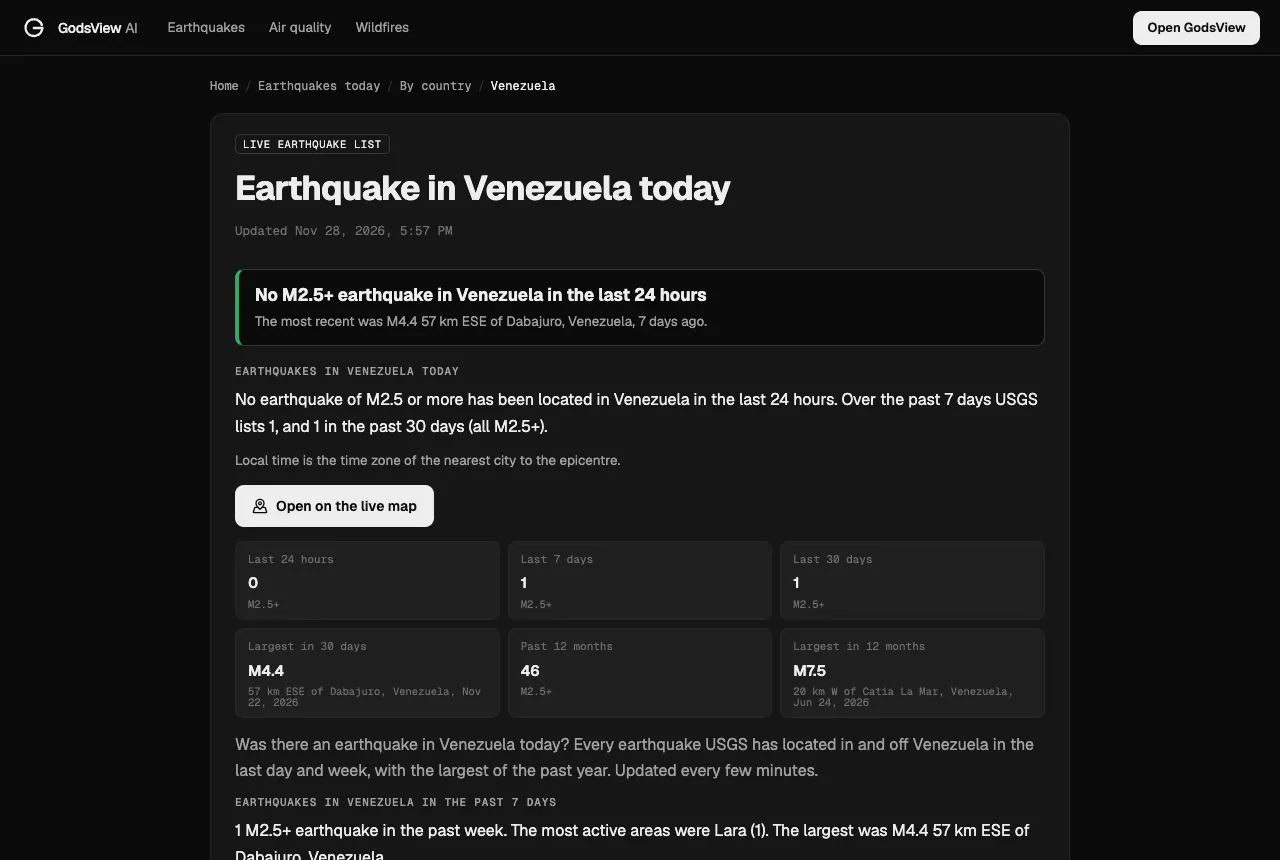
- On November 28, 2026, the USGS feed had no M2.5+ quake in Venezuela in the previous 24 hours; the most recent was an M4.4 57 km ESE of Dabajuro, seven days earlier.
- On June 24, 2026, an M7.2 and an M7.5 struck about 32 seconds apart west of Caracas. As of August 24, the USGS reported at least 6,500 people killed and about 50,000 missing.
- By October 2, 2026, Funvisis had recorded 2,152 seismic events since June 24, with most aftershocks in Yaracuy and La Guaira states.
- Venezuela's quakes come from the Caribbean plate sliding east past South America at about 20 mm a year, mainly along the San Sebastián, Boconó and El Pilar faults.
To check whether there was an earthquake in Venezuela today, open Funvisis (Fundación Venezolana de Investigaciones Sismológicas), which runs the national seismological observatory and tsunami alert centre, or use a live list like GodsView's earthquakes in Venezuela page, which shows every M2.5+ quake in Venezuela in the USGS feed with the largest of the week and the year. For one city, pages such as earthquakes near Caracas list only nearby quakes.
On November 28, 2026, the USGS feed had no M2.5+ earthquake in Venezuela in the previous 24 hours. The most recent was an M4.4 57 km ESE of Dabajuro, in Falcón, seven days earlier. Funvisis records many smaller aftershocks than that every week, still following the June 24, 2026 earthquakes.
See the latest earthquakes in Venezuela
Where to check the latest earthquake in Venezuela
| What you want | Best source | Notes |
|---|---|---|
| Every located quake in Venezuela, including small aftershocks | Funvisis (Observatorio Nacional de Sismos) | Also runs the tsunami alert centre and a "¿Sentiste un sismo?" felt report form |
| Larger quakes in a global list | USGS | Outside the US, complete from about M4 to M4.5 |
| M2.5+ quakes in Venezuela today, this week and this year | GodsView earthquakes in Venezuela | Built on the USGS feed, refreshed every few minutes |
| Quakes near one city | GodsView Caracas, Valencia, Maracay, San Felipe | Past 7 days, largest of the past year, felt reports, tsunami status |
| Weekly aftershock counts | Funvisis reports, carried by Venezuelan and regional media | For example, 109 events in the week of October 16 to 22, 2026 |
The gap between sources is large right now. Funvisis had counted 2,152 seismic events between June 24 and October 2, 2026, according to El Diario, while the USGS catalogue lists about 20 aftershocks of M4 or larger in the epicentral area over the whole period to late November. Most aftershocks are small and are recorded only by the national network.
The June 24, 2026 earthquakes
At 22:04 UTC on June 24, 2026 (6:04 pm in Venezuela), an M7.2 earthquake struck about 20 km east of San Felipe, in Yaracuy. About 32 seconds later an M7.5 followed, the mainshock. The USGS lists it 20 km west of Catia La Mar, and notes that its exact location is more uncertain than usual because the foreshock's waves obscure its first arrivals. The USGS calls it "a severe seismic doublet sequence": two earthquakes of similar size close together in time and space.
According to the USGS tectonic summary:
- both were shallow (about 10 km) right-lateral strike-slip quakes on the boundary between the Caribbean and South American plates;
- the M7.5 ruptured a fault about 175 km long and 20 km wide, rupturing east from an onshore start and offshore along the San Sebastián fault as far as Caracas and La Guaira;
- the rupture may have started on the eastern Boconó fault system or the western San Sebastián system before moving offshore.
Damage and casualties
The USGS impact summary, updated as of August 24, 2026, reports:
- at least 6,500 people killed, about 226,700 injured and an estimated 50,000 missing;
- about 59,000 buildings damaged or destroyed across seven states, based on satellite imagery, with La Guaira the worst affected, where 80% of buildings collapsed;
- damage estimated at 37 billion US dollars;
- a small tsunami, with a maximum recorded wave of 4 cm at Isla de Mona and Puerto Yabucoa in Puerto Rico.
The USGS also published a landslide hazard summary for the sequence, and Funvisis has installed additional seismic stations in the affected regions, El Diario reported. Figures for an event this large are revised over months; Venezuelan authorities and the USGS event page carry the latest.
The aftershock sequence
Funvisis's head of geology, Luz María Rodríguez, said the largest number of aftershocks is concentrated in the two epicentral states, Yaracuy and La Guaira. In the week of October 16 to 22, 2026, for example, Funvisis registered 109 events, 58 of them in the central region, 42 in the west and 9 in the east, with magnitudes between 1.3 and 3.8, NTN24 reported. That pattern is consistent with how aftershocks fade: quickly at first, then slowly, with occasional larger shocks. Our guide to what are aftershocks explains Omori's law and Båth's law.
Why Venezuela has earthquakes: the faults
Northern Venezuela lies on the boundary between the Caribbean plate and the South America plate. The USGS says the Caribbean plate moves east relative to South America at about 20 mm a year, taken up mostly on a system of right-lateral strike-slip faults:
| Fault system | Where | Slip rate (USGS) | Notes |
|---|---|---|---|
| San Sebastián | Along the northern coast, offshore Caracas and La Guaira | About 17 mm a year | Ruptured in the June 2026 M7.5; Funvisis links the ongoing aftershocks to it |
| Boconó | Westward from the June 2026 epicentres into the interior of the country | About 12 mm a year | The 2026 rupture may have begun on its eastern end |
| El Pilar | Eastern Venezuela, Sucre state | Not given | Funvisis linked an M4.8 near Güiria on October 2, 2026 to it |
In the far east, the South America plate also begins to sink beneath the Caribbean. That causes deeper quakes such as the M7.3 of August 21, 2018, about 147 km below the coast near Carúpano, which was felt widely and damaged the upper floors of a high-rise building in Caracas but caused only one injury, according to the USGS.
Venezuela's major earthquakes
| Date | Earthquake | Magnitude | Impact (USGS) |
|---|---|---|---|
| October 29, 1900 | Near the coast of Venezuela | M7.7 | Listed in the USGS catalogue |
| July 29, 1967 | Caracas | M6.6 | About 240 deaths, collapse of several high-rise apartment buildings |
| July 9, 1997 | Cariaco | M7.0 | At least 81 killed, 522 injured; landslides in the Cariaco-Cumaná area |
| September 2009 | Near Morón | M6.4 | 18 injured, buildings damaged |
| August 21, 2018 | Off Carúpano (deep) | M7.3 | One injured; high-rise damaged in Caracas |
| September 24 to 25, 2025 | Mene Grande, Zulia | M6.2 and M6.3 | One death, more than 110 injured, homes destroyed in Zulia and Lara |
| June 24, 2026 | Yaracuy to La Guaira | M7.2 and M7.5 | At least 6,500 killed (as of August 24, 2026) |
The USGS notes that before 2026 there had been only seven M6+ quakes in the past century within 250 km of the June 2026 epicentres, and five M7+ quakes in northern Venezuela or near the coast since 1900.
What to do in an earthquake in Venezuela
- During the shaking: Drop, Cover and Hold On under a sturdy table or next to an interior wall. Do not run outside or stand in a doorway.
- In a building damaged in June: do not go back in until it has been inspected; aftershocks can bring down weakened walls.
- On the coast: after strong or long shaking, move to high ground straight away. See tsunami watch vs warning.
- After: check for gas leaks and damage, and if trapped, text or bang on a pipe or wall instead of shouting.
- Prepare now: secure heavy furniture and keep water, food, a torch, a radio and a first aid kit. Our earthquake preparedness checklist has the full list.
Check earthquakes in Venezuela right now
- Whole country: earthquakes in Venezuela, with today's quakes, the past 7 days and the largest of the past year.
- Capital region: Caracas, Maracay.
- Centre-west, near the 2026 epicentres: San Felipe, Valencia, Puerto Cabello, Barquisimeto.
- West: Maracaibo, Coro.
- East: Cumaná, Puerto La Cruz.
- Region: earthquakes in Colombia, earthquakes today and the live earthquake map.
GodsView Plus ($10.99 a month or $99.99 a year) adds alerts for saved places, so you can be told when a quake strikes near a city you follow. For official information in Venezuela, Funvisis and civil protection remain the reference.
The short version
Venezuela's quakes come from the Caribbean plate sliding past South America along the San Sebastián, Boconó and El Pilar faults. The June 24, 2026 M7.2 and M7.5 doublet was far deadlier than any other Venezuelan quake in the USGS summaries, and its aftershocks continue: Funvisis had counted more than 2,100 events by October. For a tremor you just felt, check Funvisis; for larger quakes, GodsView's Venezuela page shows them within minutes.
Check earthquakes near Caracas
Frequently asked questions
Was there an earthquake in Venezuela today?
Check Funvisis for every located quake, including small aftershocks, or GodsView's earthquakes in Venezuela page for M2.5+ quakes in the USGS feed. On November 28, 2026 the USGS feed had none in the previous 24 hours; the most recent was an M4.4 near Dabajuro seven days earlier.
What happened in the June 2026 Venezuela earthquake?
On June 24, 2026, an M7.2 and an M7.5 struck about 32 seconds apart in northern Venezuela, west of Caracas, on the San Sebastián fault system. As of August 24, 2026 the USGS reported at least 6,500 killed, about 50,000 missing and some 59,000 buildings damaged or destroyed, with La Guaira worst hit.
Are aftershocks still happening in Venezuela?
Yes. Funvisis had recorded 2,152 seismic events between June 24 and October 2, 2026, mostly in Yaracuy and La Guaira, and it still registered 109 in the week of October 16 to 22, with magnitudes between 1.3 and 3.8.
What is Funvisis?
The Fundación Venezolana de Investigaciones Sismológicas, Venezuela's national seismological research foundation. It runs the national seismological observatory and tsunami alert centre, and invites people to report quakes they felt.
Which faults cause earthquakes in Venezuela?
Mainly the San Sebastián fault along the northern coast (about 17 mm a year of slip), the Boconó fault running west into the interior (about 12 mm a year) and the El Pilar fault in the east, which together take up the Caribbean plate's eastward motion past South America, according to the USGS and Funvisis.
What was the 1967 Caracas earthquake?
An M6.6 earthquake on July 29, 1967, centred about 131 km east of the 2026 mainshock. The USGS says it caused around 240 deaths and the collapse of several high-rise apartment buildings in Caracas.
Sources
- USGS event page — M7.5 northern Venezuela, June 24, 2026 (tectonic and impact summary)
- USGS event page — M7.2 foreshock near San Felipe, June 24, 2026
- El Diario — Funvisis has recorded 2,152 seismic events since June 24 (October 2, 2026)
- NTN24 — Funvisis recorded 109 earthquakes in the week of October 16 to 22, 2026
- USGS event page — M7.0 Cariaco, Venezuela, 1997
- USGS event page — M7.3 off Carúpano, Venezuela, 2018
- USGS event page — M6.2 Mene Grande, Venezuela, September 24, 2025
Facts checked on against each provider's own site.