Explainer
What Are Aftershocks? How Long They Last and How Big They Get
After a strong earthquake the ground keeps shaking for days, weeks or even years. Here is why aftershocks happen, how fast they fade, how big the largest one usually is, and what an official aftershock forecast is telling you.
Key takeaways
- Aftershocks are smaller earthquakes that follow a larger mainshock in the same general area, as the fault and the rock around it readjust after the main slip.
- They fade quickly: the aftershock rate falls roughly in proportion to one over the time since the mainshock, so there are about ten times as many on the first day as on the tenth (Omori's law).
- On average the largest aftershock is about 1.2 magnitude units smaller than the mainshock (Båth's law), but the gap ranges from 0.1 to 3 or more.
- About 5% of earthquakes are followed by a larger one nearby within a week, which is why the first quake can turn out to be a foreshock.
- The USGS publishes aftershock forecasts for M4+ quakes in the contiguous US and M5+ in other US states and territories, giving the chance of further shaking over the next day, week, month and year.
Aftershocks are the smaller earthquakes that follow a larger one, the mainshock, in the same general area. The USGS describes them as part of the "readjustment process" after the main slip on a fault. They are most frequent in the first hours and days, then fade away, although after a very large earthquake they can go on for months or even years. The largest aftershock is usually about 1.2 magnitude units smaller than the mainshock, and it can be strong enough to damage buildings that were already weakened.
If you just felt a quake and want to know whether more are coming, start with the live list: GodsView's earthquakes today page shows the latest quake worldwide and how many have struck in the last hour and the last 24 hours, and earthquakes near me narrows it to your city.
See today's earthquakes and aftershocks
What causes aftershocks
An earthquake is sudden slip on a fault. When a large patch of fault slips, it shifts stress onto nearby parts of the same fault and onto neighbouring faults. Some of those spots were already close to failing, and the extra stress pushes them over the edge. Each of those small failures is an aftershock.
The USGS gives a few rules of thumb about where and when they happen:
- Where: aftershocks occur near the fault zone where the mainshock rupture happened, usually within one to two fault lengths of it. For a magnitude 7 quake whose rupture is tens of kilometres long, aftershocks can spread over a wide area.
- When: they continue until the rate of earthquakes in the area falls back to its normal background level. That can take days for a moderate quake and years for a great one.
- Depth matters: deep earthquakes (more than about 30 km down) are much less likely to be followed by aftershocks than shallow ones.
There is no separate "type" of earthquake called an aftershock. It is the same physical process, labelled by its place in a sequence. That labelling only works in hindsight, which leads to the most unsettling question people ask after a quake.
Foreshocks, mainshocks and aftershocks
The mainshock is the largest earthquake in a sequence. Anything smaller before it is a foreshock, and anything smaller after it is an aftershock. As the USGS puts it, an earthquake cannot be identified as a foreshock until after a larger earthquake in the same area occurs.
So can an aftershock be bigger than the first earthquake? If it is bigger, it is no longer called an aftershock: it becomes the new mainshock, and the first quake is renamed a foreshock. According to the USGS, the chance that an earthquake will be followed by a larger one nearby within a week is about 5%. That is a global average; busy sequences carry a higher chance and quiet ones a lower chance.
Real sequences show all three roles:
| Sequence | What happened | Source |
|---|---|---|
| Chile, May 1960 | An M8.2 quake was a foreshock; the M9.5 Valdivia earthquake, the largest ever recorded, struck the next day | USGS |
| Northern Chile, 2014 | An M6.7 on March 16 was followed by more than 60 quakes of M4+, then the M8.2 Iquique earthquake on April 1 | USGS |
| Kamchatka, 2025 | 50 quakes of M5+, including an M7.4 on July 20, came before the M8.8 mainshock of July 29; aftershocks later included an M7.4 on September 13 and an M7.8 on September 18 | USGS |
| Nepal, 2015 | The M7.8 Gorkha earthquake of April 25 was followed by an M7.3 aftershock on May 12 | USGS |
| Venezuela, June 2026 | An M7.2 foreshock was followed seconds later by the M7.5 mainshock, a "doublet"; Funvisis had counted 2,152 seismic events by October 2 | USGS, Funvisis via El Diario |
Most earthquakes, of course, are not foreshocks. The 95% side of the statistic is the usual outcome: the first strong quake is the largest, and what follows gets smaller and rarer.
How long do aftershocks last? Omori's law
The single most useful fact about aftershocks is how quickly they die down. Seismologists call it Omori's law: the rate of aftershocks falls roughly as one over the time since the mainshock. Caltech's seismologists put it simply: there are about half as many aftershocks on day two as on day one, and about one tenth as many on day ten. The USGS aftershock forecast documentation says the same thing: about ten times as many aftershocks on the first day as on the tenth.
What that means in practice:
- The first hours are the busiest. If you are going to feel a strong aftershock, it is most likely soon after the mainshock.
- The decline slows down. The drop from day one to day ten is large, but the drop from day 100 to day 110 is small. A long tail of occasional aftershocks is normal.
- Big quakes have long tails. Caltech notes that the duration depends on the size of the mainshock and how active the region was before it, and can stretch from weeks to decades.
Caltech also points out that aftershocks of all magnitudes die off at the same rate. Because large aftershocks are rarer to begin with, they become very unlikely sooner than the small ones, but they never drop to zero overnight. A strong aftershock weeks after the mainshock is unusual but not abnormal.
How big is the largest aftershock? Båth's law
The second rule of thumb is known as Båth's law. On average, the difference between the mainshock and its largest aftershock is about 1.2 magnitude units, whatever the size of the mainshock. Caltech states it this way: "The difference in magnitude between the mainshock and largest aftershock ranges from 0.1 to 3 or more, but averages 1.2."
Some examples from the table above:
- Nepal 2015: M7.8 mainshock, M7.3 largest aftershock, a gap of 0.5.
- Kamchatka 2025: M8.8 mainshock, M7.8 aftershock in September, a gap of 1.0.
Because each step of magnitude means about 32 times more energy (see our guide to magnitude vs intensity), a gap of 1.2 means the largest aftershock usually releases a small fraction of the mainshock's energy. But an M6.6 aftershock under a town that has just survived an M7.8 can still bring down cracked walls, which is why the standard advice is to stay out of damaged buildings.
Aftershocks, swarms and doublets
Not every cluster of earthquakes is a mainshock with aftershocks.
- Swarm. The USGS defines a swarm as "a sequence of mostly small earthquakes with no identifiable mainshock." Swarms are usually short-lived but can last days, weeks or months, often recur in the same places, and are mostly linked to geothermal or volcanic activity. The 2025 sequence between Santorini and Amorgos in Greece behaved like one: the USGS catalogue lists more than 350 quakes of M4 or larger in the area between late January and the end of March 2025, ten of them M5 or larger, the biggest an M5.3, with no single shock standing far above the rest. Our Greece earthquake guide covers it.
- Doublet. Two earthquakes of similar size close together in time and place. The USGS described the June 24, 2026 Venezuela sequence, an M7.2 followed within a minute by an M7.5, as "a severe seismic doublet sequence". See earthquakes in Venezuela.
How to read an aftershock forecast
Aftershocks cannot be predicted one by one, but sequences follow patterns as a group, so agencies can forecast them as probabilities. In the US, the USGS posts aftershock forecasts for earthquakes of M4+ in the contiguous United States and M5+ in other US states and territories. Each forecast gives:
- the expected number of smaller aftershocks that may be felt (M3+ and M4+);
- the probability of aftershocks large enough to do damage (M5+);
- the probability of moderate (M6+) to large (M7+) earthquakes;
- all of it for the next day, week, month and year.
The forecasts are built with statistical models (Reasenberg-Jones or ETAS) and are updated as the sequence unfolds. Two things trip people up when reading them:
| What the forecast says | What it means for you |
|---|---|
| An expected number of M3+ and M4+ aftershocks | Small felt quakes are part of a normal sequence; on their own they do not mean a big one is coming |
| A probability of M5+ aftershocks | The chance of shaking strong enough to do damage, so keep your plan and supplies ready |
| A small probability of M6+ or M7+ | Unlikely, but higher than the usual background for that area |
| Lower numbers at each update | The sequence is fading, as Omori's law predicts |
| Higher numbers after an update | A large aftershock has happened and raised the odds again for a while |
Outside the US, follow your national seismological agency for guidance during a sequence. Our earthquake preparedness checklist covers what to do while a sequence is under way.
What to do during an aftershock sequence
The safety advice is the same as for any earthquake, with a few additions for the days after:
- Drop, Cover and Hold On the moment shaking starts. Ready.gov's after-earthquake advice begins with being ready to do exactly that if you feel an aftershock.
- Stay out of damaged buildings. Aftershocks can bring down walls, chimneys and ceilings that the mainshock cracked.
- Check gas, water and power lines for damage before relying on them, and leave if you smell gas.
- On the coast, move to high ground right after strong, long shaking. Do not wait for an official warning; see tsunami watch vs warning.
- If you are trapped, send a text or bang on a pipe or wall rather than shouting, as Ready.gov advises.
Small aftershocks can be frightening, especially for children, but a steady fall in their number is exactly what a normal sequence looks like.
How to track aftershocks right now
You do not need a seismology background to follow a sequence. Watch two things: how often quakes are happening, and how big the largest recent one is.
- Worldwide, right now: the earthquakes today page lists every recent quake from the USGS feed, with counts for the last hour and 24 hours.
- Near your city: earthquakes near me uses your location; city pages such as Los Angeles, Anchorage or Kathmandu show quakes within range over the past week and the largest of the past year.
- On a map: the live earthquake map shows the cluster shape, which usually traces the fault that broke.
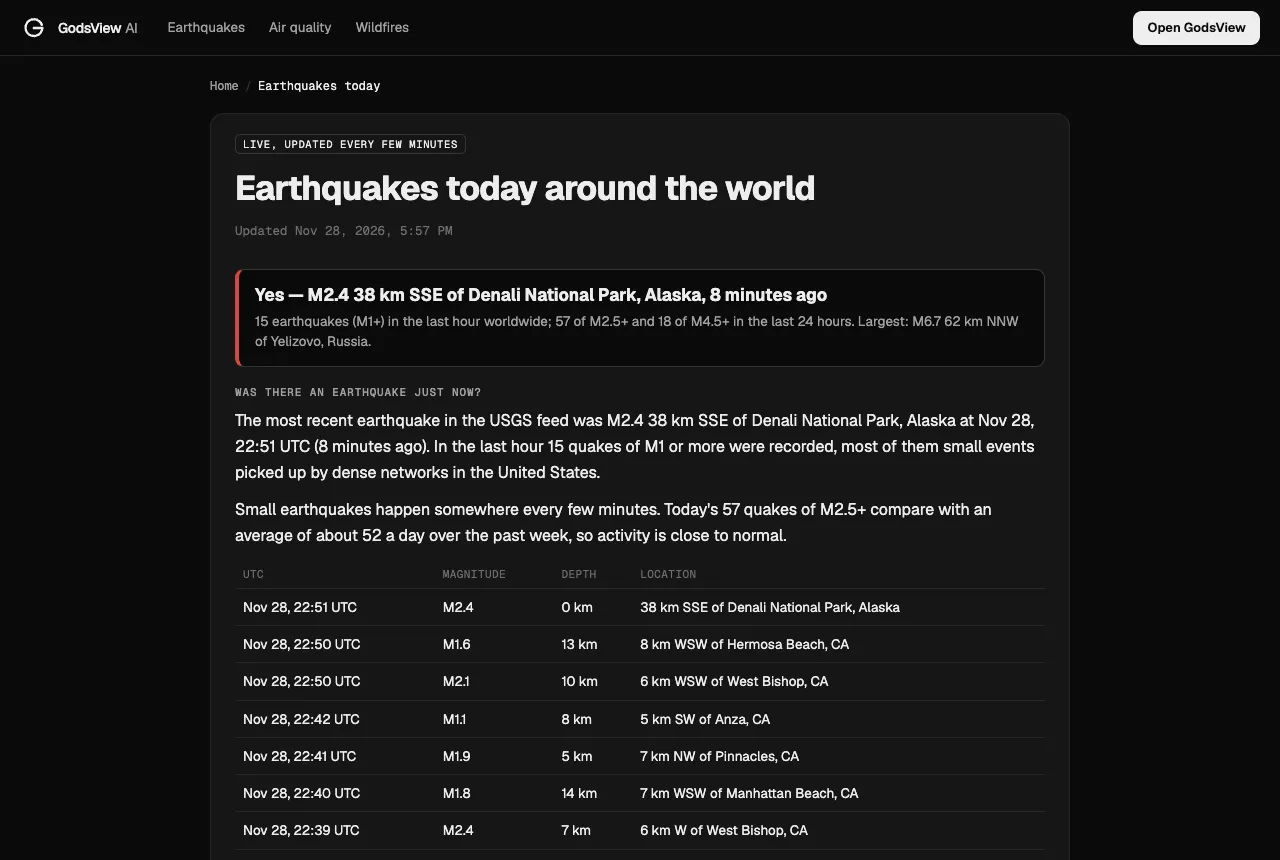
That screenshot shows the normal background: dozens of M2.5+ earthquakes every day around the world, most of them unfelt. During an aftershock sequence you will see one area light up with many quakes, then thin out day by day. If you want an alert when quakes strike near a saved place, GodsView Plus ($10.99 a month or $99.99 a year) adds alerts for saved places; our guide to the best earthquake alert apps compares other options, including free early warning systems.
The short version
Aftershocks are the fault settling after a mainshock. They are most common in the first day, fall off roughly as one over time, and the largest is usually about 1.2 magnitudes smaller than the main quake. About 1 in 20 earthquakes turns out to be a foreshock to something bigger within a week, so after any strong quake, stay ready to Drop, Cover and Hold On, keep out of damaged buildings, and follow your national agency's updates.
Frequently asked questions
How long do aftershocks last?
Most aftershocks happen in the first days, and the rate falls roughly as one over the time since the mainshock: about ten times fewer on day ten than on day one. After a very large earthquake they can continue for months or even years, according to the USGS.
Can an aftershock be bigger than the original earthquake?
If a later quake is bigger, it becomes the new mainshock and the first one is called a foreshock. The USGS puts the chance of an earthquake being followed by a larger one nearby within a week at about 5%.
How big is the largest aftershock usually?
On average about 1.2 magnitude units smaller than the mainshock (Båth's law). The gap ranges from 0.1 to 3 or more; after the 2015 M7.8 Nepal earthquake the largest aftershock was an M7.3.
What is the difference between an aftershock and a swarm?
Aftershocks follow a clear mainshock. A swarm is a sequence of mostly small earthquakes with no identifiable mainshock, often linked to geothermal or volcanic activity, as the USGS defines it.
Where can I see aftershocks live?
GodsView's earthquakes today page lists the latest quakes from the USGS feed, and earthquakes near me shows only those near your location. In the US, the USGS also publishes aftershock forecasts on the event page of each larger quake.
Are aftershocks dangerous?
Most are small, but a large aftershock can damage buildings already weakened by the mainshock. Stay out of damaged buildings, be ready to Drop, Cover and Hold On, and move to high ground on the coast after strong shaking.
Sources
- USGS — What is the difference between aftershocks and swarms?
- USGS — Foreshocks, aftershocks: what's the difference?
- USGS — What is the probability that an earthquake is a foreshock to a larger earthquake?
- USGS — Aftershock forecast overview
- Caltech — What is really happening when we have aftershocks?
- USGS event page — M8.8 2025 Kamchatka Peninsula earthquake
- USGS event page — M8.2 2014 Iquique, Chile earthquake
- USGS event page — M7.5 June 24, 2026 Venezuela earthquake
- El Diario — Funvisis has recorded 2,152 seismic events since June 24 (October 2, 2026)
- Ready.gov — Earthquakes
Facts checked on against each provider's own site.