Guide
Earthquake Preparedness Checklist: Before, During and After
Most earthquake injuries come from things falling, not buildings collapsing, and most of that can be fixed in an afternoon. This checklist turns official guidance from Ready.gov, the Earthquake Country Alliance and ShakeOut into steps you can tick off.
Key takeaways
- Secure the things that can fall on you: strap the water heater to wall studs with two metal straps, anchor tall furniture and TVs, latch cabinets and hang pictures on closed hooks.
- Keep a kit with at least a gallon of water per person per day for several days, several days of food, a flashlight, a radio, a first aid kit, a whistle, spare batteries and a phone charger.
- When shaking starts, Drop onto your hands and knees, Cover your head and neck (under a sturdy table if one is close), and Hold On until it stops. Do not run outside or stand in a doorway.
- After the shaking, expect aftershocks, check for injuries, gas leaks and damage, stay out of damaged buildings, and on a coast go to high ground at once.
- If you are trapped, text or bang on a pipe or wall instead of shouting, and use a communication plan with an out-of-area contact to find your family.
Earthquake preparedness comes down to three things you can do now: secure your space so heavy things cannot fall on you, keep supplies for several days without help, and practise Drop, Cover and Hold On until it is automatic. Then know what to do in the minutes after the shaking: check for injuries and gas leaks, expect aftershocks, and on a coast head for high ground. The Earthquake Country Alliance notes that in the 1994 Northridge earthquake, 55% of injuries came from falling furniture or objects, most of which could have been prevented.
Before you start, it helps to know how active your area is. GodsView's earthquakes near me page shows the latest quakes around you, and city pages such as earthquakes near Los Angeles list the largest of the past year.
The seven steps to earthquake safety
The Earthquake Country Alliance, the group behind the Great ShakeOut drills, organises preparedness into seven steps. They make a good backbone for any checklist:
| Step | When | What it means |
|---|---|---|
| 1. Secure your space | Before | Identify hazards and secure movable items |
| 2. Plan to be safe | Before | Make an emergency plan and decide how you will communicate |
| 3. Organise emergency supplies | Before | Keep supplies in convenient places |
| 4. Minimise financial hardship | Before | Organise documents, strengthen the building, consider insurance |
| 5. Drop, Cover and Hold On | During | Protect yourself when shaking starts or an alert arrives |
| 6. Improve safety | After | Evacuate if needed, help the injured, prevent further damage |
| 7. Reconnect and restore | After | Reunite with others, repair damage, rebuild |
The rest of this guide turns each of those into concrete items.
Before: secure your home (step 1)
This is the step that prevents the most injuries, and much of it costs little or nothing. From the Earthquake Country Alliance's list:
Free, today
- Move heavy or large items to the floor or low shelves.
- Move things that could fall on you away from beds, sofas and desks where you spend a lot of time.
Low-cost fixes
- Secure the water heater to wall studs with two metal straps.
- Anchor top-heavy furniture (bookcases, wardrobes) and appliances to wall studs.
- Secure TVs and computers with special straps.
- Hang mirrors and pictures on closed hooks, not open nails.
- Use museum putty or wax to stop small objects sliding off shelves.
- Install latches on kitchen cabinets so they do not fly open.
- Use flexible connections where gas lines meet appliances.
- Secure overhead light fixtures.
Ready.gov's list overlaps: secure bookcases, refrigerators, water heaters, televisions and anything hanging on the walls.
Before: make a plan (step 2)
- Agree on a family communication plan with an out-of-state (or out-of-area) contact everyone can call or text, as Ready.gov recommends.
- Choose where you will meet if you are separated.
- Know where and how to shut off gas, water and electricity, and keep a wrench or pliers nearby for the valves.
- Find the safe spots in each room: under a sturdy table or desk, or next to an interior wall.
- If you live on a coast, learn your tsunami evacuation zone and route; see tsunami watch vs warning.
- Sign up for alerts. In California, Oregon and Washington, ShakeAlert-powered early warnings can reach phones; elsewhere, check your government's alert system. Our earthquake alert apps guide covers the options.
Before: build an earthquake kit (step 3)
Ready.gov's basic disaster supplies kit is the standard list. Store it in airtight bags in an easy-to-carry container, such as a plastic bin or duffel bag, and make sure everyone knows where it is.
| Item | Ready.gov guidance |
|---|---|
| Water | One gallon (about 3.8 litres) per person per day, for several days, for drinking and sanitation |
| Food | At least a several-day supply of non-perishable food, plus a manual can opener |
| Light and power | Flashlight, extra batteries, and a phone with chargers and a backup battery |
| Information | Battery-powered or hand-crank radio, ideally with NOAA Weather Radio in the US |
| First aid | A first aid kit |
| Signalling | A whistle to call for help |
| Dust and shelter | Dust mask, plastic sheeting, scissors and duct tape |
| Sanitation | Moist towelettes, garbage bags and plastic ties |
| Tools | Wrench or pliers to turn off utilities, and local maps |
Ready.gov's earthquake page also suggests a fire extinguisher. Chile's disaster agency SENAPRED adds the medicines you need, important documents, warm clothing, hygiene items, and supplies for babies and pets.
Before: protect your finances and your building (step 4)
The Earthquake Country Alliance's step 4 covers the bigger jobs:
- Bolt the house to its foundation. It calls adding bolts to unsecured houses "one of the most important steps toward earthquake safety", with bolts no more than 6 feet apart in single-storey homes and 4 feet apart in multi-storey buildings.
- Brace cripple walls. Homes with a crawl space should have plywood panels connecting the studs of the short "cripple" walls.
- Check soft storeys. Large openings on lower floors, such as garages under living space or hillside homes on stilts, need a professional to check the bracing.
- Reinforce masonry and chimneys. All brick or block walls should be reinforced; poorly braced chimneys are a common hazard.
- Look at earthquake insurance. Standard homeowners policies exclude earthquake damage, so without earthquake cover you pay for all repairs yourself. California law requires insurers to offer earthquake coverage when a policy is sold and every two years after.
- Keep copies of IDs, insurance policies and other key documents in your kit or stored safely online.
During: Drop, Cover and Hold On (step 5)
When the shaking starts, or a ShakeAlert-powered warning arrives on your phone, protect yourself immediately where you are. ShakeOut's main point is "not to try to move but to immediately protect yourself as best as possible where you are."
- Drop where you are onto your hands and knees, so the shaking cannot knock you down.
- Cover your head and neck with one arm and hand. If a sturdy table or desk is close, crawl under it. If not, get next to an interior wall.
- Hold On until the shaking stops: to your shelter with one hand, or to your head and neck with both arms.
Special situations, from Ready.gov:
- In bed: turn face down and cover your head and neck with a pillow.
- Driving: pull over, stop and set the parking brake.
- Outdoors: move to an open area away from buildings, trees, streetlights and power lines.
- Wheelchair or walker: lock your wheels and cover your head and neck with your arms, a book or a pillow.
What not to do, according to ShakeOut:
- Do not stand in a doorway. In modern houses and buildings, doorways are no safer and do not protect you from flying or falling objects.
- Do not run outside. Falling glass, bricks and debris near buildings are a major hazard.
- Ignore the "triangle of life". ShakeOut says the source of that idea "has been discredited by leading experts."
After the shaking (steps 6 and 7)
The minutes after a quake matter as much as the seconds during it.
- Check yourself, then others, and give first aid if you are trained.
- Expect aftershocks. Be ready to Drop, Cover and Hold On again; see what are aftershocks.
- On a coast, go inland or to high ground right after strong shaking stops. Do not wait for an official warning.
- Look for hazards: building damage, leaking gas or water lines, and downed power lines. If you smell gas, get out.
- Stay out of damaged buildings.
- If you are trapped, send a text or bang on a pipe or wall instead of shouting.
- Reconnect: text your out-of-area contact, check on neighbours, and follow official updates by radio or phone.
Check your local earthquake risk
Preparedness is the same everywhere, but urgency is not. A quick look at recent activity near you helps set priorities.
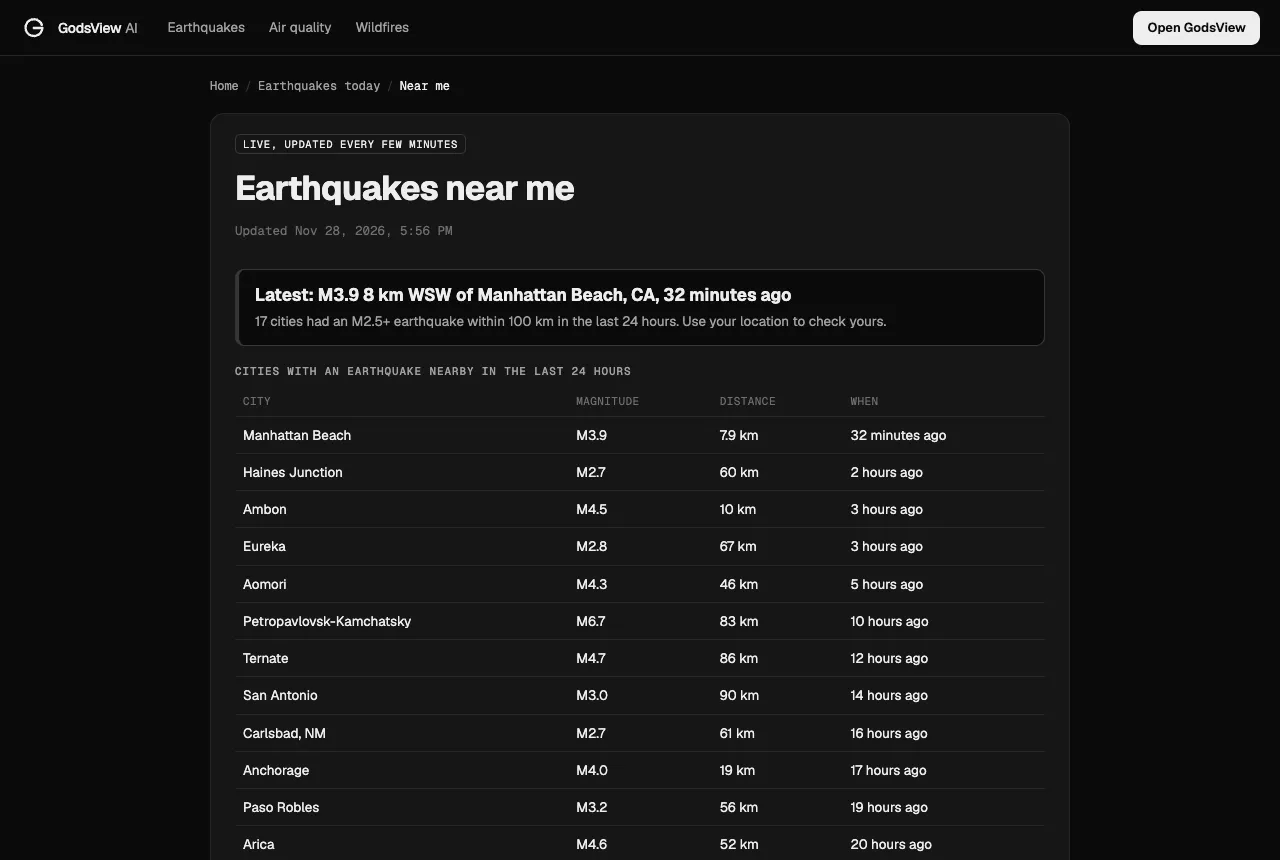
- Near you: earthquakes near me uses your location to show the latest quakes and a list of cities that had one nearby in the last day.
- Your city: pages such as Seattle, San Francisco, Tokyo or Istanbul show the past week and the largest quakes of the past year.
- Worldwide: earthquakes today lists the day's quakes as they happen.
- Alerts: GodsView Plus ($10.99 a month or $99.99 a year) adds alerts for saved places, alongside the free official alert systems in our disaster alerts guide.
Printable quick checklist
This week: move heavy items low · strap the water heater · anchor tall furniture and the TV · pick an out-of-area contact · practise Drop, Cover and Hold On with everyone at home.
This month: build the kit (water, food, light, radio, first aid, whistle, chargers) · learn the gas, water and power shut-offs · find your tsunami zone if you live on a coast · sign up for official alerts.
This year: have the foundation, cripple walls and chimney checked · review earthquake insurance · refresh the water and food in the kit.
The short version
Secure what can fall, keep several days of water and supplies, agree on a plan, and practise Drop, Cover and Hold On until it is reflex. When the shaking stops, check for injuries and gas, stay out of damaged buildings, expect aftershocks, and on the coast go to high ground right away. An afternoon of work now removes most of the risk you can control.
See the latest earthquakes worldwide
Frequently asked questions
What should be in an earthquake kit?
Ready.gov recommends one gallon of water per person per day for several days, several days of non-perishable food, a flashlight, a battery or hand-crank radio, a first aid kit, extra batteries, a whistle, a dust mask, plastic sheeting and duct tape, wipes and garbage bags, a wrench or pliers for utilities, a manual can opener, local maps, and a phone with chargers and a backup battery.
What should you do during an earthquake?
Drop onto your hands and knees, Cover your head and neck (under a sturdy table if one is close), and Hold On until the shaking stops. In bed, turn face down and cover your head with a pillow. If driving, pull over and set the parking brake.
Is a doorway the safest place in an earthquake?
No. ShakeOut says that in modern houses and buildings doorways are no safer than other places and do not protect you from flying or falling objects. Drop, Cover and Hold On where you are instead.
Should I run outside during an earthquake?
No. Trying to move during strong shaking is dangerous, and falling glass, bricks and debris near buildings cause injuries. Stay where you are and protect yourself until the shaking stops.
What should I do after an earthquake?
Check for injuries, expect aftershocks, look for gas leaks, damaged water lines and downed power lines, and stay out of damaged buildings. If you are on a coast, go to high ground at once. If trapped, text or bang on a pipe or wall instead of shouting.
How do I secure my water heater for an earthquake?
The Earthquake Country Alliance recommends securing it to the wall studs with two metal straps, and using flexible connections where gas lines meet appliances.
Sources
- Ready.gov — Earthquakes
- Ready.gov — Build a kit
- Earthquake Country Alliance — Seven Steps to Earthquake Safety
- Earthquake Country Alliance — Step 1: Secure your space
- Earthquake Country Alliance — Step 4: Minimize financial hardship
- Great ShakeOut — Drop, Cover and Hold On
- La Tercera — SENAPRED evacuation and emergency kit guidance
- USGS — Be ShakeAlert safe
Facts checked on against each provider's own site.