Explainer
Tsunami Warning vs Watch vs Advisory: What Each Alert Means
Tsunami alerts use four words that sound alike but ask for very different things, from "no action needed" to "leave now". Here is what each US alert level means, how Japan and Chile grade theirs, and the natural signs that mean you should not wait for any alert at all.
Key takeaways
- A tsunami warning is the highest US alert: dangerous coastal flooding and powerful currents are possible, so move to high ground or inland and follow local officials.
- A tsunami advisory means strong currents and waves dangerous to people in or very near the water: stay out of the water and away from beaches and waterways.
- A tsunami watch means a distant earthquake has happened and a tsunami may later affect the area: stay informed and be ready to act. An information statement means there is no threat or it is very far away.
- Japan's JMA issues a Major Tsunami Warning for expected heights over 3 m, a Tsunami Warning for up to 3 m and an Advisory for up to 1 m, usually about three minutes after the quake. Chile's levels run from Precaución to Alerta and Alarma.
- A strong or long earthquake, a sudden drop or rise of the sea, or a roar from the ocean are natural warnings: go to high ground at once, and expect several waves over hours.
A tsunami warning means a tsunami that may cause widespread flooding is expected or already happening: move to high ground or inland, away from the water, and follow local officials' evacuation instructions. It is the most serious of four US alert levels. A tsunami advisory means dangerous currents and waves for people in or near the water, so get out of the sea and off the beach. A tsunami watch means a distant earthquake has occurred and a tsunami is possible later, so stay tuned and be ready to act. An information statement means an earthquake happened but there is no threat, or it was very far away.
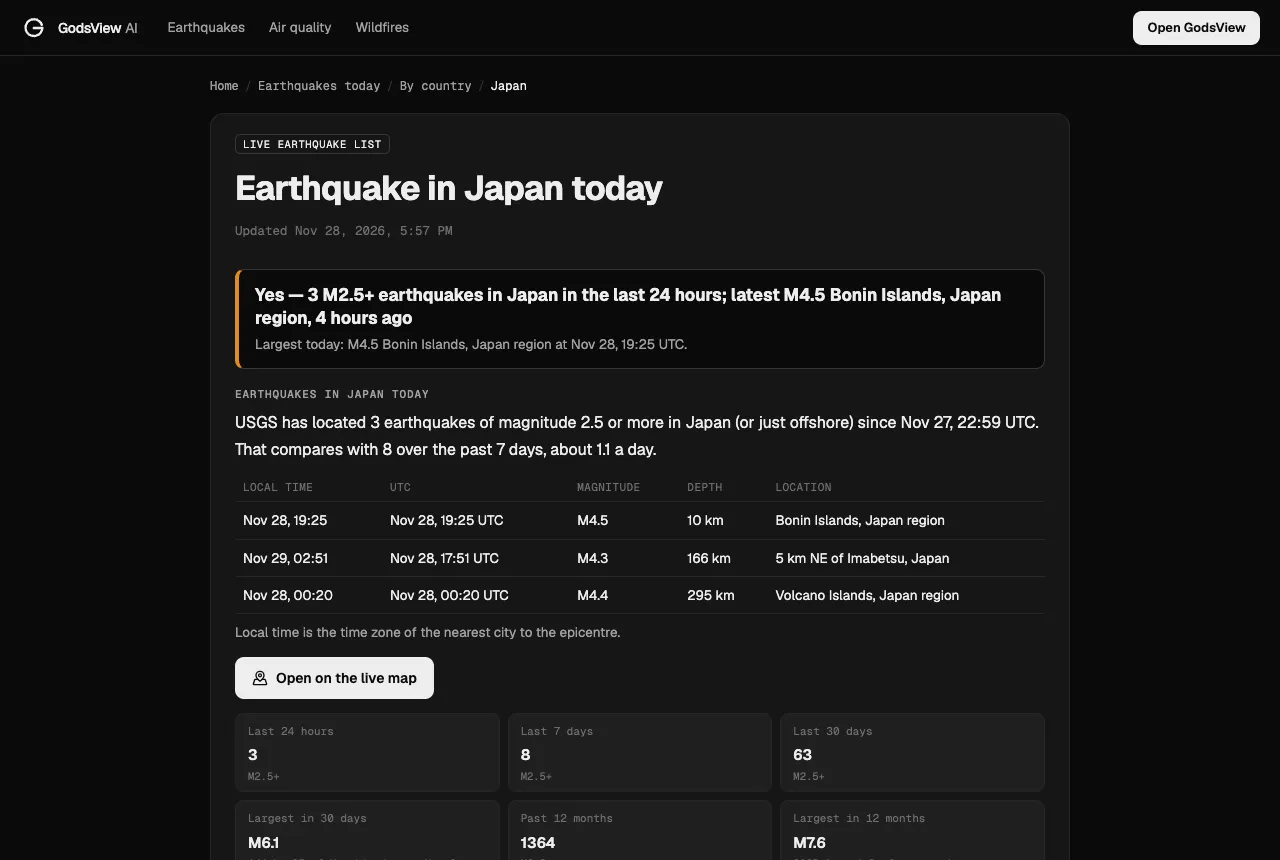
To see whether a recent earthquake was large and offshore, the kind that triggers these messages, check GodsView's earthquakes today list or a country page such as earthquakes in Japan. Each page has a tsunami status section that shows which quakes carried the USGS tsunami flag and links to the official messages on tsunami.gov.
Check today's earthquakes and tsunami status
The four US tsunami alert levels
The US tsunami warning centres use four levels. The definitions below are from the National Weather Service and tsunami.gov.
| Alert | What it means | What to do |
|---|---|---|
| Tsunami Warning | Danger. A tsunami that may cause widespread flooding is expected or occurring; dangerous coastal flooding and powerful currents are possible | Move to high ground or inland, away from the water. Follow evacuation orders from local officials |
| Tsunami Advisory | A tsunami with potential for strong currents or waves dangerous to those in or very near the water | Stay out of the water and away from beaches and waterways. Follow local officials |
| Tsunami Watch | A distant earthquake has occurred. A tsunami is possible and may later affect the watch area | Stay informed and be prepared to act if the alert is upgraded |
| Tsunami Information Statement | An earthquake has occurred, but there is no threat or it was very far away; usually no threat of a destructive basin-wide tsunami | No action needed |
A fifth product, the Tsunami Threat Message, is sent to national authorities in other countries when a potential or confirmed tsunami is forecast to affect their coasts. It is not a public alert: those governments decide what to tell their own people.
Watch vs warning, in one line
A watch is "a tsunami is possible, we are still working it out." A warning is "a dangerous tsunami is expected or already here, leave." The same pattern runs through US weather alerts, which our weather watch vs warning guide explains.
Advisory vs warning
An advisory is about the water itself: strong currents and waves that are dangerous to anyone in the sea or right at the shoreline. A warning adds the threat of dangerous, widespread flooding of the coast, which is why the action changes from "leave the beach" to "leave the area".
Who issues tsunami alerts in the US
NOAA runs two tsunami warning centres, staffed around the clock:
- The National Tsunami Warning Center in Palmer, Alaska, serves the continental United States, Alaska and Canada.
- The Pacific Tsunami Warning Center in Honolulu, Hawaii, serves the Hawaiian Islands and the US Pacific and Caribbean territories. Tsunami threat messages for other countries' authorities come from the warning centres as well.
In areas with dense seismic networks, the centres can issue messages within five minutes of an earthquake. They use seismic data and NOAA's DART buoys, which detect and measure tsunamis in the open ocean, to confirm or cancel an alert. Messages reach the public through local radio and TV, Wireless Emergency Alerts on phones, NOAA Weather Radio and NOAA websites, and locally through sirens and officials.
Tsunami warnings in Japan
Japan has its own system, run by the Japan Meteorological Agency (JMA). JMA issues tsunami warnings or advisories for each coastal region around three minutes after an earthquake, sometimes in as little as two.
| JMA alert | Expected tsunami height | What JMA asks |
|---|---|---|
| Major Tsunami Warning | More than 3 m ("Huge") | Evacuate from coastal or river areas immediately to safer places |
| Tsunami Warning | Up to 3 m ("High") | Evacuate from coastal or river areas immediately |
| Tsunami Advisory | Up to 1 m | Get out of the water and leave coastal areas immediately |
For very large earthquakes (magnitude 8 or more), the first warning uses the words "Huge" or "High" instead of a number, because the true magnitude takes longer to pin down. Numbers replace them once it is known. JMA also cautions that a tsunami may hit before a warning is issued when the source is close to the coast.
GodsView's earthquakes in Japan page lists every M2.5+ quake in and around Japan from the USGS feed. For the official tsunami status, JMA is the reference; our guide to earthquakes in Japan explains how to read its reports.
Tsunami alerts in Chile and Peru
Chile
Chile's Navy Hydrographic and Oceanographic Service (SHOA) runs the national tsunami alarm system (SNAM). After an earthquake it assesses the threat and assigns each stretch of coast a state, and the disaster agency SENAPRED organises any evacuation. Chilean media and officials describe the levels like this:
- Informativo: no tsunami threat.
- Precaución: a minor tsunami, waves of about 30 cm to 1 m. Leave beaches, rocky shores and river mouths, and keep at least 80 m back from the shoreline.
- Alerta: declared by SHOA; the population in the zone evacuates to safe areas.
- Alarma: imminent danger; everyone in the zone evacuates to safe ground at least 30 m above sea level.
SENAPRED's safe zones are more than 30 m above sea level (the "cota 30") or more than 1 km from the coast, reached on foot by the marked routes rather than by car. On July 29, 2025, after the M8.8 Kamchatka earthquake, SENAPRED placed Atacama, Coquimbo and Valparaíso on Alerta and several other regions on Precaución, with evacuations to be carried out at least three hours before the waves were due. The USGS later recorded a 2.5 m tsunami wave at Boyeruca, Chile, from that quake. See earthquakes in Chile.
Peru
In Peru, tsunami alerts come from the Navy's Directorate of Hydrography and Navigation (DHN). During the same Kamchatka event, on July 30, 2025, it called for the suspension of all coastal activities, with port captains closing ports and evacuations starting three hours before the expected arrival. See earthquakes in Peru.
Natural warning signs: when not to wait
Official alerts take minutes. A tsunami from a nearby earthquake can arrive in less. The National Weather Service lists three natural warnings that mean you should act on your own:
- You feel a strong or long earthquake near the coast.
- The ocean acts strangely: it rises fast like a flood or a wall of water, or it drains away suddenly and shows the sea floor like a very low tide.
- You hear a loud roar coming from the ocean.
If any of these happen, the NWS advice is: protect yourself during the shaking (Drop, Cover and Hold On), then move quickly to your safe place outside the hazard or evacuation zone. If you cannot get out of the zone, go as high or as far inland as you can. SENAPRED gives the same advice in Chile: if an earthquake makes it hard to stay on your feet and you are in a coastal zone, evacuate right away without waiting for an alert.
How long the danger lasts
Tsunamis are not single waves. The NWS warns that "the first wave may not be the last or the largest and the danger may last for hours or days." Tsunami.gov adds that dangerous currents can last for days in some places.
They are also fast. In the deep ocean a tsunami can travel at more than 500 mph, as fast as a jet plane, then slow to about 20 to 30 mph, the speed of a car, as it reaches shallow water. That is why a quake on one side of the Pacific can put coasts on the other side on alert many hours later, as the 2025 Kamchatka earthquake did: the USGS recorded waves of 1.74 m at Kahului, Hawaii, 1.21 m at Crescent City, California, and 1.3 m at Kuji, Japan.
Return only when local officials say it is safe. Chile's SENAPRED, for example, asks people not to go back until it officially authorises it, because several waves may come with gaps between them.
How to check for a tsunami alert right now
- Official alerts: tsunami.gov for the US and Pacific, JMA for Japan, SHOA and SENAPRED for Chile, DHN for Peru, and your national service elsewhere.
- Was there a big offshore quake? GodsView's earthquakes today page lists the largest quakes of the day, and country pages like Chile or Peru show the tsunami flag status for each one.
- Near your coast: city pages such as earthquakes near Valparaíso, Lima or Seattle have a tsunami status section.
- On your phone: our guide to the best earthquake alert apps covers government alerts on iPhone and Android.
The USGS tsunami flag on a quake is not a warning. It means the earthquake was large enough, and in an ocean area, for the tsunami centres to issue a message, which may well be "no threat". Our explainer what is a tsunami covers how they form.
The short version
Warning: leave for high ground or inland now. Advisory: get out of the water and off the beach. Watch: a tsunami is possible, stay tuned. Information statement: no threat. If you feel a strong or long quake at the coast, or the sea suddenly drains or surges, go without waiting for any alert, and stay away until officials say the danger is over.
See earthquakes in Japan today
Frequently asked questions
What is the difference between a tsunami watch and a tsunami warning?
A watch means a distant earthquake has occurred and a tsunami may later affect the area, so stay informed and be ready to act. A warning means a tsunami that may cause widespread flooding is expected or occurring, so move to high ground or inland now.
What should I do in a tsunami warning?
Move to high ground or inland, away from the water, and follow your local officials' evacuation instructions. Go on foot if you can, take marked evacuation routes, and do not return until officials say it is safe, because more waves may follow.
What does a tsunami advisory mean?
A tsunami advisory means a tsunami with strong currents or waves dangerous to people in or very near the water is expected. Stay out of the water and away from beaches and waterways. Widespread flooding inland is not expected.
How fast can a tsunami arrive?
Warning centres can issue messages within about five minutes in well-monitored areas, but a tsunami from a nearby quake can arrive very quickly. In the deep ocean tsunamis travel at over 500 mph. If you feel a strong or long earthquake at the coast, leave without waiting for an alert.
What are the tsunami warning levels in Japan?
JMA issues a Major Tsunami Warning for expected heights over 3 m, a Tsunami Warning for up to 3 m and a Tsunami Advisory for up to 1 m, usually about three minutes after the earthquake.
Is the first tsunami wave the biggest?
Not necessarily. The National Weather Service warns that the first wave may not be the last or the largest, and that the danger may last for hours or days.
Sources
- National Weather Service — Tsunami alerts
- US Tsunami Warning Centers — Message definitions
- US Tsunami Warning Centers — Tsunami FAQ
- National Weather Service — During a tsunami
- NOAA — The US tsunami warning system
- JMA — Tsunami Warning/Advisory and Tsunami Information
- Chilevisión — Alarma, alerta o precaución de tsunami: the differences
- La Tercera — How to evacuate in a tsunami alert (SENAPRED guidance)
- CNN Chile — SENAPRED reports tsunami alert in three regions (July 29, 2025)
- Andina — Tsunami alert in Peru: Navy calls for suspension of coastal activities (July 30, 2025)
- USGS event page — M8.8 2025 Kamchatka Peninsula earthquake (tsunami heights)
Facts checked on against each provider's own site.