How-to
Is the Power Out in Texas? ERCOT, Outage Maps and What to Check
When the lights go out in Texas, people check ERCOT first. But ERCOT almost never knows about your outage. Here is who does, where to look, and what the grid alerts actually mean.
Key takeaways
- Most Texas outages are local: a storm, a tree or a failed transformer. Check your poles-and-wires utility (Oncor, CenterPoint, AEP Texas, TNMP, a co-op or a city utility), not ERCOT.
- ERCOT runs the grid for about 90% of Texas load and more than 27 million customers, but it owns no power lines and does not restore local outages.
- ERCOT's alerts go Weather Watch, Voluntary Conservation Notice, Conservation Appeal, then Energy Emergency Alert levels 1 to 3. Controlled outages are possible only at EEA level 3.
- If you buy power from a retail provider, you still report outages to your delivery utility. Your retail provider cannot fix the lines.
- Winter Storm Uri in 2021 left more than 4.5 million Texans without power; Hurricane Beryl in 2024 cut power to more than 2.26 million CenterPoint customers at its peak.
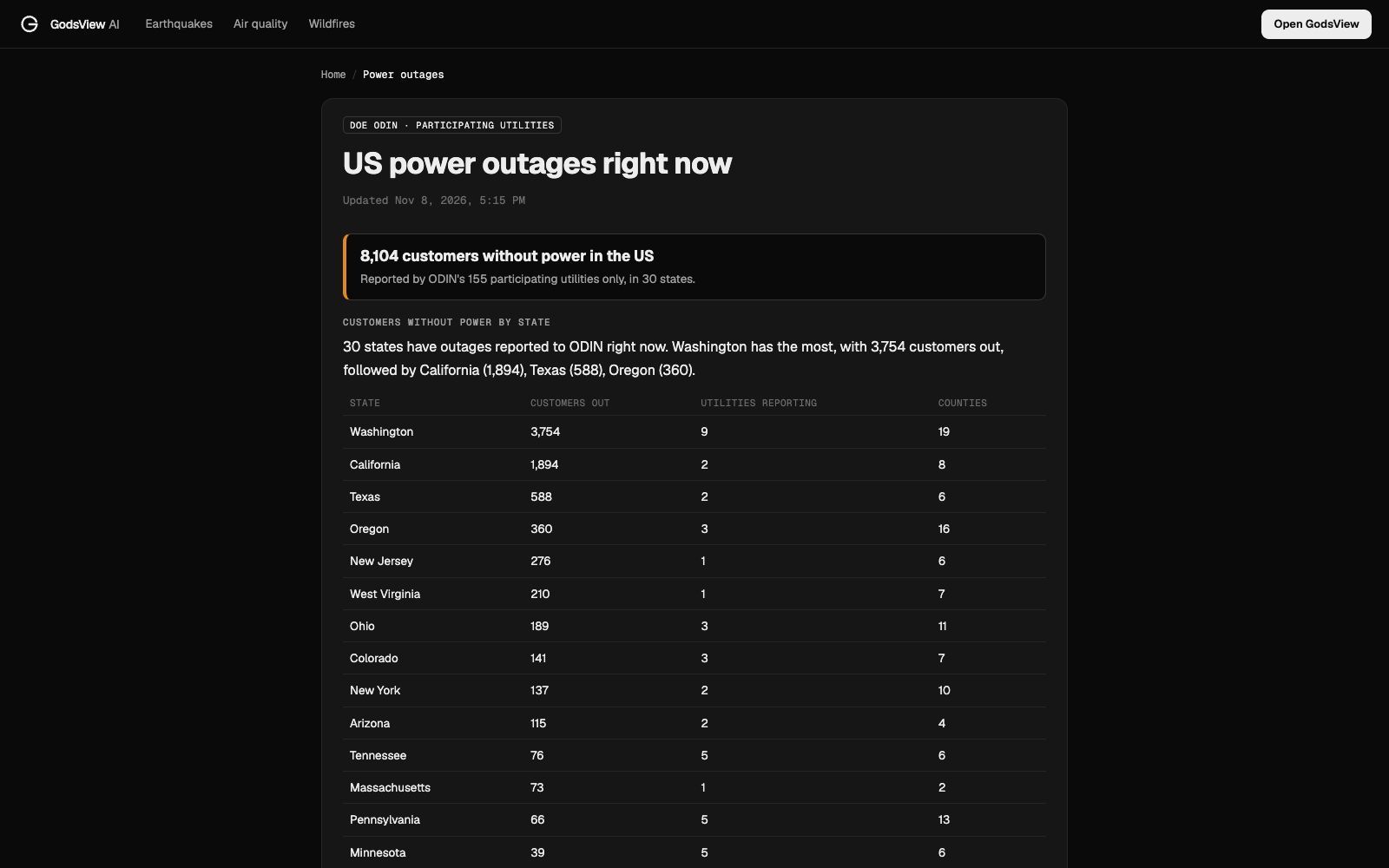
To find out if the power is out in Texas, check your local utility's outage map first: Oncor, CenterPoint, AEP Texas, TNMP, your electric co-op or your city utility. ERCOT's grid page tells you whether the statewide grid is under strain, not whether your street has power. Almost every outage in Texas is local, caused by storms, trees or equipment, and is fixed by the utility that owns the lines. For the wider picture, GodsView's power outages in Texas page shows customers out by utility and county for the Texas utilities that publish to the Department of Energy's outage feed.
This guide explains the difference between ERCOT and your utility, how to tell a grid emergency from a local outage, who to call in each part of Texas, what Winter Storm Uri and Hurricane Beryl showed about outage information, and what to do while you wait. For the general how-to that applies in every state, see our power outage map guide.
See power outages in Texas now
ERCOT vs your utility: who does what
Texans hear "ERCOT" every time the power goes out, so it is natural to look there first. But ERCOT and your utility do very different jobs.
ERCOT, the Electric Reliability Council of Texas, is the grid operator. It balances supply and demand across the grid that serves about 90% of the state's electric load and more than 27 million customers, over more than 55,000 miles of transmission lines. The Texas Comptroller notes that ERCOT does not own or operate any assets on the grid. It doesn't own the poles in your street, it doesn't send crews and it doesn't have your address.
Your delivery utility owns the poles, wires and substations that bring power to your home. When a tree falls on a line, this is the company that finds it, fixes it and puts the outage on its map. In the parts of Texas with retail competition, that is a transmission and distribution utility such as Oncor, CenterPoint Energy, AEP Texas or Texas-New Mexico Power. Elsewhere it is an electric cooperative, a city-owned utility such as Austin Energy or CPS Energy, or a traditional utility outside ERCOT.
Your retail electric provider, if you have one, sells you the electricity and sends the bill. It does not maintain lines. Oncor puts it plainly: it delivers electricity that you buy from your retail electric provider, and it, not the retailer, takes outage reports for its area.
| Who | What it does | Use it for |
|---|---|---|
| ERCOT | Runs the grid for most of Texas, balances supply and demand | Statewide grid conditions, conservation requests, emergencies |
| Delivery utility (Oncor, CenterPoint, AEP Texas, TNMP) | Owns and repairs the lines in competitive areas | Reporting outages, outage maps, restoration times |
| Co-op or city utility | Sells and delivers power in its own area | Reporting outages, outage maps, restoration times |
| Retail electric provider | Sells electricity and bills you in competitive areas | Billing and plans, not outages |
| PUCT (Public Utility Commission of Texas) | Regulates utilities, handles complaints | Complaints after the fact, outage contact list |
Is it a grid emergency or a local outage?
There are two very different kinds of "the power is out in Texas".
A local outage is by far the most common. A storm, a car hitting a pole, an animal in a substation or a failed transformer cuts power to a street, a neighbourhood or a county. Your neighbours are dark, the town next door is fine, and ERCOT's grid page says "normal". Your utility's outage map is the place to look.
A grid emergency happens when there is not enough generation to meet demand across the ERCOT grid. ERCOT then asks utilities to cut power in rotation to keep the whole system from collapsing. These events are rare, they are announced, and they come with warnings first.
ERCOT's warning ladder, published through its Texas Advisory and Notification System (TXANS), runs:
- ERCOT Weather Watch: an early notice, roughly 3 to 5 days ahead, of significant weather and high demand.
- Voluntary Conservation Notice: a call for Texans to voluntarily reduce energy use during peak demand, if safe to do so.
- Conservation Appeal: an elevated request to reduce use during peak demand.
- Energy Emergency Alert (EEA) level 1: low reserves; ERCOT deploys tools to meet demand.
- EEA level 2: lower reserves; additional tools deployed.
- EEA level 3: extremely low reserves; controlled outages possible.
So if ERCOT shows normal conditions and your lights are out, it is a local outage. If ERCOT has declared EEA 3 and asked utilities to shed load, outages may be rotating through your area, and your utility will say so on its site. You can get TXANS alerts by email, by following ERCOT on social media, or in the ERCOT mobile app.
Who to call in each part of Texas
The PUCT keeps a list of outage maps and phone numbers for every type of utility. Here are the main investor-owned utilities from that list:
| Utility | Outage phone | Where |
|---|---|---|
| Oncor Electric Delivery | 888-313-4747 | Dallas-Fort Worth and much of north, central and west Texas |
| CenterPoint Energy Houston Electric | 800-332-7143 | Houston area |
| AEP Texas | 866-223-8508 | South and west Texas, including Corpus Christi |
| Texas-New Mexico Power (TNMP) | 888-866-7456 | Scattered areas, including parts of the Gulf Coast and north central Texas |
| Entergy Texas | 800-968-8243 | Southeast Texas, outside ERCOT |
| El Paso Electric | 915-877-3400 | El Paso area, outside ERCOT |
| Southwestern Electric Power Co. (SWEPCO) | 888-218-3919 (East Texas) | Northeast Texas, outside ERCOT |
| Xcel Energy | 800-895-1999 | Panhandle and South Plains, outside ERCOT |
The PUCT list also includes city utilities such as Austin Energy (512-322-9100), CPS Energy in San Antonio (210-353-4357) and Lubbock Power and Light (806-775-2509), and the state's electric cooperatives.
Not all of Texas is on the ERCOT grid. ERCOT says its region excludes the El Paso area, Northeast Texas (Longview, Marshall and Texarkana) and Southeast Texas (Beaumont, Port Arthur and The Woodlands), and parts of the Panhandle are served by neighbouring grids too. If you live in one of those places, an ERCOT conservation appeal or emergency doesn't apply to you, and your utility's own grid operator is the one that matters.
Where to see Texas outages on a map
- Your utility's outage map. The most detailed source: your street, the cause, crew status and estimated restoration time. Report your outage here too.
- GodsView's Texas outage page. Power outages in Texas shows customers out by utility and by county, the most affected cities, and which Texas utilities publish to ODIN, the Department of Energy's outage data initiative run by Oak Ridge National Laboratory. It refreshes about every 5 minutes.
- City pages. Power outages in Houston, Dallas, Austin and San Antonio count outages within 40 km of the city centre and name the utilities that serve it.
- ERCOT's grid conditions. For the statewide supply picture, not local outages.
Know the limit of any national map. ODIN only includes utilities that choose to publish to it. As of November 10, 2026, ODIN's participant list includes two Texas utilities, CenterPoint Energy and Grayson-Collin Electric Cooperative. So GodsView's Texas page is useful for the Houston area, but if you are an Oncor, AEP Texas, TNMP or city utility customer, a quiet page tells you nothing about your street. Go straight to your utility's map. GodsView's Texas page lists the utilities it covers, so you can check whether yours is one of them.
Winter Storm Uri, February 2021
Uri is the reason so many Texans check ERCOT first. In mid-February 2021, extreme cold drove demand up while generators across the state failed. To keep the grid from a total blackout, ERCOT ordered rotating outages. The joint FERC and NERC report found that ERCOT had to shed 20,000 MW of firm load at the worst point, and that, combined with neighbouring grids, it was the largest controlled firm load shed event in US history. More than 4.5 million people in Texas lost power, some for as long as four days, while exposed to below-freezing temperatures for more than six days.
The Texas Department of State Health Services later confirmed 246 deaths related to the storm across 77 Texas counties. Most were from hypothermia. The DSHS also counted 19 deaths from carbon monoxide poisoning, from generators, grills, heaters and vehicles run in enclosed spaces.
What Uri means for you now:
- "Rotating" outages may not rotate. During Uri, many outages lasted days instead of the short rotations people expected.
- ERCOT's warnings come first. A real grid emergency follows a Weather Watch and conservation requests. Sign up for TXANS so you hear early.
- Carbon monoxide kills in outages. Never run a generator, grill or car in a garage or indoors.
Hurricane Beryl, July 2024
Beryl was the opposite kind of event: no grid shortage, but massive local damage. It made landfall on July 8, 2024 as a Category 1 hurricane, and at the storm's peak more than 2.26 million CenterPoint customers were without power in the Houston area. ERCOT's grid was fine. The problem was thousands of downed lines and poles that only CenterPoint's crews and mutual-aid crews could fix.
Many people were without power for days in July heat. After Beryl and a May 2024 derecho that also hit Houston, Governor Abbott ordered the PUCT to investigate. In November 2024 the PUCT approved the findings, which said the two storms left more than two million customers without power for multiple days, and set out 14 recommendations covering emergency planning, communication and coordination, restoration workflow, infrastructure, vegetation management, staffing and mobile generation.
Beryl is the better model for most Texas outages. Hurricanes, derechos, ice storms and tornadoes damage local lines. ERCOT can show normal conditions while millions are dark.
What to do when the power is out in Texas
- Check whether it is just you. Look at the neighbours and your breaker panel.
- Report it to your delivery utility, not your retail provider, by app, text, website or phone.
- Check ERCOT's grid conditions only if you suspect a statewide problem, such as during extreme cold or heat.
- Keep the fridge and freezer closed. The USDA says a closed fridge keeps food safe about 4 hours, a full freezer about 48 hours.
- Run generators outside only, well away from windows and doors.
- Stay cool or warm safely. In summer heat, find a cooling centre if your home gets dangerously hot. In winter, dress in layers and never heat your home with an oven or grill.
- Register medical needs in advance. If someone at home depends on powered medical equipment, ask your utility about its critical care or medical-needs registration before storm season.
- Treat every downed line as live. Stay away and call the utility or 911.
Our power outage map guide covers how to read customers out, causes and restoration times in more detail.
Watch the weather that causes outages
Most big Texas outages follow weather you can see coming. Check weather warnings for Houston or your own city for high wind, ice, severe thunderstorm and hurricane warnings, and read watch vs warning for what each level means. During hurricane season, our guide to watching a hurricane live shows how to follow the storm itself.
GodsView's outage pages are free and need no account, and outages are also a layer on the live map next to weather warnings and cameras, as part of GodsView Plus. GodsView does not send power outage alerts; for those, sign up for your utility's text alerts and ERCOT's TXANS notices.
Frequently asked questions
Is the power out in Texas right now?
Check your local utility's outage map for your street, and GodsView's power outages in Texas page for customers out by utility and county among Texas utilities that publish to the DOE ODIN feed. ERCOT's site only tells you about statewide grid conditions.
Does ERCOT have an outage map?
ERCOT runs the grid and publishes grid conditions, but it does not own power lines or track local outages. Outage maps come from the utility that delivers your power, such as Oncor, CenterPoint, AEP Texas, TNMP, a co-op or a city utility.
Who do I call when my power goes out in Texas?
Call or report online to your delivery utility, not your retail electric provider. The PUCT lists outage numbers, for example Oncor 888-313-4747, CenterPoint 800-332-7143, AEP Texas 866-223-8508 and TNMP 888-866-7456.
What does an ERCOT EEA mean?
An Energy Emergency Alert means grid reserves are low. Level 1 and 2 mean ERCOT is using extra tools to meet demand. Level 3 means reserves are extremely low and controlled outages are possible.
Is all of Texas on the ERCOT grid?
No. ERCOT excludes the El Paso area, Northeast Texas around Longview, Marshall and Texarkana, and Southeast Texas around Beaumont, Port Arthur and The Woodlands. Parts of the Panhandle are on neighbouring grids too.
How many people lost power in Winter Storm Uri?
The FERC and NERC report says more than 4.5 million people in Texas lost power in February 2021, some for as long as four days. ERCOT shed 20,000 MW of load at the worst point.
How many CenterPoint customers lost power in Hurricane Beryl?
CenterPoint says more than 2.26 million of its customers were without power at the peak after Beryl made landfall on July 8, 2024.
Sources
- ERCOT: About ERCOT
- ERCOT: Texas Advisory and Notification System (TXANS)
- ERCOT: Organization backgrounder
- PUCT: Storm resources, utility outage contacts
- Oncor: General questions
- FERC, NERC and Regional Entity staff: The February 2021 Cold Weather Outages in Texas and the South Central United States
- Texas DSHS: February 2021 Winter Storm-Related Deaths
- CenterPoint Energy: Initial update on impact of Hurricane Beryl
- PUCT: Findings of investigation into Houston area utilities (Nov. 21, 2024)
- Texas Comptroller: ERCOT
- Oak Ridge National Laboratory: ODIN
Facts checked on against each provider's own site.