Explainer
What Causes the Northern Lights? How the Aurora Forms
The aurora is a light show powered by the Sun and steered by Earth's magnetic field. Here is the chain from a solar eruption to green curtains over Norway, why the colours differ, why it hugs the poles, and why some nights deliver and most don't.
Key takeaways
- The northern lights are made by charged particles, mostly electrons, crashing into oxygen and nitrogen 80 to 500 km up. The gas glows, much like a neon sign.
- The energy comes from the solar wind. Coronal mass ejections and fast wind from coronal holes shake Earth's magnetic field and power the brightest displays.
- Green is oxygen at about 100 to 200 km, red is oxygen higher up, and blue or purple-pink comes from nitrogen lower down.
- The aurora forms in a ring around each magnetic pole, the auroral oval. Storms push that ring toward the equator, which is when cities further south get a show.
- NOAA says the best viewing is usually within an hour or two of midnight, about 10 PM to 2 AM local time, with dark, clear skies.
The northern lights are caused by charged particles from the Sun's solar wind that get funnelled by Earth's magnetic field toward the poles, where they collide with oxygen and nitrogen high in the atmosphere and make the gas glow. Oxygen gives the common green and the rarer red; nitrogen adds blue and purple. The brightest displays follow solar eruptions called coronal mass ejections, which can push the aurora far south of its usual Arctic home.
That's the one-paragraph version. The rest of this guide follows the chain step by step, from the Sun to your sky, and then turns it into practical answers: where the aurora shows up, what time to look and why tonight might or might not be the night.
Check tonight's aurora forecast
Step 1: the Sun sends out the solar wind
The Sun's outer atmosphere, the corona, is so hot that it doesn't stay put. It streams out into space in every direction as the solar wind, a thin flow of charged particles (electrons and protons) that carries the Sun's magnetic field along with it. On a quiet day the wind passing Earth moves at a few hundred kilometres per second.
On its own, that steady breeze keeps a faint aurora going near the poles most nights. The big shows need something stronger. Two things deliver it:
- Coronal mass ejections (CMEs). These are huge clouds of plasma and magnetic field blasted off the Sun, often alongside a solar flare. NOAA's Space Weather Prediction Center says CMEs leave the Sun at anything from under 250 km/s to nearly 3,000 km/s. The fastest Earth-directed ones arrive in as little as 15 to 18 hours; slower ones take several days (NOAA SWPC).
- High-speed streams from coronal holes. Coronal holes are open patches in the Sun's magnetic field where fast solar wind pours out. Because the Sun rotates about once every 27 days as seen from Earth, a long-lived hole can bring a burst of aurora back roughly every four weeks.
A flare by itself is a flash of light and X-rays that reaches Earth in about eight minutes. It doesn't make aurora. The CME that sometimes follows it does, a day or more later. Our solar flares and geomagnetic storms explainer covers the difference and the NOAA storm scales in detail.
Step 2: Earth's magnetic field catches the energy
Earth is wrapped in a magnetic bubble, the magnetosphere. It deflects most of the solar wind around the planet, which is a big part of why life on the surface is shielded from it. The bubble is squashed on the side facing the Sun and stretched into a long tail on the night side.
The key moment comes when the magnetic field carried by the solar wind points roughly opposite to Earth's own field at the front of the bubble. Scientists describe this as the interplanetary magnetic field turning "southward", or Bz going negative, and aurora apps often show it. When that happens, the two fields link up and energy from the solar wind flows into the magnetosphere instead of sliding past.
That energy is stored in the magnetotail, then released in bursts. When the tail snaps back, electrons are accelerated down along magnetic field lines toward the polar regions. Those sudden releases, called substorms, are why a quiet green arc can brighten and start to dance within minutes.
This is also why two CMEs of the same speed can give very different results. One whose field points north may barely register. One whose field points south can drive a major storm.
Step 3: particles hit the air and the air glows
The electrons racing down the field lines slam into atoms and molecules in the upper atmosphere. NOAA describes the result simply: the particles transfer energy to oxygen and nitrogen, which then give it off as light, "similar to how a neon light operates" (NOAA SWPC). This happens between about 80 and 500 km up, far above airliners and weather.
Because the particles follow magnetic field lines, the aurora takes their shape. That's why you see long curtains and rays that line up with the field, and why the bottom edge of a curtain is often sharp while the top fades out.
Why the northern lights are green, red, blue or purple
The colour tells you which gas is glowing and roughly how high. NASA gives this breakdown (NASA):
| Colour | Gas | Rough altitude | How often you'll see it |
|---|---|---|---|
| Red | Oxygen | Above about 200 km | Faint tops of displays; the whole sky turns red only in strong storms |
| Green | Oxygen | About 100 to 200 km | The most common colour by far |
| Blue | Nitrogen | About 100 to 200 km | Mixed into bright, active displays |
| Pink, purple or red-violet | Nitrogen | Below about 100 km | The lower fringe of very active curtains |
Green dominates because there's plenty of oxygen at 100 to 200 km and our eyes are most sensitive to green light. The red oxygen glow is much weaker and slower to emit, so it needs thin air high up where collisions don't knock the energy out first. In big storms more energy reaches those heights, which is why mid-latitude sightings are often red or pink: you are looking at the top of an aurora whose green base is below your horizon.
One practical note. Phone cameras often record more colour than you see. In a faint aurora the eye mostly sees grey-white, because colour vision fades in the dark, while a long exposure shows bright green. If a grey patch in the north shows up green on your phone screen, that's the aurora.
Why the aurora happens near the poles
The magnetic field lines that guide the particles come down to Earth near the magnetic poles. So the aurora forms in two rings, one around each magnetic pole, called the auroral ovals. NOAA says the best place to see it is under the oval, roughly between 60 and 75 degrees latitude, where it can be seen on more than half of all nights in a year (NOAA SWPC).
A few things follow from that:
- There are southern lights too. The aurora australis appears over Antarctica, southern New Zealand, Tasmania and the tip of South America, usually at the same time as the northern lights.
- The oval is centred on the magnetic pole, not the geographic one. The north magnetic pole sits toward the Canadian Arctic side, so North America sees the aurora further south than Europe or Asia at the same map latitude.
- Storms move the oval. As a storm builds, the oval brightens, thickens and expands toward the equator. That's what the Kp index tracks. In May 2024 a G5 "extreme" storm, the first since 2003, put the aurora over much of the US and Europe (NASA Earth Observatory).
You don't have to be under the oval. NOAA notes that from a hilltop with a clear northern view, you can see aurora that's about 1,000 km further north (NOAA SWPC). That's how people in Scotland or the northern US see it low on the horizon.
Where the northern lights are visible
The reliable zone runs through Alaska, northern Canada, southern Greenland, Iceland, northern Norway, Sweden and Finland, and the far north of Russia. Fairbanks, Yellowknife, Tromsø, Abisko, Rovaniemi and Reykjavík are popular because they sit close to the oval and have airports and roads.
Further south it depends on the storm. As a rough guide drawn from NOAA's scales: a minor storm (Kp 5) commonly brings aurora to northern Michigan and Maine, a strong one (Kp 7) has reached Illinois and Oregon, and an extreme one (Kp 9) has been seen as far south as Florida and southern Texas (NOAA space weather scales). Our guide to what Kp index you need turns that into numbers for specific cities, so we won't repeat the full table here.
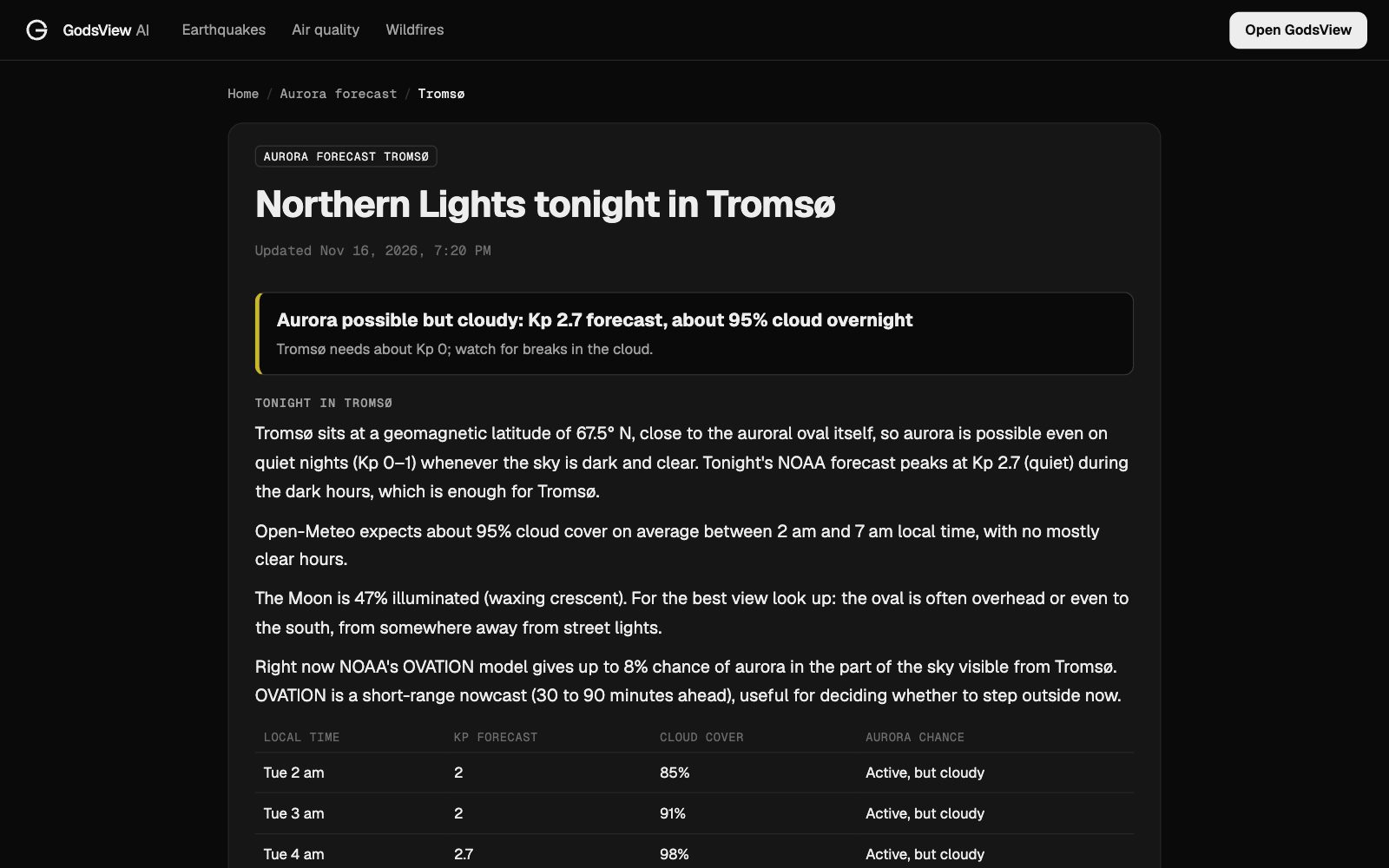
GodsView has a page for each aurora city, such as Tromsø, Fairbanks and Reykjavík, that puts the Kp forecast next to local cloud cover and dark hours.
What time are the northern lights?
NOAA's advice is that the best aurora is usually "within an hour or two of midnight (between 10 PM and 2 AM local time)", and that the window stretches earlier and later when activity is high (NOAA SWPC). The reason is geometry. Around local midnight you're on the night side of Earth, looking into the part of the oval fed by the magnetotail, where substorms release their energy.
In practice:
- Be out by 9 or 10 PM if a storm is under way, and stay until 1 or 2 AM. Displays come and go in waves, often 20 to 40 minutes of activity, then a lull.
- Give your eyes 15 to 20 minutes away from screens and headlights to adjust to the dark.
- Seasons matter. NOAA says the spring and autumn equinoxes tend to bring larger storms. Summer near the Arctic Circle is a write-off for a different reason: the sky never gets dark enough. The northern season runs roughly from late August to mid-April.
The Sun's 11-year cycle matters too. NASA and NOAA announced in October 2024 that the Sun had reached the solar maximum period of Solar Cycle 25 (NOAA SWPC). Strong storms are common for a few years around the peak and keep occurring during the decline, so the next couple of seasons should still bring good nights.
Why some nights deliver and most don't
The aurora needs four things to line up, and only one of them is about the Sun:
- Enough activity for your latitude. Under the oval, a quiet night can do. In London or Chicago you need a storm.
- Darkness. No twilight and ideally little moonlight. A bright moon washes out faint aurora but not a strong one.
- Clear skies. Cloud is the most common reason people miss a good storm. Check the cloud forecast, not just the Kp.
- A dark view toward the pole. North in the northern hemisphere, away from streetlights. A beach, a lake or a hill works well.
Forecasts can also be wrong in timing. NOAA can see a CME leave the Sun, but the important detail, which way its magnetic field points, is only measured when it passes spacecraft about 1.5 million km upstream of Earth. That gives roughly 15 to 60 minutes of warning. So a predicted storm can arrive hours early, hours late or weaker than expected.
Can the northern lights be seen tonight?
To answer that for your town, check three things in this order:
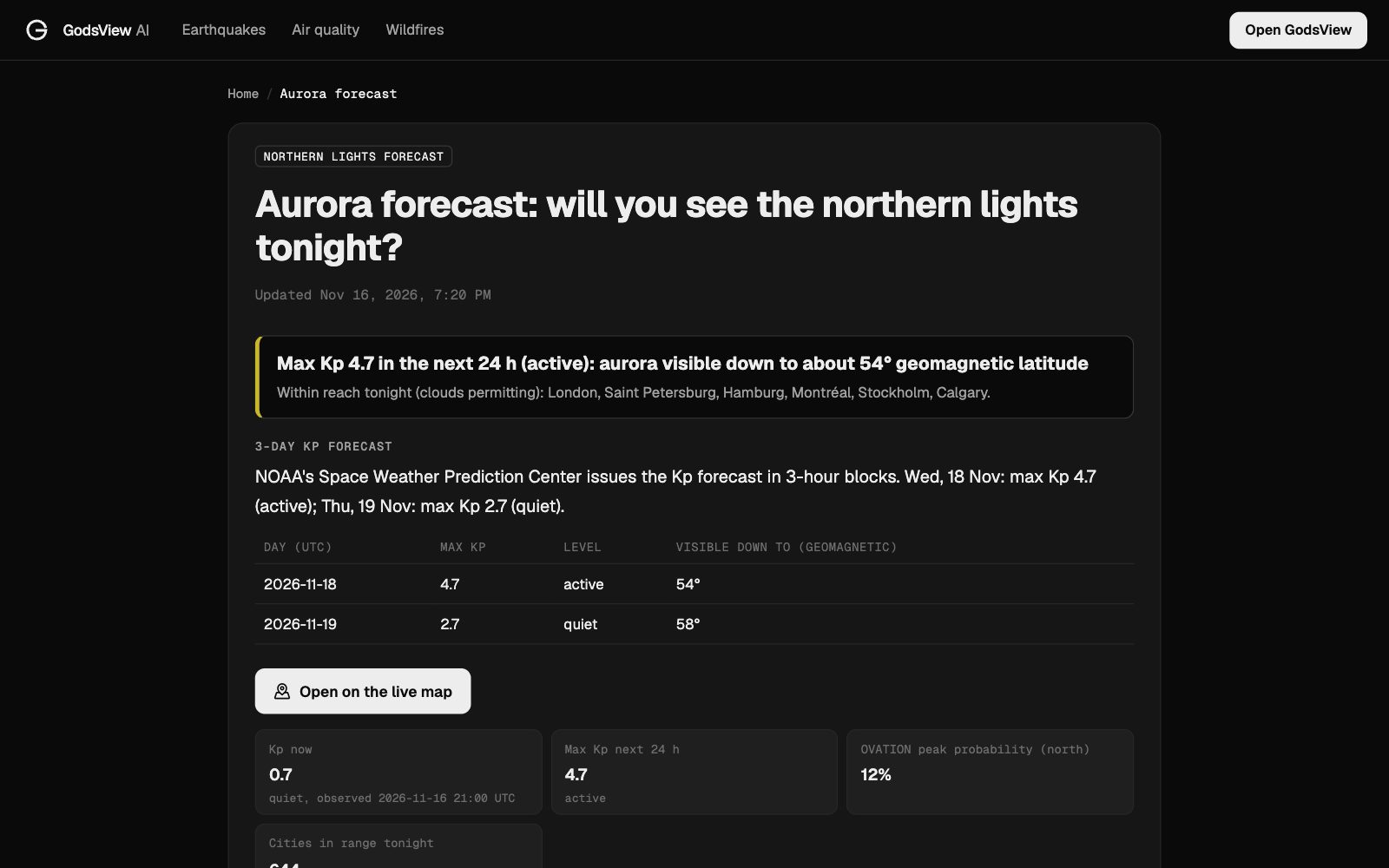
- The forecast Kp for tonight's dark hours. The GodsView aurora forecast shows Kp now, the highest Kp expected in the next 24 hours, NOAA's 3-day forecast and the OVATION model's aurora probability.
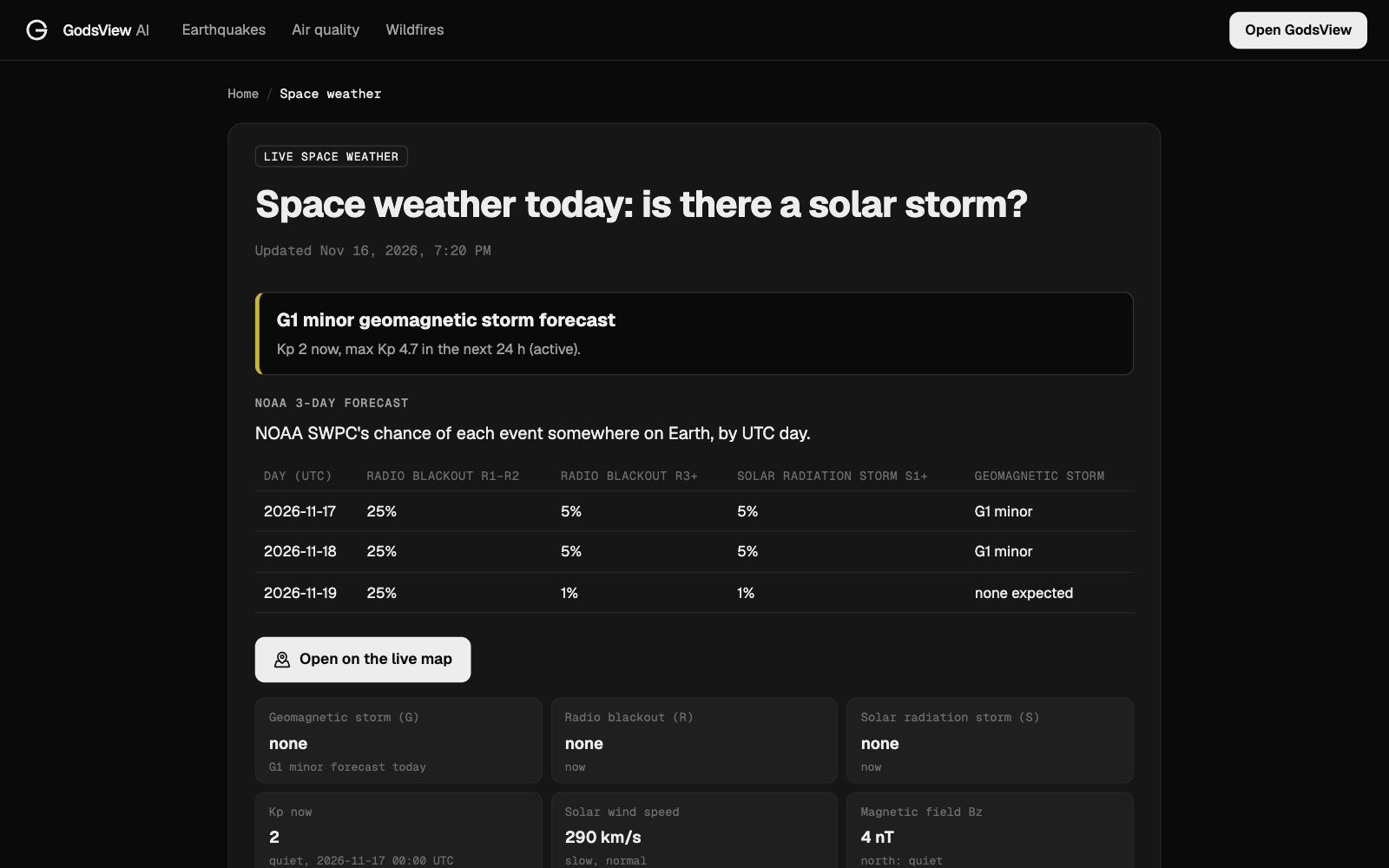
- The solar wind right now. The space weather page shows the current Kp, solar wind speed, X-ray flare level and NOAA's storm forecast. A jump in wind speed plus southward Bz means activity is likely to pick up within the hour.
- Your cloud cover. Each city page lists cloud cover for every dark hour.
You can also turn on the aurora layer on the live map to see the predicted oval over the globe. For a step-by-step plan for the night itself (where to go, how to photograph it), read how to see the northern lights tonight, and if you want a phone app for push alerts, our roundup of the best aurora forecast apps compares the main options.
Things that get mistaken for the aurora
Not every glow in the night sky is the aurora. City light domes, distant greenhouses lit orange, airglow (a faint natural green glow seen in long exposures anywhere on Earth) and rocket launch plumes all fool people. A real aurora sits toward the pole, changes shape over minutes and often shows rays. If you saw a fast-moving light instead, what was that light in the sky covers satellites, fireballs and launches.
Frequently asked questions
What causes the northern lights?
Charged particles from the Sun's solar wind are guided by Earth's magnetic field toward the poles and collide with oxygen and nitrogen 80 to 500 km up. The gas gives off light. Coronal mass ejections and fast solar wind power the brightest displays.
Why are the northern lights mostly green?
Green comes from oxygen at about 100 to 200 km, where there is plenty of it, and human eyes are most sensitive to green. Red comes from oxygen higher up, and blue and purple from nitrogen.
What time of night are the northern lights best?
NOAA says usually within an hour or two of midnight, between about 10 PM and 2 AM local time. During strong storms the window starts earlier and lasts longer.
Where are the northern lights visible?
Most reliably under the auroral oval, roughly 60 to 75 degrees magnetic latitude: Alaska, northern Canada, Iceland, northern Scandinavia and Finland. During geomagnetic storms the aurora moves south and can be seen across much of the US and Europe.
Can I see the northern lights tonight?
Check the Kp forecast for tonight's dark hours against the Kp your town needs, then check cloud cover. The GodsView aurora forecast shows both for many cities.
Do solar flares cause the northern lights?
Not directly. A flare is a burst of light that reaches Earth in minutes. The coronal mass ejection that often comes with it reaches Earth one to several days later and is what drives the aurora.
Are there southern lights too?
Yes. The aurora australis forms around the south magnetic pole at the same time and can be seen from Antarctica, Tasmania, southern New Zealand and southern South America.
Sources
- NOAA Space Weather Prediction Center: Aurora
- NOAA SWPC: Tips on viewing the aurora
- NOAA SWPC: Coronal mass ejections
- NOAA SWPC: Space weather scales
- NASA: Auroras
- NASA Earth Observatory: Historic geomagnetic storm dazzles (May 2024)
- NOAA SWPC: Joint NASA and NOAA solar maximum announcement
Facts checked on against each provider's own site.