Explainer
What Kp Index Do You Need to See the Northern Lights?
Aurora apps all show one number, the Kp index, and expect you to know what it means for your town. Here is the scale in plain terms, which Kp your latitude needs, and the other three things that decide whether you see anything.
Key takeaways
- Kp is a 0 to 9 index of how disturbed Earth's magnetic field is over a three-hour block. Kp 5 or more counts as a geomagnetic storm.
- Near the Arctic Circle (Fairbanks, Tromsø, Reykjavík) the aurora can show at Kp 0 to 1. Mid-latitude cities need a storm: around Kp 5 to 7.
- NOAA says a Kp 7 storm has brought aurora as low as Illinois and Oregon, and a Kp 9 storm as low as Florida and southern Texas.
- Decimals like 4.67 or 5.33 are thirds: 5- and 5+. Kp is officially reported in steps of a third.
- Kp is only one of four checks. You also need darkness, clear skies and a view of the poleward horizon.
The Kp index you need to see the northern lights depends on how far you are from the magnetic pole. Near the Arctic Circle, in places like Fairbanks, Tromsø or Reykjavík, the aurora can appear on a quiet night at Kp 0 to 2. In Edinburgh or Oslo you usually want Kp 2 to 3 or more. In London, Seattle or Berlin you need a geomagnetic storm, roughly Kp 5 to 6. Chicago, New York and Paris usually need about Kp 7.
Those are rules of thumb, and the number alone won't put the aurora in your sky. This guide explains what Kp measures, how to read the forecast, and the three other things you need to check before you drive out of town.
Check tonight's aurora forecast
What the Kp index measures
The Kp index is a measure of how much Earth's magnetic field is being disturbed. NOAA's Space Weather Prediction Center describes it as an integer "in the range 0-9 with 1 being calm and 5 or more indicating a geomagnetic storm" (NOAA SWPC). It is calculated from the biggest swings seen on magnetometers during each three-hour interval.
Two versions are in use:
- NOAA's estimated Kp, used for forecasts and near-real-time updates, is derived from eight ground stations: Sitka, Meanook, Ottawa, Fredericksburg, Hartland, Wingst, Niemegk and Canberra (NOAA SWPC).
- The official Kp, computed by GFZ Potsdam, is based on 13 observatories and is the index endorsed by the International Association of Geomagnetism and Aeronomy. It was introduced by Julius Bartels in 1949 (GFZ).
Why should a magnetic number predict lights in the sky? The aurora is driven by the same solar wind energy that shakes the magnetic field. When the disturbance grows, the ring of aurora around the magnetic pole, the auroral oval, gets brighter and pushes toward the equator. Higher Kp means the oval reaches further from the pole.
Which Kp do you need where you live?
NOAA links each storm level on its geomagnetic scale to how far south the aurora has been seen (NOAA space weather scales):
| Kp | NOAA storm level | Where NOAA says aurora has been seen |
|---|---|---|
| 5 | G1 Minor | Commonly visible at high latitudes (northern Michigan and Maine) |
| 6 | G2 Moderate | As low as New York and Idaho (typically 55° geomagnetic latitude) |
| 7 | G3 Strong | As low as Illinois and Oregon (typically 50° geomagnetic latitude) |
| 8 | G4 Severe | As low as Alabama and northern California (typically 45° geomagnetic latitude) |
| 9 | G5 Extreme | As low as Florida and southern Texas (typically 40° geomagnetic latitude) |
Notice the words "geomagnetic latitude". The oval centres on the magnetic pole, which sits in the Canadian Arctic, not on the geographic North Pole. That is why North American cities see the aurora further south than European cities at the same map latitude. Chicago sits at about 42° N on a map, but its geomagnetic latitude is about 51°, close to the line NOAA gives for Kp 7.
GodsView works out the geomagnetic latitude of each city and turns it into an approximate Kp for aurora on the horizon. The aurora forecast page shows a sample:
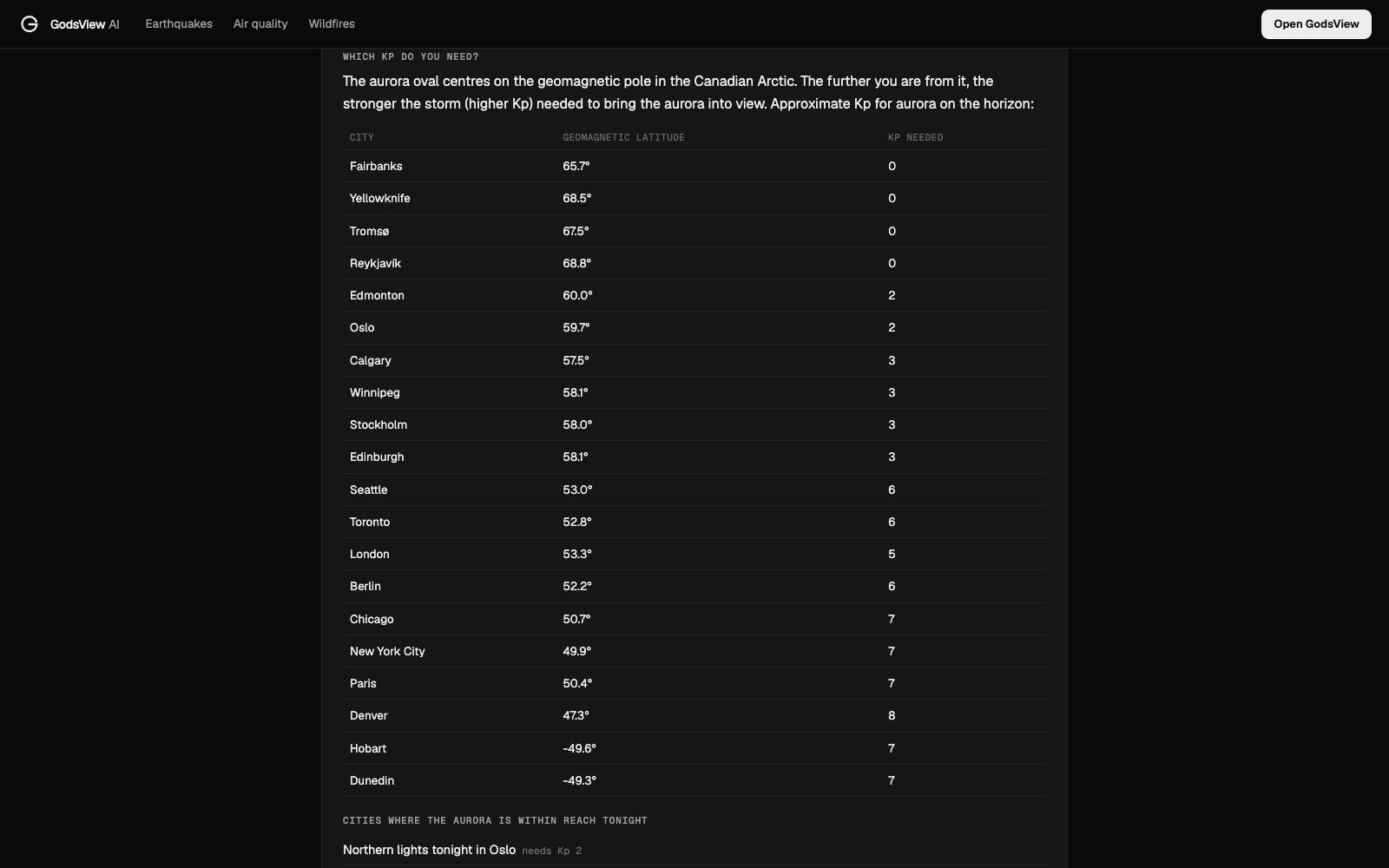
Those are estimates for aurora low on the poleward horizon. GodsView's city pages suggest about two more Kp for a display high in the sky.
How to read Kp decimals like 4.67 and 5.33
Forecast tables are full of numbers like 2.33, 3.67 and 5.33. They aren't precise measurements. Kp is reported in thirds. GFZ's data format explains the steps this way: a value of 27 "means 2 and 2/3 or 3-", 30 means "3 exactly" and 33 "means 3 and 1/3 or 3+" (GFZ).
So when you see:
- 4.67, read it as 5-, the bottom edge of a G1 storm.
- 5.00 is 5o, a G1 storm.
- 5.33 is 5+, still G1, nudging toward G2.
NOAA's mapping to storm levels puts Kp 8 and 9- in G4, and only 9o in G5 (NOAA SWPC). In practice, the difference between 4.67 and 5.33 is small. Treat a third of a Kp as noise, not a reason to stay home.
How to read a 3-day Kp forecast
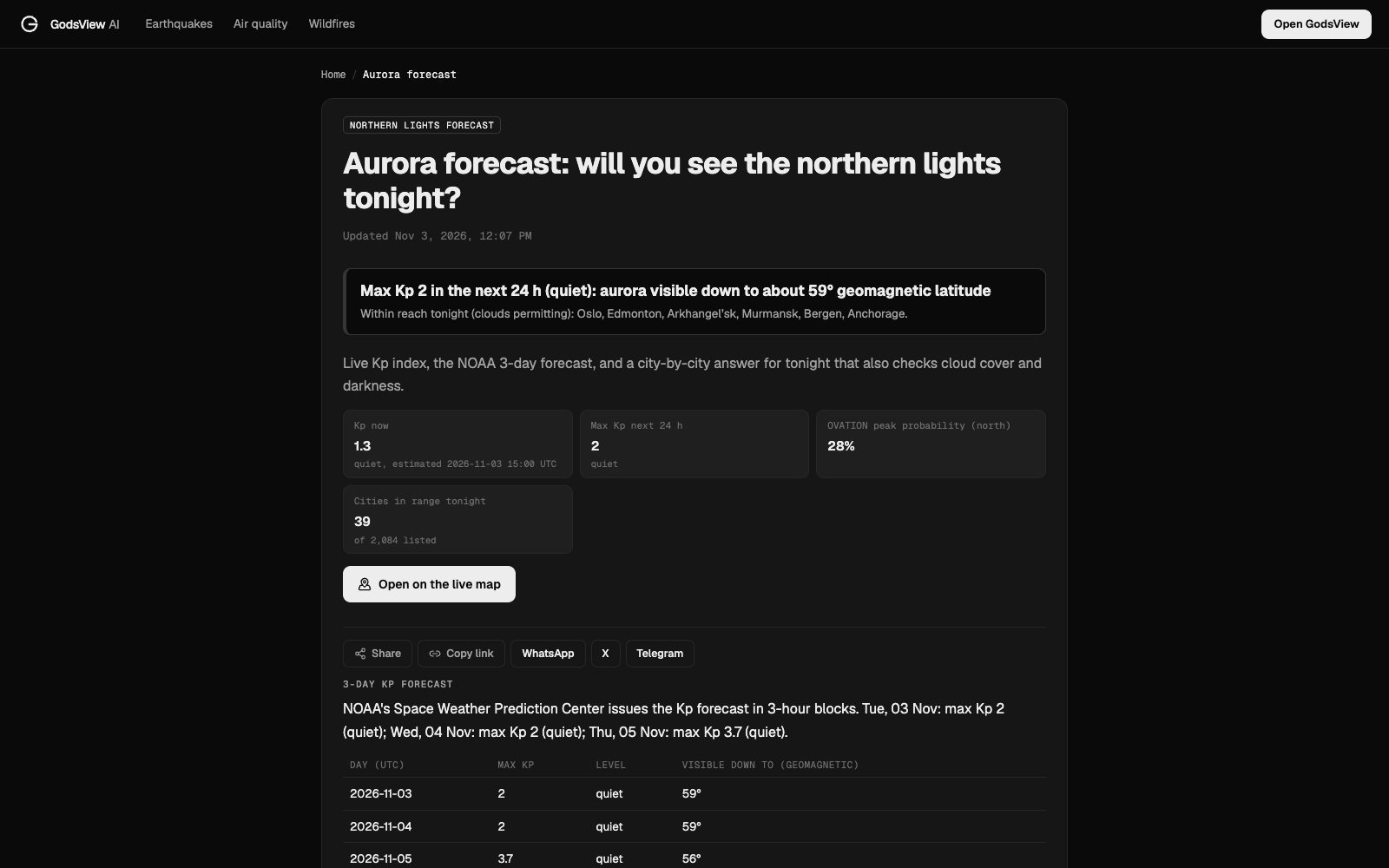
NOAA publishes a Kp forecast in three-hour blocks for the next three days. On GodsView, the top of the aurora forecast page turns that into a one-line answer and a table.
A few habits make the forecast more useful:
- Look at the night, not the day. A day's maximum Kp may fall in daylight where you are. The blocks are in UTC, so convert them to local time.
- Trust tonight more than the day after tomorrow. As the GodsView forecast notes, storms are set off by solar eruptions that take one to three days to arrive, so forecasts beyond 24 hours are uncertain.
- Watch the short-range model too. GodsView also shows the probability of aurora from NOAA's OVATION model, which looks about 30 to 90 minutes ahead, on the hub and on each city page.
The three other things you need
A Kp 7 storm under thick cloud is invisible. NOAA's viewing tips put the other conditions simply: "Go out at night. Get away from city lights" (NOAA SWPC).
- Darkness. NOAA says the best aurora is usually "within an hour or two of midnight (between 10 PM and 2 AM local time)." Full moonlight also washes out faint displays. High-latitude summers have almost no dark sky at all, which is why aurora season runs roughly autumn to spring in the north.
- Clear sky. Cloud hides even a strong display. Check the cloud forecast for the hours after dark, not the daily average.
- A view toward the pole. NOAA advises finding a place "where you can see to the north (or south if you are in the southern hemisphere)", ideally from a hilltop. At mid-latitudes the aurora sits low on the horizon, so trees and buildings to the north can hide it.
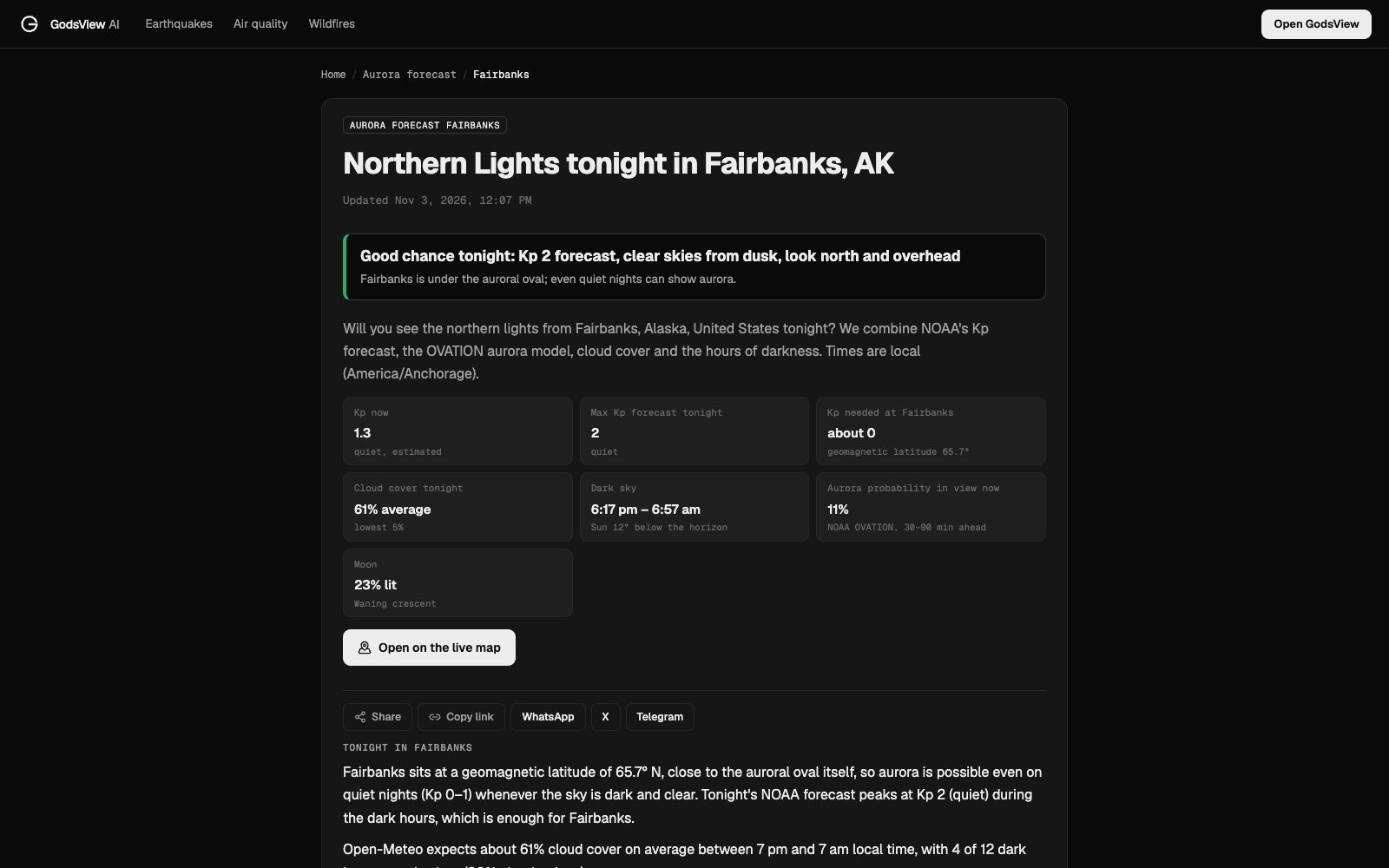
GodsView's city pages combine all four checks. The Fairbanks page below shows Kp now, the maximum forecast tonight, the Kp Fairbanks needs, average cloud cover, the dark hours (when the Sun is 12° below the horizon), the OVATION probability and the Moon.
What Kp 3, Kp 5 and Kp 7 look like from the ground
Here is how to read the common numbers, using NOAA's scale and GodsView's city estimates together:
- Kp 0 to 2. No storm. In GodsView's table, only places under the oval itself, such as Fairbanks, Yellowknife, Tromsø and Reykjavík, plus Oslo and Edmonton at Kp 2, are in range.
- Kp 3 to 4. Still below storm level. Edinburgh, Stockholm, Calgary and Winnipeg come into range at about Kp 3.
- Kp 5 to 6 (G1 to G2 storm). NOAA says G1 aurora is commonly visible in northern Michigan and Maine, and G2 aurora has been seen as low as New York and Idaho. GodsView's estimates put London at Kp 5 and Seattle, Toronto and Berlin at Kp 6.
- Kp 7 and up (G3 or stronger). NOAA's scale shows sightings as far south as Illinois and Oregon at Kp 7 and Alabama at Kp 8. These storms are rare: NOAA lists about 200 G3 storms per solar cycle, 100 G4s and only 4 G5s.
Where to go once the numbers line up
If the forecast reaches the Kp your town needs, the sky is clear and it is dark, head away from streetlights to a spot with an open view north, and check the forecast again before you leave, because Kp can change within a few hours.
While you wait, the same sky has other things to watch. The ISS tracker tells you when the space station passes over, and What's overhead lists satellite passes visible from your location tonight. The live satellite tracker and the guide to how satellite tracking works explain how those times are worked out.
If you'd like a warning before a storm rather than a forecast to check, set up My places for the hazards near home, and keep the aurora forecast page bookmarked for the nights that matter.
Frequently asked questions
What Kp index do I need to see the northern lights?
It depends on your geomagnetic latitude. Near the Arctic Circle Kp 0 to 2 is enough. Scotland and southern Scandinavia usually need Kp 3. London, Seattle and Berlin need about Kp 5 to 6, and Chicago, New York and Paris about Kp 7. The aurora forecast page shows the estimate for your city.
Is Kp 5 good for the northern lights?
Kp 5 is a G1 geomagnetic storm. NOAA says aurora is then commonly visible at high latitudes such as northern Michigan and Maine. It is a good night anywhere in Alaska, Canada, Iceland and Scandinavia.
What does Kp 4.67 mean?
Kp is reported in thirds. 4.67 is written 5-, the bottom of the Kp 5 band, and 5.33 is 5+. Treat a third of a point as noise.
What time is best to see the aurora?
NOAA says the best aurora is usually within an hour or two of midnight, between about 10 PM and 2 AM local time, on a dark, clear night away from city lights.
Can I see the northern lights with Kp 3?
Yes, if you are far enough north: Kp 3 is about what Edinburgh, Stockholm, Calgary and Winnipeg need for aurora on the horizon. Further south you need a stronger storm.
How accurate is the Kp forecast?
The next few hours are the most reliable. Forecasts one to three days ahead are uncertain because storms are triggered by solar eruptions whose strength is hard to judge until the solar wind reaches Earth.
Sources
- NOAA Space Weather Prediction Center: Planetary K-index
- NOAA Space Weather Prediction Center: Space weather scales (G1 to G5)
- NOAA Space Weather Prediction Center: Tips on viewing the aurora
- GFZ Potsdam: About the Kp index
- GFZ Potsdam: Format documentation of Kp data files (scale of thirds)
Facts checked on against each provider's own site.