Explainer
Solar Flares and Geomagnetic Storms Explained: R, S and G Scales
Space weather alerts come in letters and numbers: an X-class flare, an R3 blackout, a G4 storm, Kp 8. What each one means, what it can and can't affect, and how to check conditions today.
Key takeaways
- A solar flare is a burst of light and X-rays. It reaches Earth at the speed of light and can black out HF radio on the sunlit side for minutes to hours.
- A coronal mass ejection (CME) is a cloud of solar plasma. When one hits Earth, it can cause a geomagnetic storm, rated G1 to G5 and tied to the Kp index.
- NOAA rates radio blackouts (R1 to R5), solar radiation storms (S1 to S5) and geomagnetic storms (G1 to G5).
- Storms can degrade GPS accuracy, stress power grids, add drag to low satellites and push the aurora far from the poles.
- NASA says flare radiation does not physically affect people on the ground, because Earth's atmosphere and magnetic field shield us.
A solar flare is a sudden flash of light and X-rays from the Sun; a geomagnetic storm is a disturbance of Earth's magnetic field, usually caused by a coronal mass ejection (CME) arriving one to several days later. Flares can black out high-frequency radio on the daylit side of Earth within minutes. Storms can degrade GPS, stress power grids, drag down low satellites and bring the northern lights far south. Neither can hurt you on the ground: NASA says Earth's atmosphere and magnetic field shield us from flare radiation.
What is a solar flare?
NOAA describes solar flares as large eruptions of electromagnetic radiation from the Sun lasting from minutes to hours (NOAA SWPC). Because that energy travels at the speed of light, the effect on Earth's sunlit side starts the moment the flare is seen. There's no warning time once a flare begins.
A flare is light, not matter. NASA says its harmful radiation "does not physically affect us on the ground" (NASA). What it affects is the ionosphere, the charged upper layer of the atmosphere that radio signals pass through or bounce off.
Flare classes: A, B, C, M and X
Flares are classed by peak X-ray brightness, measured by NOAA's GOES satellites. The scale starts at A (from 10⁻⁸ watts per square meter), and each letter after it is ten times stronger: B, C, M and X (10⁻⁴ W/m² and above). The number is a multiplier (an X2 is twice an X1), and X has no upper limit: the strongest flare ever measured, in 2003, was recorded as an X28 before the sensors were overwhelmed (NASA).
A, B and C flares have no noticeable effect at Earth. Radio blackouts start at M1.
Was there a solar flare today?
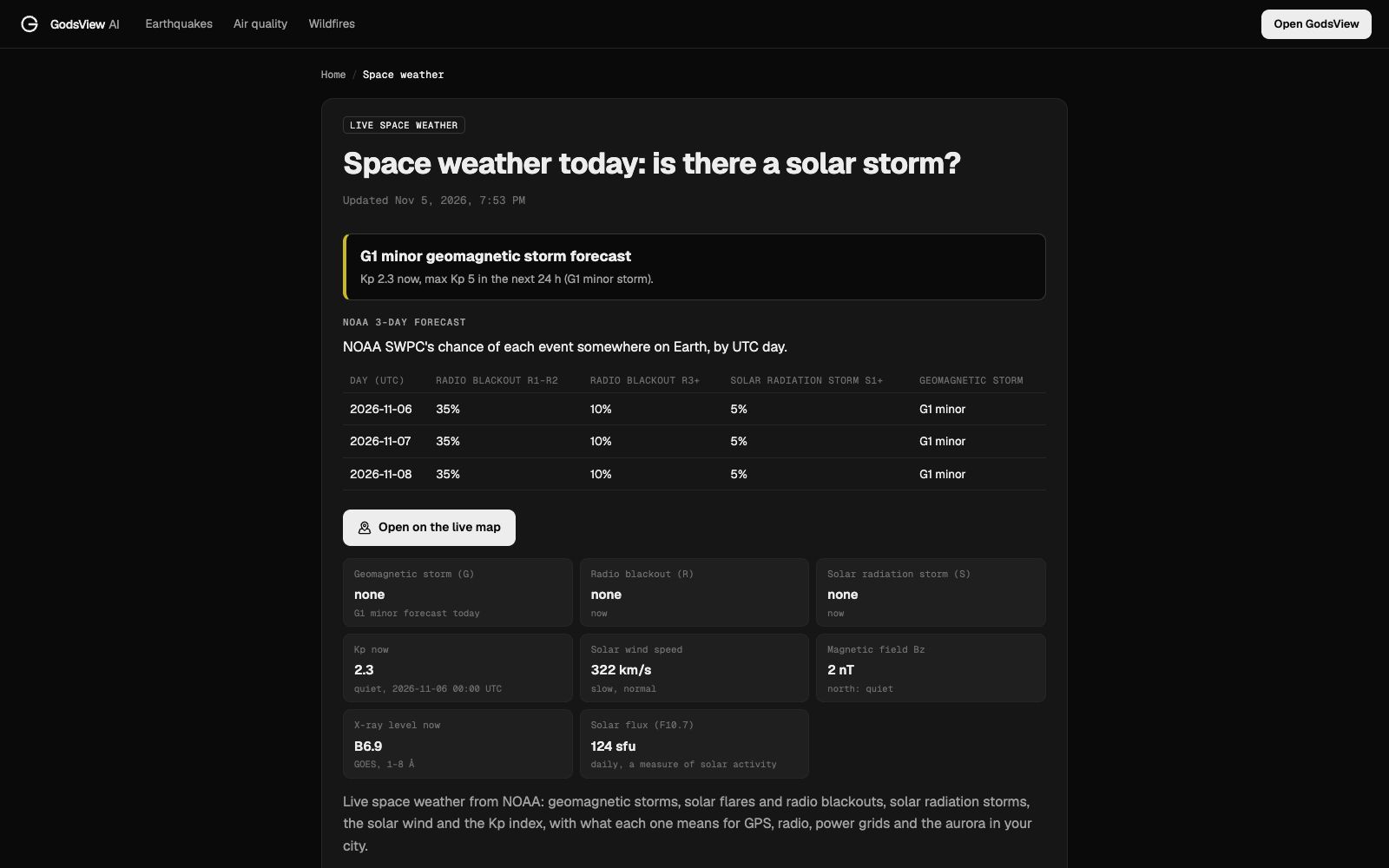
When we checked our space weather page just before 01:00 UTC on November 6, 2026 (the evening of November 5 in North America), NOAA's GOES data showed 40 flares in the previous 7 days. Only one was M-class or stronger: an M3.5 that peaked at 18:33 UTC on November 5 and caused an R1 minor radio blackout. The X-ray level had dropped back to the B class, Kp was 2.3 (quiet), and the solar wind was slow at about 318 km/s.
For each of November 6 to 8, NOAA's 3-day forecast gave a 35% chance of R1 to R2 blackouts, 10% for R3 or stronger, 5% for a radiation storm, and a G1 minor storm.
What is a CME, and how does it cause a geomagnetic storm?
A coronal mass ejection is, in NASA's words, "an enormous cloud of electrically charged gas, called plasma, that erupts from the Sun". Flares and CMEs often come together, but the flare is the flash and the CME is the cloud.
NOAA says CMEs leave the Sun at anything from under 250 km/s to nearly 3,000 km/s. The fastest Earth-directed ones arrive in as little as 15 to 18 hours; slower ones take several days (NOAA SWPC). That delay is why storms can be forecast and flare effects can't.
Storm strength depends heavily on the CME's magnetic field. When it points south (a negative Bz) for a long time, it couples with Earth's field and pours energy in; a fast CME with a northward field can pass with little effect.
How is a geomagnetic storm measured? Kp and the G scale
The Kp index is a 0 to 9 measure of how disturbed Earth's magnetic field is in each three-hour period. NOAA's G scale maps onto it: G1 is Kp 5, G2 is Kp 6, G3 is Kp 7, G4 is Kp 8 (including 9-), and G5 is Kp 9. Our guide to what Kp index you need to see the northern lights covers the decimal values apps show.
What do the NOAA R, S and G levels mean?
The measure, main effects and average frequency below come from NOAA's scales explanation. Frequency is per 11-year solar cycle.
| Level | Radio blackout (R) | Solar radiation storm (S) | Geomagnetic storm (G) |
|---|---|---|---|
| 1 Minor | R1: M1 flare. Weak HF degradation on the sunlit side, about 2,000 per cycle | S1: 10 pfu. Minor HF impacts in polar regions, about 50 per cycle | G1: Kp 5. Weak grid fluctuations, aurora at high latitudes, about 1,700 per cycle |
| 2 Moderate | R2: M5. Limited HF blackout for tens of minutes, about 350 per cycle | S2: 100 pfu. Elevated radiation risk for high-flying crew and passengers at high latitudes, about 25 per cycle | G2: Kp 6. Voltage alarms in high-latitude grids, aurora to New York and Idaho, about 600 per cycle |
| 3 Strong | R3: X1. Wide HF blackout, radio contact lost for about an hour, about 175 per cycle | S3: 1,000 pfu. Satellite single-event upsets likely, about 10 per cycle | G3: Kp 7. Intermittent satellite navigation problems, aurora to Illinois and Oregon, about 200 per cycle |
| 4 Severe | R4: X10. HF blackout on most of the sunlit side for one to two hours, about 8 per cycle | S4: 10,000 pfu. Increased navigation errors over several days likely, about 3 per cycle | G4: Kp 8. Possible voltage control problems, satellite navigation degraded for hours, about 100 per cycle |
| 5 Extreme | R5: X20. Complete HF blackout on the sunlit side for hours, less than 1 per cycle | S5: 100,000 pfu. Satellites may be rendered useless, fewer than 1 per cycle | G5: Kp 9. Possible widespread grid problems, aurora as far south as Florida, about 4 per cycle |
pfu = particle flux units, the flux of protons above 10 MeV measured by GOES.
G1 storms and R1 blackouts happen hundreds of times a cycle; R5 and S5 less than once. Solar radiation storms (S) are surges of high-energy protons that matter mostly for astronauts, satellite electronics and, from S2, people on high-flying aircraft at high latitudes.
What do solar storms affect on Earth?
HF radio, and why only the sunlit side
During a flare, extra X-rays thicken the lowest layer of the ionosphere, the D layer, and NOAA explains that HF signals passing through it lose energy or are completely absorbed. This happens only on the side of Earth facing the Sun.
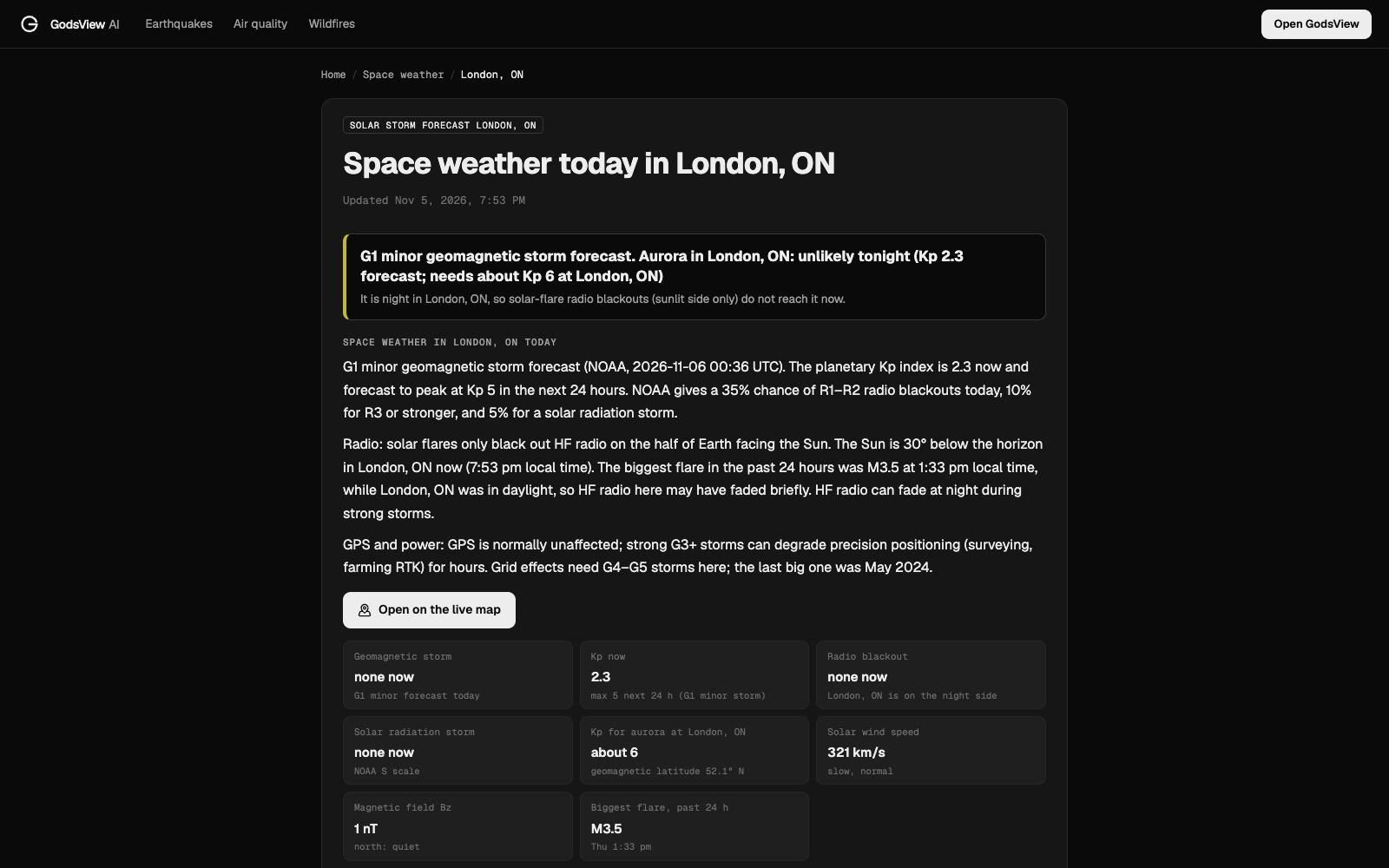
Our London, Ontario page showed why timing matters. The November 5 M3.5 flare peaked at 1:33 pm local time, in daylight, so the page said HF radio there may have faded briefly. By 7:59 pm the Sun was 31° below the horizon and the city was out of reach of any new flare blackout.
Do solar flares affect GPS?
Sometimes, but geomagnetic storms are the bigger issue. NOAA notes that solar radio bursts can interfere with GPS signals (NOAA). The ionosphere bends GPS signals like a lens, and in severe storms a phone that's normally accurate to a meter or better can be off by "tens of meters or more", and centimeter-level systems can lose lock (NOAA SWPC). The worst disturbances are usually at high latitudes.
Deliberate interference is a different problem; see GPS jamming and spoofing explained and the GPS jamming map.
Power grids
A storm induces currents in long conductors such as power lines and pipelines. NOAA says extreme storms can damage high-voltage transformers, with repairs taking days, weeks or longer, and ESA says the worst cases can cause blackouts (ESA). High-latitude grids are most exposed.
Satellites and polar flights
Storms heat and expand the upper atmosphere, adding drag on low-orbit satellites, one reason orbits on the live satellite tracker need fresh data (how satellite tracking works). During significant radiation storms, NOAA says airlines may suspend transpolar flights.
Aurora
The upside is the aurora. NOAA's G scale says it can reach Illinois and Oregon at G3, and Florida at G5. Check the aurora forecast or a city such as Oslo when a storm is due. Our London, Ontario page said the city needs about Kp 6, so the forecast Kp 5 peak would leave the aurora's visible edge about 131 km north of it.
What were the biggest solar storms?
- September 1859, the Carrington Event. The storm after a flare Richard Carrington saw from Redhill, England is the strongest on record; NOAA says telegraph sparks set paper alight and the aurora reached the Caribbean (NOAA Research).
- March 13, 1989, Quebec. At 2:44 a.m., Hydro-Québec's grid protection tripped; the province went dark in under a minute and stayed dark for more than nine hours (Hydro-Québec). USGS rates it more severe than May 2024.
- February 2022, Starlink. A storm the day after a launch into a low orbit (perigee about 210 km) raised drag up to 50 percent above previous launches, SpaceX said, and up to 40 of 49 new satellites re-entered (Spaceflight Now).
- May 10, 2024, G5. The first G5 since October 31, 2003 disrupted satellite operations, GPS and radio, with aurora across much of the continental US (USGS).
Where is solar cycle 25 now?
Solar Cycle 25 began in December 2019, NASA says, and on October 15, 2024, NASA and NOAA announced the solar maximum period (NASA). Its biggest flare so far was an X9.0 on October 3, 2024. In 2025, the Royal Observatory of Belgium's SILSO center confirmed the smoothed sunspot number peaked at 161 in October 2024 and the cycle is now declining (STCE). Declining doesn't mean quiet: strong flares still happen in the years after a maximum.
How do you check solar flares and storms for your city?
The free GodsView space weather page shows NOAA's R, S and G levels, the past week's flares, solar wind, Bz and the 3-day forecast, all from NOAA SWPC. City pages, such as London, Ontario or Tokyo, add whether the city is on the sunlit side, how exposed it is to GPS, HF and grid effects by geomagnetic latitude, and its aurora chance tonight. Sources are on the methodology page, and the same views are in the free GodsView AI iPhone app.
Check space weather for your city
Frequently asked questions
Can a solar flare hurt people on Earth?
No. NASA says harmful radiation from a flare does not physically affect people on the ground, because Earth's atmosphere and magnetic field shield us. The effects are on technology: HF radio, satellite navigation, satellites and, in big storms, power grids.
Do solar flares affect GPS?
They can, but geomagnetic storms matter more. NOAA notes that solar radio bursts can interfere with GPS signals, and in severe storms errors for phone-type receivers can grow from about a meter to tens of meters or more.
What is an X-class flare?
X is the strongest flare class, for peak X-ray flux of 10⁻⁴ watts per square meter or more, ten times an M-class flare. An X1 causes an R3 strong radio blackout on NOAA's scale, and an X10 an R4. The largest flare of Solar Cycle 25 so far was an X9.0 on October 3, 2024.
What do G1 to G5 mean?
They are NOAA's geomagnetic storm levels, tied to the Kp index: G1 is Kp 5 (minor), G2 is Kp 6, G3 is Kp 7, G4 is Kp 8 and G5 is Kp 9 (extreme). NOAA says G1 storms happen about 1,700 times per 11-year cycle and G5 storms about 4 times.
How long after a solar flare does a storm hit Earth?
A storm usually arrives one to several days later, if the flare came with an Earth-directed CME. NOAA says a very fast CME can arrive in 15 to 18 hours. The flare's own radio effects start immediately, because its light travels at the speed of light.
Where can I see if there is a solar flare today?
The GodsView space weather page lists the past week's flares, the current NOAA R, S and G levels and the 3-day forecast, using NOAA SWPC data. City pages show whether a place is on the sunlit side for flare radio blackouts and its aurora chance tonight.
Sources
- NOAA SWPC: NOAA space weather scales
- NOAA SWPC: Solar flares (radio blackouts)
- NOAA SWPC: Coronal mass ejections
- NOAA SWPC: Space weather and GPS systems
- NOAA: Space weather: storms from the Sun
- NASA: Solar storms and flares
- NASA: NASA, NOAA: Sun reaches maximum phase in 11-year solar cycle (October 15, 2024)
- ESA: Space weather and its hazards
- USGS: Space weather events of May 10, 2024
- Hydro-Québec: The March 1989 solar storm blackout
- NOAA Research: The serendipitous discovery of solar flares (Carrington 1859)
- Spaceflight Now: Solar storm dooms up to 40 new Starlink satellites
- STCE / SILSO: Solar Cycle 25 reached its maximum in October 2024
Facts checked on against each provider's own site.