How-to
Why Is a Helicopter Circling My House? How to Find Out
The thud of rotors that won't go away is one of the most searched sounds on the internet. Here is how to find the helicopter on a live map, read what kind it is, and know when the map can't help.
Key takeaways
- A helicopter circling one area is usually watching something: a police search, an emergency, a news story, or a survey or inspection job.
- If it broadcasts ADS-B, a live map shows its registration, type, height and how long it has been circling. GodsView city pages call out helicopters and anything circling.
- Many helicopters fly under visual flight rules without a flight plan, so there is often no public record of why they were there.
- US rules let helicopters fly lower than planes over towns, and the FAA does not restrict hovering, as long as they do it without hazard to people or property.
- For the reason behind a police flight, check the local police force's channels. For noise, the FAA says to contact the helicopter operator directly.
A helicopter circling near your house is almost always working over one spot. The usual reasons are a police search or pursuit, an air ambulance waiting to land, a news crew filming a fire or accident, or a survey or inspection job. You can often find out which in under a minute by looking it up on a live flight map, because most civil helicopters broadcast their position by ADS-B.
Not every helicopter shows up, though, and the map can't tell you why it is there. This guide shows what you can learn, what you can't, and who to ask.
See helicopters over your city
Step 1: find the helicopter on a live map
The fastest check is What's overhead. Share your location and it lists every aircraft within 60 km, closest first, with the direction to look and how high above the horizon it is. A helicopter low over your street will be near the top with a low altitude.
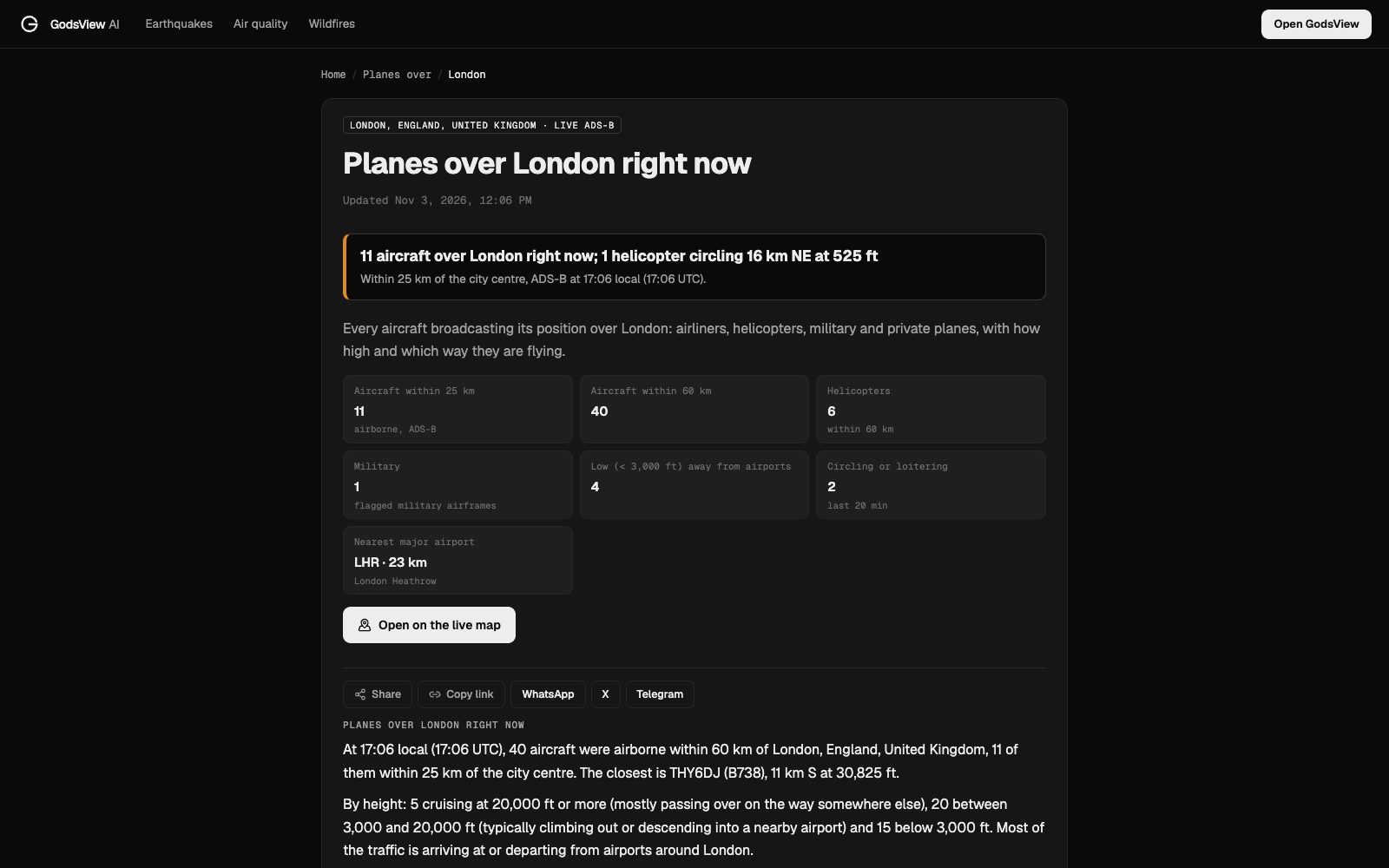
For a fuller picture, open your city on planes over. Each city page has a section called Helicopters, military and low planes, and another called Is a plane circling. On the London page on November 3, 2026, the summary read "11 aircraft over London right now; 1 helicopter circling 16 km NE at 525 ft".
Step 2: read what kind of helicopter it is
Scroll to the helicopter list. Each row gives the callsign or registration, the aircraft type code, the distance and direction from the city centre and the altitude. Rows marked circling are the ones that have stayed over one area.
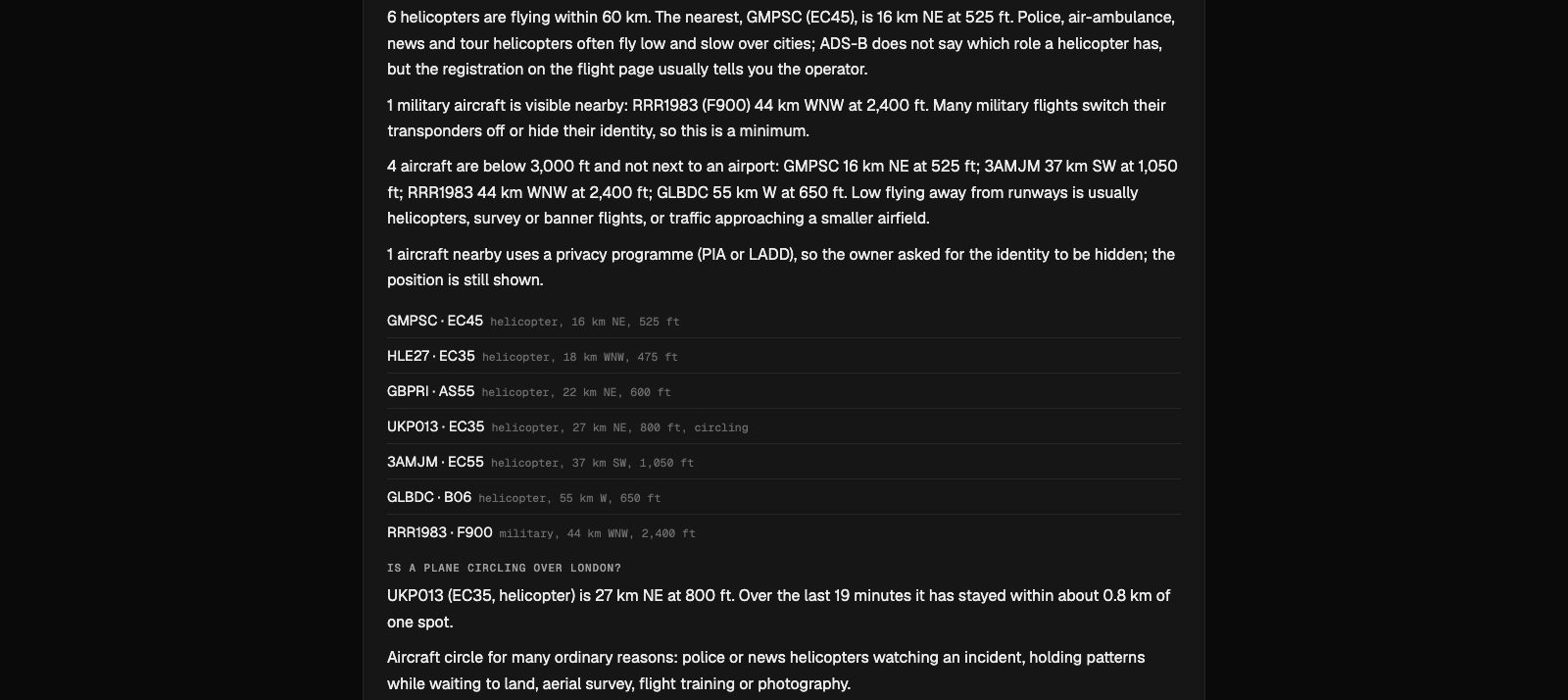
In that list, one helicopter, an EC35, had "stayed within about 0.8 km of one spot" for 19 minutes at 800 ft. That is what a helicopter watching a scene looks like in the data.
Three fields help you work out who it is:
| What you see | What it tells you | How to use it |
|---|---|---|
| Registration (for example a G- or N- number) | The specific aircraft | Look it up in the national aircraft register to find the operator |
| Callsign | Who is flying it, if it is not just the registration | Some operators use their own callsign prefix |
| Type code (EC35, AS55, B06, R22) | The model | Search the code to see what size and kind of helicopter it is |
| Altitude and circling time | How long it has been working over one spot | A long, tight orbit means it is watching something |
GodsView's own page puts it plainly: "ADS-B does not say which role a helicopter has, but the registration on the flight page usually tells you the operator." The register lookup is the step that turns "a helicopter" into "the county air ambulance" or "a TV station".
Common reasons a helicopter circles
Police. A police helicopter circles to keep its camera on a person, a car or a building while officers on the ground move in. In England and Wales, police air support comes from the National Police Air Service (NPAS). Its FAQ says aircraft are deployed "when necessary, including at night", that crews use thermal imaging, and that "they fly higher at night to reduce noise" (NPAS).
Medical. Air ambulances may orbit while a landing site near a road accident is made safe, or while waiting for a hospital helipad to clear.
News. TV helicopters circle over fires, floods, protests and traffic to film them.
Survey and inspection. Utility companies inspect power lines and pipelines from helicopters, and film crews and photographers hire them for aerial shots.
Training. Small helicopters practise hovering and circuits near airfields and heliports, just as planes do.
Tours and transport. Over some cities, sightseeing and charter helicopters fly regular routes.
If what you're seeing is a plane rather than a helicopter, the reasons are different: holding patterns, flight training and fuel dumping are covered in why is a plane circling.
Why the helicopter might not be on the map
You can hear it, you can see it, and the map shows nothing. That happens a lot with helicopters, for a few reasons.
- It doesn't broadcast, or has it switched off. GodsView's city pages say that if you can hear a helicopter that isn't listed, "it may be a police or military helicopter that does not transmit ADS-B." Military aircraft in particular often fly without broadcasting.
- It's too low for the receivers. Public flight maps rely on volunteer receivers. A helicopter at a few hundred feet between buildings or hills can drop out of their line of sight.
- Its identity is hidden. In the US, owners can ask for their aircraft to be kept off public data through the FAA's LADD programme (FAA LADD), and some use privacy addresses. You may see a position without a name. The London list above notes one aircraft using such a programme.
The military aircraft tracking guide and is flight tracking legal go deeper into what is and isn't broadcast.
Why helicopters can fly so low over houses
People often ask whether a helicopter is allowed to circle that low. In the US, the general rule for aircraft over a congested area is 1,000 ft above the highest obstacle within 2,000 ft. Helicopters have an exception. They "may be operated at less than the minimums" if the flight is "conducted without hazard to persons or property on the surface" and they follow any routes or altitudes the FAA has set for helicopters (14 CFR 91.119).
The FAA's noise page adds two points that answer most complaints. Helicopters "generally fly under visual flight rules (VFR) in which case they are not required to file a flight plan", so "historical flight track data is often not available". And "the FAA does not have restrictions that prevent helicopters from hovering" (FAA).
In other words, a low, circling helicopter is usually legal. What matters is whether it is flying safely.
Who to ask about a circling helicopter
The map tells you what and where. For why, go to the people who sent it.
- Police activity. NPAS says its flights are "tactical and directed by local police forces" and that "some forces may share information via their social media channels" (NPAS). Check your local police force's accounts and website.
- News coverage. If a TV helicopter is circling, the station is probably streaming the pictures. Local news sites and the live news map are worth a look.
- Noise. The FAA says: "For information about specific helicopter operations, contact the helicopter operator directly." It also runs an online noise complaint portal (FAA).
- Safety. If you think a helicopter is flying unsafely, the FAA asks you to report it to your local Flight Standards District Office. Noise from low-flying aircraft on its own is not treated as a safety issue.
Helicopter circling at night
At night you can't see the markings, so the map is your best tool. Check three things:
- Height and type. The map shows both even when you can only see lights. NPAS says its crews fly higher at night to cut noise.
- No searchlight. NPAS says its crews use thermal imaging, so a helicopter doesn't need a light to be searching.
- How long. The circling note on a city page says how many minutes the helicopter has stayed near one spot. A long, tight orbit means it is watching something on the ground.
If something serious is happening near home, such as a fire, a flood or a storm, the map can show you that too. The live wildfire map and weather radar cover the most common causes of a busy sky.
Make it a habit, not a scare
A circling helicopter is noisy, but it is rarely a reason to worry about your own street. If you want to know when something unusual really does happen near home, add your address to My places. It watches for earthquakes, severe weather warnings, floods, wildfires and bad air within 50 km. And next time you hear rotors, open the overhead page before you start guessing.
Frequently asked questions
Why is a helicopter circling my house right now?
Usually it is a police, air ambulance, news or survey helicopter working over one spot. Open What's overhead or your city on planes over to see its registration, type, height and how long it has been circling.
How can I tell if it is a police helicopter?
Look up the registration from the flight page in the national aircraft register to find the operator. For the reason behind the flight, check your local police force's website and social media.
Why is the helicopter not on any flight tracker?
It may not broadcast ADS-B, it may be flying too low for nearby receivers, or its identity may be hidden through a privacy programme. Police and military helicopters are the most common gaps.
Is a helicopter allowed to circle that low over houses?
In the US, helicopters may fly below the minimum heights that apply to planes if they do so without hazard to people or property, and the FAA does not restrict hovering.
Who do I complain to about helicopter noise?
The FAA advises contacting the helicopter operator directly. You can also file a concern through the FAA noise portal. Unsafe flying should be reported to your local FAA Flight Standards District Office.
Why do police helicopters circle at night?
They are usually supporting an incident on the ground, such as a search or pursuit. NPAS says its crews use thermal imaging and fly higher at night to reduce noise.
Sources
- FAA: Who should I contact with my noise concern? (helicopters and low-flying aircraft)
- 14 CFR 91.119: Minimum safe altitudes
- National Police Air Service: Frequently asked questions
- FAA: Limiting Aircraft Data Displayed (LADD)
Facts checked on against each provider's own site.