Guide
Is Flight and Ship Tracking Legal? What to Know
Aircraft and ships broadcast their positions by design, and viewing public tracking sites is widely done. The legal questions start with how you collect, combine and use that data, especially about people.
Key takeaways
- ADS-B and AIS are broadcast on purpose so that others can see aircraft and ships; regulators require them for safety.
- In the US, the FAA offers two privacy programs: LADD limits FAA-fed data on tracking sites, and PIA assigns an alternate ICAO address.
- Radio reception, privacy, data protection and harassment laws differ by country, and the UK and EU have rules worth knowing.
- Using tracking data to follow, intimidate or expose a private person can be unlawful anywhere; this article is not legal advice.
In most places, looking at public flight and ship tracking websites is a common, openly practiced activity, because aircraft and ships broadcast their positions on purpose for safety. The harder legal questions are about what you do with the data: operating your own radio receiver in some countries, combining positions with personal information, and using tracking to follow, harass or expose a person.
Below you will find why aircraft and ships broadcast at all, the US privacy programs that limit what tracking sites show, the main legal frameworks in the US, EU and UK, and a practical set of responsible-use rules.
Why can anyone see aircraft and ships?
Because regulators require them to broadcast. Tracking websites mostly repackage signals that were designed to be received by anyone nearby.
Aircraft: ADS-B Out
In the US, 14 CFR 91.225 has required ADS-B Out since January 1, 2020 for aircraft in Class A, B and C airspace, in Class E airspace at and above 10,000 feet MSL over the 48 contiguous states (excluding airspace at and below 2,500 feet above the surface), within 30 nautical miles of listed major airports, and in certain other areas. In Europe, Commission Implementing Regulation (EU) No 1207/2011 requires ADS-B Out on aircraft with a maximum take-off mass above 5,700 kg or a maximum cruising true airspeed above 250 knots (EASA).
Each transmission carries the aircraft's 24-bit ICAO address plus position, altitude and velocity. The FAA states plainly that this makes identification "possible by any individual with an ADS-B receiver" (FAA ADS-B Privacy). Our explainer on how ADS-B flight tracking works covers the technical side.
Ships: AIS
Under SOLAS chapter V, the IMO requires AIS on all ships of 300 gross tonnage and upwards on international voyages, cargo ships of 500 gross tonnage and upwards not on international voyages, and all passenger ships regardless of size. AIS broadcasts identity, type, position, course, speed and navigational status to other ships and to shore stations. See what is AIS ship tracking? for message types and classes.
| System | Who must carry it | What it broadcasts | Main privacy control |
|---|---|---|---|
| ADS-B Out (US) | Aircraft in specified airspace since Jan 1, 2020 (14 CFR 91.225) | ICAO address, position, altitude, velocity, flight ID | FAA LADD and PIA programs |
| ADS-B Out (EU) | Larger or faster aircraft under Reg. (EU) 1207/2011 | Same as above | Varies; no direct equivalent covered here |
| AIS (SOLAS) | Ships of 300 GT+ international, 500 GT+ cargo domestic, all passenger ships | MMSI, name, type, position, course, speed, status | Limited; flag state exemptions and security provisions |
What are the FAA LADD and PIA programs?
The US has two formal programs that let aircraft owners limit how easily their flights are tracked. They work very differently.
LADD: Limiting Aircraft Data Displayed
The LADD program implements Section 803 of the FAA Reauthorization Act of 2024. It lets aircraft owners have their flight data filtered from the FAA's System Wide Information Management (SWIM) feed, or filtered from public display by websites that participate in the program. Vendors that subscribe to FAA SWIM data are bound by a Data Access User Agreement to filter LADD participants from public display.
Owners can choose FAA Source (data limited to FAA use only) or Subscriber Level (data reaches vendors, who show it only to parties the owner authorizes). The FAA applies changes on the first Thursday of each month.
LADD governs data that flows from FAA systems to participating vendors. It does not change what an aircraft broadcasts over the air, which is why receiver-based networks can still pick up the signal. Whether a given site applies LADD filtering depends on that site's own sources and policies.
PIA: Privacy ICAO Address
The PIA program gives eligible owners an alternate, temporary ICAO address that is not assigned to them in the Civil Aircraft Registry. To qualify, an aircraft must be US-registered, 1090 MHz ADS-B equipped, use a third-party call sign, and fly in US-managed flight information regions. The FAA can still identify the aircraft and operator when needed for security requests from the Department of Defense, Department of Homeland Security or law enforcement.
PIA reduces how quickly someone can link a broadcast to a registered owner. It does not make the aircraft invisible on trackers, because the aircraft still broadcasts its position under the alternate address.
| Program | What it does | What it does not do |
|---|---|---|
| LADD (FAA Source) | Keeps FAA flight data for the aircraft out of feeds to external vendors | Stop over-the-air ADS-B broadcasts |
| LADD (Subscriber Level) | Vendors receive data but restrict public display | Apply to sites outside the program |
| PIA | Replaces the publicly registered ICAO address with an alternate one | Hide the aircraft's position or track |
Why some government and military aircraft appear on trackers while others do not is covered in military aircraft tracking explained.
Is flight tracking legal in the United States?
Viewing public flight tracking websites is widespread in the US, and the FAA itself acknowledges that ADS-B can be received by anyone with a receiver. Several federal laws are still relevant to how tracking data is collected and used.
- Radio communications. 47 U.S.C. § 605 restricts intercepting and divulging radio communications. The same section states that it does not apply to radio communications transmitted for the use of the general public or relating to ships, aircraft, vehicles or persons in distress. How that applies to a particular data source or use is a question for a lawyer.
- Stalking and harassment. 18 U.S.C. § 2261A makes it a federal crime to use electronic communication services or other facilities of interstate commerce to engage in a course of conduct that places someone under surveillance with intent to kill, injure, harass or intimidate them, when the conduct causes or would be expected to cause fear or substantial emotional distress. Many states have their own stalking and harassment laws.
- Terms of service. Tracking sites set their own rules on scraping, redistribution and commercial use. Breaking them can have contractual consequences even when the underlying data is public.
None of this is a definitive answer for your situation. It shows why "the data is public" is the start of the analysis, not the end.
Is flight and ship tracking legal in the EU and UK?
Europe adds two layers that matter for anyone collecting or publishing tracking data: data protection law and, in some countries, rules on receiving radio messages.
Data protection: GDPR and UK GDPR
The EU GDPR defines personal data as any information relating to an identified or identifiable person, and lists location data and identification numbers as examples of identifiers (GDPR Article 4). The UK GDPR uses the same definition, as the UK Information Commissioner's Office explains in its personal data guidance.
A commercial airliner's position is unlikely to identify a person on its own. A private aircraft or a small boat linked to a named owner is different: its movements can reveal where an identifiable person goes. The GDPR does not apply to processing by a person "in the course of a purely personal or household activity" (Article 2), but publishing, building databases, or doing it as part of a business can bring obligations into play.
UK radio reception rules
In the UK, section 48 of the Wireless Telegraphy Act 2006 makes it an offence, without lawful authority, to use wireless telegraphy apparatus with intent to obtain information about the contents, sender or addressee of a message of which you are not an intended recipient, or to disclose such information. If you plan to run your own receiver in the UK, or to share what it picks up, check the current Ofcom guidance and take advice on how that section applies to you. Using a website is a different activity from operating a receiver, but the safest course is to understand both.
Ships and the IMO position
At its 79th session in December 2004, the IMO's Maritime Safety Committee said publishing AIS data on the web could be detrimental to the safety and security of ships and port facilities, and urged member governments, subject to their national laws, to discourage it (IMO). That statement is a policy position, not a ban, and public AIS websites have operated for many years since. It is still a useful reminder of the security concerns behind ship positions.
| Jurisdiction | Key instruments to know | Main concern |
|---|---|---|
| United States | 14 CFR 91.225; FAA LADD and PIA; 47 U.S.C. § 605; 18 U.S.C. § 2261A | Radio interception rules, stalking and harassment |
| European Union | GDPR Articles 2 and 4; Reg. (EU) 1207/2011 | Personal data in movement records |
| United Kingdom | UK GDPR; Wireless Telegraphy Act 2006 s.48 | Personal data; receiving and disclosing radio messages |
| International (ships) | SOLAS chapter V; IMO MSC 79 statement on AIS publication | Ship and port security |
What counts as responsible flight and ship tracking?
Legal limits vary, but responsible-use principles are fairly consistent. These are the ones we recommend:
- Track aircraft and ships, not people. Following a cargo ship through a chokepoint or an airliner through a storm is very different from following a named private individual.
- Respect privacy programs. If an aircraft appears to use LADD or PIA, do not try to unmask the owner by combining other data.
- Do not publish live positions that could endanger anyone. That includes military operations, rescue flights, aid convoys, and vessels or aircraft carrying vulnerable people.
- Never use tracking to harass, intimidate or confront. Showing up at an arrival point, posting someone's movements to pressure them, or encouraging others to do so can be unlawful.
- Check terms of service before scraping, redistributing or using data commercially.
- Keep the uncertainty. Positions can be delayed, spoofed or wrong; treat them as evidence to verify, not proof.
- Leave emergencies to the authorities. If an aircraft squawks an emergency code or a vessel appears in distress, the relevant air traffic and coast guard services are already involved.
These principles echo the wider OSINT ethics covered in what is OSINT?, and journalists will find a newsroom version in using a live map for journalism.
How GodsView approaches tracking data
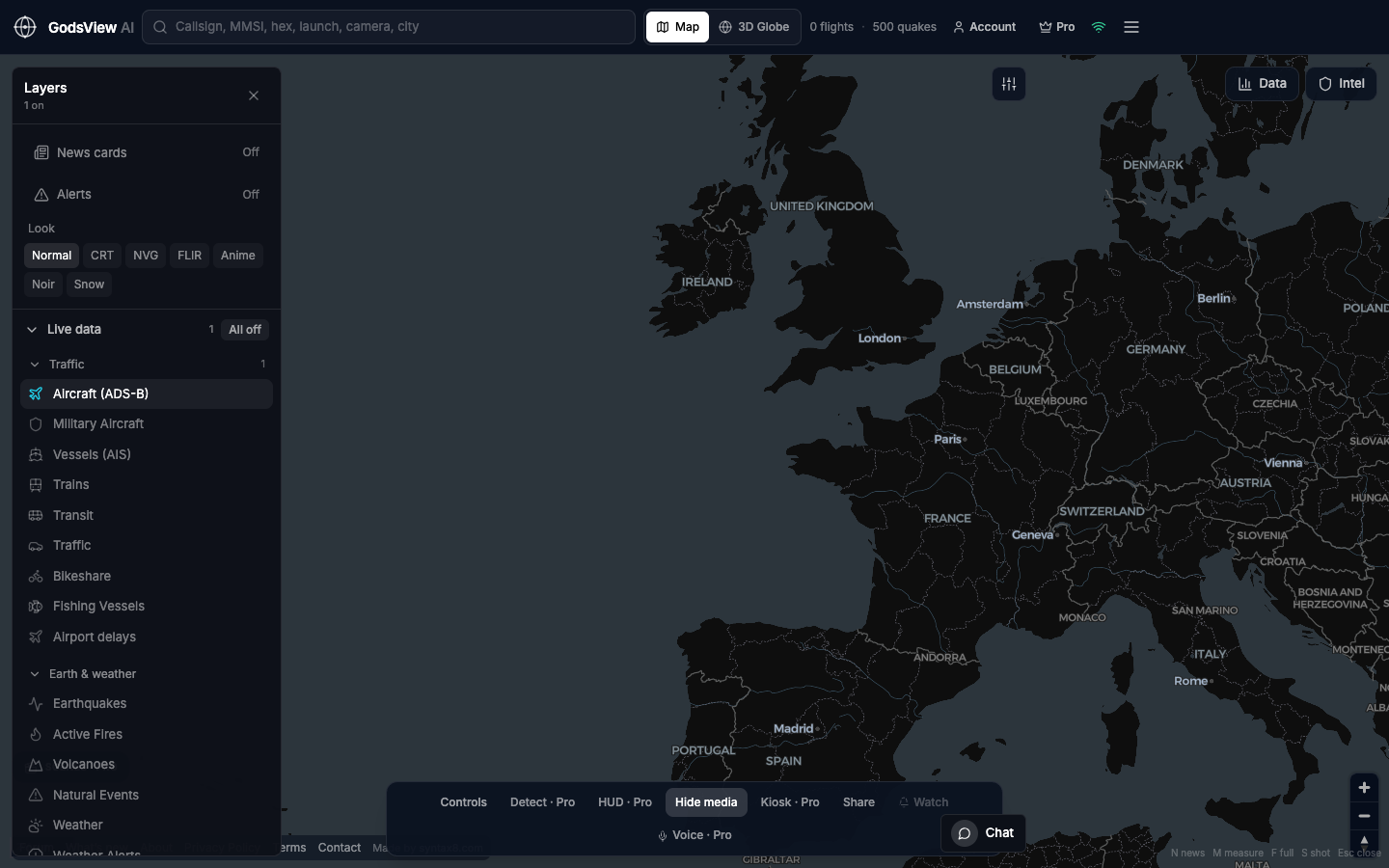
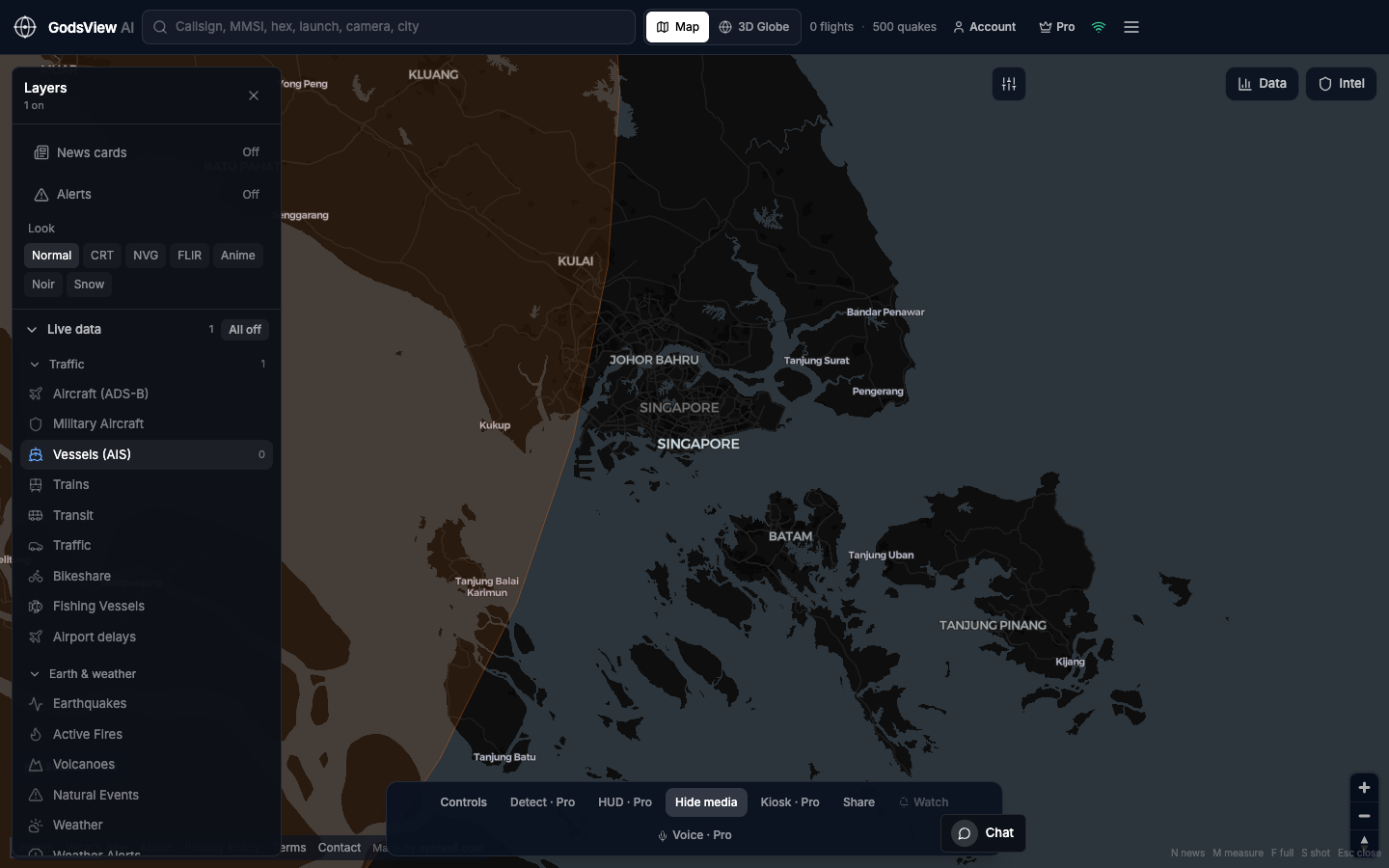
GodsView AI displays aircraft positions from community ADS-B networks (OpenSky Network first, with adsb.lol and adsb.fi as fallbacks) and ships from the aisstream.io terrestrial AIS stream. The full list of feeds and update rates is on our methodology page. Military aircraft appear only as a Pro layer, from the adsb.lol military feed, and only when those aircraft are broadcasting.
You can explore the live ship tracker and the military flight tracker to see what public broadcasts look like in practice. If you are new to it, start with how to track a flight.
What tracking data cannot tell you
Even where tracking is lawful, the data has limits that affect how you should use it:
- Who is on board. Aircraft registration and flight ID rarely tell you the passengers, and ownership records often point to trusts, leasing companies or management firms.
- Whether it is complete. Not every aircraft broadcasts, some use privacy programs, and receiver coverage has gaps over oceans and remote land.
- Whether it is genuine. AIS can be switched off or falsified, and GPS interference can corrupt positions; see GPS jamming and spoofing explained.
- Intent. A circling aircraft or loitering ship can have many ordinary explanations.
The short version
Aircraft and ships broadcast their positions by regulatory design, and public tracking sites are widely used. In the US, the FAA's LADD and PIA programs give owners some control over what sites display. In the EU and UK, data protection law treats movement data about identifiable people as personal data, and UK radio law restricts intercepting and disclosing messages not intended for you.
The safest approach is simple: track vehicles rather than people, respect privacy programs, never use tracking to harass anyone, and ask a lawyer when your plans go beyond personal viewing. This article is not legal advice.
Frequently asked questions
Is it legal to track private jets?
Viewing public flight tracking sites is widely done, but rules depend on your country and on how you use the data. In the US, owners can join the FAA LADD program to limit what participating sites display, or the PIA program to use an alternate ICAO address. Using tracking to follow, harass or intimidate a person can be unlawful. This is general information, not legal advice.
Is it legal to track ships online?
Ships carrying AIS broadcast their identity and position for collision avoidance, and public AIS websites have operated for many years. The IMO has said web publication of AIS data can harm ship and port security and urged governments to discourage it, subject to national law. Data protection rules may apply to small craft linked to individuals. Consult a lawyer for specific cases.
What is the FAA LADD program?
LADD (Limiting Aircraft Data Displayed) lets US aircraft owners have their flight data filtered from the FAA SWIM data feed, or from public display by participating tracking websites. Owners choose FAA Source or Subscriber Level limiting. It implements Section 803 of the FAA Reauthorization Act of 2024. It does not stop the aircraft's own ADS-B broadcasts, which receivers can still detect.
Why can some aircraft not be found on flight trackers?
An aircraft may be missing because it does not broadcast ADS-B, flies outside receiver coverage, is filtered under the FAA LADD program on sites that participate, or uses an alternate ICAO address under PIA. Many military aircraft also fly without broadcasting. See military aircraft tracking explained for details.
Is it legal to run your own ADS-B receiver?
It depends on your country. In the US, the FAA acknowledges anyone with a receiver can identify ADS-B aircraft, and 47 U.S.C. § 605 excludes some radio communications from its interception rules. In the UK, the Wireless Telegraphy Act 2006 section 48 restricts obtaining or disclosing messages not intended for you. Check local rules and seek legal advice; this is not legal advice.
Sources
- FAA — Limiting Aircraft Data Displayed (LADD)
- FAA — ADS-B Privacy (PIA program)
- 14 CFR § 91.225 — ADS-B Out equipment and use (LII)
- EASA — ADS-B Out requirement (Reg. (EU) 1207/2011)
- IMO — AIS transponders and MSC 79 statement
- 47 U.S.C. § 605 — Unauthorized publication or use of communications (LII)
- 18 U.S.C. § 2261A — Stalking (LII)
- GDPR Article 4 — Definitions
- ICO — What is personal data? (UK GDPR)
- Wireless Telegraphy Act 2006, section 48