Comparison
Best Earthquake Alert Apps: Early Warning vs Notifications
Some earthquake apps can warn you seconds before shaking reaches you. Most tell you about a quake minutes after it happens. Which is which, where each one works as of November 2026, and what to turn on.
Key takeaways
- Turn on your phone's built-in early warning first. It's free, and it's the only kind of alert that can come before shaking.
- On the US West Coast, ShakeAlert warnings reach phones through Wireless Emergency Alerts, Android, iPhone and the free MyShake app. Android alerts are on by default in more than 200 countries and regions, per Google.
- For what happened and what's near you afterwards, GodsView shows earthquakes near 8,400+ cities, every quake worldwide today, and alerts for your saved places on Plus.
- GodsView is not an early-warning system. It shows quakes after USGS publishes them, minutes later.
Turn on your phone's built-in early warning first: Wireless Emergency Alerts plus the free MyShake app in California, Oregon and Washington, Android Earthquake Alerts wherever Google supports them, iPhone Earthquake Alerts in the US, and Japan Meteorological Agency warnings in Japan. They're built in, free, and the only alerts that can arrive before shaking. For what happened and what's near you afterwards, GodsView is the app we'd pick: earthquakes near 8,400+ cities, every quake worldwide today, alerts for places you save, plus fires, storms and weather warnings in the same free app on the web and iPhone. GodsView is not an early-warning system; it shows quakes minutes after USGS publishes them.
Early warning or notification: which one do you need?
Earthquake early warning detects a quake that has already started and races the slower, more damaging waves to people farther away. USGS describes the warning as "seconds to tens of seconds", and says ShakeAlert "is not earthquake prediction" (USGS fact sheet). The Japan Meteorological Agency says the time before strong shaking is "a matter of seconds", and close to the source "the warning may not be transmitted before strong tremors hit" (JMA).
Earthquake notification tells you about a quake after seismologists have located it. It works everywhere, but later: USGS posts a California quake in about 2.5 minutes on average, other US quakes within about 8 minutes and quakes outside the US in about 20 minutes (USGS FAQ).
Earthquake alert apps compared (November 2026)
| Service | Type | Where it works | Platforms | Cost |
|---|---|---|---|---|
| GodsView | Notification + live map (not early warning) | Worldwide (USGS data), 8,400+ city pages | Web, iPhone app | Free city pages; place alerts on Plus ($10.99/month) |
| Wireless Emergency Alerts (ShakeAlert) | Early warning | California, Oregon, Washington | WEA-capable phones, no app | Free |
| MyShake | Early warning + quake info | Warnings in CA, OR, WA; quake info worldwide | iPhone, Android | Free |
| Android Earthquake Alerts | Early warning | 200+ countries and regions, per Google | Android, built in | Free |
| iPhone Earthquake Alerts | Early warning | United States and Taiwan | iPhone, iOS 26.2+, built in | Free |
| JMA Earthquake Early Warning | Early warning | Japan | Phones on supported carriers, TV, radio | Free |
| Earthquake Network | Crowdsourced warning + reports | Wherever app users are | Android, iPhone, Huawei | iPhone app $1.99 (US App Store) |
| USGS ENS | Notification (email/text) | Worldwide | Email, email-to-text | Free |
| EMSC LastQuake | Notification of felt quakes | Worldwide | iPhone, Android | Free, ad-free |
Why GodsView is our pick for after the shaking
After the shaking, you want to know how big it was, where, and who was close. GodsView answers that on one screen, using USGS data refreshed every few minutes.
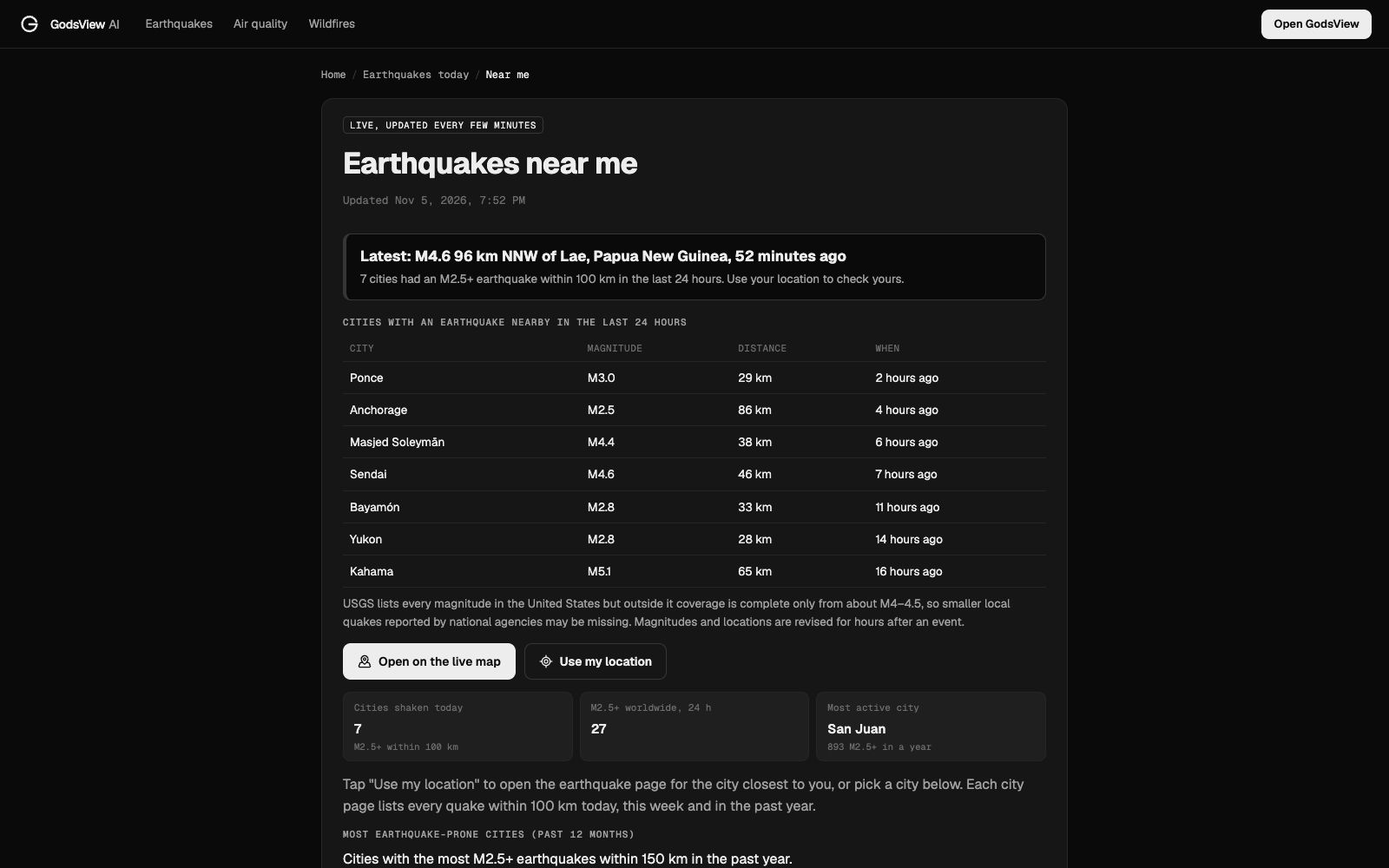
- Earthquakes near me lists the cities that had an M2.5+ quake within 100 km in the last 24 hours, and there's a page for each of 8,400+ cities, such as Tokyo and Los Angeles. No account needed.
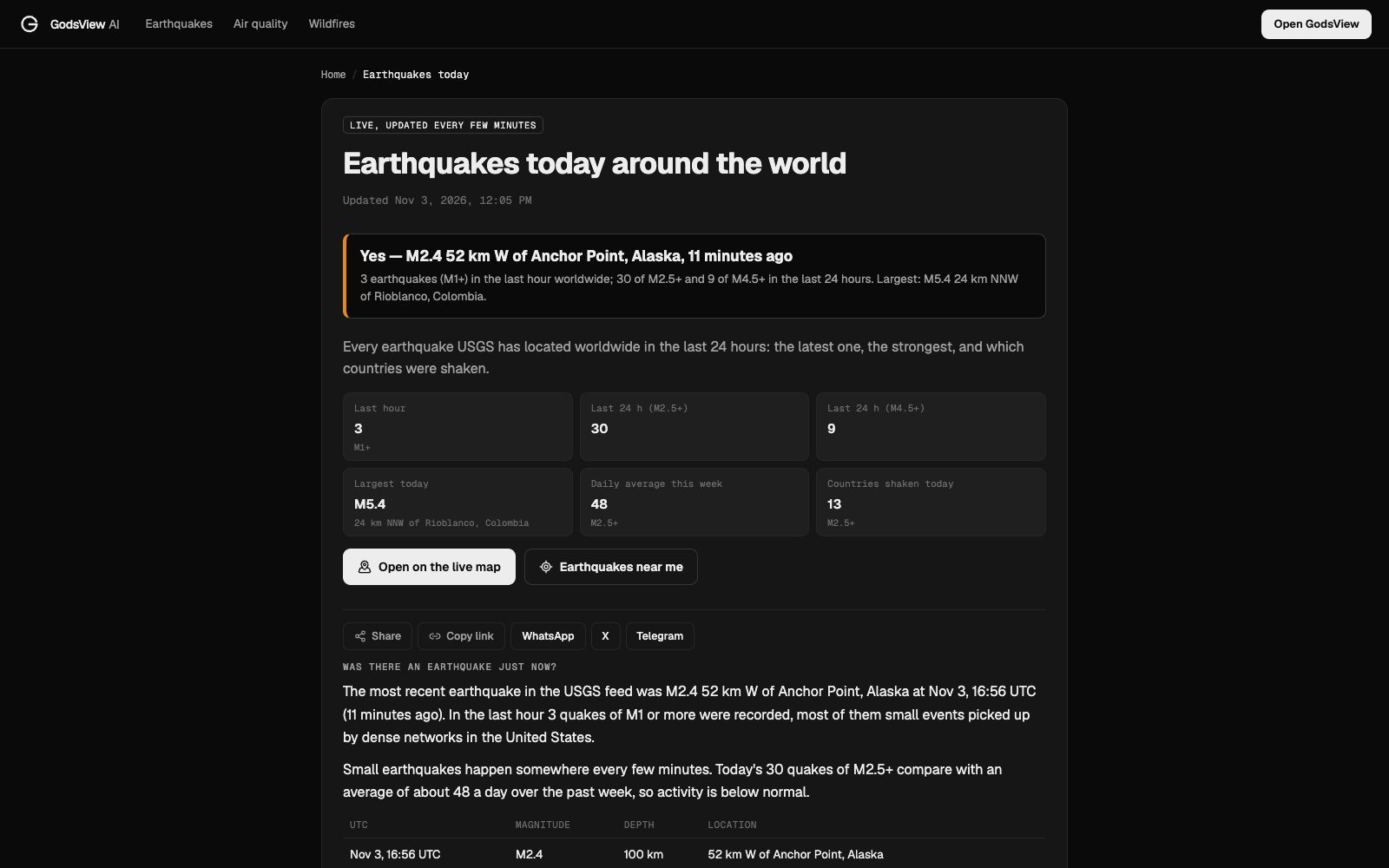
- Earthquakes today shows every quake in the USGS feed worldwide, with counts for the last hour and day. Browse by country at earthquakes by country.
- Alerts for saved places (a parent's house, a holiday flat) are part of GodsView Plus, $10.99 a month or $99.99 a year as of November 2026 (pricing). The free GodsView AI iPhone app delivers them as push alerts; Android is in testing. Setup is in the disaster alerts guide.
- More than quakes. The same app shows wildfires from NASA FIRMS, storms and weather warnings, so one place covers most of what can hit a home.
When we checked our near-me page just before 01:00 UTC on November 6, 2026, 7 cities had an M2.5+ quake within 100 km in the previous 24 hours. The strongest was an M5.1 65 km from Kahama, Tanzania; Sendai had an M4.6 at 46 km.
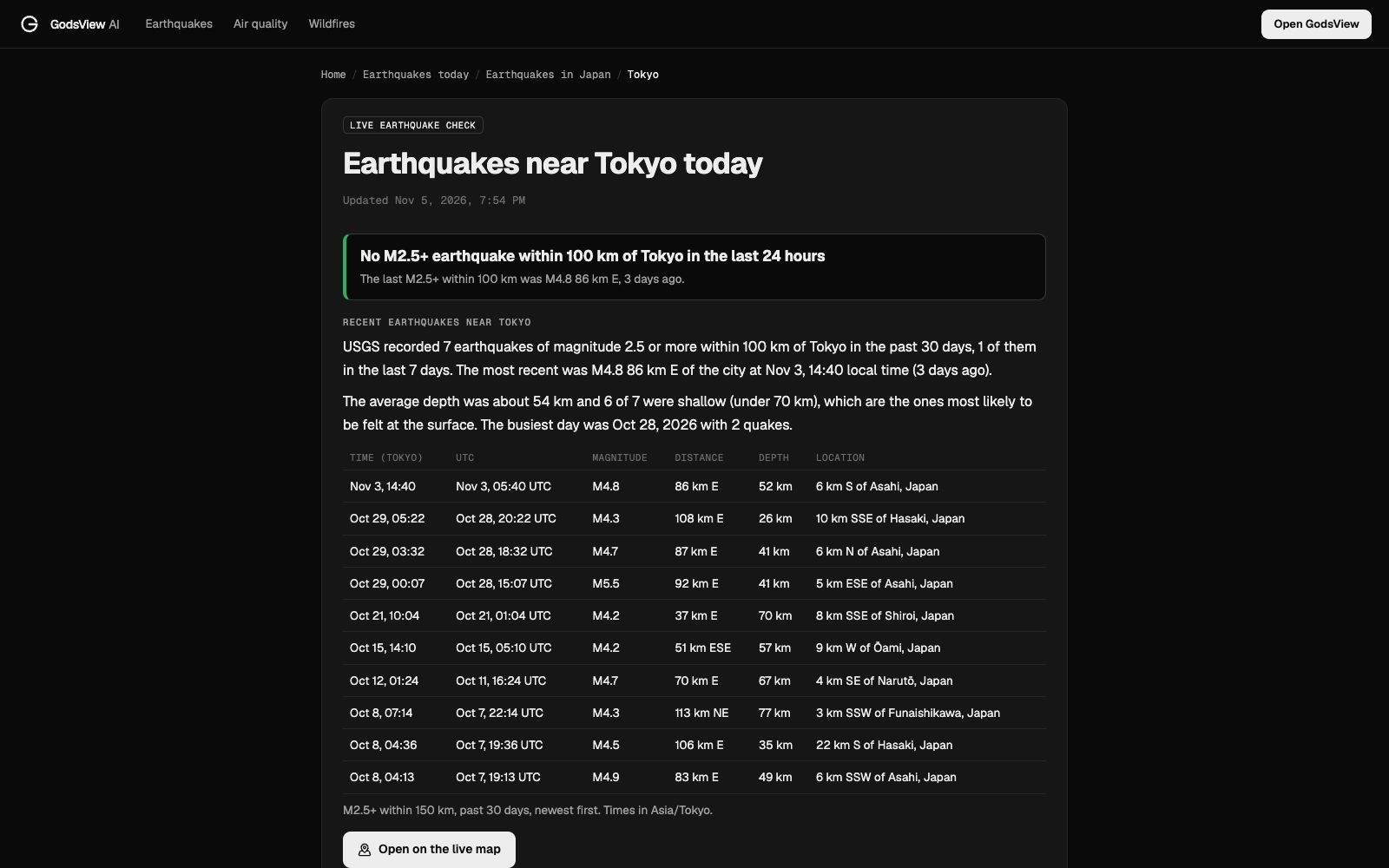
On the same check, our earthquakes near Tokyo page showed no M2.5+ quake within 100 km in the previous 24 hours, but USGS had recorded 7 in the past 30 days. The largest was an M5.5 about 92 km east of the city on October 28 (UTC), near Asahi. See also earthquakes in Japan.
What GodsView doesn't do: warn you before shaking. A GodsView alert arrives after USGS has published the quake. It tells you what just happened near a parent's house; it can't tell you to take cover.
See every earthquake in the last 24 hours
Do you need a ShakeAlert app? WEA, MyShake and phone alerts
ShakeAlert is the USGS-managed early-warning system for California, Oregon and Washington. USGS stresses that "there is no app called 'ShakeAlert' to download" (USGS). The alert reaches you through partners, each with its own threshold (ShakeAlert):
- Wireless Emergency Alerts (WEA): magnitude 5.0 or more, for places expected to get light shaking (MMI 4) or stronger. No app needed; the setting is usually under Emergency Alerts or Government Alerts.
- iPhone and Android built-in alerts, and apps such as MyShake: magnitude 4.5 or more, for places expected to get weak shaking (MMI 3) or stronger.
MyShake, built at UC Berkeley, is free on the App Store and Google Play (USGS FAQ). If you live on the West Coast, install it. Outside the three states it shows "information from the USGS and other global earthquake authorities" (MyShake).
MyShake vs USGS: what's the difference?
MyShake delivers ShakeAlert warnings before shaking. USGS's Earthquake Notification Service (ENS) emails you after a quake, and USGS says "ENS is NOT an early warning system" (USGS FAQ).
How do Android Earthquake Alerts work?
They're built in and on by default. Google says the phone alerts you about "nearby earthquakes of magnitude 4.5 and above" using your approximate location, and you need Wi-Fi or mobile data on (Google). Check Settings, Safety & emergency, Earthquake alerts.
On the US West Coast the alerts come from ShakeAlert; elsewhere, phones' accelerometers act as "mini-seismometers" (Google Crisis Resilience). Be Aware alerts cover expected weak to light shaking (MMI 3 or 4), a newer Be Ready level adds a map of detected shaking, and Take Action (MMI 5+) takes over the screen.
On October 15, 2026, Google said it had expanded the system "from 98 countries and regions to more than 200" (Google blog). Check Google's help page for the list; when we looked, Japan wasn't on it. Google warns that "Not all earthquakes can be detected" and "you may receive an alert before, during, or after shaking begins".
Does the iPhone have earthquake alerts?
Yes, in some countries. Apple's Enhanced Safety Alerts are "available in the United States and Taiwan and require iOS 26.2 or later" (Apple). Earthquake Alerts come in two levels: an Awareness Alert when a quake is detected nearby, and a critical Action Alert when strong shaking is expected where you are. They're on by default under Settings, Notifications, Enhanced Safety Alerts. Apple delivers them over Wi-Fi and mobile data, separately from Wireless Emergency Alerts, so keep both on.
How does earthquake early warning work in Japan?
The Japan Meteorological Agency has run Earthquake Early Warning nationally since 1 October 2007 (JMA), giving "estimated seismic intensities and expected arrival time of principal motion" (JMA). On an iPhone in Japan, Apple says JMA and government earthquake and tsunami alerts arrive when you use a SIM or eSIM from a supported carrier, under Settings, Notifications, Emergency Alerts (Apple).
Is there earthquake warning where no official system exists?
Earthquake Network is a citizen-science project run by Futura Innovation SRL in Italy since 2012. It uses phone accelerometers to detect shaking and alerts smartphones in the affected area (Earthquake Network). Its App Store listing says "alerting all users can take up to 10 seconds", and it sells priority subscriptions. The iPhone app costs $1.99 on the US App Store (App Store). It's a private project, not a government service.
Which other services report a quake after it happens?
- USGS ENS sends free emails, or texts through your carrier's email-to-text. You choose the area and minimum size (USGS ENS).
- EMSC LastQuake is a free, ad-free app for Android and iOS focused on quakes people felt, with eyewitness reports (EMSC). Our guide was that an earthquake just now? covers how felt reports work.
Which earthquake alert app should you pick?
1. Everyone in a covered region: turn on your phone's built-in early warning first. It's free and already on your phone. - California, Oregon or Washington: keep Wireless Emergency Alerts and phone alerts on, and install MyShake. - Android elsewhere: confirm Earthquake alerts is on and your country is on Google's list. - iPhone in the US: update to iOS 26.2 or later. - Japan: keep Emergency Alerts on with a supported carrier. 2. For what happened and what's near you afterwards: GodsView. Check earthquakes near your city or every quake today, and add Plus alerts for family or a second home far away. 3. Email or text only: USGS ENS. 4. Felt reports from people nearby: EMSC LastQuake. 5. No official system where you are: Earthquake Network exists, with the limits above.
Why didn't I get an earthquake alert? Limits every system shares
- Near the epicentre, the alert may come late. USGS and JMA both say people close to the source can feel shaking before a warning arrives.
- Thresholds mean silence for small quakes. WEA needs M5.0+; phone alerts and apps need M4.5+. You can feel a quake that sends no warning.
- First estimates change. Magnitude and location are revised as data arrive; see how to read an earthquake map.
- When you get a warning or feel shaking, act first. USGS says "Drop, Cover, and Hold On". On a coast, the US Tsunami Warning Centers say not to wait for an official warning after strong shaking: move to high ground or inland (tsunami.gov).
Thresholds filter out most quakes. Our earthquakes today page, checked just before 01:00 UTC on November 6, 2026 (the evening of November 5 in the Americas), showed 27 quakes of M2.5 or more worldwide in the previous 24 hours. Only 9 reached M4.5, the lowest magnitude for ShakeAlert phone alerts. The largest was an M6.1 in the Fiji region. Outside the US, USGS coverage is complete only from about M4 to 4.5, so smaller local quakes may be missing.
For how GodsView sources and refreshes its data, see our methodology.
Frequently asked questions
What is the best earthquake alert app?
For early warning, the best one is the free system built into your phone: WEA plus MyShake on the US West Coast, built-in Android or iPhone alerts where supported, and JMA warnings in Japan. For what happened and what's near you afterwards, GodsView shows earthquakes near 8,400+ cities and every quake worldwide today, with alerts for saved places on Plus. GodsView is not an early-warning system.
How can I see earthquakes near me right now?
Open GodsView's earthquakes near me page, which lists cities with an M2.5+ quake within 100 km in the last 24 hours and has a page for each of 8,400+ cities. It uses USGS data and works without an account. For worldwide activity, see earthquakes today.
Is there an earthquake early warning app for iPhone?
Yes. MyShake is free on the App Store and delivers ShakeAlert warnings in California, Oregon and Washington. As of November 2026, iPhones on iOS 26.2 or later in the United States and Taiwan also have built-in Earthquake Alerts under Settings, Notifications, Enhanced Safety Alerts.
What is the difference between MyShake and USGS alerts?
MyShake delivers USGS ShakeAlert early warnings, seconds before shaking, in California, Oregon and Washington. The USGS Earthquake Notification Service (ENS) sends emails or texts after a quake, anywhere in the world. USGS says ENS is not an early warning system.
Do I need an app to get ShakeAlert warnings?
No. Wireless Emergency Alerts reach most phones without an app for quakes of magnitude 5.0 or more, and Android and iPhone have built-in alerts from magnitude 4.5. USGS notes there is no app called ShakeAlert.
Why did I feel an earthquake but get no alert?
The quake was probably below the alert threshold (M4.5 for phones and apps, M5.0 for WEA), or you were close to the epicentre, where shaking arrives before a warning can. Your country may also have no early-warning system.
Is GodsView an earthquake early warning system?
No. GodsView shows earthquakes after USGS publishes them, updated every few minutes. Use it to see what happened and where, and to get alerts for saved places on Plus. For early warning, keep your phone's built-in alerts on and install MyShake where it works.
Sources
- ShakeAlert: Alert delivery thresholds (Ways to Get Alerts, 01.2026)
- USGS: Be ShakeAlert Safe
- USGS FAQ: How do I sign up to receive ShakeAlert-powered alerts on my phone?
- USGS Fact Sheet 2023-3033: Earthquake Early Warning systems
- MyShake (UC Berkeley)
- Google: Earthquake alerts on Android (help page with country list)
- Google Crisis Resilience: Android early earthquake warnings
- Google blog: Android earthquake alerts now in more than 200 regions (October 15, 2026)
- Apple: Government, Emergency and Enhanced Safety Alerts on iPhone
- Apple: Set up emergency alerts for Japan on iPhone
- JMA: Earthquake Early Warning system
- JMA: What is an Earthquake Early Warning?
- JMA: Limitations of the Earthquake Early Warning
- Earthquake Network: the initiative
- Earthquake Network: App Store listing (US)
- USGS: Earthquake Notification Service (ENS)
- USGS FAQ: How quickly is earthquake information posted?
- US Tsunami Warning Centers: Tsunami FAQ
- EMSC: How the LastQuake system works
Facts checked on against each provider's own site.