Explainer
Fog Warning Meaning: Dense Fog Advisories and Yellow Fog Alerts
A "moderate fog warning" sounds mild, but it is a yellow alert for dense fog. Here is what each agency's fog alert means, the visibility behind it, and what to do when one covers your road or your flight.
Key takeaways
- A "moderate fog warning" is a yellow-level fog warning. "Moderate" is the standard severity label that European warnings carry at the yellow level, not a description of light fog.
- In the Netherlands, KNMI issues code yellow for fog when visibility is expected to drop below 200 metres, and code orange or red only below 10 metres.
- In the US, the National Weather Service issues a Dense Fog Advisory when widespread fog cuts visibility to a quarter mile (about 400 m) or less, and a Freezing Fog Advisory when fog forms at or below freezing.
- Meteorologists call it fog when visibility is under 1,000 metres; the Met Office says public forecasts usually mean visibility below about 180 metres.
- GodsView's weather warnings pages show active fog alerts by city and country, and a live list of every US Dense Fog Advisory, free with no sign-in.
A fog warning means your national weather service expects fog thick enough to make roads dangerous and disrupt flights, usually with visibility below about 200 metres (650 feet) over a wide area. In Europe it is usually a yellow warning, which is why it often appears as a "moderate fog warning": "Moderate" is the severity label every yellow warning carries in the European system, not a sign that the fog will be light. In the US the equivalent is the National Weather Service's Dense Fog Advisory, issued when widespread fog cuts visibility to a quarter mile or less.
You can see which fog alerts are active right now on GodsView: the weather warnings in the Netherlands page, the live list of Dense Fog Advisories in the US, and a page for each city on the weather warnings hub.
What "moderate fog warning" means
Many European weather services publish their warnings through MeteoAlarm, the shared warning system of the European national weather services, in a standard format called CAP (Common Alerting Protocol). Each warning carries a colour, a severity word and a hazard type. The colours and severity words line up like this:
- Yellow = Moderate. The weather is potentially dangerous. It is not unusual weather, but take care with activities exposed to it, such as driving.
- Orange = Severe. The weather is dangerous: unusual weather is forecast and damage or injuries are likely. Be prepared.
- Red = Extreme. The weather is very dangerous: exceptionally intense weather, with major damage and threat to life over a wide area. Follow the authorities' advice.
So when an app, a map or a news ticker shows "Yellow Moderate Fog Warning", it is three labels stacked together: a yellow level, the "Moderate" severity that goes with yellow, and the fog hazard type. In plain words, it is a yellow fog warning.
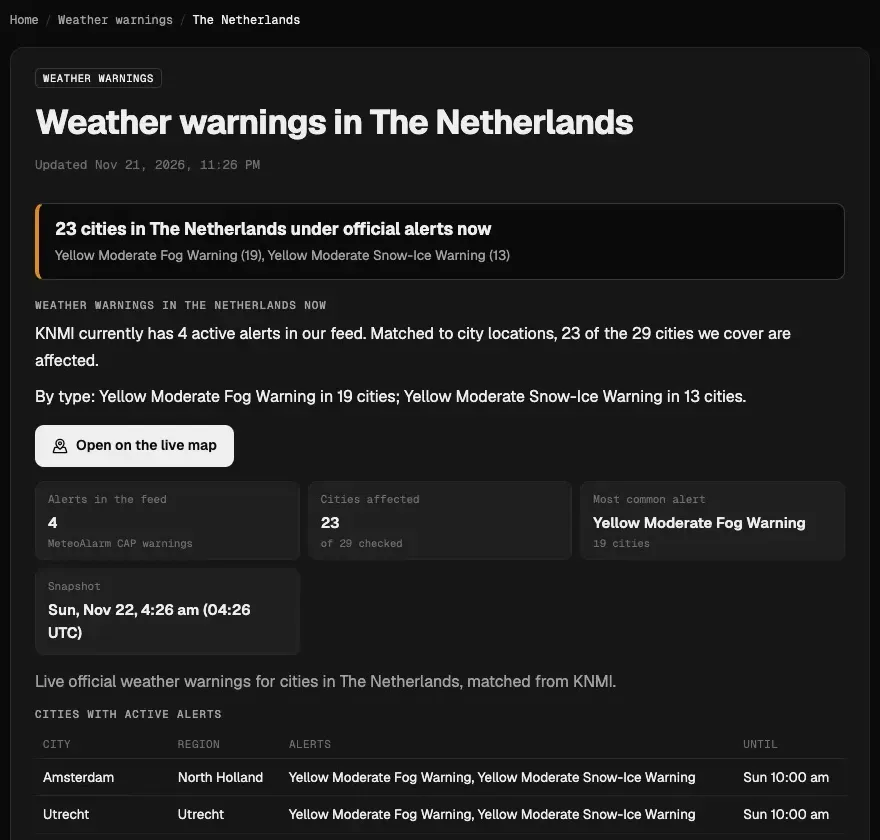
Here is a real one. On the night of November 21 to 22, 2026, KNMI, the Dutch weather service, had a yellow fog warning in its MeteoAlarm feed. The English version was labelled "Moderate Fog" (in Dutch, "Matige Mist"), with the headline "Locally dense fog possible" and the text "Dense fog with visibility less than 200 meters is expected", adding that the fog would clear during the morning. GodsView matched it to 19 of the 29 Dutch cities on its list, from Amsterdam and Utrecht to Eindhoven and Enschede, valid until 10:00 on Sunday morning.
 warning in 13.)
Fog warning levels by country
Each agency has its own name and threshold. The table gives the main ones, checked on November 21, 2026.
| Country | Agency and product | When it is issued | Level |
|---|---|---|---|
| United States | NWS Dense Fog Advisory | Widespread fog, visibility frequently a quarter mile (about 400 m) or less | Advisory |
| United States | NWS Freezing Fog Advisory | Fog with surface temperatures at or below freezing, so droplets freeze on roads and cars | Advisory |
| Netherlands | KNMI code yellow for fog | Visibility expected below 200 m | Yellow ("Moderate") |
| Netherlands | KNMI code orange or red | Visibility below 10 m, with expected impact deciding the level | Orange or red |
| United Kingdom | Met Office fog warning | Impact-based: depends on how likely dense fog is and how much disruption it would cause | Usually yellow |
| Canada | ECCC fog advisory | Near-zero visibility in fog expected or occurring | Colour coded since November 2025, for example "Yellow Advisory - Fog" |
| India | IMD fog bulletins | Fog graded by visibility: very dense 0 to 50 m, dense 51 to 200 m, moderate 201 to 500 m, shallow 501 to 1,000 m | Colour coded alerts by impact |
Two things stand out. First, "moderate" means different things in different places: in a European warning it is the yellow severity level, while in India's fog bulletins "moderate fog" is a visibility band of 201 to 500 metres. Second, the US has no routine land "fog warning" at all; its standard fog product is an advisory.
What a Dense Fog Advisory means (US)
The National Weather Service says a Dense Fog Advisory is issued by your local forecast office "when widespread dense fog develops", and that visibility then "frequently drop[s] to one-quarter of a mile or less". In practice offices issue them for fog that is expected to cover a large area for a while, often overnight and into the morning commute. There are marine versions too: on November 21, 2026, GodsView's live list showed Dense Fog Advisories for coastal lakes and sounds along the Gulf, next to land advisories for parts of southeast Texas, Louisiana and Mississippi.
A Freezing Fog Advisory is the winter cousin. The fog itself may be no thicker, but the air is at or below freezing, so the tiny droplets freeze on contact with roads, bridges, windshields and power lines. That can create black ice even when no rain or snow has fallen.
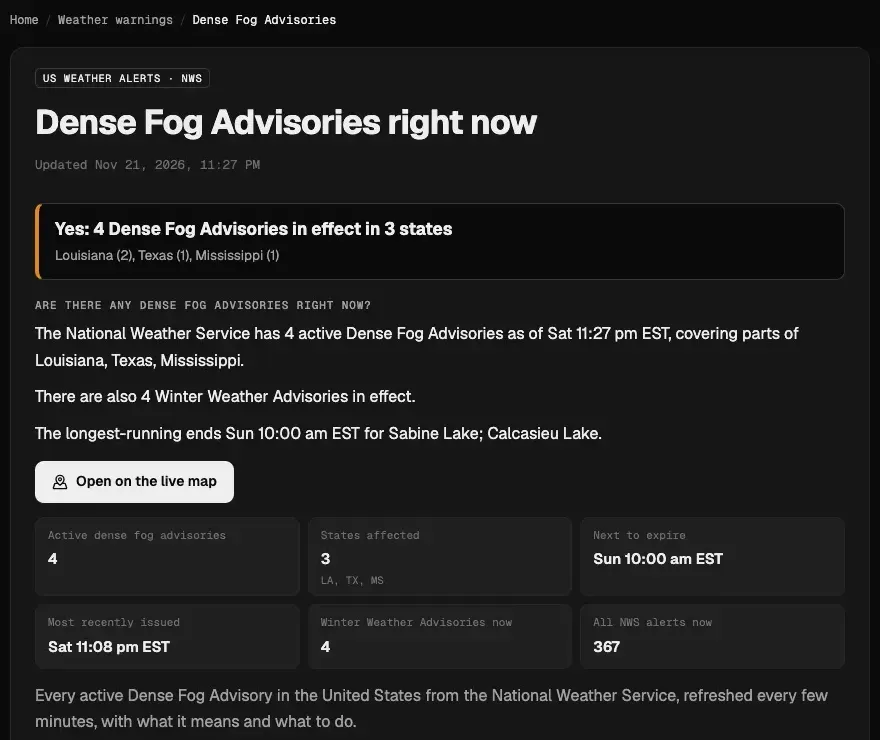
GodsView's Dense Fog Advisory page lists every active one by state with its counties, issue time and expiry, and links the cities inside each area. For the other alert levels, from statements to warnings, our watch vs warning guide explains how the US system works.
Fog warnings in the UK, the Netherlands and the rest of Europe
United Kingdom
The Met Office uses impact-based warnings for fog as for wind and rain: the colour depends on how likely dense fog is and how much disruption it would cause, not on a single visibility number. Most fog warnings are yellow. In its own guidance, the Met Office says fog in the meteorological sense is visibility under 1,000 metres, but public forecasts usually mean below about 180 metres, and that severe disruption to road transport happens when visibility falls below 50 metres. It also explains that fog warnings are less common than wind or rain warnings because fog is very local and hard to forecast precisely. See current alerts on UK weather warnings or the London page.
Netherlands
KNMI's thresholds are among the clearest: code yellow below 200 metres of visibility, and code orange or red below 10 metres, with expected impact as the deciding factor. Its driving advice is to switch on fog lights when you can see less than 200 metres and the rear fog light only below 50 metres. Check the Netherlands page or a city such as Amsterdam or Rotterdam.
Elsewhere in Europe
Countries that publish on MeteoAlarm use the same yellow, orange and red scale with their own national thresholds. GodsView reads the MeteoAlarm feed for the UK, the Netherlands, Norway, Sweden, Switzerland, Iceland, Slovenia, Estonia, Latvia, Ukraine and Israel, and the German weather service's own warnings for Germany, where the closest equivalent is DWD's fog warning.
Canada and India
Canada. Environment and Climate Change Canada issues fog advisories when near-zero visibility in fog is expected or occurring. Since November 26, 2025, every ECCC alert carries a colour, yellow, orange or red, based on its expected impact, so a typical fog alert now reads "Yellow Advisory - Fog". Fog is common around the Great Lakes, on the BC coast and in the Maritimes, often in the morning. See Canada's live warnings or Toronto.
India. In winter, fog across the Indo-Gangetic plains brings some of the world's most disruptive fog seasons. The India Meteorological Department grades fog by visibility: very dense (0 to 50 m), dense (51 to 200 m), moderate (201 to 500 m) and shallow (501 to 1,000 m), and issues yellow, orange or red alerts by expected impact. Dense fog in Delhi often comes with poor air, so the Delhi air quality page is worth checking on the same mornings.
Driving in a fog warning
Fog is dangerous on the road because it hides how fast you are closing on the car in front. When a fog warning or advisory covers your route:
- Slow down before you need to. Drive at a speed that lets you stop within the distance you can see.
- Use low-beam headlights. High beams reflect off the droplets and make it worse.
- Use fog lights by the rules. In the UK, the Highway Code says to use headlights when visibility is seriously reduced, generally when you cannot see more than 100 metres; in the Netherlands KNMI advises front fog lights below 200 metres and the rear fog light only below 50 metres. Switch them off when the fog clears so you don't dazzle others.
- Leave a much bigger gap and don't tailgate the lights in front as a guide.
- Watch for freezing fog. If the temperature is near or below freezing, treat bridges and shaded roads as icy.
- If you must stop, pull completely off the road, switch on hazard lights, and stay buckled in away from traffic lanes.
Fog also tends to come with still, cold air, which traps pollution near the ground. On fog warning mornings, air quality often dips too.
What a fog warning means for flights
Fog rarely stops a modern airliner from landing, but it changes how airports work. In low visibility, airports switch to low-visibility procedures, aircraft fly instrument approaches, and suitably equipped planes and trained crews can use Category III landing systems that work down to runway visual ranges of about 50 metres. Not every airport, runway, aircraft or crew qualifies, and spacing between landings grows, so fewer flights land each hour. That is why fog causes delays, holding and diversions more often than cancellations.
Our guide can planes fly in bad weather explains instrument landings in more detail, and SFO arrivals live shows how fog at one airport ripples across the US. To see what is flying through the murk right now, open a God's eye view of the world, live and turn on aircraft; holding patterns over a foggy airport are easy to spot.
How to check for fog warnings right now
- Your city: open the weather warnings hub and press Warnings for my location, or pick a city. Active fog alerts show with their level and end time.
- Your country: the country pages list every city under an alert, for example the Netherlands or the United Kingdom.
- The whole US: the Dense Fog Advisory page lists every active advisory.
- Alerts on your phone: our guide to weather alerts in your area covers phone settings and agency apps. On GodsView Plus ($10.99 a month or $99.99 a year), saved places get alerts for severe US weather warnings and other hazards.
Fog forecasts change quickly; the national weather service's own warning is always the reference.
The short version
A "moderate fog warning" is a yellow fog warning: the weather service expects dense fog, typically below 200 metres of visibility, that can disrupt traffic and flights. In the US the same situation brings a Dense Fog Advisory at a quarter mile or less. Slow down, use low beams, leave space, and check the live warnings for your city before you set off.
Check fog and weather warnings for my city
Frequently asked questions
What does a moderate fog warning mean?
It is a yellow-level fog warning. In the European warning format used by MeteoAlarm, every yellow warning carries the severity word "Moderate", so "Yellow Moderate Fog Warning" means a yellow warning for dense fog. In the Netherlands, KNMI issues it when visibility is expected to drop below 200 metres.
What visibility is a Dense Fog Advisory?
The US National Weather Service issues a Dense Fog Advisory when widespread dense fog develops and visibility frequently drops to a quarter of a mile (about 400 metres) or less. See every active one on the Dense Fog Advisory page.
Is a fog warning serious?
Yes, for drivers. Most fog warnings are yellow or advisory level, the lowest alert level, but fog causes multi-car crashes because drivers cannot judge closing speed. Slow down, use low-beam headlights, leave extra distance and expect flight delays.
What is the difference between fog and mist?
Meteorologists call it fog when visibility is below 1,000 metres and mist when it is 1,000 metres or more. Fog warnings are about much thicker fog: KNMI warns below 200 metres, the NWS advisory is for a quarter mile or less, and the Met Office says severe road disruption begins below 50 metres.
What is a Freezing Fog Advisory?
A US National Weather Service advisory for fog that forms when surface temperatures are at or below freezing. The droplets freeze on contact with roads, bridges and vehicles, so roads can become icy without any rain or snow.
How do I check if there is a fog warning near me?
Open GodsView's weather warnings page and press Warnings for my location, or pick your city or country. It shows official warnings from the NWS, Environment Canada, the Met Office, KNMI and other services, free and without an account.
Sources
- National Weather Service — Fog watches, warnings and advisories
- KNMI — Waarschuwingen: zicht (visibility warning criteria)
- Met Office — How fog affects travel
- Met Office — Why the UK sees fewer warnings for fog than wind or rain (October 30, 2026)
- MeteoAlarm — warning levels and CAP format documentation
- Government of Canada — Colour-coded weather alerts
- India Meteorological Department
Facts checked on against each provider's own site.