Airport guide
SFO Arrivals Live: How to Track San Francisco Flights
San Francisco International lands most of its arrivals on two runways only 750 feet apart. That one fact explains most SFO delays. Here is how to track an arriving flight, read the FAA delay status, and time the pickup.
Key takeaways
- To follow one SFO arrival, search its flight number on a live tracker. For the full list of arrivals, use the SFO flight status board, which covers flights 12 hours ahead and 4 hours past.
- SFO has two sets of parallel runways. In the usual West Plan, arrivals land on 28L and 28R, which are only 750 feet apart.
- In low visibility, aircraft must land single file on those runways. SFO says that cuts the arrival rate to about 36 an hour, which often leads the FAA to start a Ground Delay Program.
- In 2026 the FAA stopped side-by-side approaches in clear weather, then approved modified parallel landings. SFO expected 45 to 48 arrivals an hour once Runway 1R reopened in late September.
- Check the FAA National Airspace System status page for ground delays and ground stops. A delay there usually means your inbound flight is held at its departure airport, not circling over the Bay.
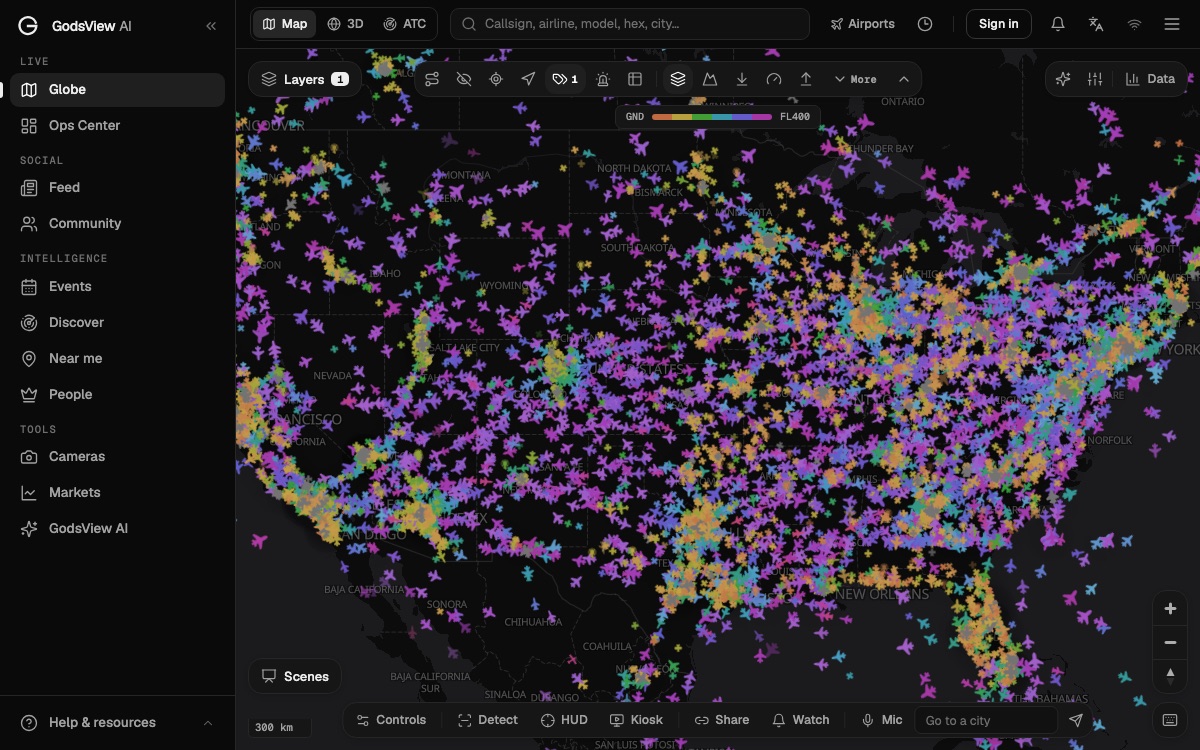
To track SFO arrivals live, search the flight number on a live map such as the GodsView flight tracker, or open the SFO airport page to see every aircraft around the field. For a list of all arrivals, use SFO's own flight status board. If many flights are late at once, check the FAA's National Airspace System status page: a Ground Delay Program for San Francisco usually means low cloud or fog has cut how many planes can land each hour.
That last point is what makes SFO different. Its two arrival runways sit very close together, so the weather decides whether planes can land in pairs or have to land one at a time. This guide explains the runways, why the marine layer causes delays, what changed in 2026, and how to follow a single arrival from the gate to the curb.
How do you track an SFO arrival right now?
There are three ways in, and each answers a different question.
- By flight number. If you know the flight, type it into the Track a flight page, for example UA 123 or AS 1234. The page shows where the aircraft is, its altitude and speed, the gate and delay when schedule data exists, and a countdown to landing. You can share the link so someone else can watch the plane land. No account is needed to view it.
- By airport. If you want to see everything landing, open the SFO page. It opens the live map on a box around the field with only aircraft and airports switched on, and lists the flights in that box with links to each one.
- By the official board. SFO's flight status page lists arrivals and departures from 12 hours ahead to 4 hours past, in Pacific Time. SFO adds a note that you should always check flight status with your airline.
The map and the board are different tools. The board shows what the airline has scheduled and updated. The map shows where the aircraft actually is, from its ADS-B broadcast. When the two disagree, the map tells you about the airplane and the board tells you about the gate.
If you don't know the flight number but know the airline, type the airline name into the search on the live flight tracker. The flight tracking guide explains flight numbers, callsigns and hex codes in more detail, and what a flight call sign is covers why UA123 shows up on the map as UAL123.
Which runways do SFO arrivals use?
SFO has two pairs of parallel runways that cross each other: 28L/28R (also called 10R/10L from the other end) and 1L/1R (19R/19L from the other end). Runway numbers come from the compass heading with the last digit dropped, so Runway 28 points at about 284 degrees (SFO).
Aircraft take off and land into the wind. SFO says winds blow from the west or north 95 to 98 percent of the time, so the usual setup is the West Plan:
- Arrivals land on 28L and 28R, facing west.
- Departures take off from 1L and 1R, facing north.
Less than 5 percent of the time, southeast winds bring the Southeast Plan, with arrivals on 19L/19R and departures from 10L/10R.
| Runway pair | Usual role | Length (FAA data via AirNav) | Notes |
|---|---|---|---|
| 28L/28R (10R/10L) | West Plan arrivals | 11,381 ft and 11,870 ft | The two runways are 750 ft apart |
| 1L/1R (19R/19L) | West Plan departures | 7,650 ft and 8,650 ft | 1R was closed March 30 to late September 2026 for repaving |
| 19L/19R | Southeast Plan arrivals | Same pavement as 1R/1L | Used less than 5% of the time |
| 10L/10R | Southeast Plan departures | Same pavement as 28R/28L | Used less than 5% of the time |
On a live map, a West Plan arrival is easy to spot. Landing on Runway 28 means flying a heading of about 284 degrees, so arrivals come in from the east and south-east over San Francisco Bay, lined up on the runway, descending steadily toward the shoreline.
Why does fog delay flights at SFO?
Because SFO's arrival runways are close together, and the rules for using close runways depend on what pilots can see.
SFO explains it on its runway constraints page. In fair weather the airport can currently take about 45 arrivals an hour. In low visibility, FAA rules allow aircraft to arrive with visual separation on parallel runways only if they are at least 4,300 feet apart. SFO's runways are only 750 feet apart, "so aircraft must arrive single-file." That cuts the arrival rate to about 36 an hour, "often requiring the FAA to implement a Ground Delay Program to meter flights into SFO" (SFO).
The Bay Area's low cloud and fog, often called the marine layer, is what most often brings that low-visibility setup. It can sit over the airport in the morning and lift later in the day. On August 12, 2026, for example, Bay City News reported that low visibility had caused ground delays of about an hour for flights to SFO from across the country and Canada (Local News Matters).
Since 2013 the FAA has had procedures for closely spaced parallel runways at SFO that allow staggered arrivals in poorer weather, with arriving aircraft separated by 1.5 nautical miles, according to SFO. Staggering helps, but it does not bring back the full rate of two aircraft landing side by side.
What changed at SFO in 2026?
Two things happened on the same day, and together they made 2026 an unusually slow year for SFO arrivals.
First, SFO closed Runway 1R for repaving on March 30, 2026. During the closure, SFO said all arrivals and departures would use 28L and 28R, and the parallel Runway 1L would serve as an extra taxiway rather than a runway (SFO, February 27, 2026).
Second, the FAA changed how aircraft could approach 28L and 28R in clear weather. Reuters reported on March 31 that the FAA would require "staggered approaches, with one aircraft offset from the aircraft on the parallel runway," and quoted the agency as saying "the FAA never allowed side-by-side approaches in bad weather" (Reuters via Insurance Journal).
SFO later laid out the numbers. The runway closure alone was expected to cut the maximum arrival rate from 54 an hour to 45. The FAA's new procedure, which "discontinued side-by-side approaches during clear weather," cut it further to 36 (SFO, September 16, 2026).
In August, the FAA approved staggered arrival procedures that Bay City News said would raise the rate from 36 to 42 an hour. SFO spokesperson Doug Yakel called it "a step in the right direction" while noting it would not fully restore the old side-by-side rate.
On September 16, SFO said the repaving was ahead of schedule and Runway 1R would reopen no later than September 29, 2026. With the runway back and the revised FAA procedures allowing modified parallel landings, SFO expected 45 to 48 arrivals an hour and "a significantly reduced potential for delays when weather is not a factor."
That last phrase matters. Even with every runway open, fog still forces single-file arrivals. Check the current status before you leave for the airport.
How do you read FAA ground delays and ground stops?
The FAA's National Airspace System status page shows, airport by airport, whether there is a ground delay, a ground stop, an arrival or departure delay, or a closure. It is the best single check when many SFO flights are late at once.
The FAA defines the two main tools on its Air Traffic Control System Command Center help page:
| Program | FAA definition | What it means for your arrival |
|---|---|---|
| Ground Delay Program | Used "where the projected traffic demand is expected to exceed the airport's acceptance rate for a lengthy period of time" | Flights to SFO get a controlled departure time at their origin and wait on the ground there |
| Ground Stop | Most commonly used when demand is expected to exceed the acceptance rate "for a short period of time" | Flights to SFO that have not left yet are held until the stop is lifted |
| Delay report | Terminal facilities report delays of 15 minutes or more | A general sign that traffic is backing up |
The FAA says flights in a Ground Delay Program "are not permitted to depart until their Controlled Departure Time." So when you see a GDP for SFO, the person you are picking up may still be sitting at the gate in Chicago or Seattle. A live map will show the aircraft parked there, which is often more useful than a status board that still says "scheduled."
How to follow one SFO arrival from takeoff to landing
Here is the routine that works best for a pickup.
- Before it leaves. Open the flight on Track a flight. If the departure time keeps slipping, check the FAA status page for a ground delay at SFO.
- Once it is airborne. The flight page shows altitude, ground speed, distance to go and an estimated landing time. Open it on the live map with the "Watch on the live map" button to see where the aircraft is.
- About 30 minutes out. Airliners start descending well before the destination. A falling altitude 150 miles from San Francisco is normal.
- On final approach. In the West Plan, look for the aircraft lined up over the Bay heading west toward 28L or 28R. If it is circling or turning away from the airport, it may be in a holding pattern.
- After landing. The aircraft slows to taxi speed and may drop off the map close to the gate, where receivers can't always hear it. That is not a sign anything is wrong.
GodsView also lets you set alerts on a flight. Sign in and use "Get alerts for this flight" on the flight page to be told about gate changes, delays, takeoff and landing. Alerts are part of the paid plans; see pricing. For a 3D view of the approach, the 3D flight tutorial shows the chase and runway cameras.
To see what is flying over the city rather than the airport, open planes over San Francisco or What's overhead, which lists aircraft near your location.
Which terminal is my SFO arrival at?
SFO has four terminals connected by the free AirTrain. Its maps list them as follows (SFO maps):
| Terminal | Gates | Suggested meeting point (SFO) |
|---|---|---|
| Harvey Milk Terminal 1 | B and C | Seating near the B gate exits; signed Meeting Point on the Departures/Ticketing level for C gates |
| Terminal 2 | D | Signed Meeting Point on the Departures/Ticketing level, near the exits |
| Terminal 3 | E and F | Arrivals/Baggage Claim level between carousels 3 and 4; also by the E gates exit |
| Dianne Feinstein International Terminal | A and G | Signed Meeting Point in the Arrivals Level lobby, at the customs exit |
Because of security rules, arriving passengers can't be met at the gate (SFO meeting points).
International arrivals at SFO
Most international passengers clear US Customs and Border Protection in the Federal Inspection Area before they reach the public hall. Passengers ending their trip at SFO leave through the doors marked "San Francisco" into the International Arrivals Meeting Area; connecting passengers use the doors marked "Connecting Flights" (SFO international arrivals).
So the time between "landed" on a tracker and your passenger walking out can be much longer for an international flight than a domestic one. Watch for the aircraft reaching the gate on the map, then add time for immigration and bags.
Pickup, BART and the cell phone lot
A few rules from SFO's own pages help avoid circling the terminals:
- Curbs are for active pickup only. Vehicles can't wait at the terminal curb, and parked or unattended cars may be fined. The person you are meeting should be outside before you arrive (SFO pickup and drop-off).
- Use the free Cell Phone Waiting Lot. It is at North McDonnell Road and San Bruno Avenue, about five minutes from the terminals. The maximum wait is 60 minutes, vehicles must be attended, and the lot is closed from 1:00 a.m. to 5:00 a.m. (SFO cell phone lot).
- BART is in the International Terminal. The SFO BART station is on the Departures/Ticketing level on the G gates side. From other terminals, take the AirTrain to the Garage G/BART stop; AirTrain is free. BART accepts contactless bank cards and phones at the gate, as well as Clipper (SFO public transit).
- Caltrain riders change at Millbrae. SFO says to take a Millbrae-bound BART train and transfer there.
A simple routine: leave for the cell phone lot when the tracker shows the aircraft on final approach, and drive to the curb when your passenger texts that they have their bags.
What a live map cannot tell you about SFO
A live map is very good at one thing: showing where the aircraft is. It has limits worth keeping in mind.
- It is not the airport's official board. Gates, baggage carousels and cancellations come from the airline and the airport.
- It doesn't predict delays. A sudden FAA ground delay can hold a flight that looked on time an hour ago.
- Coverage near the ground can drop. Aircraft at the gate or on taxiways show only where a nearby receiver can hear them.
- It shows the aircraft, not your passenger. Customs, bags and the AirTrain all happen after the wheels stop.
Use the map to know when the plane lands, the board to know where to go, and the FAA status page to know why things are slow. For the free and paid options side by side, see free live flight trackers.
Frequently asked questions
How can I see SFO arrivals live?
Search the flight number on the GodsView Track a flight page or open the SFO airport page to see aircraft around the field. For a full list of arrivals, use the SFO flight status board, which covers flights 12 hours ahead and 4 hours past.
Why are so many flights to SFO delayed in the morning?
Low cloud and fog often cover the airport in the morning. In low visibility, aircraft must land single file on SFO's two closely spaced arrival runways, which SFO says cuts the arrival rate to about 36 an hour and often leads to an FAA Ground Delay Program.
How far apart are SFO's runways?
Runways 28L and 28R are 750 feet apart, according to SFO. FAA rules allow visual-separation arrivals on parallel runways in low visibility only when they are at least 4,300 feet apart.
What is a Ground Delay Program at SFO?
It is an FAA traffic management tool used when demand is expected to exceed the airport's acceptance rate for a long period. Flights bound for SFO get a controlled departure time and wait on the ground at their origin until then.
Is Runway 1R at SFO open again?
SFO closed Runway 1R for repaving on March 30, 2026, and said on September 16 that it would reopen no later than September 29, 2026. Check SFO or the FAA for the current runway status.
Where do I meet international arrivals at SFO?
At the Dianne Feinstein International Terminal, passengers leave customs through the doors marked "San Francisco" into the International Arrivals Meeting Area, where there is a signed Meeting Point.
How long can I wait in the SFO cell phone lot?
Up to 60 minutes, free. The lot is at North McDonnell Road and San Bruno Avenue, vehicles must be attended, and it is closed from 1:00 a.m. to 5:00 a.m.
Sources
- SFO — Runway constraints, flight patterns and operations
- SFO — Six-month closure of Runway 1R set to begin March 30th (February 27, 2026)
- SFO — Runway repaving project ahead of schedule, expected to reopen early (September 16, 2026)
- Reuters via Insurance Journal — FAA imposes restrictions on some landings at San Francisco airport (March 31, 2026)
- Local News Matters (Bay City News) — FAA approves staggered arrival procedures for SFO (August 12, 2026)
- FAA ATCSCC — Ground Delay Program and Ground Stop definitions
- FAA — National Airspace System status
- SFO — Flight status
- SFO — Meeting points
- SFO — Public transit (BART, Caltrain, SamTrans)
- SFO — Cell Phone Waiting Lot
- AirNav — KSFO runway data (from FAA records)
Facts checked on against each provider's own site.