Explainer
Can Planes Fly in Bad Weather? Rain, Snow, Fog and Storms
Rain on the window at the gate looks worrying, but it barely matters to an airliner. Strong crosswinds, freezing precipitation, thick fog and thunderstorms are another story. Here is what each kind of weather does to a flight, and how to tell whether yours will go.

Key takeaways
- Yes, planes fly in rain every day. Rain on its own is not a reason to delay a flight; heavy rain mainly means longer landing distances on wet runways.
- Snow and ice are mostly a ground problem. Aircraft are de-iced before departure, and the anti-icing fluid only protects for a limited holdover time.
- Fog is handled with instrument landing systems. The best-equipped airports and aircraft can land with as little as a few hundred feet of visibility, but fewer flights fit per hour.
- Airliners do not fly through thunderstorms. FAA guidance is to stay about 20 nautical miles from severe storms, which is why storms cause ground stops and reroutes.
- Weather is the biggest single cause of US air traffic delays. The FAA NAS status page shows ground stops and ground delay programs by airport.
Yes. Commercial planes routinely take off and land in rain, snow, wind and fog; rain alone almost never stops a flight. What does delay or cancel flights is weather that affects the runway or the airspace: strong crosswinds, freezing precipitation that needs de-icing, fog thick enough to cut how many planes can land each hour, and thunderstorms, which airliners avoid rather than fly through.
Weather is also the main reason flights run late. Over the six years from June 2017 to May 2023, the FAA attributed about 74% of system-impacting delays longer than 15 minutes to weather (FAA). Here's what each kind of weather actually does.
Can planes fly in rain?
Yes. Rain is the most common weather pilots deal with, and airliners are built for it. Jet engines are certified to swallow large amounts of water and hail without flaming out, the cockpit windscreens have wipers and rain repellent, and the instruments that guide an approach don't care whether it's wet outside.
The real effects of rain are on the ground:
- Longer stopping distance. A wet runway gives less grip. Pilots and dispatchers use wet-runway landing distances, and on a short runway with heavy rain, a flight may need to carry less weight.
- Hydroplaning. Standing water can make tyres skim on a film of water. Most major runways are grooved to drain water away, which is why heavy rain on a well-built runway is rarely a problem.
- Low cloud and visibility. Heavy rain usually comes with low cloud, so a rainy day can turn into an instrument-approach day (see fog below).
So can planes take off in the rain? Yes, every day, at every major airport. If your flight is delayed on a rainy day, the cause is almost always something that comes with the rain, such as thunderstorms or low visibility, not the rain itself.
Wind and crosswinds
Wind matters more than rain. Planes take off and land into the wind where possible, because a headwind shortens the runway they need. The trouble is wind blowing across the runway.
Every aircraft type has a maximum demonstrated crosswind in its flight manual: the strongest crosswind tested during certification. For common airliners like the Boeing 737 and Airbus A320, that figure is in the low-to-mid 30s of knots, depending on the model. Airlines then set their own limits, which are often lower on wet or icy runways and lower again for less experienced captains. Tailwind limits are much tighter, often around 10 to 15 knots.
When crosswinds exceed the limit, the airport may switch to a runway better aligned with the wind. If it has none, flights hold, divert or wait. Gusty winds also mean bumpy approaches and the occasional go-around, where the crew abandons a landing and climbs away to try again. A go-around is a normal, trained manoeuvre, and it's one reason a plane may circle; see why is a plane circling.
Fog and low visibility: ILS categories
Fog doesn't stop a modern airliner from landing; it changes how it lands. Most big airports have an Instrument Landing System (ILS), radio beams that guide the aircraft down to the runway. The approaches are grouped into categories by how low the pilots can go before they must see the runway, the decision height, and how much runway visual range (RVR) there must be (FAA AIM).
| ILS category | Decision height | Minimum runway visual range |
|---|---|---|
| CAT I | 200 ft | 2,400 ft (1,800 ft with touchdown zone and centreline lights) |
| CAT II | 100 ft | 1,200 ft |
| CAT IIIa | Below 100 ft or none | 700 ft |
| CAT IIIb | Below 50 ft or none | Less than 700 ft, not less than 150 ft |
CAT II and III approaches need special runway equipment, certified aircraft with autoland, and specially trained crews. Not every airport, runway or plane qualifies, so in thick fog some flights land normally while others hold or divert.
The bigger effect is capacity. In low visibility, controllers space aircraft farther apart, and airports with closely spaced parallel runways may lose one of them. San Francisco is the classic example: in fog it can lose much of its arrival rate, and the FAA slows inbound flights at their departure airports. Our guide to SFO arrivals live shows how that plays out.
Can planes fly in snow?
Yes. Snow falling in the air is not a problem for a flying airliner. The challenges are frost, snow and ice on the aircraft before take-off, and snow on the runway.
De-icing and holdover time
Even a thin layer of frost on a wing can spoil the airflow and reduce lift, so US rules require a clean aircraft for take-off. In freezing weather, planes are sprayed first with heated Type I fluid (usually dyed orange) to remove snow and ice, and often then with thicker Type IV anti-icing fluid (usually green), which stops new snow from sticking.
Anti-icing fluid only works for a limited time, called the holdover time. The FAA publishes holdover tables every winter for each fluid, temperature and type of precipitation; the 2026-27 tables were issued on August 11, 2026 (FAA). In heavy snow or freezing rain, holdover times can be short. If the plane waits too long in the take-off queue, it has to go back for another spray. That's why snowy days bring long taxi times and missed slots.
The fluid is for the ground only. In flight, airliners keep their wings and engine inlets clear with built-in anti-ice systems that use hot engine air or electric heat.
Snow on the runway
Airports plough, sweep and treat runways, and report how slippery they are. In the US, airports report a Runway Condition Code from 6 (dry) down to 0 (nil braking), and pilots use it to work out whether they can stop. During heavy snow, runways close in turn for clearing, which cuts how many flights the airport can handle. Freezing rain is worse than snow, since it coats aircraft and runways in clear ice and can shut down an airport's departures entirely.
Can planes fly in thunderstorms?
Not through them. Thunderstorms can contain severe turbulence, hail, lightning, icing and violent up- and downdrafts, and the FAA's guidance is blunt: penetrating any thunderstorm can lead to an accident. Its advisory circular recommends staying at least 20 nautical miles from severe thunderstorms (FAA AC 00-24C).
So pilots go around them. Airliners carry weather radar, dispatchers watch storms along the route, and controllers reroute traffic around lines of storms. Planes do fly near thunderstorms and through rain from weaker cells, which is why a summer flight can be bumpy without being dangerous.
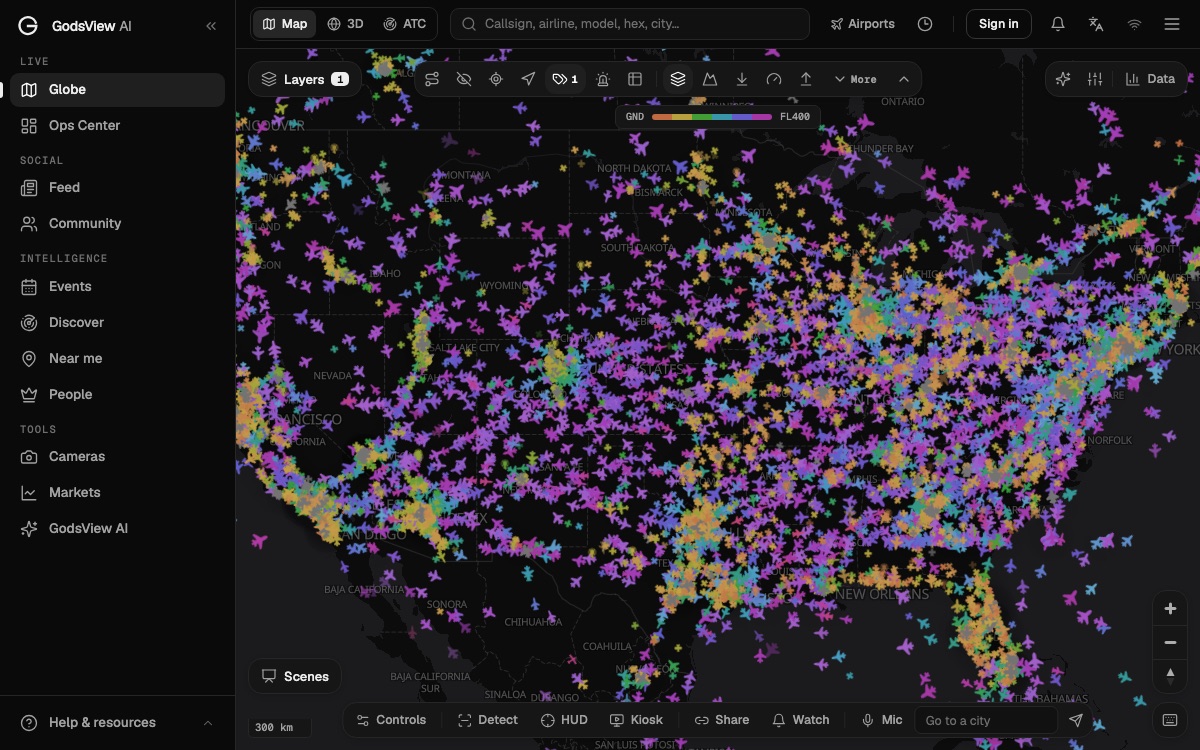
Why storms cause ground stops
The problem is often the airport, not the route. When a storm sits over or near a busy airport, arrivals and departures can't use the usual paths, and planes can't be marshalled on the ground while lightning is close. The FAA then holds flights at their origin airports with a ground stop or a ground delay program rather than sending them to circle. That's why your flight can be delayed on a sunny day: the storm is at the other end.
Wind shear and microbursts
The most dangerous storm hazard near the ground is the microburst, a small, intense downdraft less than about 2.5 miles across that spreads out when it hits the ground. An aircraft flying into one gets a sudden headwind, then a downdraft, then a tailwind that robs it of lift at low altitude. On August 2, 1985, Delta Air Lines Flight 191 crashed short of the runway at Dallas/Fort Worth after encountering a microburst on approach (NWS). That accident drove the installation of wind shear detection on airliners and Doppler weather radars at major airports. Today crews are trained to abort an approach at the first sign of wind shear.
What happens if lightning hits a plane?
Usually very little. According to the National Weather Service, commercial airliners are struck by lightning on average once or twice a year. Aircraft are designed with conductive paths through the skin, so the current passes through the outside of the plane and leaves again. Passengers may see a flash and hear a bang.
Lightning protection became far more rigorous after Pan Am Flight 214 was struck over Elkton, Maryland, on December 8, 1963; the strike ignited fuel vapour in a tank (FAA). Fuel tank and wiring standards have since been tightened. After a strike, the aircraft is inspected on the ground before its next flight, which can mean a delay.
Turbulence
Turbulence is the weather that most often hurts people on airliners. The NTSB found that turbulence was involved in more than a third of US airline accidents from 2009 to 2018, and most of the people seriously injured were flight attendants (NTSB). Most injuries involve people who were not wearing a seat belt.
Turbulence comes from storms, from wind flowing over mountains, and from clear-air turbulence near jet streams, which shows no sign on radar. Pilots share reports, and forecasters at the Aviation Weather Center issue turbulence forecasts, so crews can often change altitude to find smoother air. The aircraft itself is built to handle far more than passengers ever feel. The practical advice is simple: keep your seat belt fastened whenever you're seated.
Weather and flights at a glance
| Weather | Can planes fly? | What usually happens |
|---|---|---|
| Rain | Yes | Normal operations; longer landing distances on wet runways |
| Strong crosswind | Up to the aircraft and airline limit | Runway changes, go-arounds, holds or diversions |
| Fog | Yes, with ILS | Fewer arrivals per hour, ground delays, some diversions |
| Snow | Yes | De-icing, runway closures for ploughing, slower departures |
| Freezing rain | Rarely | Long de-icing queues, short holdover times, cancellations |
| Thunderstorms | Around them, not through | Reroutes, ground stops, holding |
How to check your flight and watch a ground stop live
When the weather looks bad, these are the places to look:
- Your airline's app. It has the final word on your flight, including rebooking options.
- FAA National Airspace System status. nasstatus.faa.gov lists US airports with active ground stops, ground delay programs, closures and the reason, often "weather / thunderstorms" or "low ceilings".
- The inbound aircraft. Your plane usually arrives from somewhere else first. Search your flight on the GodsView flight tracker or follow the guide on how to track a flight to see where the inbound aircraft is right now.
- The live map. On the GodsView live map, aircraft positions come from ADS-B receivers; our explainer on how ADS-B flight tracking works covers the details. During a ground stop you can see departures thin out at the airport and arrivals start holding. The live flight tracker page and free live flight tracker guide explain what's free.
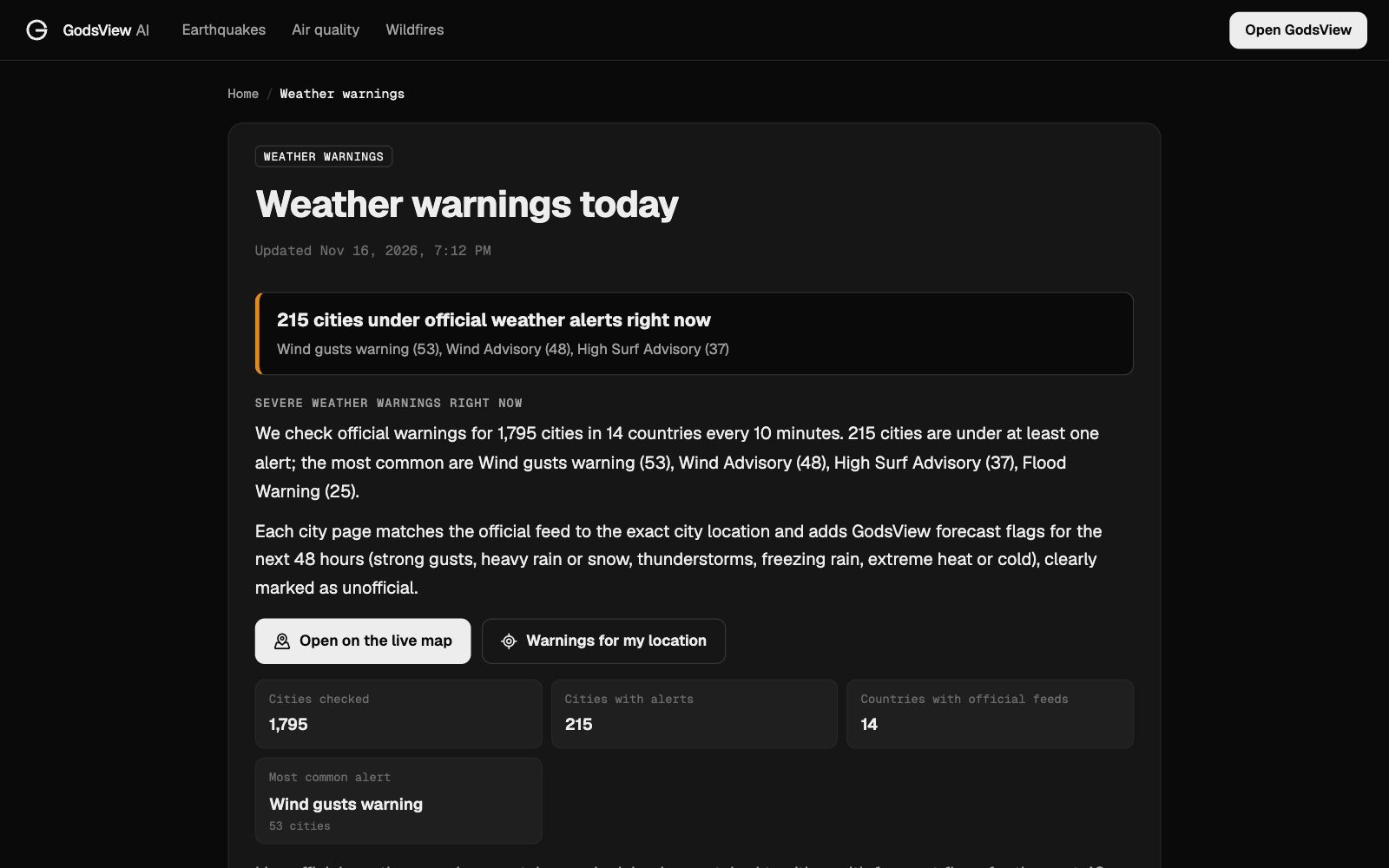
- Official weather alerts. The weather warnings page shows cities under official alerts right now. If you're not sure what a watch or a warning means for your trip, see weather watch vs warning.
A last tip: a delay posted hours before departure on a stormy day is often a good sign. It usually means the FAA or the airline has planned around the weather, and the flight is likely to go once the storm passes.
Frequently asked questions
Can planes take off in the rain?
Yes. Airliners take off and land in rain every day. Heavy rain mainly increases the runway length needed to stop, and grooved runways drain water to reduce hydroplaning.
Can planes fly in snow?
Yes. Snow is mostly a ground problem: aircraft must be de-iced before take-off, and runways need ploughing. Freezing rain causes more delays than snow.
Do planes fly through thunderstorms?
No. Airliners route around them. FAA guidance is to stay about 20 nautical miles from severe thunderstorms, so storms near airports lead to holding, reroutes and ground stops.
Can a plane land in fog?
Often, yes. With an Instrument Landing System, certified aircraft and trained crews, the most advanced CAT III approaches allow landings with runway visual range down to a few hundred feet. Fewer planes can land per hour, so delays are common.
Is it dangerous if lightning hits the plane?
Rarely. The NWS says airliners are hit on average once or twice a year. The current passes through the conductive skin, and the plane is inspected after landing.
How do I know if there is a ground stop?
Check the FAA status page at nasstatus.faa.gov, which lists ground stops and ground delay programs by airport. You can also watch traffic at the airport on the GodsView live map.
How much wind is too much for a plane?
It depends on the direction. Crosswind limits for common airliners are around the low-to-mid 30s of knots, and airlines often set lower limits on slippery runways. Tailwind limits are much lower.
Sources
- FAA: Weather delay FAQ
- FAA Advisory Circular 00-24C: Thunderstorms
- FAA Aeronautical Information Manual: Navigation aids (ILS)
- FAA: Ground deicing program and holdover time guidelines
- National Weather Service: Lightning and planes
- NWS Fort Worth: Delta Flight 191 at DFW
- NTSB: Preventing turbulence-related injuries in air carrier operations (2021)
- FAA: National Airspace System status
Facts checked on against each provider's own site.