Explainer
Houthi Red Sea Attacks: How They Changed Shipping (2023-2026)
Since late 2023, attacks by Yemen's Houthis have pushed a large share of Asia-Europe shipping around Africa. Here is what happened, year by year, where things stand in November 2026, and how to follow the Red Sea on a live map.
Key takeaways
- The Iran-backed Houthis began attacking commercial ships near the Bab el-Mandeb after the October 7, 2023, Hamas-led attacks on Israel; the IMO recorded 69 attacks on shipping between November 2023 and October 2024.
- Ships were seized (the Galaxy Leader, November 2023), sunk (including the Rubymar in 2024 and the Eternity C in July 2025) and crews killed, starting with three sailors on the True Confidence in March 2024.
- Attacks paused in early 2025, a US strike campaign from March to May 2025 ended in an Oman-brokered truce, and the Houthis renewed attacks on some non-US ships in July 2025.
- In 2026, during the conflict involving Iran, the Houthis threatened Israel-linked ships in June and Saudi-linked ships in July, and later extended threats to all Red Sea ports.
- Traffic is recovering but not back: Lloyd's List Intelligence counted Suez transits in October 2026 still 34% below pre-crisis levels and Bab el-Mandeb transits 46% below.
Houthi Red Sea attacks are the missile, drone and boarding attacks that Yemen's Houthi movement has carried out against merchant ships in and around the Red Sea since late 2023. They turned the Bab el-Mandeb, the southern gate of the Red Sea, into one of the most dangerous stretches of water in the world, and pushed a large share of Asia-Europe shipping onto the long route around Africa. As of November 2026, Houthi attacks on shipping are far less frequent than in 2024, but the threat has widened rather than ended, and traffic through the Red Sea is still well below its pre-crisis level.
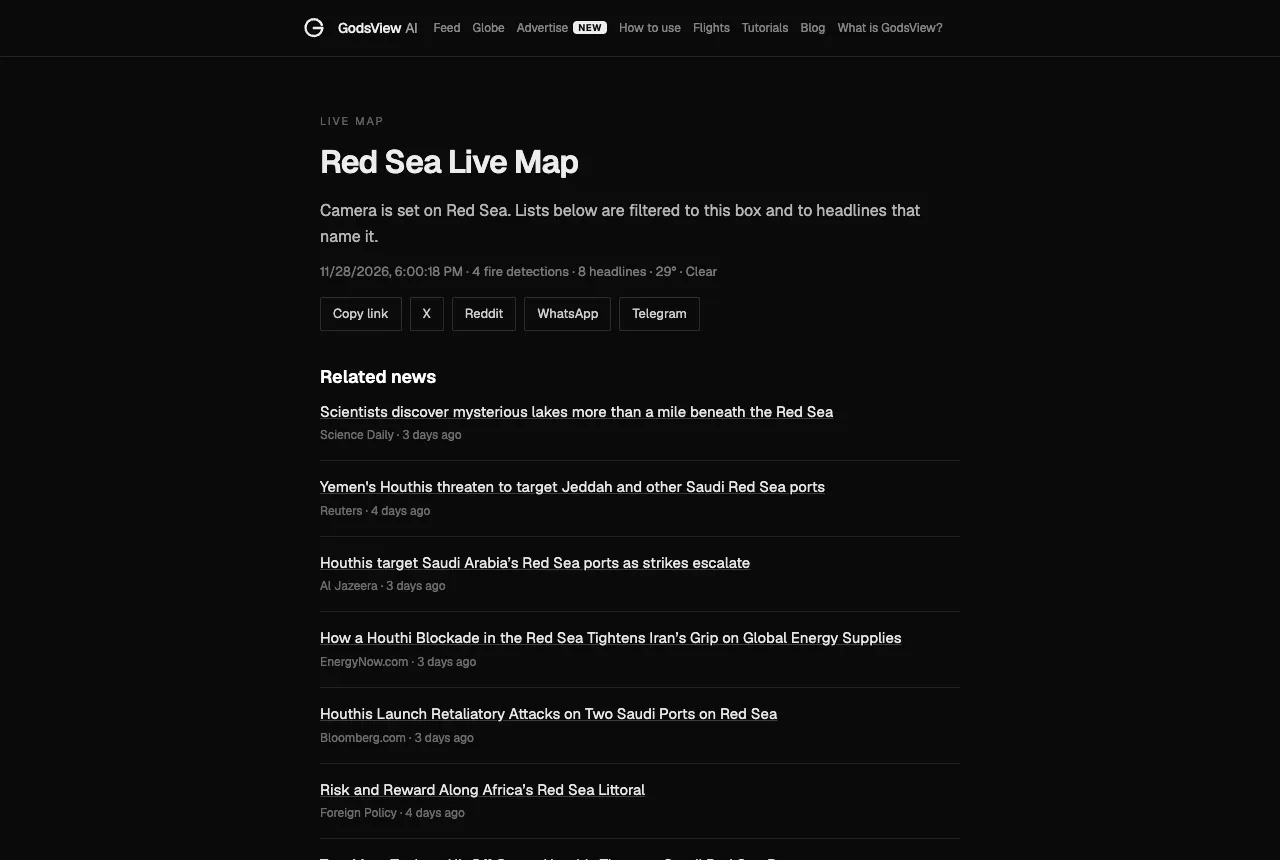
You can follow the area on GodsView's Red Sea live map, which shows ships, flights and geolocated news headlines over the Red Sea and the Gulf of Aden. This article explains who the Houthis are, what has happened since 2023, how it changed shipping, and how to follow new incidents.
Who the Houthis are and why they attack ships
The Houthis, also called Ansar Allah, are a north Yemen-based Zaydi Shia movement. They seized Yemen's capital Sana'a in 2014 and today control most of northwestern Yemen, including the Red Sea coast around Hodeidah. Since 2015 they have fought a civil war against Yemen's internationally recognised government and, until a 2022 truce, a Saudi-led coalition.
After the October 7, 2023, Hamas-led attacks on Israel and Israel's military operations in Gaza, the Houthis began targeting Israeli territory and commercial ships passing the Bab el-Mandeb, saying they would hit Israel-linked shipping. In practice, the US Congressional Research Service (CRS) notes, they targeted vessels from many countries. US officials have said Iran supplied the group with weapons, targeting information and military advice.
The US government redesignated the Houthis as a Foreign Terrorist Organization in March 2025. UN Security Council Resolution 2722 (2024) demands that the Houthis stop the attacks.
Timeline of Houthi attacks on shipping
| Date | Event |
|---|---|
| October-November 2023 | Houthis announce attacks on Israel-linked ships, then widen the targets to ships sailing to Israeli ports |
| 19 November 2023 | Houthi forces board the vehicle carrier Galaxy Leader and take it to Hodeidah; its 25 crew are held |
| 19 February 2024 | The EU launches naval operation ASPIDES to protect ships in the Red Sea |
| Early March 2024 | The cargo ship Rubymar, carrying fertiliser, sinks after being hit by the Houthis in February |
| 6 March 2024 | A missile hits the bulk carrier True Confidence about 50 nautical miles off Aden, killing three crew: the first deaths of the campaign |
| November 2023 to October 2024 | The IMO records 69 attacks on international shipping linked to the conflict |
| January 2025 | After the Israel-Hamas ceasefire, the Houthis halt some attacks; the Galaxy Leader crew are freed on 22 January after Omani mediation |
| 15 March to May 2025 | US forces conduct an expanded strike campaign in Yemen; it ends in an Oman-brokered truce in which the Houthis stop targeting US ships |
| 6-7 July 2025 | The Houthis attack the Magic Seas and the Eternity C, the first incidents since October 2024; the Eternity C sinks and four of its crew are reported dead |
| October 2025 | After the Israel-Hamas ceasefire, the Houthis suspend attacks on Israel |
| June-July 2026 | During the 2026 conflict involving Iran, the Houthis threaten Israel-linked ships (June) and Saudi-linked ships (July) |
| 7 October 2026 | A Chinese-operated container ship is fired upon in the southern Red Sea; the crew are safe and the Houthis do not claim it |
| November 2026 | The Houthis extend their targeting threats to all Red Sea ports, according to Lloyd's List |
2023-2024: the main campaign
The campaign started with a hijacking. On 19 November 2023 the Houthis boarded the Galaxy Leader, a Bahamas-flagged vehicle carrier linked to an Israeli businessman, and held its 25 crew, most of them Filipino, for 14 months. Missile and drone attacks followed throughout the southern Red Sea and the Gulf of Aden. The Rubymar sank after drifting for days, and the attack on the True Confidence in March 2024 was the first to kill seafarers. By the time of the January 2025 pause, PBS NewsHour reported more than 100 commercial ships targeted, two sunk and four sailors killed.
The US led the Operation Prosperity Guardian coalition patrolling the southern Red Sea, intercepted projectiles and struck Houthi targets. The EU launched EUNAVFOR ASPIDES on 19 February 2024 to accompany and protect merchant ships, a mission since extended to 28 February 2027.
2025: pause, strikes, truce and renewed attacks
Attacks paused in early 2025 after the Israel-Hamas ceasefire. The US began a wider campaign of strikes on 15 March 2025, intended to end the Houthis' capacity to threaten shipping. It ended in May 2025 under an agreement brokered by Oman: the Houthis would stop targeting US vessels and the US would halt strikes. In July 2025 the Houthis attacked two Greek-operated, Liberian-flagged ships. All 22 crew of the Magic Seas were rescued; the Eternity C sank, four crew were reported dead and others were missing, according to the UN. IMO Secretary-General Arsenio Dominguez called it "a renewed violation of international law and freedom of navigation."
2026: a wider threat
The 2026 conflict involving Iran, which began on 28 February, changed the picture again. With the Strait of Hormuz heavily disrupted, more Gulf trade moved through Saudi Arabia's Red Sea ports and the Bab el-Mandeb. The CRS reports that the Houthis restarted attacks on Israel during the conflict, threatened Israel-linked ships in June 2026, and, after strikes on Sana'a airport in July that they blamed on Saudi Arabia, said they would target Saudi-linked ships. By late November, Lloyd's List reported that the threat covered all Red Sea ports.
How the attacks changed Red Sea shipping
The most visible effect was the detour. Ships avoiding the Red Sea sail around the Cape of Good Hope, which the US Energy Information Administration (EIA) says adds about 15 transit days from the Arabian Sea to Europe.
| Measure | Before | After | Source |
|---|---|---|---|
| Oil through the Bab el-Mandeb | 9.3 million b/d (2023) | 4.2 million b/d (first half of 2025) | EIA |
| Oil through Suez and SUMED | 8.8 million b/d (2023) | 4.9 million b/d (first half of 2025) | EIA |
| Oil around the Cape of Good Hope | 6.0 million b/d (2023) | 9.2 million b/d (Jan-Aug 2024) | EIA |
| Suez Canal transits | About 2,009 a month (Jan-Nov 2023) | 1,338 (October 2026) | Lloyd's List Intelligence |
| Bab el-Mandeb transits | Pre-crisis level | 1,363 (October 2026), 46% lower | Lloyd's List Intelligence |
| LNG through the Bab el-Mandeb | Regular flows | 0.0 Bcf/d (first half of 2025) | EIA |
Longer voyages tie up more ships for the same cargo, which raises freight rates and insurance premiums. The CRS says the attacks diverted more than half of the pre-conflict maritime traffic from the Red Sea and drove up shipping costs, insurance premiums and ocean freight rates.
Is traffic coming back?
Slowly. Lloyd's List Intelligence's brief of 12 November 2026 counted 1,338 Suez transits in October, up 63% on a year earlier and the highest since the crisis began, but still 34% below the pre-crisis average. Container ship transits rose to 426 in October from 230 a year earlier, as Evergreen ended a near three-year absence from the Suez route. About half of container ship transits were made with tracking switched off. Our Suez Canal traffic guide has more on the canal side.
Are the Houthis still attacking ships?
The short answer, as of November 2026: attacks are much rarer than in 2024, but not over, and the list of potential targets has grown. Lloyd's List Intelligence reported a container ship fired upon in the southern Red Sea on 7 October 2026 that the Houthis did not claim, and a large explosion of unknown cause in the Bab el-Mandeb on 6 November. Lloyd's List reported on 27 November that calls by foreign cargo ships to 10 Saudi Red Sea ports fell 74% year on year in October, with many ships off Saudi Arabia sailing with tracking disabled.
The International Maritime Bureau also warns of ships off Yemen, in the Gulf of Aden and the southern Red Sea being approached by skiffs and hailed by radio, allegedly by Yemeni naval forces, and told to change course into Yemeni waters. Somali piracy in the Gulf of Aden has also risen in 2026; see piracy in Somalia today.
How to follow Red Sea attacks on a live map
Incidents are usually reported first by UKMTO and then by news outlets, often hours later. A live map helps you put a report in context.
- Open the Red Sea live map. It frames the Red Sea and Gulf of Aden with ships, flights and news.
- Find the reported position. UKMTO alerts usually give a distance and bearing from a port, such as "50 nautical miles southeast of Aden". Zoom to that area.
- Look at nearby ships. Ships slowing, turning or stopping near the position may be responding. Click one to see its type, speed and course.
- Check the headlines. The news layer places reports near Yemen and the Red Sea on the map.
- Rule out interference. JMIC has reported anomalous AIS positions near Port Sudan and the Suez approaches. Check the GPS jamming map before reading too much into a strange track.
- Widen the view. The Middle East live map and the military flight tracker show regional flights and military aircraft that broadcast ADS-B.
GodsView's ships come from a terrestrial AIS stream refreshed about every 30 seconds; flights come from ADS-B. The full map needs a free account. With GodsView Plus ($10.99 a month or $99.99 a year) you can set topic alerts, for example on "Houthi" or "Red Sea", and alerts for saved places.
What a live map can and cannot tell you
A map shows ships that broadcast where they are. In the Red Sea, many ships do not. Lloyd's List Intelligence's estimate that about half of container ship transits were dark in October 2026 means any AIS-only count of Red Sea traffic is too low. Warships seldom broadcast, so you will not see the escorts either. The map also cannot tell you why a ship stopped, what it carries or whether it has been threatened.
Use it for what it does well: a quick, current picture of traffic density, port approaches and the news around them. For anything that affects safety at sea, follow official advisories. For the methods behind conflict maps in general, read how live conflict maps work, and for the broader shipping picture, our guide to shipping chokepoints on a live map.
The short version
Since late 2023, Houthi attacks on merchant ships have seized one vessel, sunk others and killed seafarers, and pushed much of Asia-Europe trade around Africa. The campaign paused and restarted several times; in 2026 the Houthis widened their threats to Saudi-linked shipping and Red Sea ports. Traffic in October 2026 was rising but still well below pre-crisis levels. Watch the Red Sea live map for traffic and headlines, and rely on UKMTO and JMIC for the official picture.
See ships and news on the Red Sea live map
Frequently asked questions
Why are the Houthis attacking ships in the Red Sea?
The Houthis began attacking ships after the October 7, 2023, Hamas-led attacks on Israel and the war in Gaza, saying they were targeting Israel-linked shipping. In practice they hit ships from many countries. In 2026 they also threatened Saudi-linked ships after strikes on Sana'a airport that they blamed on Saudi Arabia.
Are the Houthis still attacking ships in 2026?
Attacks are much rarer than in 2024, but the threat continues. A container ship was fired upon in the southern Red Sea on 7 October 2026, and by November the Houthis had extended their targeting threats to all Red Sea ports, according to Lloyd's List. Check UKMTO alerts for the latest incidents.
How many ships have the Houthis attacked?
The IMO recorded 69 attacks on international shipping linked to the conflict between November 2023 and October 2024. By January 2025, PBS NewsHour reported more than 100 commercial ships targeted, two sunk and four sailors killed. Further ships were attacked in July 2025, when the Eternity C sank.
Which ships have the Houthis sunk?
They include the Rubymar, which sank in early March 2024 after being hit in February, and the Eternity C, which sank in July 2025 after attacks that killed at least four crew. The Galaxy Leader was seized in November 2023 rather than sunk.
Is it safe to sail through the Red Sea now?
Many ships do sail through, and October 2026 traffic was the highest since the crisis began, but threat levels remain elevated. Shipowners decide case by case using UKMTO, JMIC and naval guidance. Insurance and crew safety are the main factors.
How can I follow Red Sea attacks live?
Open the GodsView Red Sea live map to see ships, flights and geolocated headlines in one place, then confirm any incident with UKMTO alerts. Many ships sail with AIS off, so the map shows only part of the traffic.
Sources
- Congressional Research Service — Yemen: Conflict, Red Sea Security, and U.S. Policy (July 21, 2026)
- Congressional Research Service — Yemen: Conflict, Red Sea Attacks, and U.S. Policy (March 20, 2025)
- IMO — Secretary-General statement on renewed Red Sea attacks (July 8, 2025)
- UN News — Houthi attacks on Magic Seas and Eternity C (July 2025)
- PBS NewsHour — Houthi rebels release crew of Galaxy Leader (January 22, 2025)
- Al Jazeera — Houthi attack kills three sailors on True Confidence (March 6, 2024)
- EIA — World Oil Transit Chokepoints (updated March 3, 2026)
- EIA — Red Sea and Bab el-Mandeb oil flows (October 11, 2024)
- Lloyd's List Intelligence — Red Sea brief, 12 November 2026
- Lloyd's List Intelligence — Red Sea brief, 15 October 2026
- Lloyd's List — Saudi Red Sea port calls plunge as Houthi threat drives shipping dark (November 27, 2026)
- EEAS — About Operation EUNAVFOR ASPIDES
Facts checked on against each provider's own site.