Explainer
Piracy in Somalia Today: The 2026 Resurgence Explained
After years of near silence, Somali pirates are hijacking merchant ships again. Here is what the latest International Maritime Bureau figures show, where the attacks happen, how UKMTO and MSCIO handle reports, and what a live map can and cannot show.
Key takeaways
- Somali piracy has returned: the ICC International Maritime Bureau (IMB) says Somali pirates carried out all eight hijackings worldwide in January to September 2026 and took 94% of the crew held hostage globally.
- In those nine months, 15 ships came under attack off Somalia and in the Gulf of Aden, including four tankers, two general cargo ships and two dhows hijacked; one tanker was seized at a Yemeni anchorage and sailed to Somalia.
- The worst case was the product tanker Honour 25, hijacked off Somalia on 21 April 2026 and released on 30 September; Puntland authorities reported five crew killed and five injured.
- This is not yet the scale of 2011, when the IMB counted 236 Somali incidents, but the IMB says ships that follow Best Management Practices have not been successfully hijacked.
- Ships in the region report to UKMTO and register with the EU's Maritime Security Centre Indian Ocean (MSCIO); a public AIS map shows traffic, not pirate skiffs, which do not broadcast.
Piracy in Somalia is rising again in 2026. According to the ICC International Maritime Bureau (IMB), Somali pirates were behind all eight ship hijackings recorded worldwide from January to September 2026, and held 94% of all crew taken hostage anywhere in the world. Fifteen ships came under attack off Somalia and in the Gulf of Aden in those nine months. Global piracy is at its lowest level since 1992, so the Horn of Africa now stands out as the most dangerous area for merchant ships. The scale is still far below the peak of 2008 to 2013, but the IMB warns against complacency.
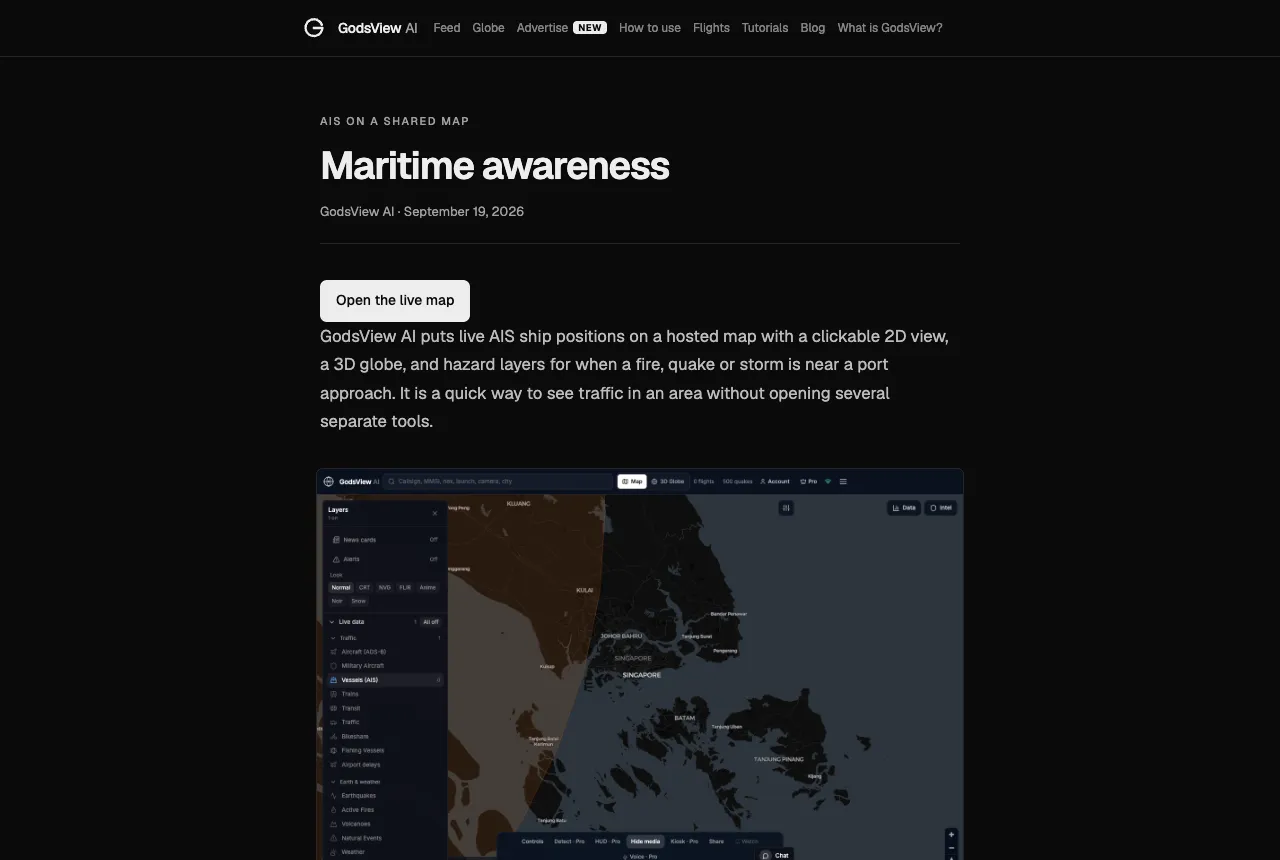
GodsView's maritime awareness view shows live AIS ship traffic in the Gulf of Aden and off the Somali coast, next to news and hazard layers. This guide explains what is happening, where, who reports it, and how to follow it.
Somali piracy in 2026: the numbers
The IMB's Piracy Reporting Centre (PRC) publishes quarterly reports based on incidents reported directly by ship masters and owners. Its January to September 2026 report gives the clearest current picture.
| Measure, January to September 2026 | Figure |
|---|---|
| Ships attacked by Somali pirates | 15 |
| Hijackings worldwide attributed to Somali pirates | 8 of 8 |
| Ships fired upon worldwide attributed to Somali pirates | 4 of 4 |
| Share of crew taken hostage globally | 94% |
| Crew taken hostage (all regions) | 90 |
| Types hijacked | 4 tankers, 2 general cargo ships, 2 dhows |
| All piracy and armed robbery incidents worldwide | 51, the lowest since 1992 |
Off Somalia and in the Gulf of Aden specifically, the IMB counted seven vessels hijacked, four fired upon, two attempted approaches and one boarding, plus one tanker hijacked at a Yemeni anchorage and then sailed to Somalia.
Most hijacked ships have been released with their crews safe. The exception was the Palau-flagged product tanker Honour 25. It was hijacked on 21 April 2026, about 6 nautical miles south-southwest of Durdura, Somalia, by around 30 people armed with RPGs and AK-47s, with 17 crew on board. It was released on 30 September 2026. Puntland authorities reported that five crew were killed and five injured during the hijacking.
Where Somali pirates attack
Somali pirates have historically operated in a very large area. The IMB lists the southern Red Sea and Bab el-Mandeb, the Gulf of Aden including the Yemeni and northern Somali coasts, the Arabian Sea off Oman, the Gulf of Oman, and the eastern and southern Somali coast. Ships have also been targeted off Kenya, Tanzania, the Seychelles, Madagascar, Mozambique and the west coast of India, and past incidents were recorded more than 1,000 nautical miles from the Somali coast.
The 2026 incidents fall into three groups:
- Off the Somali coast (Puntland). Several hijackings took place close to shore, between Eyl, Garacad and Durdura. The Cameroon-flagged general cargo ship MV Lutuf was hijacked about 24 nm northeast of Eyl on 17 August and released on 29 August. A St. Kitts and Nevis-flagged general cargo ship was hijacked about 20 nm north-northeast of Garacad on 26 April and released on 11 September.
- In the Gulf of Aden. A Tanzanian-flagged product tanker was hijacked on 17 July with 22 crew and sailed to Somalia, and an Eritrean-flagged product tanker was hijacked about 136 nm east of Mukalla, Yemen, on 20 August. In June, pirates fired on a container ship and a tanker in the Gulf of Aden; both escaped by speeding up and manoeuvring, and the tanker's armed guards returned fire.
- Far offshore and off Yemen. An Iranian-flagged dhow was hijacked about 400 nm east of Mogadishu in March. On 2 May, nine armed men seized a Togo-flagged tanker at anchor about 12 nm south of the Qana port terminal in Shabwa, Yemen, and sailed it to Somalia with its 12 crew; the IMB listed the case as ongoing.
The IMB says Somali pirates are usually armed with automatic weapons and RPGs, and sometimes use skiffs launched from "mother vessels", which may be hijacked fishing boats or dhows. That is one reason dhow hijackings matter: a captured dhow can extend the range of a pirate group. The IMB also notes that some hijackings of dhows and fishing boats may go unreported.
How the resurgence started
For several years after 2013, Somali piracy almost disappeared. The IMB dates the return to 14 December 2023, when it recorded the first successful hijacking of a merchant ship by Somali pirates since 2017. That ship was the Maltese-flagged cargo ship MV Ruen, seized near Yemen's Socotra island. It was held for three months until the Indian Navy intercepted it. In a 40-hour operation that ended on 16 March 2024, INS Kolkata, supported by other ships, aircraft and marine commandos dropped from a C-17, forced 35 pirates to surrender and freed 17 crew, almost 2,600 km from India's coast.
The IMB counted eight piracy incidents and hijackings off Somalia and in the Gulf of Aden in 2024. In 2025 two fishing vessels and a dhow were hijacked. The 2026 figures are the highest since the resurgence began.
The IMB report does not name a single cause. The same waters have also been the scene of the Red Sea crisis since late 2023. For that side of the story, see Houthi attacks on Red Sea shipping and the Bab el-Mandeb strait.
How today compares with the 2011 peak
| Period | Somali incidents | Hijackings | Source |
|---|---|---|---|
| 2010 | 219 | 49 | IMB, via ICC (January 2012) |
| 2011 | 236 | 28 | IMB, via ICC (January 2012) |
| 2024 | 8 piracy incidents and hijackings | Included in total | IMB (October 2026 report) |
| 2025 | 2 fishing vessels and a dhow hijacked | 3 | IMB (October 2026 report) |
| January to September 2026 | 15 ships attacked | 8 | IMB (October 2026 report) |
In 2011, Somali incidents rose to 236 but successful hijackings fell to 28 from 49 a year earlier. The ICC credited pre-emptive action by international navies, which disrupted at least 20 pirate action groups in the last quarter of 2011, along with ship hardening and armed security teams. The IMB says the 2026 incidents are "not comparable in scale or reach" to the deep-sea piracy of 2008 to 2013. The direction of travel is what worries shipowners.
Who fights piracy and who you report to
Naval forces
The EU's naval operation EUNAVFOR ATALANTA has run off the Horn of Africa since late 2008. In December 2024 the EU extended it to 28 February 2027, with a mandate to deter, prevent and repress piracy and armed robbery and to protect vulnerable shipping, including food aid deliveries. EU NAVFOR recorded 19 attacks and 15 suspicious approaches in 2024. Ships from many other navies also patrol the area; the IMB thanks coalition forces, NATO, the US Navy and the Indian, Chinese, Japanese, South Korean and other navies for assisting attacked ships.
Reporting channels
Merchant ships in the region use a voluntary reporting system:
- UKMTO (United Kingdom Maritime Trade Operations) receives reports from ships, issues security alerts, and is usually the first public source for a new incident.
- MSCIO, the Maritime Security Centre Indian Ocean, run by EUNAVFOR ATALANTA from Brest, France, is the successor to the former MSCHOA. It runs a Voluntary Registration Scheme and gives threat assessments and incident bulletins.
- The Voluntary Reporting Area covers the Indian Ocean, the Arabian Sea, the Gulf of Aden and the Red Sea. Ships send an initial report and daily position reports at 08:00 UTC; MSCIO warns that ships that do not report may get military help later in an incident.
- The IMB Piracy Reporting Centre, manned 24 hours a day since 1991, relays reports to response agencies and broadcasts alerts to ships through the GMDSS SafetyNET service.
What protects ships
The IMB's main message is simple: ships following the latest Best Management Practices (BMP) guidance have not been successfully hijacked. That means registering and reporting, hardening the ship before entering the area, keeping a 24-hour visual and radar watch, and taking early evasive action. The IMB also reminds crews that local fishermen may approach aggressively to protect their nets, and some may be armed, so they should not be mistaken for pirates.
How to follow Somali piracy on a live map
A live map will not show pirates. Skiffs and most dhows do not broadcast AIS. What it can show is the traffic around a reported incident and the wider pattern of shipping in the area.
- Start with an alert. UKMTO and IMB reports give a position, often as a distance and bearing from a coastal town such as Eyl or Garacad.
- Open the map. Use maritime awareness or the live ship tracker, switch on Vessels and zoom to the Gulf of Aden or the Puntland coast.
- Look at nearby traffic. Ships changing course or speeding up near the reported position may be reacting to an approach.
- Compare ships with their neighbours. Most ships in the Gulf of Aden follow similar east-west tracks between the Red Sea and the Arabian Sea. A ship behaving very differently from those around it may be worth a second look.
- Remember the gaps. A hijacked ship may switch off AIS, and terrestrial AIS coverage thins out far offshore. A ship disappearing from the map is not proof of anything.
- Check the news layer on the Red Sea live map, which covers the Gulf of Aden, for reports of new incidents.
GodsView's ship positions come from a terrestrial AIS stream refreshed about every 30 seconds, and the full map needs a free account. GodsView Plus ($10.99 a month or $99.99 a year) adds alerts for saved places and topics, so you can be told when "Somali piracy" or "Gulf of Aden" appears in the news. GodsView is a public-data map for awareness, not a security service: if you are at sea, use UKMTO, MSCIO and your company security officer.
What the map cannot tell you
| Question | Can a public AIS map answer it? |
|---|---|
| Where are the pirate skiffs? | No. They do not broadcast AIS. |
| Has a ship been hijacked? | Not on its own. Official reports confirm hijackings. |
| Which ships carry armed guards? | No. That is not in AIS data. |
| How busy is the Gulf of Aden right now? | Partly, for ships within receiver range that transmit. |
| Where was the latest attack? | Only through linked news and official alerts. |
For a broader look at what AIS can and cannot do, read what is AIS ship tracking?, and for why some ships deliberately disappear from it, see dark fleet ships explained.
The short version
Somali piracy is back. From January to September 2026, Somali pirates carried out every hijacking recorded worldwide, attacked 15 ships and held most of the world's seafarer hostages, and five crew of the Honour 25 were killed. It is far smaller than the 2011 peak, and ships that follow BMP have not been hijacked. Follow incidents through UKMTO and IMB reports, and use a live map to see the traffic around them.
See Gulf of Aden traffic on the live ship tracker
Frequently asked questions
Is there still piracy in Somalia?
Yes. The IMB reports that Somali pirates attacked 15 ships from January to September 2026, carried out all eight hijackings recorded worldwide, and held 94% of the crew taken hostage globally.
Where do Somali pirates operate?
Mostly in the Gulf of Aden and off the northern and eastern Somali coast, especially Puntland, but the IMB says they have historically attacked in the southern Red Sea, the Arabian Sea, off Oman, Kenya, Tanzania, the Seychelles and India, sometimes more than 1,000 nautical miles from Somalia.
Why did Somali piracy come back?
The IMB dates the resurgence to the hijacking of MV Ruen in December 2023, the first successful hijacking of a merchant ship by Somali pirates since 2017. The IMB report does not name a single cause.
Who do ships report pirate attacks to?
Ships in the region report to UKMTO and register with the EU's Maritime Security Centre Indian Ocean (MSCIO) under a voluntary reporting scheme, and can also report to the IMB Piracy Reporting Centre, which relays reports to navies and broadcasts alerts to ships.
Is Somali piracy as bad as in 2011?
No. In 2011 the IMB counted 236 Somali incidents and 28 hijackings. In the first nine months of 2026 there were 15 attacks and 8 hijackings. The IMB says current incidents are not comparable in scale or reach to the 2008 to 2013 era, but they are increasing.
Can I see pirates on a ship tracking map?
No. Pirate skiffs do not broadcast AIS, and hijacked ships may switch theirs off. A map such as GodsView maritime awareness shows the traffic around an incident; official UKMTO and IMB reports confirm what happened.
Sources
- ICC International Maritime Bureau — Piracy and Armed Robbery Against Ships, January to September 2026
- ICC — Maritime piracy incidents remain at historic lows despite Somali piracy concerns (October 15, 2026)
- The Maritime Executive — Maritime piracy in 2026 fell to 1992 levels despite Somalia-Yemen surge (October 16, 2026)
- ICC — Piracy attacks in East and West Africa dominate world report (January 2012)
- EUNAVFOR — The Maritime Security Centre Indian Ocean (MSCIO)
- MSCIO — Voluntary reporting
- The Maritime Executive — EU extends Horn of Africa maritime security mission to 2027
- All India Radio News — Indian Navy rescues 17 crew of MV Ruen, captures 35 pirates (March 17, 2024)
Facts checked on against each provider's own site.