Explainer
What Is a Flight Call Sign? Callsigns vs Flight Numbers
Your ticket says one thing, the flight tracker says another, and the pilot on the radio says something else again. Here is how call signs work for airlines, private planes and the military, and why they so often fail to match the flight number.
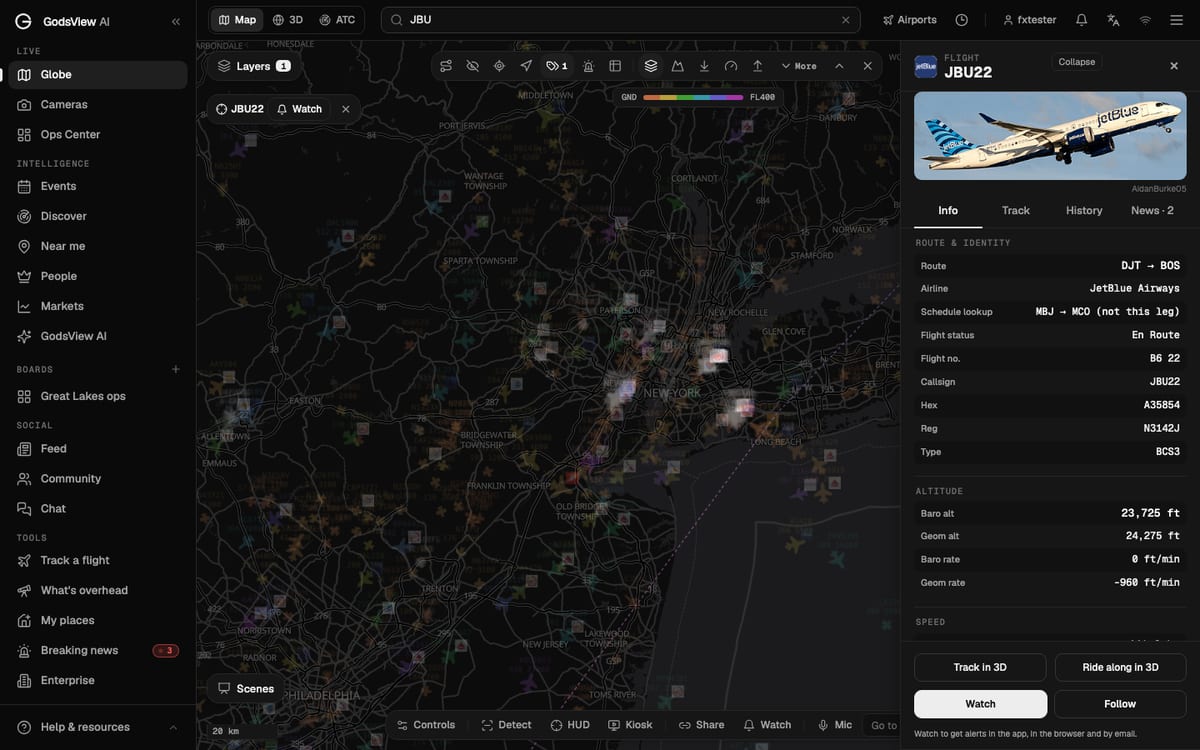
Key takeaways
- A call sign is how an aircraft identifies itself to air traffic control. For airlines it is a three-letter ICAO code plus a number, such as BAW117; on the radio the code is spoken as a word, such as "Speedbird".
- The flight number on your ticket uses the two-character IATA code instead, such as BA117. Trackers show the call sign because that is what the aircraft broadcasts.
- Private planes usually use their registration as the call sign. Military aircraft use service names, serial numbers or word call signs such as REACH or SAM.
- Call signs can differ from flight numbers on purpose: airlines use letter suffixes to avoid similar-sounding call signs, and codeshare flights broadcast the operating airline's code.
- To track a flight, search the ticket number on a tool that converts it, or search the call sign, registration or hex code on a live map.
A flight call sign is the name an aircraft uses when it talks to air traffic control, and the identity it broadcasts to flight trackers. For an airline flight it is usually the airline's three-letter ICAO code plus a number, such as BAW117 for British Airways. On the radio, the three letters are replaced by a spoken word, so BAW117 is called "Speedbird 117". The flight number on your ticket, BA117, uses a different two-letter code and is meant for passengers, not pilots.
Most of the time the two line up neatly. Sometimes they don't, and that is the main reason people can't find a flight on a live map. This guide explains every part of a call sign, the formats used by airlines, private pilots and the military, and why the code on the tracker can look nothing like the one on your boarding pass.
For the step-by-step tracking guide, see how to track a flight. This page goes deeper on the call sign itself.
Track a flight by number or call sign
Call sign vs flight number: the short version
| Flight number | Call sign (written) | Call sign (spoken) | |
|---|---|---|---|
| Example | BA117 | BAW117 | "Speedbird One One Seven" |
| Airline part | IATA code, two characters | ICAO designator, three letters | Telephony designator, a word |
| Who uses it | Passengers, tickets, airport boards | Flight plans, radar, ADS-B, trackers | Pilots and controllers on the radio |
| Unique to | One scheduled service | One flight on one day (usually) | The same |
Three things change between the ticket and the radio. The airline code changes from IATA to ICAO. The ICAO code is pronounced as a word. And sometimes the number changes too. The rest of this page takes each in turn.
The parts of an airline call sign
An airline call sign has two parts: the operator and the flight identifier.
The three-letter designator. ICAO assigns three-letter designators to aircraft operating agencies and publishes them in Doc 8585 (ICAO). In the US, the FAA publishes the same list in its contractions handbook, JO 7340.2, alongside the spoken telephony for each company (FAA JO 7340.2, chapter 3).
The telephony designator. This is the word said on the radio in place of the three letters. Some are obvious, some are not. A few examples from the FAA list:
| Operator | ICAO designator | Telephony (spoken) |
|---|---|---|
| British Airways | BAW | SPEEDBIRD |
| British Airways Shuttle | SHT | SHUTTLE |
| Aer Lingus | EIN | SHAMROCK |
| Air France | AFR | AIRFRANS |
| easyJet UK | EZY | EASY |
| Qatar Airways | QTR | QATARI |
| JetBlue | JBU | JETBLUE |
| American Airlines | AAL | AMERICAN |
| Republic Airways | RPA | BRICKYARD |
| NetJets Aviation | EJA | EXECJET |
| US Air Mobility Command | RCH | REACH |
All of these come from the FAA's list. Telephony words are chosen to be clear over a noisy radio, which is why some airlines use a word that has nothing to do with their name.
The flight identifier. After the designator comes the number, sometimes with letters. Controllers say it in "group form", meaning the number is read as a whole or in pairs rather than digit by digit, for example "American Fifty-two" or "Southwest One Ten". They may switch to single digits for clarity (FAA JO 7110.65, 2-4-20).
Heavy and super. Large aircraft add a word to the spoken call sign. FAA rules say "super" or "heavy" must be used as part of the identification with or about those aircraft, as in "United Fifty-Eight Heavy". There is one famous exception: controllers do not add "heavy" to "Air Force One" or "Air Force Two", whatever the aircraft type (FAA JO 7110.65, 2-4-14).
Why the tracker's call sign doesn't match your ticket
There are four common reasons.
1. The airline code is different. This one is predictable. BA117 on the ticket is BAW117 on the map. Once you know the ICAO code, you can convert most flight numbers in your head.
2. The airline uses an alphanumeric call sign. Airlines usually number flights in sequence, so many call signs end up sounding alike on the same frequency. SKYbrary's guidance on call sign confusion notes that airlines allocate commercial flight numbers as call signs, that these are "normally consecutive and therefore similar", and recommends avoiding four-digit sequences, repeated digits and similar or reversed digits and letters (SKYbrary). The usual fix is a call sign with letters in it, such as a number followed by a two-letter suffix. Your flight might be sold under one number and fly under a call sign that mixes digits and letters and looks nothing like it. The FAA's own handbook has a procedure for similar-sounding call signs on one frequency, such as saying "United Thirty-one United" so pilots don't take each other's clearances (FAA JO 7110.65, 2-4-15).
3. It's a codeshare. A codeshare is an arrangement where one airline's designator code is used to identify a flight operated by another airline. US rules require airlines and ticket agents to tell passengers when this happens and to disclose the "transporting carrier's identity" (14 CFR Part 257). The aircraft only broadcasts one call sign, and it belongs to the operating carrier. If your ticket says one airline and the small print says "operated by" another, search the operating airline's code.
4. A regional airline flies it. Flights sold under a large airline's brand are often flown by a regional partner. The tracker may then show the regional operator's own ICAO code, such as SKW for SkyWest, ENY for Envoy or RPA for Republic, with a flight number that may or may not match the ticket.
A small fifth reason: some flight numbers on tickets have leading zeros, such as BA0117, that the call sign drops. GodsView's flight status page strips those for you.
Call signs for private planes and helicopters
Most general aviation aircraft have no airline code. They use their registration as the call sign.
In the US, a controller starting contact with a US-registered aircraft says "November" followed by the registration in the phonetic alphabet, for example "November One Two Three Four Golf". Pilots may use the aircraft type or manufacturer instead, and when they do, the N is dropped: "Bonanza Six Five Five Golf" or "Sikorsky Six Three Eight Mike Foxtrot" (FAA JO 7110.65, 2-4-20). After contact is established, controllers may shorten it to the prefix and the last three characters (FAA AIM 4-2-4).
Some other formats you may hear or see:
- Tango. Air taxi and other commercial operators without an FAA-authorized call sign put the word "Tango" in front of their registration.
- MEDEVAC. Air ambulance flights that need priority handling say "MEDEVAC" before their call sign on the radio. The AIM gives the example of a flight identified as MDSTR1 being called "MEDEVAC Medstar One", and a registration flight identified as N123G or LN123G being called "MEDEVAC One Two Three Golf".
- Student pilot. Student pilots may add "student pilot" to their first call so controllers know to give extra help.
On a flight tracker, a private plane usually shows its registration where an airliner shows its call sign. That makes it easy to look up: for a US aircraft, search the N-number in the FAA registry to see the make, model and registered owner. Some owners use a privacy program instead, so the tracker shows a position but no name. Our guide on how to track helicopters live covers the low-flying side of this.
Military call signs
Military aircraft follow their own formats, and some of them are easy to spot on a tracker. The FAA controllers' handbook lists the main US patterns (FAA JO 7110.65, 2-4-20):
| Format | Example | Used for |
|---|---|---|
| Service name plus last 5 digits of serial | "Navy Five Six Seven One Three", "Army Copter Three Two One Seven Six" | Routine flights |
| REACH plus serial digits | "Reach Seven Eight Five Six Two" | Air Mobility Command transport |
| SAM plus serial digits | "Sam Niner One Five Six Two" | Special Air Mission (government VIP transport) |
| Air Evac, Rescue | "Air Evac One Seven Six Five Two" | Medical evacuation and rescue |
| A pronounceable word of 3 to 6 letters plus a number | "Pat One Five Seven", "Gaydog Four" | Tactical and training flights |
| Service name plus "One" or "Two" | "Air Force One", "Marine One" | The President or Vice President aboard a military aircraft |
"Air Force One" is not the name of a plane. It is the call sign of whichever Air Force aircraft the President is on. When the President flies on a civil aircraft, the call sign is "Executive One".
On a tracker, military aircraft that broadcast often show these as short codes, such as RCH followed by digits for REACH. Many military aircraft don't broadcast at all. The military flight tracker shows the ones that do, and our military aircraft tracking explainer covers the gaps.
Where the call sign comes from on a flight tracker
The call sign you see on a live map is not looked up from a schedule. The crew enters it into the aircraft's avionics, and the aircraft broadcasts it in its ADS-B identification message. That message has room for eight characters. The 1090 Megahertz Riddle, an open textbook on the protocol, puts it plainly: a call sign "is not a unique identifier of an aircraft, since different aircraft flying the same route at different times would share the same callsign" (mode-s.org).
That has two practical effects.
- Typos happen. A crew can enter the wrong call sign or leave the field blank. When that happens, a tracker shows an odd code or only the hex code.
- The call sign follows the flight, not the plane. BAW117 today and BAW117 tomorrow may be different aircraft. To follow one airframe, use its registration or its six-character hex code, which stays with the aircraft.
How to track a plane by its call sign
- If you have a ticket, open Track a flight and type the flight number as printed, such as BA117. The page maps the IATA airline code to the ICAO code and searches the live data for the matching call sign. You can also type the call sign itself, such as BAW117.
- If you have a call sign, open the live flight tracker or the globe and type it into the search box. Partial searches work too: typing an airline's ICAO code lists that airline's live flights.
- If the search fails, check the "operated by" line on your booking for a codeshare, and try the operating airline's code. Then try the aircraft's registration or hex code if you know it.
- Once you have it, click the aircraft to see the hex code, registration, type, altitude and speed. Copy the hex code if you want to follow the same airframe later.
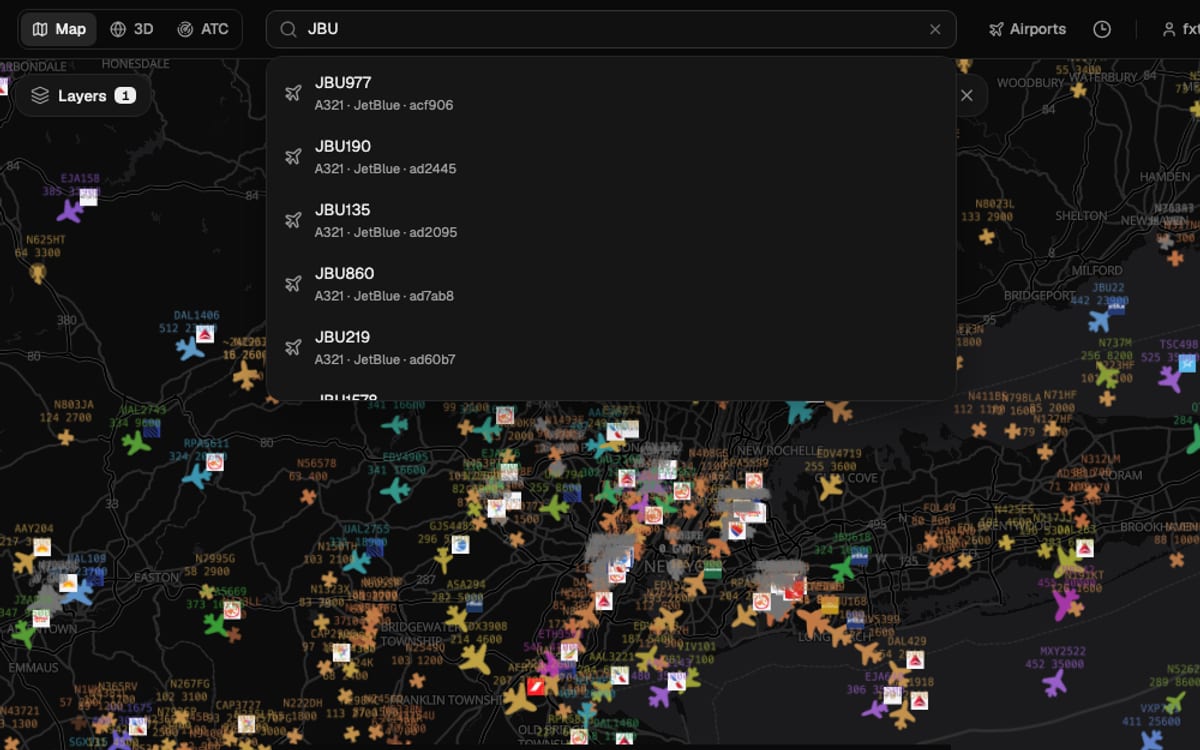
Search a call sign on the live map
What call signs can't tell you
A call sign identifies a flight to controllers. It doesn't say where the flight is going, whether it is late, or why it is doing something unusual. Route data on trackers comes from separate databases and can be wrong for charters, repositioning flights and diversions.
The four-digit squawk code is a separate identifier. Controllers assign it to match the radar return to the flight, and a few codes have special meanings. If you see a flight on 7700 or 7600, read what squawk 7700 means before drawing conclusions.
Quick reference
- Ticket: IATA airline code plus number. BA117.
- Tracker: ICAO designator plus number or alphanumeric suffix. BAW117.
- Radio: telephony word plus the number in group form. "Speedbird One Seventeen" or "Speedbird One One Seven".
- Private plane: the registration. "November One Two Three Four Golf".
- Military: service name and serial, or a word call sign. REACH, SAM, Air Force One.
- One airframe over time: registration or hex code, not the call sign.
Frequently asked questions
What is a flight call sign?
It is the identity an aircraft uses with air traffic control and broadcasts to flight trackers. For airlines it is the three-letter ICAO code plus a number, such as BAW117, spoken on the radio with a telephony word, such as "Speedbird 117".
Is the call sign the same as the flight number?
Not exactly. The flight number on your ticket uses the two-character IATA code (BA117), while the call sign uses the three-letter ICAO code (BAW117). Some airlines also use alphanumeric call signs that do not match the flight number at all.
Why is British Airways called Speedbird?
Speedbird is the radio telephony designator assigned to British Airways' ICAO code BAW. Telephony words are what pilots and controllers say instead of the three letters, and many do not match the airline's name.
Why can I not find my flight by flight number on a tracker?
The tracker may show the ICAO call sign, an alphanumeric call sign, or the operating airline's code on a codeshare or regional flight. Try Track a flight, which converts ticket numbers, or search the registration or hex code.
What call sign do private planes use?
Usually the registration. In the US, controllers say "November" and the registration in the phonetic alphabet, or the pilot can use the aircraft type, such as "Bonanza Six Five Five Golf".
Is Air Force One a specific plane?
No. It is the call sign for any Air Force aircraft carrying the US President. "Marine One" is used when the President is on a Marine helicopter, and "Executive One" when the President is on a civil aircraft.
Sources
- FAA Order JO 7110.65, chapter 2 section 4: Radio and interphone communications (2-4-14, 2-4-15, 2-4-20)
- FAA Aeronautical Information Manual 4-2-4: Aircraft call signs
- FAA JO 7340.2, chapter 3: ICAO three-letter designators and telephony
- ICAO Doc 8585: Designators for Aircraft Operating Agencies
- SKYbrary: Call sign confusion
- 14 CFR Part 257: Disclosure of code-sharing arrangements
- Junzi Sun, The 1090 Megahertz Riddle: ADS-B aircraft identification
Facts checked on against each provider's own site.