Reference
Squawk Codes List: 7500, 7600, 7700, 1200, 7000 and More
A squawk code is the four-digit number a pilot dials into the transponder so air traffic control can tell aircraft apart. Most are routine, a handful mean trouble. Here is the full list of the codes you will see on flight trackers, what each one means in the US and Europe, and where to watch emergency squawks live.
Key takeaways
- A squawk code is a four-digit transponder code from 0000 to 7777 (each digit runs 0 to 7, giving 4,096 codes) that air traffic control assigns or that pilots set by rule.
- Three codes signal emergencies worldwide: 7700 for a general emergency, 7600 for radio communication failure, and 7500 for unlawful interference (hijacking).
- In the US, VFR pilots squawk 1200 unless ATC says otherwise; in Europe the EU rules (SERA) say pilots not receiving air traffic services select 7000, and 2000 when there are no code instructions.
- Other US special codes include 1202 for VFR gliders, 1255 for firefighting aircraft, 1277 for VFR search and rescue, 4000 for military aircraft in restricted or warning areas, 7400 for unmanned aircraft that have lost their control link, and 7777, reserved for military interceptors.
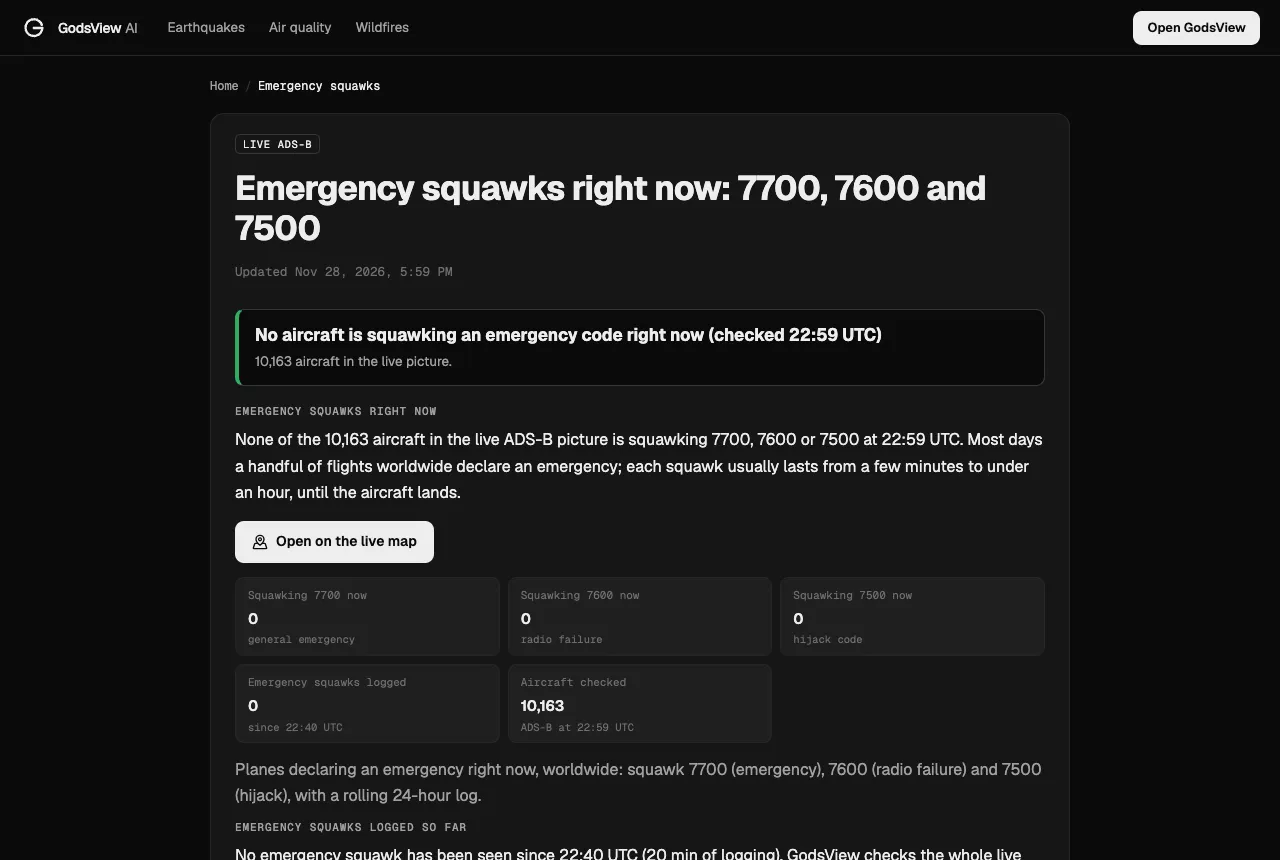
- GodsView's emergency squawks page shows which aircraft in the live ADS-B picture are squawking 7700, 7600 or 7500 right now, free and without an account.
A squawk code is a four-digit number that a pilot sets on the aircraft's transponder so air traffic control (ATC) can identify the aircraft on radar. Most squawk codes are routine: a discrete code ATC assigns to one flight, or a standard code such as 1200 for small planes flying visually in the US. A few codes carry a message: 7700 means emergency, 7600 means radio failure and 7500 means hijacking. Each digit runs from 0 to 7, so there are 4,096 possible codes, from 0000 to 7777.
You can see squawk codes on most flight trackers. Below is the list of codes that matter, with what they mean under US FAA rules and the EU's Standardised European Rules of the Air (SERA), followed by tips on reading them on a live map.
See emergency squawks right now
Squawk codes list
| Code | Meaning | Where it applies |
|---|---|---|
| 7700 | General emergency (distress or urgency) | Worldwide |
| 7600 | Loss of two-way radio communication | Worldwide |
| 7500 | Unlawful interference (hijacking) | Worldwide |
| 1200 | VFR flight, no other code assigned | United States (regardless of altitude) |
| 7000 | VFR conspicuity, not receiving air traffic services | Europe under SERA, including the UK, unless the national authority says otherwise |
| 2000 | No code instructions received from ATC | Europe under SERA, unless the national authority prescribes another code |
| 1202 | VFR glider | United States |
| 1203 | Lead aircraft of a VFR formation not receiving ATC services | United States |
| 1255 | Firefighting aircraft not in contact with ATC | United States |
| 1277 | VFR search and rescue missions for the USAF or USCG | United States |
| 4000 | Military aircraft in restricted or warning areas, and some flights with frequent altitude changes | United States |
| 7400 | Unmanned aircraft that has lost its control link | United States |
| 7777 | Reserved for military interceptor operations; never to be used by civil aircraft | United States |
Any other code is normally a discrete code assigned by ATC to one flight, for example 2102, which a controller would read as "two one zero two". The FAA notes that ATC may occasionally assign a non-discrete code, one ending in "00".
The emergency codes: 7700, 7600 and 7500
Squawk 7700: emergency
The FAA's Aeronautical Information Manual (AIM) says a pilot facing a distress or urgency condition who wants to alert a ground radar facility should squawk 7700 with altitude reporting, then establish radio contact with ATC. Radar facilities are set up so that 7700 normally triggers an alarm or special indicator at every control position. The radio phrase "SQUAWK MAYDAY" means the same thing.
It is the code for any distress or urgency condition, not one specific problem. The EU rule adds that if ATC has already assigned a code, the pilot may still select 7700 whenever there is a specific reason to think it is the best course of action. Our guide what does squawk 7700 mean covers what happens next on the ground and in the air.
Squawk 7600: radio failure
If an aircraft with a transponder loses two-way radio contact, the pilot should set 7600. The pilot then follows the published lost-communication procedures. Transport Canada's AIM gives the same instruction for IFR flights, telling pilots to keep a listening watch on the appropriate frequencies, and in Canada a VFR pilot who loses communications in a control zone is told to set 7600, leave the airspace and inform ATC as soon as possible.
Squawk 7500: hijack
7500 means the aircraft is being subjected to unlawful interference. The AIM's code word is "TRANSPONDER SEVEN FIVE ZERO ZERO", meaning "I am being hijacked/forced to a new destination". ATC will never assign 7500 unless the pilot has first said the aircraft is under unlawful interference, and controllers confirm a 7500 by asking the pilot to verify it. If it was a mistake, the pilot says in the clear that the aircraft is not being subjected to unlawful interference and resets the code. Under the EU rules, if a pilot asked to confirm 7500 does not reply, ATC treats that as confirmation that the code was not set by accident.
VFR codes by country: 1200, 7000 and 2000
United States. The AIM says that unless ATC instructs otherwise, VFR pilots set 1200 "regardless of altitude", with altitude reporting on. A pilot who cancels an IFR flight plan before landing switches to the VFR code.
Europe (EU and UK). SERA.13005, the European rule for transponder code setting, gives three cases outside emergencies:
- Select the code instructed by the ATS unit.
- With no ATS instructions related to code setting, select 2000 or another code prescribed by the competent authority.
- When not receiving air traffic services, select 7000 "in order to improve the detection of suitably equipped aircraft" unless the competent authority prescribes otherwise.
The UK CAA publishes the same rule in its regulatory library for the UK version of Regulation 923/2012. Because the rule lets each competent authority prescribe other codes, national publications can add their own.
Canada and elsewhere. National aeronautical information publications set their own VFR and IFR conspicuity codes. Check the country's AIP or AIM before flying there; the three emergency codes are the same everywhere.
Other US special codes
- 1202 (gliders): VFR gliders squawk 1202 instead of 1200.
- 1203 (formation flights): in a VFR formation not receiving ATC services, only the lead aircraft transmits and squawks 1203; the others go to standby.
- 1255 (firefighting): firefighting aircraft not in contact with ATC may squawk 1255 while going to, from or within the firefighting area. Over a large fire you may see several on the live wildfire map.
- 1277 (search and rescue): VFR aircraft flying authorized SAR missions for the Air Force or Coast Guard may be told to squawk 1277.
- 4000 (military): military pilots in restricted or warning areas squawk 4000 unless ATC assigns another code. ATC can also assign 4000 to flights with frequent or rapid altitude changes, such as some flight tests, military training routes and aerial refueling.
- 7400 (drone lost link): FAA controller instructions say unmanned aircraft systems may transmit 7400 when the control link between the aircraft and the pilot is lost. On controller screens it shows as "LLNK" or "LL".
- 7777 (interceptors): reserved for military interceptor operations. The AIM says civil aircraft must not use it "under no circumstances".
Where to see squawk codes live
Squawk codes reach public flight trackers through the same signals that carry position: ADS-B messages and Mode S replies picked up by volunteer receivers. Our guide on how ADS-B flight tracking works explains the technology.
GodsView's emergency squawks page checks the live picture for 7700, 7600 and 7500 and lists any aircraft using them with callsign and altitude. It is free and needs no account.
To look at any aircraft's code, click it on the live flight tracker or search its flight number on Track a flight. If a flight is circling while squawking 7700, our explainer on why a plane is circling covers the usual reasons. GodsView Plus ($10.99 a month or $99.99 a year) adds alerts for flights you follow.
How to read a squawk on a tracker
- Check it lasts. A code that flashes 7700 for a few seconds may be a pilot passing through it while changing codes, which the FAA warns causes momentary false alarms.
- Look at the flight path. A real emergency usually comes with a turn back, a diversion, a descent or holding.
- Treat 7500 with care. The FAA's own procedures allow for a 7500 set by mistake, and only official sources can confirm either way. Don't spread a hijack claim based on a tracker alone.
- Remember the gaps. A tracker shows only what a receiver hears. An emergency over the ocean may not appear at all.
Squawk, ADS-B and Mode S: what is the difference?
Controllers still tell pilots to "squawk" a code. Today the code is sent by a Mode A/C or Mode S transponder and, on aircraft with ADS-B Out, also included in ADS-B broadcasts. The AIM says ADS-B Out systems also report altitude automatically, in 100-foot steps. That is why public trackers can show both an aircraft's squawk and its altitude, and why an emergency code reaches the public almost as fast as it reaches ATC.
The short version
Three codes mean trouble anywhere: 7700 emergency, 7600 radio failure, 7500 hijack. 1200 is the US VFR code; 7000 is the European VFR code when not receiving a service, and 2000 is the European default with no instructions. The rest are either special-purpose codes such as 1255 for firefighters and 7777 for military interceptors, or discrete codes ATC assigns to individual flights.
Frequently asked questions
What are the three emergency squawk codes?
7700 for a general emergency, 7600 for loss of radio communication, and 7500 for unlawful interference (hijacking). They are used worldwide.
What does squawk 1200 mean?
In the United States, 1200 is the code VFR pilots set when ATC has not assigned another code, regardless of altitude. It usually means a small private aircraft flying under visual flight rules.
What does squawk 7000 mean?
In Europe and the UK, under SERA.13005, pilots who are not receiving air traffic services select 7000 so they are easier to detect, unless the national authority prescribes another code. It is the European equivalent of the US 1200.
What is squawk 2000?
Under the European rules, pilots with no ATC instructions about code setting select 2000 or another code prescribed by the national authority.
What does squawk 7777 mean?
It is reserved for military interceptor operations. The FAA says civil aircraft must never use it.
What does squawk 7400 mean?
FAA controller instructions say unmanned aircraft systems may transmit 7400 when the control link between the aircraft and the pilot is lost.
How many squawk codes are there?
4,096. Each of the four digits runs from 0 to 7, so codes go from 0000 to 7777.
Where can I see planes squawking 7700 right now?
GodsView's emergency squawks page lists aircraft in the live picture squawking 7700, 7600 or 7500, free and without an account.
Sources
- FAA Aeronautical Information Manual 4-1-20, Transponder and ADS-B operation
- FAA AIM Chapter 6 Section 2, Emergency assistance (7700)
- FAA AIM Chapter 6 Section 3, Distress and urgency procedures (7500)
- FAA AIM Chapter 6 Section 4, Two-way radio communications failure (7600)
- FAA Order JO 7110.65, Chapter 5 Section 2, Beacon systems (4000, 7400)
- UK CAA regulatory library — SERA.13005 SSR transponder Mode A code setting
- UK CAA regulatory library — GM1 SERA.13005(a)
- Transport Canada — TC AIM RAC (October 1, 2026)
Facts checked on against each provider's own site.