Explainer
What Does Squawk 7700 Mean? Emergency Codes Explained
A flight tracker turns a plane red and the label says 7700. Here is what that four-digit code means, what it does not mean, and what usually happens in the next half hour.
Key takeaways
- Squawk 7700 means the crew has set the general emergency code on the transponder. It covers anything from an engine problem to a sick passenger.
- 7600 means the crew has lost two-way radio contact with air traffic control. 7500 means unlawful interference, the hijack code.
- The code tells controllers that something is wrong. It does not say what, and it is not a crash report.
- Pilots are told to avoid passing through 7500, 7600 or 7700 by accident when they change codes, because those codes set off alarms on the ground.
- The GodsView emergency squawks page checks every aircraft in the live picture and keeps a rolling 24-hour log of the three codes.
Squawk 7700 means the crew of an aircraft has set its transponder to the general emergency code. It is the fastest way for a pilot to tell air traffic control "we have a problem and need priority" without saying a word. On a flight tracker, the plane usually turns red or gets a warning label, and that is often how people outside aviation first hear the term.
The code is a signal, not a diagnosis. It does not say whether the problem is a failed engine, smoke in the cabin or a passenger having a heart attack. This guide explains the three emergency codes, what controllers and pilots do when they see them, and how to check which planes are squawking an emergency right now.
See emergency squawks right now
What is a squawk code?
A transponder is a radio box in the aircraft that answers radar and broadcasts data about the flight. Part of that data is a four-digit code, the "squawk". Controllers give each flight a code so they can match the blip on their screen to the right aircraft. Each digit runs from 0 to 7, so codes like 1200, 2000 and 7700 are possible and codes with an 8 or 9 are not.
Most codes are ordinary. In the United States, a pilot flying under visual flight rules who is not talking to a controller sets 1200, according to the FAA's Aeronautical Information Manual (AIM, section 4-1-20). In Europe, the common rules of the air say a pilot not receiving air traffic services should select 7000, and a pilot with no other instruction should select 2000 or whatever code the national authority prescribes (SERA.13005).
A small number of codes are reserved. Three of them mean an emergency, and every pilot learns them in training.
Squawk 7700, 7600 and 7500 at a glance
| Code | Name | What it means | What usually happens |
|---|---|---|---|
| 7700 | Emergency | The crew has a distress or urgency situation | Controllers give priority; the flight often diverts or returns |
| 7600 | Radio failure | The crew has lost two-way radio contact with ATC | The flight follows set rules for routing and landing |
| 7500 | Unlawful interference | Hijack code | Controllers confirm it with the crew by radio |
| 7777 | Military interception | Reserved for military interceptor operations | Civil pilots must never use it |
The FAA and the European rules agree on the three emergency codes. SERA tells a pilot to select 7700 for a state of emergency, 7600 for radio failure and to attempt 7500 for unlawful interference, and adds that 7700 may be used instead of 7500 "if circumstances so warrant" (SERA.13005).
What squawk 7700 means in practice
The FAA's rule is short. When a pilot meets "a distress or urgency condition" and wants to alert radar controllers, they should squawk 7700 with altitude reporting on, then "immediately establish communications" with ATC (AIM 6-2-2). The same paragraph says radar facilities are set up so that 7700 "normally triggers an alarm or special indicator at all control positions."
Two words in that rule matter. Distress is serious and immediate danger. Urgency is a problem that needs attention but is not, yet, a threat to the aircraft. On the radio, pilots mark the first with "MAYDAY" and the second with "PAN-PAN". The AIM says MAYDAY "commands radio silence on the frequency in use", and PAN-PAN gives the call priority over everything except distress (AIM 6-3-1). Both can come with a 7700 on the transponder.
So 7700 on a tracker can mean many things:
- An engine or system failure.
- A pressurisation problem that forces a fast descent.
- Smoke, fire or a warning light the crew can't clear.
- A medical emergency on board.
- A crew that simply wants priority handling to land quickly.
What you will usually see next is a change of plan: a turn back to the departure airport, a diversion to the nearest suitable runway, or a descent. A 7700 is a request for help, not news that something terrible has happened. Many flights land normally a short time later.
The AIM also tells pilots that they "might not be within a radar coverage area" and should keep squawking 7700 until they reach someone. That matters on public trackers too: over oceans and remote areas, the code may not show until the aircraft comes back into receiver range.
What squawk 7600 means
7600 means lost communications. If the radios fail, the pilot "should adjust the transponder to reply on Mode A/3, Code 7600" (AIM 6-4-2). Controllers then know why the aircraft is not answering.
What the crew does next is written into US regulation (14 CFR 91.185, quoted in AIM 6-4-1). If the failure happens in good visual weather, the pilot "must continue the flight under VFR and land as soon as practicable". The AIM adds that this does not mean "as soon as possible": the pilot does not have to land at an unsuitable airport or a few minutes short of the destination. In cloud, the flight follows the route and altitudes from its last clearance, so controllers can predict where it will go and keep other traffic away.
On a tracker, a 7600 flight often looks completely normal. It keeps flying its route, because that is exactly what the rules tell it to do. It is often a radio or headset fault rather than a danger to the aircraft.
What squawk 7500 means
7500 is the hijack code. The AIM lists it under special emergencies: the crew can say "transponder seven five zero zero" on the radio or set the code, and it means "I am being hijacked/forced to a new destination" (AIM 6-3-4).
The same section says ATC will never assign 7500 unless the pilot has already reported unlawful interference, and that a pilot should refuse it otherwise. When the code appears, controllers "acknowledge and confirm receipt" by asking the pilot to verify it.
Real hijackings are extremely rare. Most 7500s you see on a public map are mistakes, a crew passing through the wrong digits while changing code, and they disappear within seconds or minutes. That is why you should never treat a 7500 on a tracker as confirmed.
Why you sometimes see a code for a few seconds
The FAA expects these slips and tells pilots how to avoid them. When changing codes, pilots "should avoid inadvertent selection of Codes 7500, 7600 or 7700", because those cause "momentary false alarms at automated ground facilities" (AIM 4-1-20). The example it gives: to go from 2700 to 7200, switch to 2200 first, not to 7700.
The same paragraph covers 7777: "Under no circumstances should a pilot of a civil aircraft operate the transponder on Code 7777. This code is reserved for military interceptor operations."
So when you see a short-lived emergency code, the most likely story is a fat-fingered code change. When you see one that stays on for many minutes, with the aircraft turning toward an airport and descending, that is a real emergency being handled.
How to see which planes are squawking 7700 right now
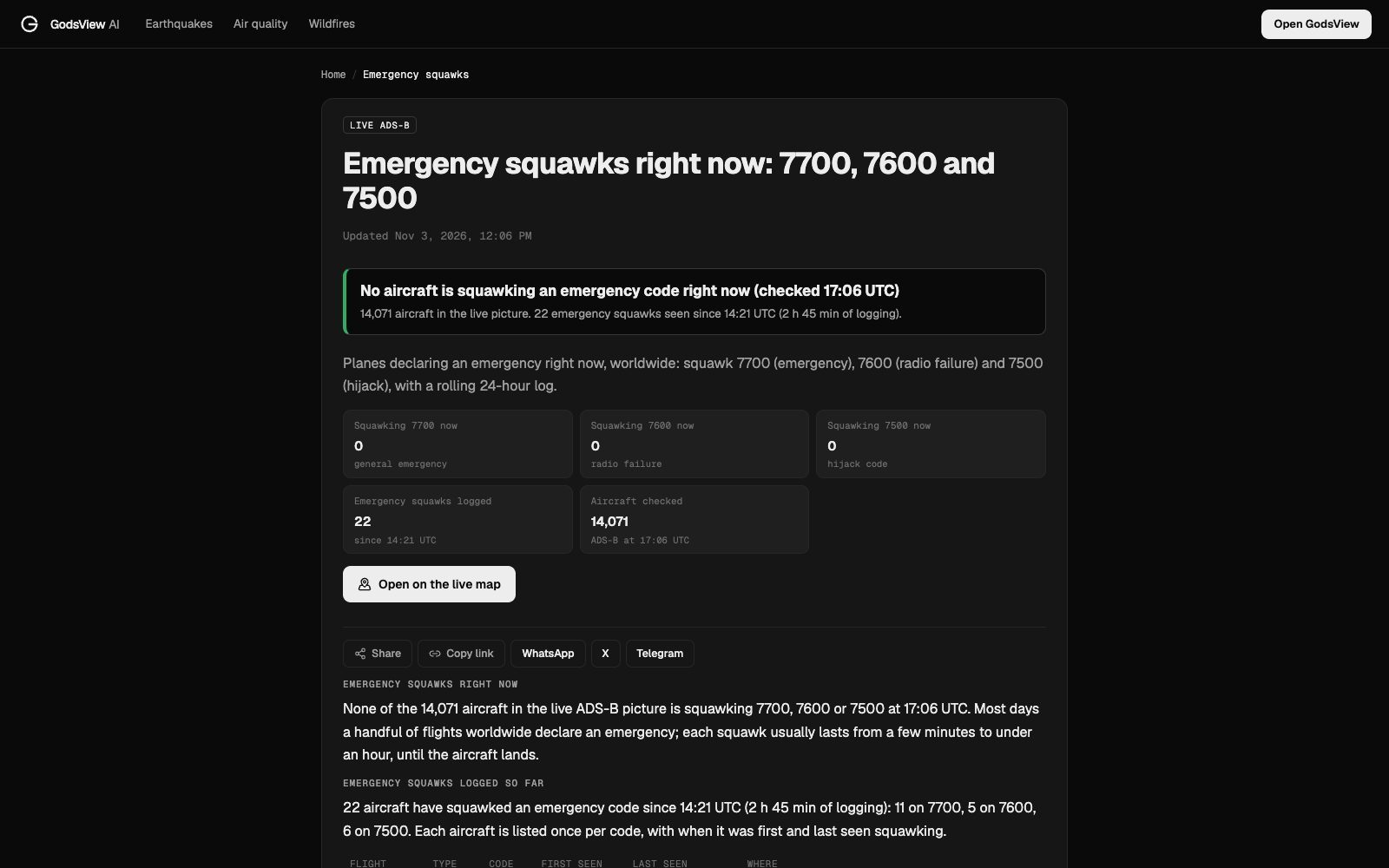
On GodsView, open Emergency squawks. The page checks every aircraft in the live ADS-B picture for 7700, 7600 and 7500 and answers the question at the top. When I took the screenshot below on November 3, 2026, it said no aircraft was squawking an emergency code at 17:06 UTC, out of 14,071 aircraft in the live picture, and that 22 emergency squawks had been logged since 14:21 UTC.
Below the summary there are three parts:
- Right now. A table of aircraft currently on an emergency code, with flight, type, code, altitude and the nearest city. Tap a flight to open it.
- The log. Every aircraft that squawked an emergency code during the last 24 hours, once per aircraft and code, with when it was first and last seen squawking.
- What each code means. A short explainer for 7700, 7600 and 7500 with the live count for each.
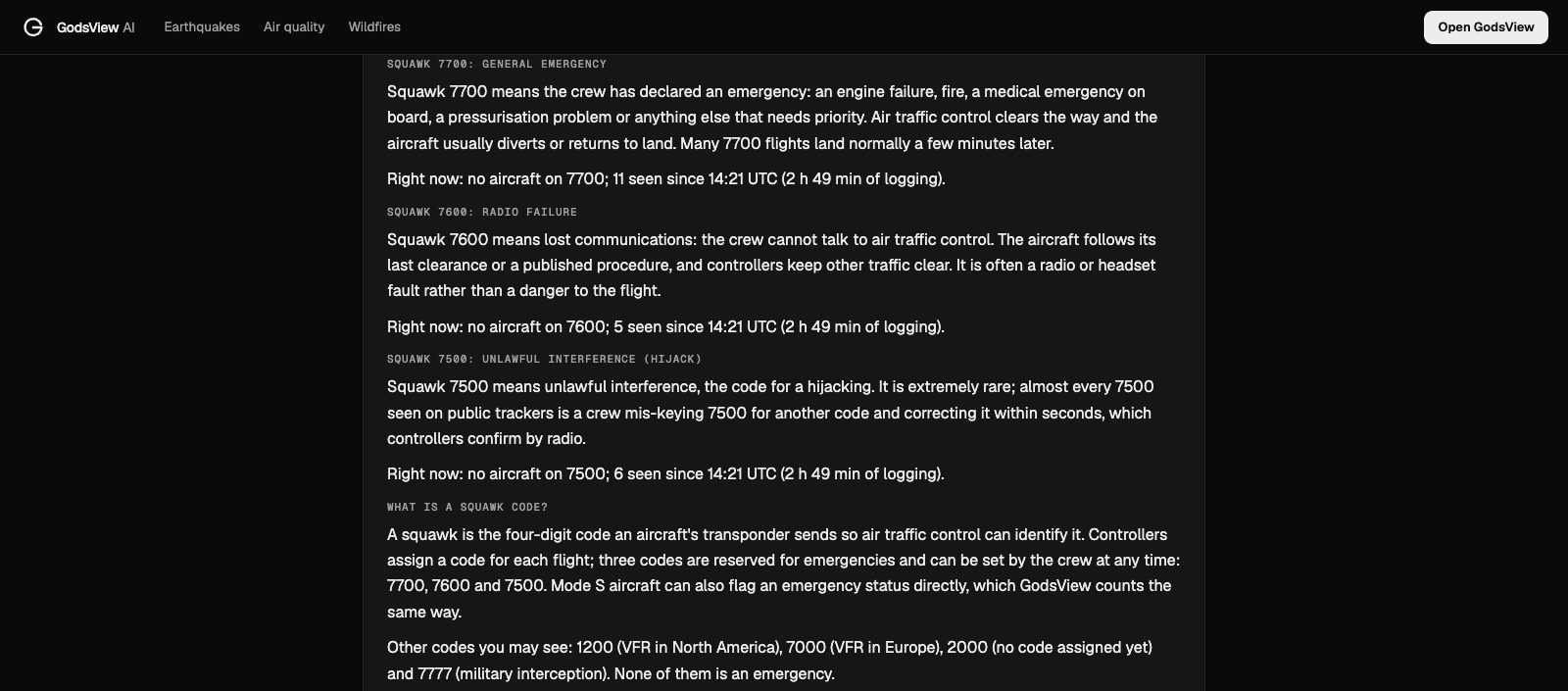
The log is the useful part if you heard about an emergency after the fact. A news alert about a diverted flight usually comes after the aircraft has landed and the code has gone. Look for the flight in the log, then open it to see the route it flew. For a flight you already know, Track a flight lets you search by flight number, and the live flight tracker page explains the map.
Coverage has limits. An aircraft over the ocean or far from receivers can't be seen by anyone's public map, and a squawk is what the transponder sends, not a confirmed incident. The ADS-B explainer covers how the signal gets from the aircraft to your screen.
How to get an alert when a flight squawks 7700
If you are watching one flight, because a relative is on board, or you cover aviation for a newsroom, you don't want to keep refreshing a page. GodsView Pro includes emergency squawk alerts for 7500, 7600 and 7700, along with takeoff, landing and signal-lost alerts, delivered in the app, by browser push and by email. The flight tracking guide shows how to set them up, and the 3D flight tutorial shows how to follow the aircraft once you have found it.
If what you care about is the sky over your own home, the What's overhead page lists the aircraft near you, and planes over London and the other city pages call out helicopters, military aircraft and anything circling.
What 7700 does not tell you
It is worth repeating the limits, because emergency codes are the part of flight tracking most often misread on social media:
- It doesn't say what is wrong. Only the crew, the airline or the investigators can tell you that.
- It doesn't mean the aircraft is about to crash. It means the crew wants priority and help.
- It doesn't last. The code usually goes back to normal after landing, or sooner.
- 7500 on a map is not a hijacking until someone confirms it. Controllers check it by radio for a reason.
If you report on an emergency, cite the code, the time in UTC and the source, and wait for the airline or authority before saying why. The guide for journalists has a longer checklist.
Frequently asked questions
What does squawk 7700 mean?
It means the crew has set the general emergency code on the transponder. It tells air traffic control the flight has a distress or urgency situation and needs priority. It does not say what the problem is.
Is squawk 7700 the same as a mayday?
They often go together. MAYDAY is the spoken distress call on the radio; 7700 is the transponder code that sets off an alarm on controllers' screens. A crew can use one, the other or both.
What is the difference between 7500, 7600 and 7700?
7700 is a general emergency, 7600 is lost two-way radio contact and 7500 is unlawful interference, the hijack code. 7777 is reserved for military interception and never used by civil pilots.
Where can I see planes squawking 7700 today?
Open the GodsView emergency squawks page. It lists aircraft on 7700, 7600 or 7500 right now and keeps a log of the last 24 hours.
Why did a plane squawk 7500 and then stop?
Usually because the crew selected it by mistake while changing codes and corrected it. The FAA tells pilots to avoid passing through 7500, 7600 and 7700 for exactly this reason, and controllers confirm a real 7500 by radio.
Does squawk 1200 or 7000 mean an emergency?
No. 1200 is the normal code for visual flight in the US when not talking to a controller, and 7000 is the European equivalent. Neither is an emergency.
Sources
- FAA Aeronautical Information Manual 6-2-2: Transponder emergency operation
- FAA Aeronautical Information Manual 6-3: Distress and urgency procedures (MAYDAY, PAN-PAN, code 7500)
- FAA Aeronautical Information Manual 6-4: Two-way radio communications failure (code 7600)
- FAA Aeronautical Information Manual 4-1-20: Transponder and ADS-B operation (code changes, 1200, 7777)
- SERA.13005: SSR transponder Mode A code setting (UK CAA regulatory library)
Facts checked on against each provider's own site.