Explainer
AWACS Explained: What the E-3 Sentry and E-7 Wedgetail Do
AWACS aircraft are flying radar stations: a big jet with a radar on its back that watches the sky for hundreds of miles and directs friendly aircraft. Here is what they do, how the old E-3 Sentry and the newer E-7 Wedgetail compare, what NATO chose in 2026, and why you sometimes see one circling on a flight tracker.
Key takeaways
- AWACS stands for Airborne Warning and Control System: an aircraft that carries a long-range radar and a crew of controllers to detect, identify and track aircraft and ships and to direct friendly forces.
- The US Air Force E-3 Sentry is a modified Boeing 707 with a 30-foot rotating radar dome; the Air Force says its radar reaches more than 250 miles and it can fly about 8 hours without refueling.
- The E-7 Wedgetail is a newer airborne early warning and control jet based on the Next-Generation Boeing 737, with a fixed Northrop Grumman MESA radar that gives 360-degree coverage. The RAF received its first E-7 at Lossiemouth on May 21, 2026.
- NATO flies 14 E-3A aircraft from Geilenkirchen, Germany. It dropped its E-7 plan in November 2025 and on July 7, 2026 chose Saab's GlobalEye, opening negotiations for up to 10 aircraft.
- AWACS often appear on public flight trackers because they spend long periods flying orbits in or near civil airspace with transponders on. They are absent when they switch ADS-B off or fly beyond receiver coverage.
AWACS stands for Airborne Warning and Control System. An AWACS aircraft is a large jet that carries a powerful radar, usually in a big disc or a fin on top of the fuselage, and a team of controllers in the cabin. From high altitude it can see aircraft and ships far beyond the reach of ground radar, tell friend from foe, and direct fighters, tankers and other aircraft. The US Air Force describes its E-3 Sentry as providing "an accurate, real-time picture of the battlespace" and "early warning of enemy actions".
The best-known AWACS is the E-3 Sentry with its rotating dome. Its successor in several air forces is the E-7 Wedgetail, and NATO chose a third type, Saab's GlobalEye, in July 2026. These aircraft also turn up on public flight trackers more than most military jets, usually as a slow, repeating orbit over one area. This guide explains what they do, how the types differ, and how to read one on a live map.
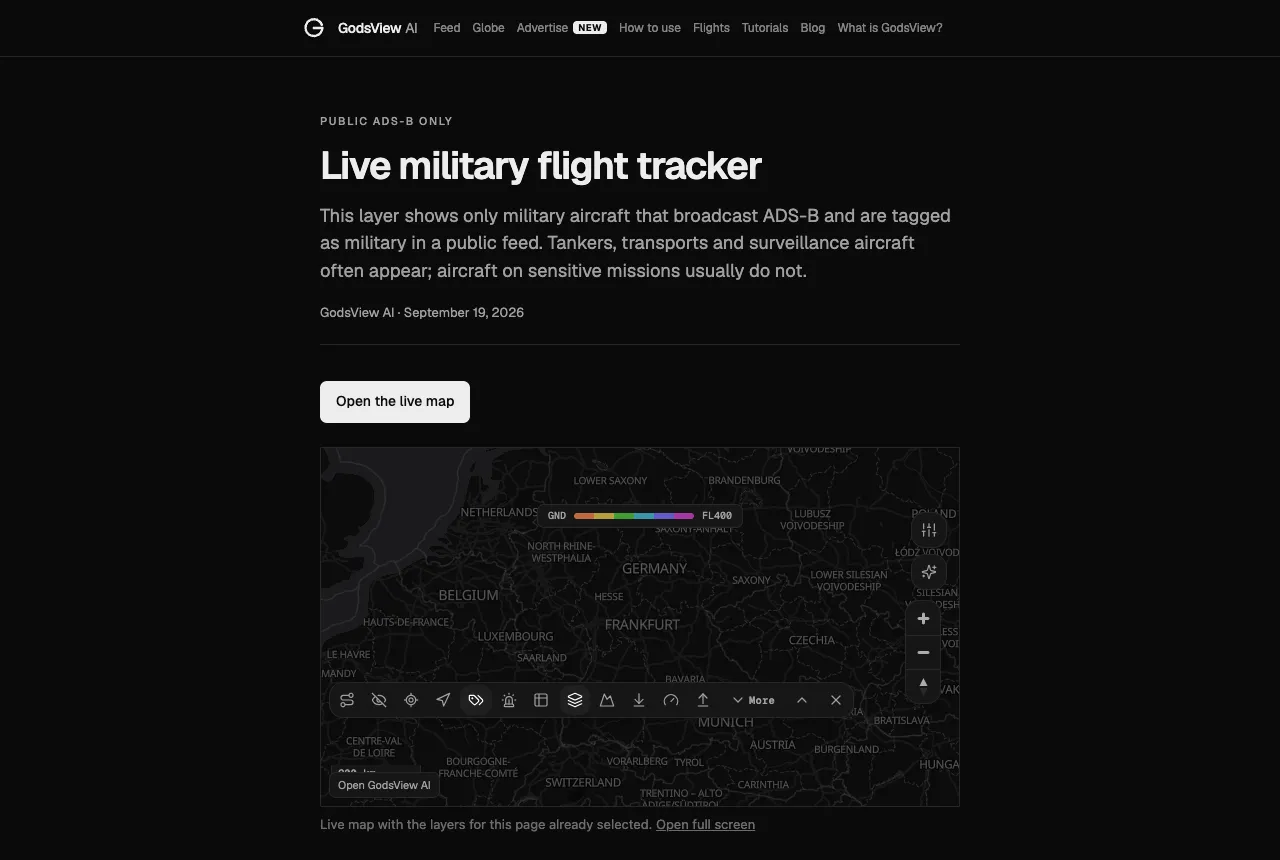
Open the military flight tracker
What does an AWACS aircraft do?
The Air Force fact sheet lists the E-3's jobs as situational awareness of friendly, neutral and hostile activity, command and control of an area of responsibility, battle management of theater forces, all-altitude and all-weather surveillance, and early warning of enemy actions. In plainer terms:
- See. The radar looks from the surface up into the stratosphere, over land or water. Combined with an IFF (identification friend or foe) system, it can pick out low-flying aircraft against ground clutter.
- Identify. The crew works out what each track is: friendly, neutral or hostile, aircraft or ship.
- Direct. Controllers on board send fighters toward threats, manage air-to-air refueling and coordinate other aircraft. As an air defense system, the Air Force says, E-3s can detect and track enemy forces far from US or NATO borders and direct fighter-interceptors to them.
- Share. The picture is passed by datalink to command centers on land and at sea, and in a crisis can be forwarded to the President and Secretary of Defense.
Because it flies, an AWACS can move. The Air Force notes that the Sentry has a better chance of surviving in war than a fixed ground radar because its flight path can be changed quickly.
You will also see the term AEW&C (airborne early warning and control). It describes the same kind of aircraft: the Air Force calls the E-3 an AWACS, while Boeing and Saab describe the E-7 and GlobalEye as AEW&C systems.
The E-3 Sentry: the classic AWACS
The E-3 is a modified Boeing 707/320 with a rotating radar dome. According to the Air Force:
| Item | E-3 Sentry (US Air Force fact sheet) |
|---|---|
| Airframe | Modified Boeing 707/320 |
| Radar dome | 30 feet (9.1 m) across, 6 feet (1.8 m) thick, held 11 feet above the fuselage on two struts |
| Radar range | More than 250 miles |
| Mission length | About 8 hours without refueling; longer with in-flight refueling and an on-board crew rest area |
| First delivered | March 1977, to the unit now called the 552nd Air Control Wing at Tinker Air Force Base, Oklahoma |
| NATO | First E-3 delivered to NATO in January 1982 |
E-3s have flown in Desert Storm, Allied Force, Enduring Freedom, Iraqi Freedom and the Libya operations, and the Air Force says they also supported relief after Hurricanes Rita and Katrina by coordinating rescue efforts between military and civilian authorities. Japan's AWACS are built on the Boeing 767 airframe.
The E-3 is old and getting harder to keep flying. In November 2025, The Aviationist reported that the US Air Force inventory had shrunk to a number similar to NATO's 14 after rapid retirements, and cited a 2024 mission readiness rate of 55.7 percent for the type.
The E-7 Wedgetail: the newer design
The Boeing E-7 replaces the rotating dome with a fixed radar mounted on top of the fuselage. Boeing says:
- It is a derivative of the Next-Generation 737, so it shares a global supply chain and maintenance network with thousands of airliners.
- Its MESA (multirole electronically scanned array) radar, made by Northrop Grumman, does air-to-air and air-to-ground surveillance with 360-degree coverage.
- A standard mission covers more than 1.5 million square miles (4 million square kilometers) and lasts over 10 hours, longer with aerial refueling.
- It carries 21 crew and has 10 battle manager workstations.
The Royal Australian Air Force flies the E-7A with No. 2 Squadron at RAAF Base Williamtown. The UK's first E-7 Wedgetail AEW Mk1, registration WT001, arrived at RAF Lossiemouth in Scotland on May 21, 2026 to continue test and evaluation at its future main base, and The Aviationist reported that the RAF plans to operate three.
The US E-7 fight
In the United States the E-7 has been a budget battle. The Trump administration proposed canceling the program in its 2026 budget, preferring space-based early warning and the Navy's E-2D Hawkeye as a cheaper stopgap. Congress pushed back: the compromise fiscal 2026 defense appropriations bill released on January 20, 2026 included $900 million for E-7, bringing the 2026 total to $1.1 billion "to continue E-7 rapid prototyping activities and transition to engineering and manufacturing development aircraft," according to Air & Space Forces Magazine. The first two US prototypes were contracted to be modified by STS Aviation in Birmingham, UK.
NATO's AWACS and the 2026 GlobalEye decision
NATO owns its own AWACS fleet, separate from any one country's air force. It operates 14 E-3A aircraft from Geilenkirchen Air Base, Germany, down from an initial 18, and intends to keep them flying to 2035.
NATO picked the E-7 as its replacement in 2023. In November 2025, the Netherlands Ministry of Defence announced on behalf of the partner nations that the E-7 purchase was being dropped, after the United States had withdrawn from the program, and that alternatives would be sought to replace the E-3A by 2035.
On July 7, 2026, at the NATO summit in Ankara, NATO announced it had selected Saab's GlobalEye. Saab said NATO would begin formal negotiations for up to ten GlobalEye airborne early warning and control systems, and that no contract had been signed at the time of the announcement. GlobalEye combines Saab's Erieye Extended Range radar, other sensors and a command and control system on a Bombardier Global 6500 business jet.
| Aircraft | Airframe | Radar | Main operators (as of November 2026) |
|---|---|---|---|
| E-3 Sentry | Boeing 707/320 | Rotating dome | US Air Force, NATO (E-3A) |
| E-7 Wedgetail | Next-Generation Boeing 737 | Fixed MESA array, 360 degrees | Royal Australian Air Force; UK (entering service); US prototypes funded |
| GlobalEye | Bombardier Global 6500 | Erieye Extended Range | Selected by NATO in July 2026; contract under negotiation |
Why AWACS show up on flight trackers
Most military aircraft are rarely visible on public maps. AWACS are an exception, for a few reasons:
- They fly long, steady missions of 8 to 10 hours or more, much of it in or near airspace shared with airliners, where broadcasting position helps keep traffic separated.
- They fly repeated orbits over one area, which makes them easy to notice: a slow oval at high altitude that does not go anywhere.
- Their identifiers are known. Every aircraft broadcasts a 24-bit address, shown as a hex code, and databases link many of these to military operators. NATO's E-3As carry Luxembourg registrations; one example posted in September 2025 showed NATO E-3A LX-N90445 using the callsign NATO01.
They also disappear. US rules (14 CFR 91.225(f)) let aircraft on sensitive government missions for national defense switch ADS-B Out off with FAA authorization, and over open sea or conflict zones there may be no public receivers. Some commercial trackers block military aircraft entirely. So an AWACS you can see is one that is choosing to broadcast; it tells you nothing about the ones you cannot.
How to spot one on GodsView
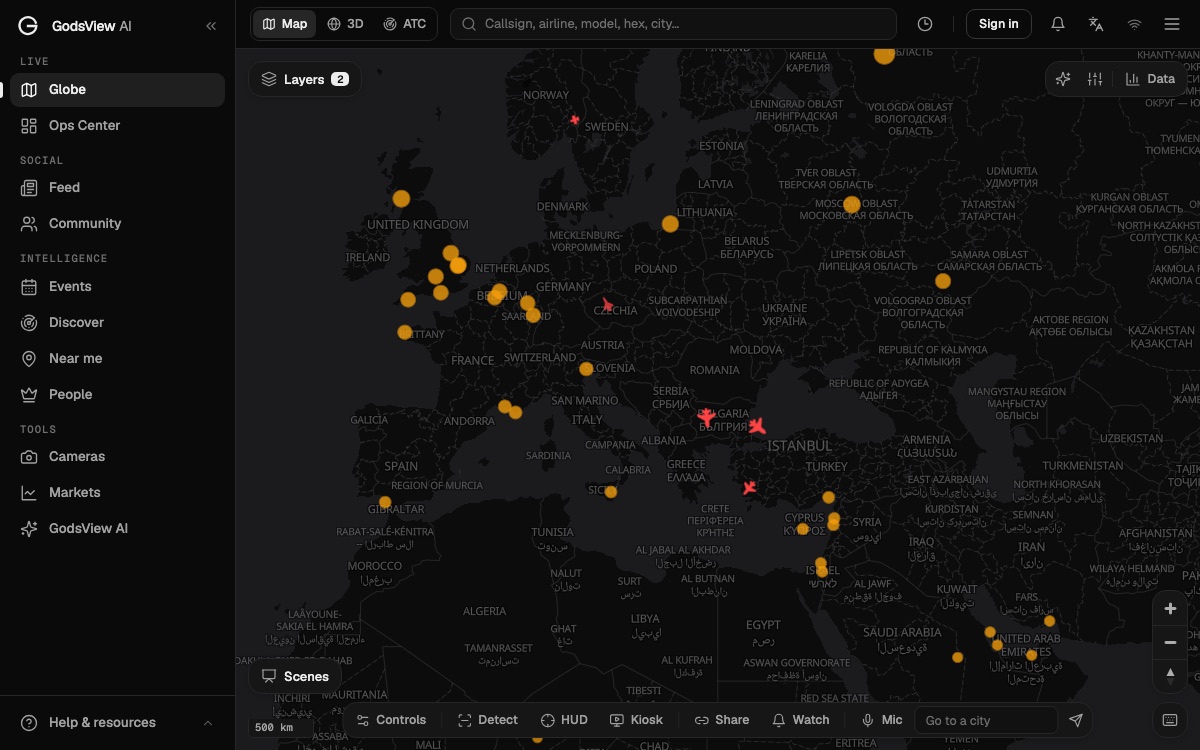
Open the military flight tracker, which shows military aircraft that are broadcasting. Search the map for a callsign or look for a large aircraft flying a slow, repeating orbit at high altitude, then click it to see its callsign, hex code and altitude. For context on Eastern Europe, the Ukraine live map adds news and events for that region.
For the background on what public maps can and cannot show, read military aircraft tracking explained and how ADS-B flight tracking works. If you see an AWACS together with tankers and fighters in one area, the map alone cannot tell you whether it is training or an operation; news and official statements can.
AWACS vs other military aircraft you may see
- Tankers such as the KC-135 Stratotanker also spend long periods on station, and AWACS refuel from them; the Air Force publishes photos of an E-3 breaking away from a KC-135 after refueling.
- Command posts like the E-4B "doomsday plane" carry leaders and communications equipment, not a surveillance radar, and do not direct air battles.
- Type is the giveaway. The aircraft type on the flight card (a 707-based E-3, a 737-based E-7, a Global 6500) tells you more than the flight pattern does.
Reading AWACS activity responsibly
An AWACS orbit is a sign that someone is watching an area of sky, not that something is about to happen. The Aviationist notes that NATO's fleet focuses mainly on European airspace and operates mostly from or near its home base. Avoid drawing conclusions from one track, and avoid sharing live positions of military aircraft in ways that could put crews at risk. Our guide to whether flight tracking is legal covers the rules on public data.
The short version
AWACS are flying radar and control stations. The E-3 Sentry, a 707 with a 30-foot rotating dome, has done the job since 1977, and its replacements are the 737-based E-7 Wedgetail in Australia and the UK, and Saab's GlobalEye for NATO, chosen in July 2026. They show up on flight trackers because they spend hours in steady orbits with transponders on, and vanish when they switch off or fly beyond public receivers.
See military aircraft broadcasting now
Frequently asked questions
What does AWACS stand for?
Airborne Warning and Control System. It is an aircraft with a long-range radar and a crew of controllers that detects, identifies and tracks aircraft and ships and directs friendly forces.
How far can an AWACS see?
The US Air Force says the E-3 Sentry radar has a range of more than 250 miles and can look from the Earth's surface up into the stratosphere. Boeing says an E-7 standard mission covers more than 1.5 million square miles.
What replaced the E-3 Sentry?
Different operators chose different aircraft. Australia and the UK fly the Boeing E-7 Wedgetail, the US is funding E-7 prototypes, and NATO selected Saab's GlobalEye on July 7, 2026, opening negotiations for up to 10 aircraft.
Why can I see AWACS on Flightradar24 or other trackers?
AWACS often transmit ADS-B or Mode S while flying long orbits in or near civil airspace. They disappear when they switch ADS-B off, which US rules allow for sensitive missions, or when they fly beyond receiver coverage. Some trackers also block military aircraft.
How many AWACS does NATO have?
NATO operates 14 E-3A aircraft from Geilenkirchen Air Base in Germany, down from an initial fleet of 18, and plans to keep them flying to 2035.
What is the difference between AWACS and AEW&C?
They describe the same kind of aircraft. AEW&C stands for airborne early warning and control; the US Air Force calls the E-3 an AWACS, while Boeing and Saab describe the E-7 and GlobalEye as AEW&C systems.
Sources
- US Air Force — E-3 Sentry (AWACS) fact sheet
- Boeing — E-7 Airborne Early Warning and Control
- Boeing UK — RAF and Boeing UK welcome the first Wedgetail to RAF Lossiemouth (May 2026)
- Saab — NATO selects Saab’s GlobalEye (July 7, 2026)
- Air & Space Forces Magazine — Compromise defense appropriations bill would add funds for E-7 (January 20, 2026)
- The Aviationist — NATO shelves plans to buy E-7 Wedgetail (November 13, 2025)
- eCFR — 14 CFR 91.225, ADS-B Out equipment and use
Facts checked on against each provider's own site.