Aurora
Can I See the Northern Lights Tonight in the US? State by State
Most nights the aurora stays over Canada and Alaska. When a geomagnetic storm hits, it can reach the northern tier of states, and in big storms much farther. Here is how to tell, in a few minutes, whether tonight is your night and where in the US you would need to be.
Key takeaways
- Whether you can see the northern lights tonight in the US depends on three things: the Kp index forecast for your dark hours, your geomagnetic latitude, and clear skies.
- NOAA's storm scale says a G1 storm (Kp 5) brings aurora to northern Michigan and Maine, G2 (Kp 6) to New York and Idaho, G3 (Kp 7) to Illinois and Oregon, G4 (Kp 8) to Alabama and northern California, and G5 (Kp 9) to Florida and southern Texas.
- Alaska is the exception: Fairbanks sits under the auroral oval, and GodsView estimates it can see aurora at Kp 0 on a clear, dark night.
- NOAA says the best aurora is usually between 10 p.m. and 2 a.m. local time, and that a hilltop with a clear view north lets you see aurora that is up to 1,000 km (600 miles) farther north.
- GodsView aurora pages for US cities show tonight's Kp forecast, the Kp the city needs, overnight cloud cover and dark hours in one place.
Can you see the northern lights tonight in the US? On most nights, only in Alaska. In the lower 48 states you need a geomagnetic storm: at Kp 5 (a G1 storm) NOAA says aurora reaches places like northern Michigan and Maine; at Kp 6 New York and Idaho; at Kp 7 Illinois and Oregon; and in rare severe storms the far south. Then you need a dark, clear sky and a view to the north, ideally between 10 p.m. and 2 a.m. Check tonight's Kp forecast against the Kp your city needs, and look at the cloud forecast.
The fastest way to check is your city's GodsView page, for example northern lights tonight in Minneapolis, which puts the Kp forecast, the Kp needed, cloud cover and dark hours side by side. The aurora forecast hub lists every city.
Check tonight's aurora forecast
The three things that decide tonight
- How active is the magnetic field? That is the Kp index, from 0 to 9. Kp 5 or more is a geomagnetic storm. NOAA's three-day forecast predicts Kp in three-hour blocks. Our Kp index explainer covers how it works.
- How far north are you, magnetically? What counts is your geomagnetic latitude. Because the north magnetic pole is offset toward North America, US cities sit at higher geomagnetic latitudes than European cities at the same geographic latitude. That is good news for the northern US.
- Is it dark and clear? No forecast helps under clouds or in city glare. NOAA's tips stress escaping city lights and avoiding the full Moon.
Which US states can see the aurora at each Kp
NOAA's G-scale says where aurora has been seen at each storm level. The aurora is usually low on the northern horizon at the edge of its range, so "seen in" often means "a glow to the north from a dark spot".
| Kp | NOAA storm level | Where NOAA says aurora can be seen | How often (per 11-year cycle) |
|---|---|---|---|
| 5 | G1 minor | Northern Michigan and Maine | About 1,700 times (900 days) |
| 6 | G2 moderate | New York and Idaho | About 600 times (360 days) |
| 7 | G3 strong | Illinois and Oregon | About 200 times (130 days) |
| 8 | G4 severe | Alabama and northern California | About 100 times (60 days) |
| 9 | G5 extreme | Florida and southern Texas | About 4 times (4 days) |
NOAA's viewing tips add that from a hilltop with a clear view north, "a person can see aurora even when it is 1000 km (600 miles) further north." That is why people in, say, Minnesota or Washington often catch a G1 or G2 storm low on the horizon even when the oval is overhead in Canada.
Kp needed by US city
GodsView estimates the Kp each city needs for aurora low on the poleward horizon, from its geomagnetic latitude. These are estimates, but they line up with NOAA's state descriptions. A selection:
- Alaska: Fairbanks about Kp 0 (under the oval), Anchorage and Juneau about Kp 1.
- Northern Plains and Upper Midwest: Duluth, Grand Forks and Minot about Kp 4; Fargo, Bismarck and Minneapolis about Kp 5.
- Northern Rockies: Great Falls, Helena, Missoula and Spokane about Kp 5; Billings about Kp 6.
- Pacific Northwest: Seattle, Tacoma and Olympia about Kp 6; Portland about Kp 7.
- Great Lakes: Detroit, Milwaukee, Grand Rapids, Buffalo and Rochester about Kp 6; Chicago and Cleveland about Kp 7.
- Northeast: Bangor about Kp 4; Boston, Burlington and Albany about Kp 6; New York City and Pittsburgh about Kp 7; Philadelphia about Kp 8.
- Central and Mountain West: Omaha and Des Moines about Kp 7; Denver, Salt Lake City, St. Louis and Kansas City about Kp 8.
Farther south, cities like Atlanta, Dallas, Houston and Miami need storms at the very top of the scale, which NOAA says occur on only about 4 days per solar cycle.
Reading tonight's forecast
Check the maximum Kp for your dark hours. Most aurora forecasts, including NOAA's experimental "tonight and tomorrow night" map, are driven by the three-day Kp forecast. NOAA's map uses the highest forecast Kp between 6 p.m. and 6 a.m. US Central Time. Note that NOAA removed the red "view line" from that experimental map in May 2026, so older advice to "look for the red line" no longer applies.
Use the 30-minute forecast on the night. NOAA's OVATION model also runs as a 30 to 90 minute forecast driven by solar wind measured about 1.6 million km upstream of Earth. It responds to what is actually arriving, which matters because CME arrival times are uncertain by many hours.
Mind UTC. Kp blocks and NOAA alerts often use UTC. For Eastern Standard Time subtract 5 hours, for Central 6, Mountain 7 and Pacific 8.
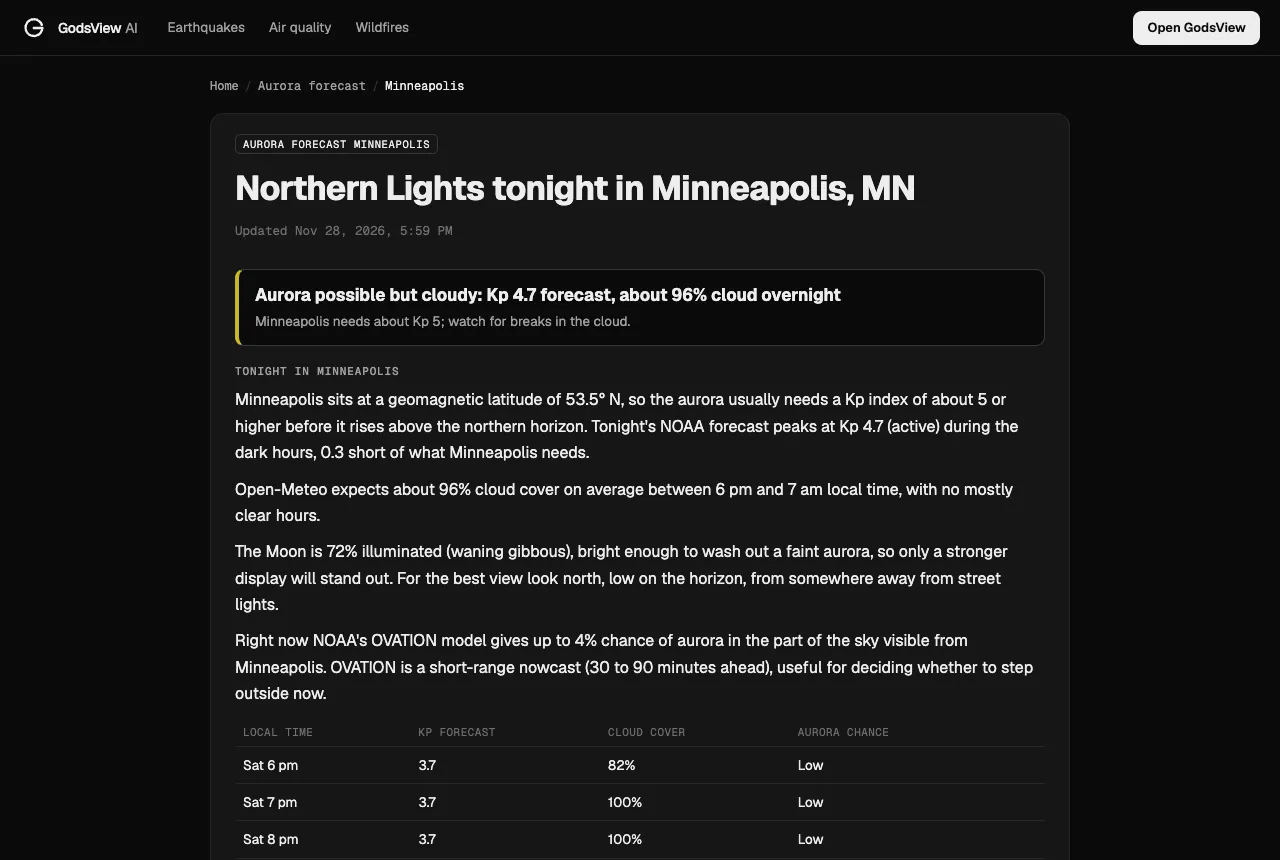
Here is what the forecast looked like for one city on the day this guide was written:
That is a typical "maybe" night: the Kp forecast is right at the city's threshold, but cloud is the deciding factor. On a night like this, people a little farther north, or under a gap in the clouds, have the best chance.
Best time and place to look
- Time: NOAA says the best aurora is "usually within an hour or two of midnight (between 10 PM and 2 AM local time)". During strong storms activity spreads into the evening and morning.
- Season: NOAA names the spring and autumn equinoxes as the best seasons. Winter's long nights help too. Summer is hard in Alaska because it barely gets dark.
- Place: get away from city lights to somewhere with a low, open northern horizon: a lake shore, a hill, a field. Lakes are good because they give a flat, open horizon.
- Moon: a bright Moon washes out faint aurora. A storm on a moonless night is the best case.
What the aurora looks like from the US
From the northern US, an aurora at the edge of its range often starts as a pale, grey-green glow or arc low in the north, which can be easy to mistake for cloud or light pollution. During stronger storms NOAA says the aurora becomes brighter and more active, and you may see rays that move. In big storms such as May 2024, NASA reported aurora across much of the southern US.
A phone camera on night mode or a long exposure on a camera can show colour in a glow that looks grey to your eyes. If you are unsure whether you are seeing aurora, take a photo facing north.
Recent storms that reached the US
- May 10 to 11, 2024: NOAA observed G5 conditions at Earth at 6:54 p.m. EDT on May 10, the first G5 storm since 2003. NASA says aurora appeared at unusually low latitudes, including the southern US.
- November 11 to 12, 2025: a G4 storm began at 7:10 p.m. Eastern on November 11. The USGS says northern lights were seen as far south as Utah and Pennsylvania.
- January 19, 2026: NOAA reported G4 levels reached at 2:38 p.m. EST, when a CME arrived.
Storms like these are why people far from Alaska keep an eye on space weather. Our guide to geomagnetic storm levels lists what each level means beyond the aurora.
How to check in two minutes
- Open your city's page from the aurora forecast hub and compare tonight's Kp with the Kp needed.
- Look at the overnight cloud cover and dark hours on the same page.
- Check the space weather page for whether a storm is in progress right now, and for Kp over the next 24 hours.
- If it looks promising, head somewhere dark with a clear northern view between about 10 p.m. and 2 a.m.
For a deeper look at the official products, see our guides to the NOAA aurora forecast and how to see the northern lights tonight. GodsView Plus ($10.99 a month or $99.99 a year) can alert you about saved places.
The short version
Most nights, only Alaska sees the aurora. In the lower 48, you need a storm: Kp 5 for the northern edge (Michigan, Maine, Minnesota), Kp 6 to 7 for states like New York, Idaho, Illinois and Oregon, and Kp 8 to 9 for the far south. Check your city's Kp threshold, the cloud forecast and the dark hours, and look north between 10 p.m. and 2 a.m.
See the northern lights forecast for my city
Frequently asked questions
What Kp do I need to see the northern lights in the US?
In Alaska, often Kp 0 to 1. In the northern tier of states, around Kp 5 to 6. NOAA says a Kp 7 (G3) storm brings aurora to Illinois and Oregon, and only Kp 8 to 9 storms reach the South. Check your city on the aurora forecast pages.
What time is best to see the northern lights tonight?
NOAA says the best aurora is usually within an hour or two of midnight, between about 10 p.m. and 2 a.m. local time. During strong storms it can appear earlier in the evening or later toward dawn.
Can I see the northern lights in Minnesota tonight?
Only if the Kp forecast is high enough and the sky is clear. GodsView estimates Minneapolis needs about Kp 5 and Duluth about Kp 4 for aurora low on the northern horizon. See Minneapolis for tonight's Kp and cloud forecast.
Which US state is best for the northern lights?
Alaska. Fairbanks sits under the auroral oval, so aurora can appear on many clear nights whenever it is dark enough; in summer the sky barely gets dark. In the lower 48, northern Minnesota, North Dakota, Montana, northern Michigan and Maine are best placed.
Where is the NOAA aurora view line?
NOAA removed the view line from its experimental "aurora tonight and tomorrow night" product in May 2026. The map still shows the forecast oval, driven by the highest Kp forecast between 6 p.m. and 6 a.m. Central Time.
Why can't I see the aurora when the Kp is high?
The most common reasons are clouds, light pollution, a bright Moon, or the storm peaking during your daytime. At the edge of its range, the aurora is also low and faint, so you need a dark site with a clear view north.
Sources
- NOAA SWPC — NOAA Space Weather Scales
- NOAA SWPC — Tips on viewing the aurora
- NOAA SWPC — Aurora tonight and tomorrow night (experimental)
- NOAA SWPC — Aurora 30-minute forecast
- NOAA SWPC — G5 conditions observed (May 10, 2024)
- NASA — How NASA tracked the most intense solar storm in decades
- USGS — Severe magnetic storm, November 11, 2025
- NOAA SWPC — G4 levels reached, January 19, 2026
Facts checked on against each provider's own site.