Explainer
Kp Index Explained: What Kp 0 to 9 Means for Aurora
Aurora apps, NOAA alerts and news stories all quote a Kp number. Here is what that number measures, how it is made, what each level means for the northern lights, and how it links to the G1 to G5 storm scale.
Key takeaways
- The Kp index is a 0 to 9 scale of how strongly Earth's magnetic field is being disturbed, measured over three-hour periods by a network of ground magnetometers.
- NOAA says Kp 1 is calm and Kp 5 or more is a geomagnetic storm: Kp 5 is a G1 minor storm, Kp 6 is G2, Kp 7 is G3, Kp 8 is G4 and Kp 9 is G5.
- A higher Kp pushes the auroral oval toward the equator. NOAA's scale says a G1 storm brings aurora to northern Michigan and Maine, and a G5 storm can bring it to Florida and southern Texas.
- The official Kp index comes from GFZ Potsdam using 13 observatories between 44 and 60 degrees geomagnetic latitude; NOAA publishes a real-time estimate that updates every minute.
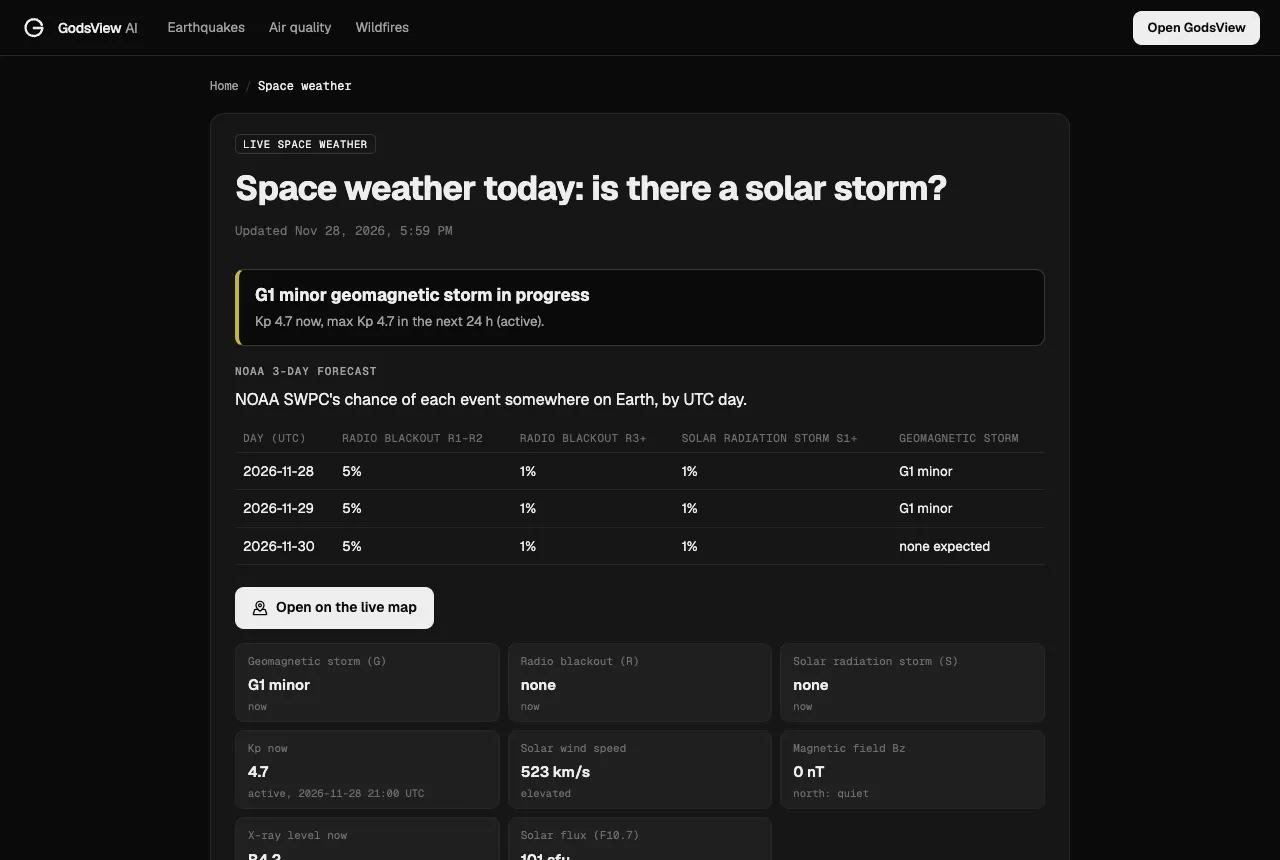
- GodsView's space weather page shows the current Kp, the next 24 hours and the storm level, and each aurora city page gives the Kp a city needs.
The Kp index is a number from 0 to 9 that tells you how disturbed Earth's magnetic field is right now. Low numbers mean a quiet field and an aurora confined to the far north; Kp 5 or more means a geomagnetic storm, and the higher it climbs, the farther toward the equator the northern and southern lights can be seen. NOAA's Space Weather Prediction Center ties each storm level to Kp: Kp 5 is a G1 minor storm and Kp 9 is a G5 extreme storm.
If you just want the number for tonight, the GodsView space weather page shows the current Kp, the highest Kp forecast for the next 24 hours and whether a storm is under way. For your own town, the aurora forecast pages say what Kp your city needs.
What the Kp index measures
The Sun constantly blows a stream of charged particles, the solar wind, past Earth. When a fast stream or a coronal mass ejection (CME) hits, it shakes the magnetosphere, and ground instruments called magnetometers see the horizontal part of the magnetic field swing back and forth.
NOAA describes it this way: the K-index "quantifies disturbances in the horizontal component of earth's magnetic field with an integer in the range 0-9 with 1 being calm and 5 or more indicating a geomagnetic storm." Each observatory computes its own local K value from the largest swing it records in a three-hour window. The planetary Kp is the standardized average of those local values, so it describes the whole planet rather than one place.
Three things follow from that design:
- Kp is a three-hour number. A display that says "Kp 5" usually refers to the current or latest three-hour block, not one instant.
- Kp is not linear. The scale is quasi-logarithmic, so the jump from Kp 7 to Kp 8 is a much bigger disturbance than from Kp 1 to Kp 2. GFZ also publishes a linear companion index, ap, for scientists who need to average activity.
- Kp says nothing about clouds or darkness. It measures the magnetic field. Whether you see an aurora also depends on the sky above you.
Who makes the Kp index
There are two Kp numbers you will meet, and both are legitimate:
- The official Kp. The GFZ German Research Centre for Geosciences in Potsdam distributes what it calls "the internationally recognised official Kp index endorsed by the International Association of Geomagnetism and Aeronomy, IAGA." It is built from 13 observatories, 11 in the north and 2 in the south, between 44 and 60 degrees geomagnetic latitude. Julius Bartels introduced the index in 1949, and the series goes back to 1932. GFZ publishes a near real-time nowcast and definitive values each month.
- NOAA's estimated Kp. The Space Weather Prediction Center (now at spaceweather.gov) produces an "Estimated 3-hour Planetary Kp-index" that updates every minute, using ground magnetometers that include Sitka in Alaska, Meanook and Ottawa in Canada, Fredericksburg in Virginia, Hartland in the UK, Wingst and Niemegk in Germany, and Canberra in Australia. NOAA also issues a three-day Kp forecast, which is what most aurora apps use for "tonight".
GFZ expresses Kp in thirds: 0o, 0+, 1-, 1o, 1+, 2-, and so on up to 9o. That is why you sometimes see "Kp 5-" or a decimal like 4.67 or 4.7 on a dashboard: it is the same value written two ways, just under a full 5.
Kp levels and what each one means
Here is the Kp scale with NOAA's storm level, and NOAA's general description of how the aurora behaves at each level, taken from its aurora viewing tips.
| Kp | NOAA storm level | What the aurora does (NOAA) |
|---|---|---|
| 0 to 2 | None (quiet) | Aurora far north, dim, little motion |
| 3 to 4 | None (unsettled to active) | Oval moves toward the equator, brightens, more motion |
| 5 | G1 minor storm | Aurora can reach northern Michigan and Maine |
| 6 | G2 moderate storm | Aurora can reach New York and Idaho |
| 7 | G3 strong storm | Aurora can reach Illinois and Oregon |
| 8 | G4 severe storm | Aurora can reach Alabama and northern California |
| 9 | G5 extreme storm | Aurora can reach Florida and southern Texas |
NOAA's tips page groups it more loosely: at Kp 6 to 7 the aurora is "quite bright/active" and potentially visible from the northern edge of the US, and at Kp 8 to 9 it can be overhead in the northern states. The state names in the table come from NOAA's G-scale and describe roughly where aurora has been seen at that level, usually low on the northern horizon.
Kp and the NOAA G-scale
NOAA's geomagnetic storm scale is a translation of Kp into plain impact levels. Each step also comes with an average frequency over the Sun's 11-year cycle:
- G1 (Kp 5): weak power grid fluctuations, minor effects on satellites. About 1,700 times per cycle (900 days).
- G2 (Kp 6): high-latitude power systems may see voltage alarms. About 600 per cycle (360 days).
- G3 (Kp 7): voltage corrections may be needed, intermittent satellite navigation problems. About 200 per cycle (130 days).
- G4 (Kp 8): widespread voltage control problems are possible. About 100 per cycle (60 days).
- G5 (Kp 9): some grid systems may collapse; pipeline currents can reach hundreds of amps. About 4 per cycle (4 days).
Our guide to geomagnetic storm levels G1 to G5 explains each level's effects on power, GPS and radio and the recent storms that reached them.
What Kp you need to see the aurora
The aurora sits in a ring around each magnetic pole called the auroral oval. As Kp rises, the oval widens and slides toward the equator. What matters for you is your geomagnetic latitude, not your ordinary latitude, because the magnetic pole is not at the geographic pole. That is why Minneapolis needs a lower Kp than Paris even though Paris is farther north.
NOAA adds a useful point: from a hilltop with a clear view to the north, "a person can see aurora even when it is 1000 km (600 miles) further north." So the Kp you need for aurora low on the horizon is lower than the Kp you need for aurora overhead.
GodsView's aurora pages estimate the Kp each city needs for aurora low on the poleward horizon, from its geomagnetic latitude. A few examples from those pages:
- Fairbanks: about Kp 0, under the oval on most clear nights.
- Anchorage: about Kp 1.
- Duluth: about Kp 4.
- Minneapolis and Fargo: about Kp 5.
- Seattle, Detroit and Boston: about Kp 6.
- Chicago and New York City: about Kp 7.
- Denver: about Kp 8.
Pick your city on the aurora forecast hub, for example Minneapolis, Fairbanks or Seattle, to see its Kp threshold next to tonight's Kp forecast and cloud cover. Our longer guide on what Kp you need to see the northern lights covers Europe and the southern hemisphere too.
How to read a Kp forecast
A Kp forecast is a prediction of the three-hour Kp values for the next one to three days. NOAA's three-day forecast drives most aurora apps, including its own experimental "tonight and tomorrow night" map, which uses the highest forecast Kp between 6 pm and 6 am US Central Time to drive the OVATION aurora model. NOAA removed the red "view line" from that experimental product in May 2026, so if an older guide tells you to look for the line, it is no longer there.
Some practical rules for reading the numbers:
- Look at the maximum for your night, not the daily average. A single three-hour block at Kp 6 is what produces the show.
- Treat CME arrival times loosely. Forecasters often give arrival windows of many hours. A storm that arrives in daylight for you may be over by dark.
- Check the short-range view on the night. NOAA's 30-minute OVATION forecast uses solar wind measured at the L1 point, about 1.6 million km upstream, and gives a 30 to 90 minute lead. It reacts faster than the three-day Kp forecast.
- Remember time zones. Kp blocks are in UTC (00-03, 03-06 and so on). Convert them to your local time before you plan.
NOAA's tips say the best aurora is "usually within an hour or two of midnight (between 10 PM and 2 AM local time)", and that the best seasons are around the spring and autumn equinoxes.
Common Kp myths
"Kp 9 means the aurora will be overhead everywhere." No. Even G5 storms bring the aurora to the far south only for some hours, and often low on the northern horizon.
"A high Kp guarantees aurora tonight." No. Kp can be high while it is daytime for you, and cloud blocks everything. Darkness, clear skies and a view to the north are just as important.
"Kp predicts solar flares." No. Flares are measured on NOAA's separate R (radio blackout) scale. Kp responds later, when the solar wind or a CME reaches Earth. Our explainer on solar flares and geomagnetic storms covers the difference.
"Kp 4 is a storm." Not by NOAA's definition. Kp 4 is active, and Kp 5 is the start of a G1 storm. Kp 4 can still give a good show at high latitudes such as Fairbanks, Iceland or northern Norway.
How to check the Kp index right now
- The whole planet: the GodsView space weather page shows Kp now, the 24-hour maximum, solar wind and the NOAA three-day forecast.
- Your city: the aurora forecast hub lists cities with the Kp each one needs; city pages add cloud cover, dark hours and moon phase. For a city's storm effects on GPS and radio, see pages like space weather in Minneapolis.
- Apps and alerts: our comparison of aurora forecast apps covers the options. GodsView Plus ($10.99 a month or $99.99 a year) adds alerts for saved places.
Space weather forecasts change by the hour. NOAA's Space Weather Prediction Center is the official US source for watches, warnings and alerts.
The short version
Kp is a 0 to 9 measure of magnetic disturbance over three hours. Kp 5 is the start of a storm (G1), Kp 9 is the top (G5), and every step pushes the aurora toward the equator. Find the Kp your city needs, check the forecast maximum for your dark hours, and step outside when the number and the clouds both line up.
See tonight's aurora forecast for my city
Frequently asked questions
What is a good Kp index for seeing the northern lights?
It depends on where you are. Under the auroral oval, in places such as Fairbanks or Tromsø, GodsView's pages estimate Kp 0 is enough on a clear dark night. In the northern US states you usually need Kp 5 to 6, and in the middle of the US Kp 7 or more. Check your city on the aurora forecast pages.
What does Kp 5 mean?
Kp 5 is the threshold of a geomagnetic storm. NOAA classes it as a G1 minor storm, with weak power grid fluctuations possible and aurora visible in places such as northern Michigan and Maine.
Is Kp 9 the highest?
Yes. Kp runs from 0 to 9, and Kp 9 is a G5 extreme storm. NOAA says G5 conditions occur on about 4 days per 11-year solar cycle; the May 2024 storm reached G5.
How often is the Kp index updated?
Kp is defined over three-hour blocks. NOAA publishes an estimated Kp that updates every minute, GFZ Potsdam publishes a near real-time nowcast, and GFZ releases definitive values monthly.
Why does my app show Kp 4.7 instead of 5?
Kp is reported in thirds (for example 5-, 5o, 5+). Kp 5- equals about 4.67, so a decimal like 4.7 is the same value written as a number.
Does the Kp index affect GPS and power?
High Kp values come with stronger effects. NOAA's scale lists intermittent satellite navigation problems at G3 (Kp 7) and possible grid voltage problems at G4 and G5 (Kp 8 and 9).
Sources
- NOAA SWPC — Planetary K-index
- NOAA SWPC — NOAA Space Weather Scales
- NOAA SWPC — Tips on viewing the aurora
- NOAA SWPC — Aurora tonight and tomorrow night (experimental)
- NOAA SWPC — Aurora 30-minute forecast
- GFZ Potsdam — About the Kp index
Facts checked on against each provider's own site.