Explainer
Contrails Explained: Why Planes Leave White Trails in the Sky
One plane draws a long white line across the sky, the next draws nothing, and an hour later the sky is criss-crossed with haze. The difference is the air the planes fly through. Here is how contrails form, why some last, what they mean for climate, and how to see which plane made one.
Key takeaways
- Contrails, short for condensation trails, are line-shaped clouds of ice crystals that form when hot, humid jet exhaust mixes with very cold air several miles up.
- Whether a contrail vanishes or lasts depends on the humidity at cruise altitude: in dry air it evaporates within seconds to minutes; in very humid air it can persist for hours and spread into cirrus-like cloud.
- A joint EPA, FAA and NOAA fact sheet (July 2025) says persistent contrails do not mean a plane released harmful chemicals, and that the US government is not conducting weather modification.
- Persistent contrails matter for climate: EPA says they could have a small net warming effect, and airlines and Google have tested route changes that cut contrails by more than half on trial flights.
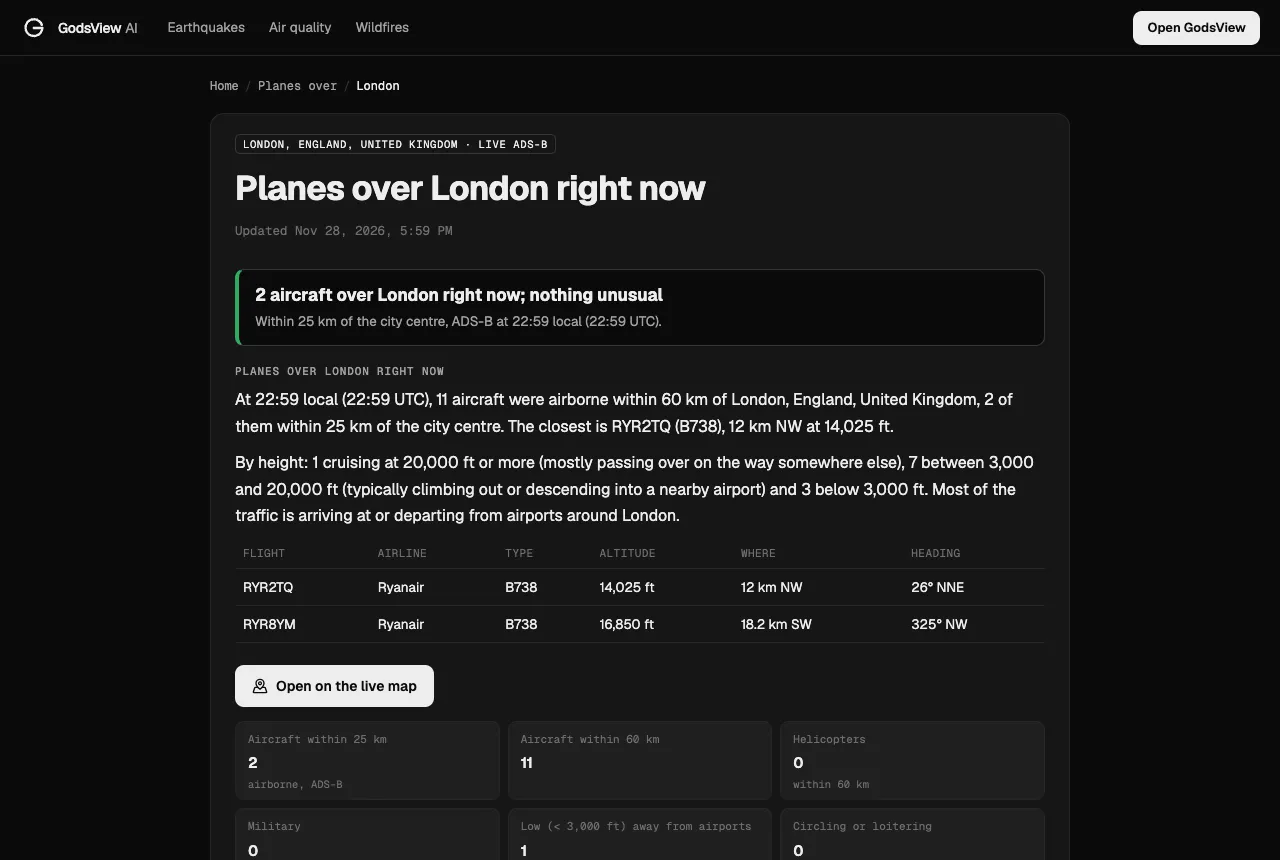
- To see which plane is drawing a contrail over you, GodsView pages such as Planes over London list aircraft near a city with their altitude.
Contrails are thin clouds made by aircraft. A jet engine's exhaust is hot and full of water vapour; when it meets the very cold air at cruising altitude, that vapour condenses on tiny particles and freezes into ice crystals, leaving a white line behind the plane. If the air up there is dry, the line vanishes within seconds or minutes. If it is very humid, the contrail can last for hours and spread into a sheet of cirrus-like cloud. The difference comes from the air, not from what the plane is releasing.
Want to know which plane drew the line above you? GodsView's planes over London page, and the same page for many other cities, lists the aircraft near the city centre with their altitudes, so you can match a contrail to a flight.
How contrails form
The US Environmental Protection Agency, the Federal Aviation Administration and NOAA explain it in a joint contrails fact sheet published in July 2025. Contrails "form when hot, humid air from an airplane exhaust mixes with low temperature air in the upper atmosphere." If the air is cold and humid enough, the water vapour condenses onto fine particles, forms droplets, and the droplets "quickly freeze into ice crystals."
A few numbers help:
- Exhaust is mostly CO2 and water. The fact sheet gives airplane engine exhaust as 71 percent carbon dioxide and 28 percent water vapour, with less than 1 percent other combustion products such as sulfur oxides, nitrogen oxides and soot.
- It is very cold up there. The fact sheet says air at these altitudes can be as cold as -70 °F. The National Weather Service office in Flagstaff says contrail temperatures are "generally colder than -40 F".
- Only the water needs to be added. Fine particles are already present throughout the atmosphere, so "only the addition of water vapor in the engine exhaust is required to form a contrail."
It is the same thing that happens when you see your breath on a cold morning, just several miles up.
Why some contrails disappear and others last
The fact sheet sorts contrails into three types:
| Type | What you see | Why |
|---|---|---|
| Short-lived | A short line that fades within seconds to minutes | Low humidity: the new ice crystals evaporate as the exhaust mixes in |
| Persistent, non-spreading | A long thin line that stays after the plane is gone, from minutes to more than a day | Extremely humid air with little wind shear keeps the line intact |
| Persistent, spreading (contrail cirrus) | Lines that widen into hazy sheets of cloud over hours to days | Extremely humid air; the crystals keep growing, and wind shear spreads them across the sky |
The air at cruise height is patchy. The fact sheet calls the humid pockets ice supersaturation regions (ISSR). When a plane flies in and out of one, its contrail can seem to switch on and off. That is "entirely due to changes in the natural atmospheric state and not to changes in the aircraft exhaust."
This also answers a common question: why do two planes at the same time leave different trails? They are usually at different altitudes, in different layers of air. One is in a humid layer and leaves a long contrail; the other is a few thousand feet higher or lower in dry air and leaves almost none.
Contrails "will not form if the air at the airplane's altitude is too warm or too dry," and humidity at the ground can be very different from humidity aloft. A dry sunny day on the ground can still have a humid layer at 35,000 feet.
Contrails and the weather
People have long used contrails as a rough weather sign. The National Weather Service in Flagstaff notes that when contrails dissipate quickly or fail to form, the upper air is dry and stable weather is likely to continue, while "on days where they persist, a change in the weather pattern may be expected." Persistent contrails mean moisture is moving in high up, which often comes ahead of an approaching weather system.
It is a hint, not a forecast. For real weather, check the weather radar and your local weather warnings.
Chemtrails: what the agencies say
"Chemtrails" is the claim that long-lasting trails are chemicals sprayed on purpose. The EPA describes it this way: chemtrail claims "inaccurately claim that contrails resulting from routine air traffic are actually an intentional release of dangerous chemicals or biological agents."
The 2025 EPA, FAA and NOAA fact sheet addresses the main points directly:
- Persistent contrails "do not indicate an airplane had dispersed harmful chemicals."
- "The U.S. Government is not conducting weather modification nor releasing harmful agents into the atmosphere."
- "Jet fuel does not contain metal-based compounds." Dissolved metals in jet fuel would affect engine stability and be a major safety concern.
- Contrails are made primarily of water in the form of ice crystals and "do not pose direct health risks to humans."
The fact sheet also explains a source of confusion: once persistent contrails widen, they are hard to tell apart from natural cirrus, and natural cirrus that happens to form in parallel lines can be mistaken for contrails.
At ground level, engine exhaust does contain pollutants that matter for health, which is why agencies regulate aircraft engines. Those emissions near airports are a separate issue from the ice clouds at cruise altitude. For the air you breathe, see the air quality in London page or your own city.
Why scientists care: contrails and climate
Contrails are not harmless for the climate, even though they are only ice. The National Weather Service notes that these cirrus-like clouds can influence climate through their reflective and insulating properties.
- The EPA says that "current models indicate that persistent contrail clouds could have a small net warming effect", while stressing that more research is needed.
- The joint fact sheet says that in certain flight corridors, cloud cover has increased by as much as 20 percent, an estimate the National Weather Service also cites.
- Google, which has worked on contrail prediction, says contrails account for "roughly 35% of aviation's global warming impact". That estimate comes from research Google cites; the size of the effect is still an active research question.
Contrail forecasts and avoidance
Because persistent contrails only form in specific humid layers, a plane can often avoid making one by flying a little higher or lower. That needs a forecast of where those layers are.
- 2023 test: Google Research, American Airlines and Breakthrough Energy used AI and satellite imagery to build contrail forecast maps. In 70 test flights over six months, pilots who used the predictions cut contrails by 54 percent, using about 2 percent more fuel on those flights.
- 2025 trial, reported in March 2026: American Airlines, Google, the flight planning service Flightkeys, Contrails.org and Breakthrough Energy ran a larger trial on flights from the US to Europe between January and May 2025. The 112 flights that flew the contrail-avoiding option "formed 62% fewer contrails compared to the control group," with no statistically significant difference in fuel use, according to the report published by WTOP.
These are trials, not standard airline practice. The EPA and FAA fact sheet lists engine technology, new fuel formulations and operational re-routing as possible ways to reduce contrails, and says more research is needed to decide how to use them.
How to tell which plane is making a contrail
- Look at the time and direction. Note where the contrail starts and which way the plane is heading.
- Open a live flight map. The planes over London page lists aircraft within 25 km of the city centre from ADS-B data, with altitude, distance and heading. There are matching pages for other cities, such as planes over New York City.
- Pick the high one. Contrails form at cruise altitudes, so the aircraft you want is one at cruising altitude, far higher than planes climbing out of or descending into an airport.
- For a single point, the What's overhead page shows the aircraft closest to your own location.
To see how these positions are collected, read how ADS-B flight tracking works. If you are curious about the planes themselves, what is flying over my house walks through identifying a flight, and the live flight tracker shows traffic worldwide.
The short version
Contrails are ice clouds made when hot, humid jet exhaust meets air colder than about -40 °F. Dry air at cruise height makes short trails; very humid air makes long ones that can spread into cirrus. US agencies say persistent contrails do not mean anything is being sprayed. They do matter for climate, and trials have shown that small altitude changes can cut them by more than half. Next time a plane draws a line across your sky, open a live map and see which flight it was.
Find the plane over you right now
Frequently asked questions
What are contrails made of?
Mostly water in the form of ice crystals. Water vapour in jet exhaust condenses on tiny particles in very cold air at cruise altitude and freezes. The EPA, FAA and NOAA say contrails do not pose direct health risks to humans.
Why do some planes leave contrails and others don't?
Because they fly through different air. Contrails only last where the air at the plane's altitude is cold and humid enough. A plane a few thousand feet higher or lower, in drier air, may leave a short trail or none at all.
Why do some contrails stay in the sky for hours?
They form in extremely humid layers called ice supersaturation regions. There the ice crystals keep growing instead of evaporating, and wind shear can spread them into wide cirrus-like cloud that lasts hours or even more than a day.
Are chemtrails real?
A 2025 EPA, FAA and NOAA fact sheet says persistent contrails do not indicate that a plane dispersed harmful chemicals, that the US government is not conducting weather modification or releasing harmful agents, and that jet fuel does not contain metal-based compounds.
Do contrails affect the climate?
Yes, a little. EPA says persistent contrail clouds could have a small net warming effect, and in some flight corridors cloud cover has increased by up to 20 percent. Trials have shown that avoiding humid layers can cut contrails by more than half.
Do contrails predict the weather?
Loosely. The National Weather Service notes that when contrails persist, moisture is increasing aloft and a change in the weather may follow; when they vanish quickly, dry and stable weather is likely to continue.
Sources
- EPA, FAA and NOAA — Contrails Fact Sheet (July 2025, PDF)
- EPA — Information on contrails from aircraft
- National Weather Service Flagstaff — Clouds and contrails
- Google — How AI is helping airlines mitigate the climate impact of contrails (August 2023)
- WTOP — American Airlines and Google say AI helped airplanes reduce contrails (March 2026)
Facts checked on against each provider's own site.