Explainer
How Many Planes Are in the Air Right Now? The Real Numbers
Nobody publishes one official worldwide count, but the agencies that run the airspace do publish their numbers. Here is what they say, why every flight tracker shows a slightly different total, and how to see the traffic for yourself.
Key takeaways
- Over the United States, the FAA says about 5,500 aircraft are in the sky at peak operational times, out of an average of 44,360 flights it handles each day.
- Europe's busiest day in 2025 had 37,034 flights in the Eurocontrol network, on 18 July 2025. ICAO counted 37.4 million scheduled departures worldwide in 2024.
- No agency publishes a live global count. The figure you see on a flight tracker is how many aircraft that network can hear right now, not every plane in the sky.
- Counts differ because of receiver coverage, oceans and remote areas, aircraft that do not broadcast ADS-B, privacy filtering, and what each site counts as a flight.
- To see what is over your own home, use a planes-over city page or the overhead list instead of the world map.
How many planes are in the air right now? Over the United States alone, up to about 5,500 aircraft at the busiest times of day, according to the FAA. Worldwide, no agency publishes a live total. The best public figures are daily: the FAA handles about 44,360 flights a day, Europe's network peaked at 37,034 flights on one day in 2025, and ICAO counted 37.4 million scheduled departures across the world in 2024.
So the number of planes in the sky right now depends on the time of day, the day of the week and the season, and on who is counting. A live flight tracker can show you the aircraft it hears at this moment, which is the closest thing to a real-time answer. This guide gives you the official numbers, explains why trackers disagree, and shows how to see the traffic on a map.
See planes in the air on the live map
How many planes are in the air right now? The numbers
Here are the figures that air traffic agencies publish, with what each one actually measures.
| Measure | Figure | Area | Source |
|---|---|---|---|
| Aircraft in the sky at peak operational times | 5,500 | Airspace the FAA controls | FAA, Air Traffic by the Numbers |
| Average flights handled per day | 44,360 | United States (FAA) | FAA |
| Flights handled per year | 16,191,379 | United States (FAA) | FAA |
| Flights in 2025 | 11.1 million | Eurocontrol Network Manager area | Eurocontrol |
| Busiest single day of 2025 | 37,034 flights (18 July 2025) | Eurocontrol Network Manager area | Eurocontrol |
| Scheduled departures in 2024 | 37.4 million | Worldwide | ICAO |
The FAA figures come from its Air Traffic by the Numbers page. The European numbers come from Eurocontrol's 2025 European Aviation Overview, which says 2025 traffic was up 4% on 2024 and back to pre-pandemic levels. The world figure comes from ICAO's 2024 air transport results, which recorded 37.4 million departures, up 5.1% on 2023.
Only the first row is a "right now" figure. The rest are counts of flights per day or per year, and a flight is only airborne for part of that day.
Flights per day vs planes in the sky at once
People often mix up two numbers: how many flights happen in a day, and how many are airborne at the same moment.
A flight from New York to London takes hours; a hop between two nearby cities takes under an hour. At any moment, only the flights between takeoff and landing count as being in the air. That is why the FAA's peak airborne figure (5,500) is much smaller than its daily total (44,360).
Here is a rough way to connect the two. Flightradar24 logged 153,359 commercial flights worldwide on 23 July 2026, its busiest day on record, according to Airways Magazine. If you assume, just for illustration, that the average flight lasted two hours, that day would have averaged about 12,800 commercial flights in the air at any moment, with more at the daily peak and fewer overnight. The real average duration is not published, so treat that as arithmetic, not a measured count.
When the sky is busiest
The busiest periods follow travel demand:
- Summer. Europe's 2025 peak day fell on 18 July, and Flightradar24's commercial record was set on 23 July 2026.
- Holidays. For Thanksgiving week 2025, the FAA prepared for more than 360,000 flights and expected Tuesday, 25 November to be the peak, with more than 52,000 flights (FAA). That is well above the FAA's daily average.
- Peak hours. The FAA's own airborne figure is quoted for "peak operational times", so the count at any other hour is lower.
So the number of airplanes in the air right now on a summer holiday afternoon is not the number you would see on a quiet winter night. A live map lets you check the current picture rather than rely on an average.
Why flight trackers show different counts
Open two flight tracking sites side by side and their totals will not match. That is normal. Each one counts the aircraft its own network can hear, and each makes different choices about what to show.
Receiver coverage
Most consumer trackers, GodsView included, are built on ADS-B: aircraft broadcast their position, and ground receivers pick it up. A plane appears only when it is broadcasting and a receiver is in range. Coverage is dense where many receivers are running, and has gaps over oceans and remote areas, as our methodology page notes for the aircraft layer. Our guide on how ADS-B flight tracking works explains the radio side.
Oceans and remote areas
Ground receivers cannot hear an aircraft in the middle of the Atlantic or Pacific. Some networks buy satellite-received ADS-B to fill those gaps; Flightradar24, for example, made satellite data available to all its users from March 2020 (Wikipedia). A network without satellite data will undercount long-haul flights over the ocean, and positions resume when they come back into receiver range.
Aircraft that do not broadcast
ADS-B Out is required in much US airspace. Federal rules say that after January 1, 2020, aircraft need it in Class A airspace and other listed airspace, unless ATC authorizes otherwise (14 CFR 91.225). Outside that airspace, and in countries with different rules, some small planes and many military aircraft do not broadcast ADS-B at all. Our military aircraft tracking explainer covers why state aircraft are often missing.
Privacy filtering
In the US, the FAA's LADD program lets owners ask for their aircraft data to be filtered from public display by sites that use FAA data and take part in the program. The Privacy ICAO Address program lets eligible US aircraft use an alternate, temporary address that is not linked to the owner in the public registry. Different sites apply these filters differently.
What counts as a flight
Some sites count only airborne aircraft; others include aircraft taxiing at airports. Some include gliders, balloons and helicopters; others count only scheduled passenger and cargo flights. Flightradar24's record day shows how big that gap can be: it tracked 287,364 flights in total, and the 153,359 commercial flights were 53.4% of them (Airways Magazine).
| Why counts differ | Effect on the number |
|---|---|
| Fewer ground receivers in an area | Lower count there |
| No satellite ADS-B | Lower count over oceans |
| Aircraft without ADS-B Out | Missing small planes and military aircraft |
| LADD and PIA privacy filtering | Some private aircraft hidden or unlabeled |
| Counting ground traffic and gliders | Higher count |
| Counting only commercial flights | Lower count |
How to see planes in the air right now on a live map
You can watch the traffic yourself in a few seconds. Here is how to do it on GodsView, which is free with a free account.
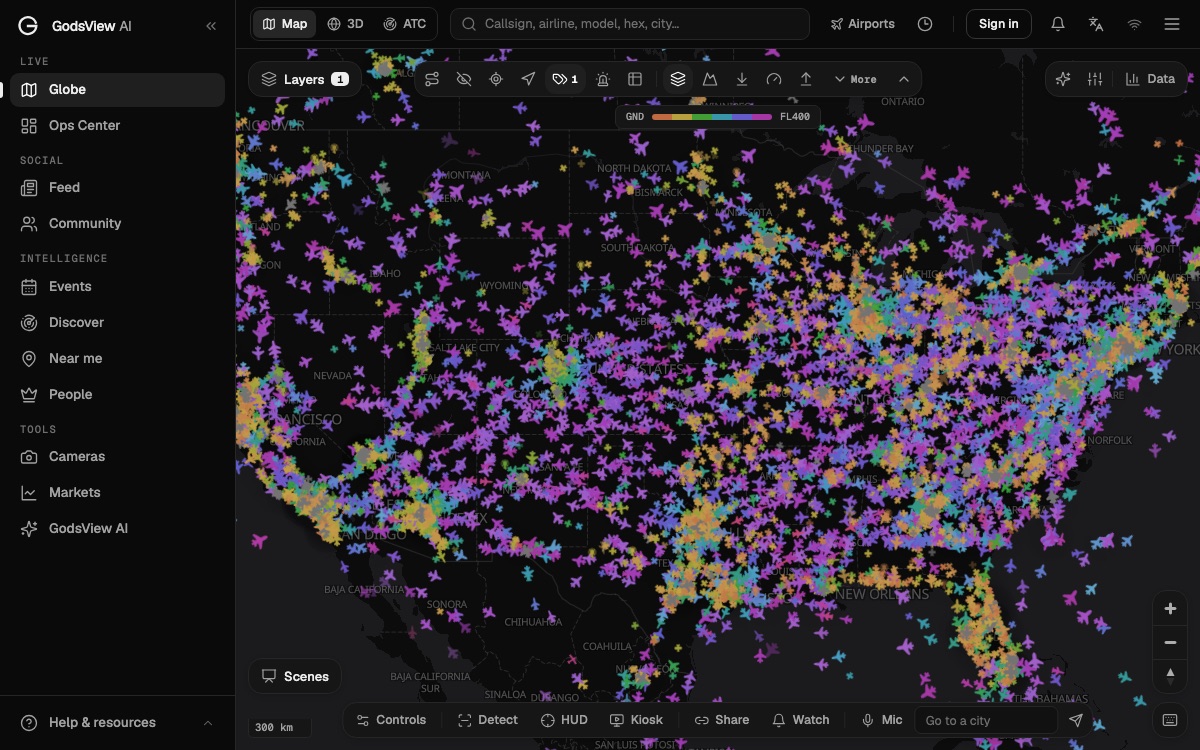
- Open the map. Go to the live flight tracker, or the 3D globe for the whole world at once.
- Zoom out. Aircraft are colored by altitude, so you can tell climbing and descending traffic near airports from airliners at cruise.
- Pick a region. Pan to a busy area such as Europe or the eastern US to see dense traffic, or to an ocean to see how coverage thins out.
- Click any aircraft. The flight card shows the callsign, registration, aircraft type, route, altitude and speed when the data includes them.
- Search. Type an airline, callsign, registration or airport into the search box to jump straight to it.
Remember what the map is showing: aircraft that GodsView's ADS-B sources can hear right now. If you want the official count for a country's airspace, the air navigation agency is the source, not any tracker.
Tracking all flights in the air vs one flight
Tracking all flights in the air is useful for curiosity, for watching a storm push traffic around, or for seeing how busy a hub is. For a trip, though, you usually care about one plane.
To follow one flight, type its flight number into Track a flight. The page shows position, altitude, speed, distance to go and estimated landing time, and you can share the link with family. If the flight number does not match what the aircraft broadcasts, our guide on how to track a flight explains how flight numbers, callsigns and hex codes fit together. To follow one airframe across many flights, use its registration; see track a plane by tail number.
To see everything landing at one airport, open an airport page such as JFK or Heathrow. It opens the live map around the airport and lists the flights nearby.
On your phone, GodsView is also available as an iPhone app and an Android app on Google Play.
What is flying over me right now?
If your real question is which planes are above your house at this moment, the world total does not help much. Use a local view instead:
- Planes-over city pages list the aircraft near a city right now, with altitude, distance and heading, and flag planes that are circling. Try New York City, London or Toronto.
- The overhead list at What's overhead shows planes within a set distance of your location, with direction and elevation angle, so you know where to look.
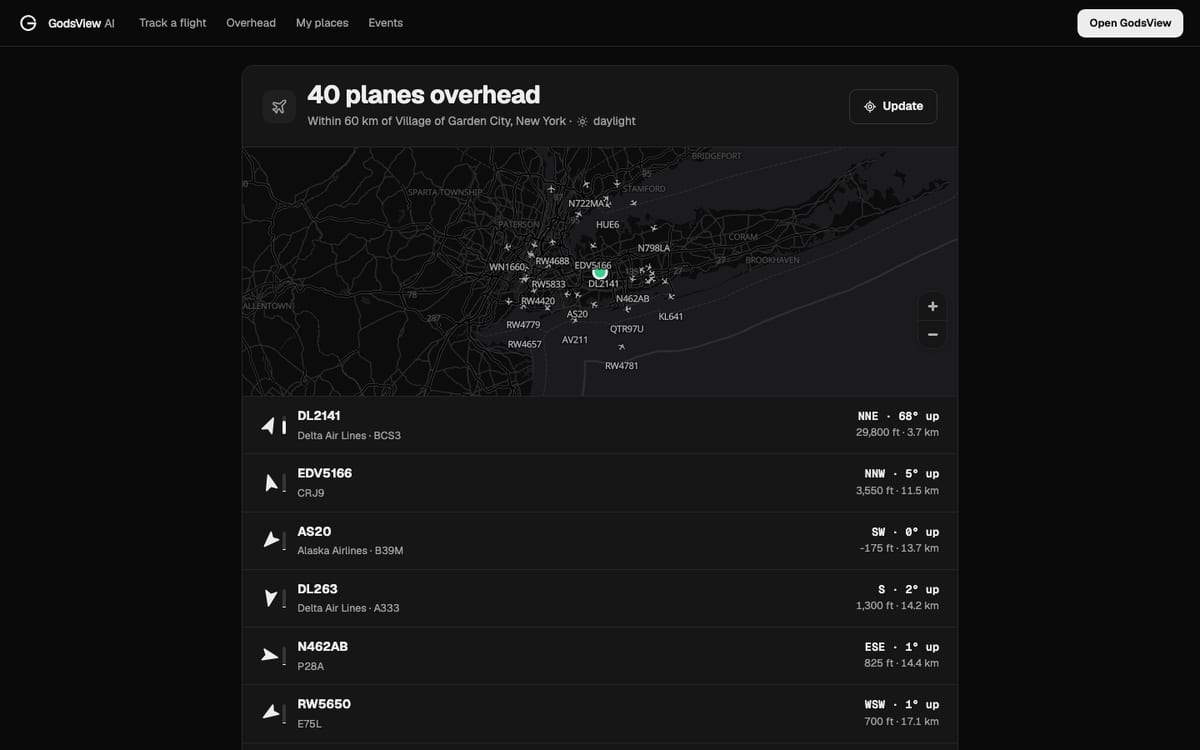
Our guide What's flying over my house right now? walks through matching a plane on screen to the one you can see or hear, and why some never appear.
The short answer, and where to look next
There is no single official count of planes in the air right now. The FAA puts the US peak at about 5,500 aircraft, Europe's busiest day in 2025 had just over 37,000 flights, and the world flies tens of millions of scheduled departures a year. Any live tracker's total is the number of aircraft its network can hear at that moment, so expect it to differ from site to site.
To see the traffic yourself, open the live map, pick a region in daytime and click a few aircraft. For the planes over your own street, go straight to a planes-over page.
Frequently asked questions
How many planes are in the air at any one time?
Over the United States, the FAA says about 5,500 aircraft are in the sky at peak operational times. No agency publishes a live worldwide figure. Europe's busiest day in 2025 had 37,034 flights in the Eurocontrol network, and ICAO counted 37.4 million scheduled departures worldwide in 2024, but those are daily and yearly totals, not planes airborne at once.
How many flights are there per day in the US?
The FAA handles an average of 44,360 flights a day and 16,191,379 a year. Busy holiday days run higher: for Thanksgiving week 2025 the FAA expected more than 52,000 flights on its peak day, Tuesday 25 November.
Why does each flight tracker show a different number of planes?
Each tracker counts only the aircraft its own receivers can hear. Totals change with receiver coverage, whether the network has satellite ADS-B over oceans, aircraft that do not broadcast ADS-B, privacy programs such as the FAA's LADD, and whether the site counts ground traffic, gliders and private aircraft or only commercial flights.
When are the most planes in the sky?
In summer and on holiday travel days. Europe's busiest day of 2025 was 18 July, Flightradar24 set its commercial record on 23 July 2026, and the FAA expected more than 52,000 flights on the peak day of Thanksgiving week 2025, against a daily average of 44,360.
How can I see the planes flying over me right now?
Open a planes-over page for your city, such as Planes over New York City, or the What's overhead page, which lists planes near your location with direction, altitude and distance. A plane appears only if it is broadcasting ADS-B and a receiver can hear it.
Sources
- FAA — Air Traffic by the Numbers
- FAA — Expects busiest Thanksgiving travel period in 15 years (Nov 21, 2025)
- Eurocontrol — European Aviation Overview 2025 (Jan 23, 2026)
- ICAO — The world of air transport in 2024
- Airways Magazine — Flightradar24 record commercial flights, July 2026
- Wikipedia — Flightradar24
- eCFR — 14 CFR 91.225, ADS-B Out equipment and use
- FAA — Limiting Aircraft Data Displayed (LADD)
- FAA — Privacy ICAO Address (PIA) program
Facts checked on against each provider's own site.