Explainer
Dark Fleet Ships Explained: Shadow Tankers and AIS
The "dark fleet" or "shadow fleet" is the network of ageing tankers that moves sanctioned oil outside mainstream shipping. Here is what the term means, the tricks these ships use, how large the fleet is in 2026 and how analysts spot them.
Key takeaways
- The dark fleet, also called the shadow fleet, is the IMO's term for ships that operate illegally to evade sanctions, safety or environmental rules or insurance costs, for example by switching off AIS or hiding their real identity.
- Most of it is old tankers carrying Russian, Iranian or Venezuelan oil. The KSE Institute found shadow tankers carried 75% of Russia's seaborne crude exports in April 2026.
- Common tactics, as listed by the US Treasury, State Department and Coast Guard, are disabling or spoofing AIS, painting over names, falsifying documents, ship-to-ship transfers at sea, odd routes, false flags and layered ownership.
- As of November 2026, the EU has listed more than 670 shadow fleet vessels (after its July 2026 package) and the UK more than 600 shadow fleet and Russian LNG vessels.
- Analysts find dark ships by comparing satellite radar and optical images with AIS, looking for gaps, impossible tracks and ship-to-ship meetings. A public AIS map shows only ships that transmit, so it cannot reveal a dark ship on its own.
The dark fleet, often called the shadow fleet, is the group of ships, mostly old oil tankers, that moves sanctioned cargo outside normal shipping rules. The International Maritime Organization (IMO) uses both names for ships "engaged in illegal operations" to evade sanctions, safety or environmental rules, or insurance costs. The best-known tactic is switching off or faking the ship's AIS signal, the radio broadcast that shows a ship's identity and position on public ship maps. Most of today's dark fleet carries Russian oil, with other parts serving Iran and, until early 2026, Venezuela.
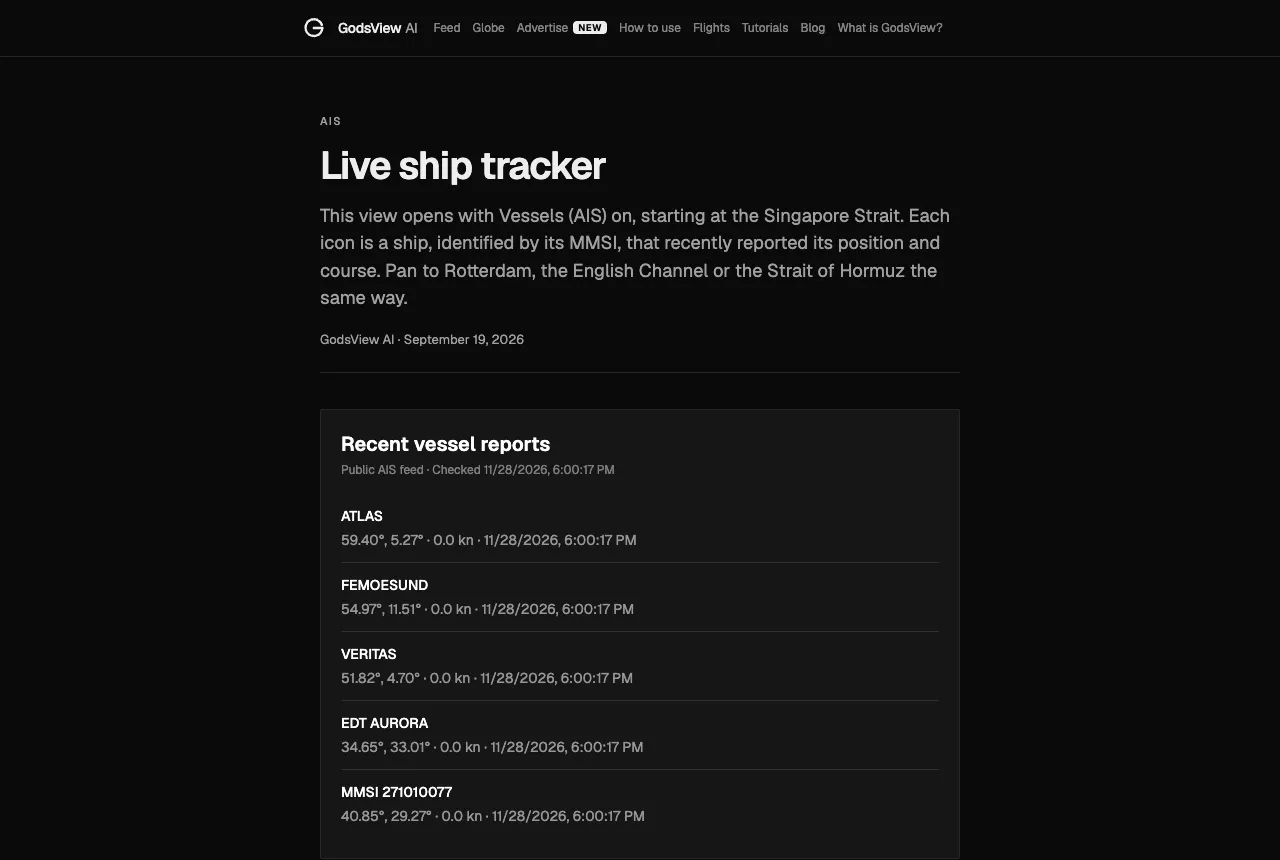
This guide explains what qualifies a ship as dark fleet, the tricks these ships use, how large the fleet is in 2026, what sanctions have done, and how analysts find ships that do not want to be seen. If you want to look at tanker traffic yourself, the GodsView live ship tracker shows ships that are transmitting AIS.
What is the dark fleet?
In December 2023 the IMO Assembly adopted Resolution A.1192(33), a resolution aimed at the "dark fleet" or "shadow fleet". It defines these as ships carrying out illegal operations to evade sanctions, avoid safety or environmental rules, avoid insurance costs, or engage in other illegal activity, including:
- Running unsafe operations that do not follow international rules and established industry standards.
- Deliberately avoiding inspections by port states and flag states.
- Not carrying adequate liability insurance or other financial security.
- Deliberately avoiding commercial vetting and inspections.
- Not running a transparent corporate governance policy that protects crew and the marine environment.
- Deliberately avoiding detection, for example by switching off AIS or LRIT transmissions or hiding the ship's real identity, when there is no legitimate safety or security reason.
The resolution also notes concerns that these ships are poorly maintained, have unclear ownership, lack insurance and hide where their cargo comes from or goes, and that they pose a real risk of accidents, especially during ship-to-ship transfers.
Dark fleet, shadow fleet, or just "dark"?
People use the words loosely. The IMO treats "dark fleet" and "shadow fleet" as the same thing. Researchers often use narrower working definitions: the KSE Institute, which tracks Russian oil exports, counts a tanker as shadow fleet if it has no links to G7-plus countries for its ownership, management and flag, and no insurance from the International Group of P&I Clubs. A ship "going dark" simply means its AIS signal stopped being received, which on its own proves nothing: the IMO resolution itself says that missing AIS reception is not conclusive evidence of illegal activity and needs further investigation.
How big is the shadow fleet in 2026?
There is no official count, because the whole point is to be hard to count. Different analysts use different definitions, so their numbers differ. Here are figures from sources that publish their methods, as of 2026:
| Measure | Figure | Source |
|---|---|---|
| Share of Russia's seaborne crude exports carried by shadow tankers | 75% in April 2026 (29% of oil products) | KSE Institute, May 2026 tracker |
| Tankers used for Russian crude exports in April 2026 | 137 unique tankers, 75% of them shadow fleet | KSE Institute |
| Top flags of Russian shadow tankers | Cameroon, Russia and Panama, 61% together; Russia's share rose from 3% in May 2025 to 23% in April 2026 | KSE Institute |
| Tankers that served Iran and Venezuela at the peak | Over 350 vessels of MR size or larger | Kpler, Q1 2026 tanker outlook |
| Vessels under EU shadow fleet sanctions | 632 before July 2026, plus 41 added on July 23, 2026 | EU Council / EEAS |
| Vessels under UK sanctions | More than 600 shadow fleet and Russian LNG vessels (June 2026) | UK government |
Kpler noted in February 2026 that demand for shadow tonnage serving Iran and Venezuela had started to fall in January 2026, after Venezuela was removed from sanctioned trade networks, the first real decline since the shadow fleet grew up nearly a decade ago. The Russian trade remains the largest part.
The tricks: how dark fleet ships hide
The clearest public list of tactics comes from a joint advisory by the US Treasury's Office of Foreign Assets Control (OFAC), the State Department and the US Coast Guard, issued on May 14, 2020 and still the standard reference for compliance teams.
| Tactic | What it looks like |
|---|---|
| Disabling AIS | The ship stops broadcasting, so it disappears from AIS maps, often near a loading port or a transfer area |
| Manipulating AIS ("spoofing") | The ship broadcasts a different name, IMO number, MMSI or a false position, so the track shows it somewhere it is not |
| Physically altering identification | Painting over the name and IMO number on the hull to pass as another ship |
| Falsifying cargo and ship documents | Bills of lading, certificates of origin or insurance papers that disguise where the oil came from |
| Ship-to-ship (STS) transfers | Moving cargo between ships at sea, especially at night or in high-risk areas, to hide origin or destination |
| Voyage irregularities | Indirect routes, unscheduled detours and transshipment through third countries |
| False flags and flag hopping | Flying a flag without authorisation, or changing registries repeatedly to avoid scrutiny |
| Complex ownership | Shell companies and frequent changes of owner or manager to hide who really controls the ship |
The advisory stresses that AIS sometimes goes off for legitimate safety reasons or poor reception, so a gap is a reason to look harder, not proof.
Sanctions on the shadow fleet
Western governments now sanction individual ships, not just companies. In the EU, a listed ship faces a port access ban and a ban on a broad range of services related to maritime transport.
- European Union. On December 18, 2025 the EU listed 41 more vessels, bringing its total to nearly 600. By July 2026 the list stood at 632. The 21st package, adopted on July 23, 2026, added another 41 vessels and, for the first time, allowed listing of ships that support the shadow fleet with bunkering and other services. It also designated a crewing agency for the first time.
- United Kingdom. By June 16, 2026 the UK had sanctioned more than 600 shadow fleet and Russian LNG vessels, describing the fleet as "decrepit and ageing".
- United States. OFAC designates ships and their owners and managers, and its maritime advisories set out the red flags listed above.
Flags shift quickly as well: the KSE Institute found the Russian flag's share of shadow tankers rose from 3% in May 2025 to 23% in April 2026.
Why the dark fleet matters beyond sanctions
The IMO's main worry is safety. Old ships with unclear owners and no mainstream insurance are more likely to have accidents and less able to pay for them. The 2026 example is the Caroline Bezengi, a Cameroon-flagged tanker believed to be part of Russia's shadow fleet. It was carrying about 800,000 barrels of sanctioned Russian crude when it was hit off Yemen on June 8, 2026 and ended up aground off Oman, where its leaking oil reached the coast in August. Our oil spill tracking guide follows that case.
Ship-to-ship transfers at sea add risk too, which is why the IMO resolution asks flag states to require notification of STS operations and asks coastal states to monitor them.
How analysts find dark fleet ships
Finding a ship that does not want to be found means combining sources. The main methods are:
- AIS gap analysis. Look for tankers whose signal stops near a sanctioned port or a known transfer area and returns days later.
- Spotting spoofed tracks. A ship that appears to sit on land, or jump impossible distances is probably broadcasting false positions. Interference such as GPS jamming can cause similar errors, so analysts check both; see our guide to GPS jamming and spoofing.
- Satellite radar. Radar satellites such as ESA's Sentinel-1 see ships day and night and through cloud. A study led by Global Fishing Watch, published in Nature with five years of Sentinel-1 and Sentinel-2 data (2017 to 2021), found that about 75% of industrial fishing vessels and more than 25% of transport and energy vessel activity were missing from public tracking systems. Matching radar detections against AIS shows which ships are there but not broadcasting.
- Optical images. High-resolution photos can show two tankers side by side, a hull colour or even a painted name, helping to confirm a transfer or an identity.
- Official tools. Governments have more: LRIT, a satellite reporting system that the IMO notes can identify ships up to 1,000 nautical miles from a coastal state, plus port state inspections and intelligence.
- Paper trails. Ownership records, flag changes, insurance and classification status, all of which feed the sanctions lists above.
What a public live ship map can and cannot show
A free AIS map like GodsView shows ships that are transmitting and within range of a receiver. GodsView's ship layer comes from a terrestrial AIS stream refreshed about every 30 seconds, so coverage is strong near coasts and thin far offshore. That makes it useful for a first look:
- Watching tanker traffic in a strait or off a port, such as the Strait of Hormuz or the Red Sea. The Red Sea live map and Middle East live map open on those areas.
- Seeing a ship's reported identity: name, MMSI, speed, course and status.
- Noticing oddities such as ships appearing on land, which usually mean bad position data.
It cannot show a ship that has its AIS off, and it is not built for detecting vessels that switch off AIS or for sanctions compliance. For that, use a specialist maritime data provider. Treat anything you notice on a public map as a question to check, not a finding. Our maritime awareness page and guides to what AIS is and global vessel tracking by satellite explain the limits in more detail.
The short version
The dark fleet or shadow fleet is a set of mostly old tankers that carries sanctioned oil while dodging the rules: switching off or spoofing AIS, changing names and flags, transferring cargo at sea and sailing without mainstream insurance. In April 2026 such ships carried three-quarters of Russia's seaborne crude, and the EU and UK have each sanctioned more than 600 of them. Analysts find them by comparing satellite images with AIS. A public ship map shows only ships that transmit, so use it for context and rely on official sanctions lists for facts.
See tanker traffic in the Red Sea
Frequently asked questions
What is the dark fleet?
The dark fleet, or shadow fleet, is the IMO's name for ships that operate illegally to evade sanctions, safety or environmental rules, or insurance costs. Typical signs are switching off or faking AIS, hiding the real owner, avoiding inspections and lacking proper liability insurance. Most are old tankers carrying Russian or Iranian oil.
Is the dark fleet the same as the shadow fleet?
Yes. The IMO resolution adopted in December 2023 uses "dark fleet" and "shadow fleet" for the same group of ships. Some analysts use stricter definitions, for example tankers with no G7-linked owner, manager or flag and no International Group P&I insurance.
How many ships are in the Russian shadow fleet?
There is no official count, and estimates depend on the definition. The KSE Institute found that 75% of the 137 tankers used for Russian crude exports in April 2026 were shadow fleet, carrying 75% of the volume. The EU has sanctioned more than 670 vessels and the UK more than 600 shadow fleet and Russian LNG vessels.
Why do ships turn off AIS?
Sometimes for legitimate safety reasons and sometimes because of poor reception. Dark fleet ships also switch AIS off or broadcast false data to hide loading at sanctioned ports or ship-to-ship transfers. A missing signal alone does not prove wrongdoing.
Can I track dark fleet ships on a free ship tracker?
Only when they are transmitting AIS. A free terrestrial AIS map such as the GodsView live ship tracker shows tankers that broadcast near coasts, but it cannot see ships with AIS off. Detecting dark ships requires satellite imagery and specialist data.
What is AIS spoofing?
Spoofing is broadcasting false AIS data, such as another ship's name, IMO number or MMSI, or a fake position. The US advisory on deceptive shipping practices lists it alongside switching AIS off as a main way sanctioned ships hide their movements.
Sources
- IMO — Resolution A.1192(33) on the "dark fleet" or "shadow fleet" (Spanish text, adopted December 6, 2023)
- OFAC, US State Department and US Coast Guard — Sanctions advisory for the maritime industry (May 14, 2020)
- KSE Institute — Russian Shadow Fleet Tracker, May 2026
- EEAS — 21st package of sanctions (July 24, 2026)
- EEAS — Council sanctions 41 vessels of the Russian shadow fleet (December 18, 2025)
- UK government — New sanctions package (June 16, 2026)
- Kpler — Q1 2026 tanker market outlook
- ESA — Sentinel-1 and AI reveal 75% of fishing vessels not tracked
- Al Jazeera — Oman says massive oil spill reaches coastline (August 13, 2026)
Facts checked on against each provider's own site.