Live guide
Earthquake in Greece Today: How to Check the Latest Quakes
Greece feels earthquakes from the Ionian islands to Crete and across the Aegean. Here is how to check whether a quake just struck, how to read Greek and global reports, and what recent sequences like Santorini 2025 mean.
Key takeaways
- To check for an earthquake in Greece today, use the Institute of Geodynamics of the National Observatory of Athens (NOA), which shows real-time seismicity for the last 24 hours, or GodsView's earthquakes in Greece page built on the USGS feed.
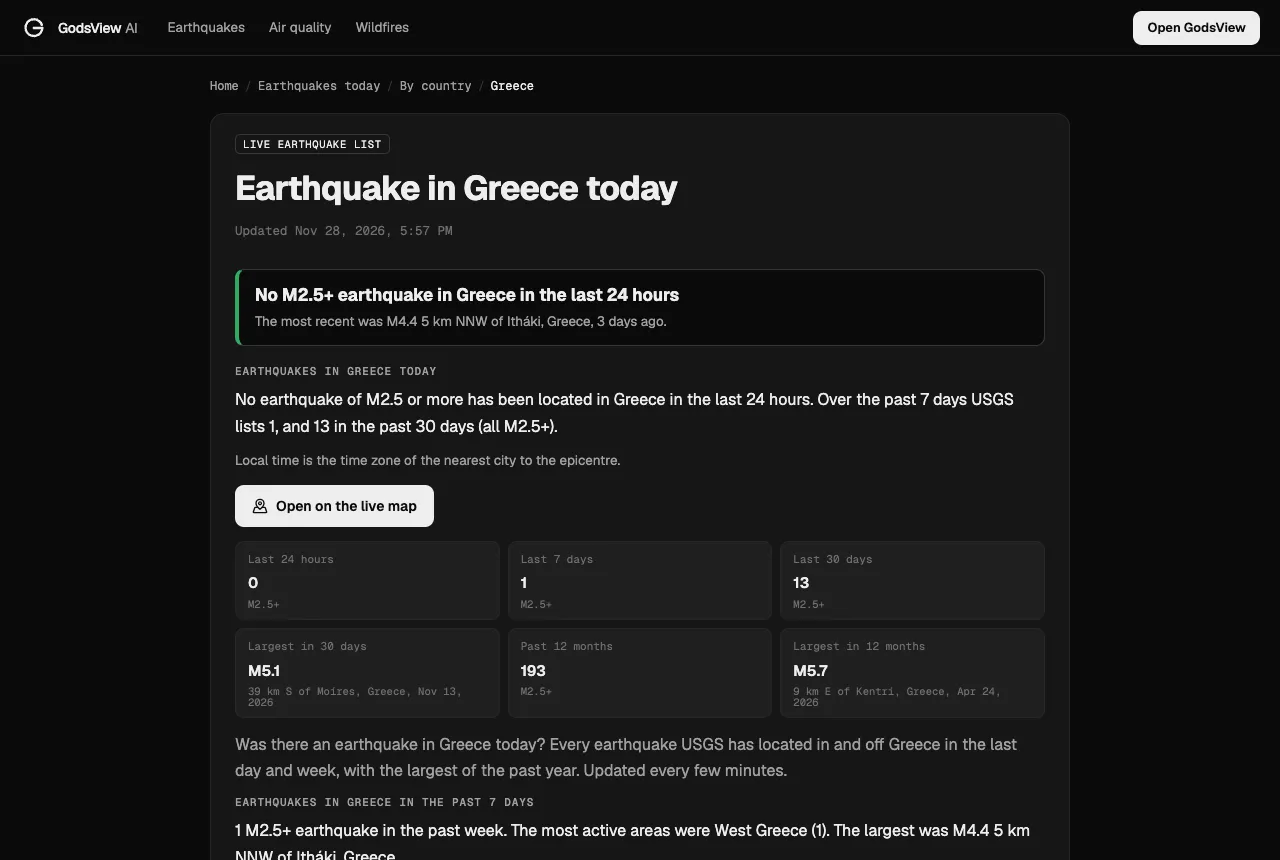
- On November 28, 2026, the USGS feed had no M2.5+ quake in Greece in the previous 24 hours; the most recent was an M4.4 5 km NNW of Itháki, three days earlier.
- Greece shakes because the Africa plate sinks beneath Eurasia at the Hellenic Trench south of Crete while the Aegean is stretched north to south.
- From late January to March 2025, the sea between Santorini and Amorgos produced more than 350 quakes of M4 or larger in the USGS catalogue, ten of them M5 or more, with no single dominant mainshock.
- The largest instrumentally recorded quake in the region was an M7.7 in July 1956 between Naxos and Santorini, and the deadliest recent one in Greece was the M6.0 Athens earthquake of 1999 (143 killed).
To check whether there was an earthquake in Greece today, open the Institute of Geodynamics of the National Observatory of Athens (NOA) at gein.noa.gr, which shows real-time seismicity for the last 24 hours, or use a live list like GodsView's earthquakes in Greece page, which shows every M2.5+ quake in Greece in the USGS feed with the largest of the week and year. For one city, pages such as earthquakes near Athens list only nearby quakes.
On November 28, 2026, the USGS feed had no M2.5+ earthquake in Greece in the previous 24 hours. The most recent was an M4.4 5 km NNW of Itháki in the Ionian Sea, three days earlier. Small local quakes happen in Greece every day, and NOA records many that global lists leave out.
See the latest earthquakes in Greece
Where to check the latest earthquake in Greece
| What you want | Best source | Notes |
|---|---|---|
| Every located quake in Greece in the last 24 hours | NOA Institute of Geodynamics, gein.noa.gr | Automatic locations marked [A], analyst-revised ones marked [M] |
| Larger quakes in Greece in a global list | USGS | Outside the US, complete from about M4 to M4.5 |
| M2.5+ quakes in Greece today, this week and this year | GodsView earthquakes in Greece | Built on the USGS feed, refreshed every few minutes |
| Quakes near one city | GodsView Athens, Thessaloníki, Patras, Chania, Larissa | Past 7 days, largest of the past year, felt reports, tsunami status |
| Quakes across the Aegean | GodsView earthquakes in Turkey | Many Aegean quakes are felt on both sides |
NOA's real-time page carries a useful caution: automatic solutions come first, and analyst-reviewed solutions marked [M] "may be improved at a later time without notice." Magnitudes from NOA and the USGS can differ by a few tenths; our guide to magnitude vs intensity explains why that is normal.
Why Greece has so many earthquakes
The USGS describes the region's tectonics as "relatively complex". Three things happen at once:
- Subduction in the south. The Africa (Nubia) plate sinks northward beneath the Eurasia plate at the Hellenic Trench, south of Crete. Africa moves north at about 10 mm a year relative to Eurasia. Quakes there can be deep: the M6.2 of May 22, 2025 off Kasos was about 64 km down.
- Stretching in the Aegean. The Aegean Sea, western Turkey and southern Greece are being pulled apart north to south, driven by the southward migration of the Hellenic Trench. That causes normal-faulting quakes like the M7.0 Samos earthquake of 2020.
- Anatolia moving west. To the east, the Anatolian microplate moves west, driving right-lateral faulting along the North Anatolian Fault on its northern edge.
The result is frequent moderate and large quakes. The USGS notes that the region within 250 km of Samos alone hosted 29 other M6+ earthquakes in the 100 years before 2020.
The 2025 Santorini-Amorgos swarm
In early 2025 the sea between Santorini and Amorgos produced a long, intense earthquake sequence. In the USGS catalogue for that area, from late January to the end of March 2025:
- more than 350 quakes of M4 or larger were recorded;
- ten were M5 or larger, the biggest two both M5.3, on February 4 (21 km NE of Firá, Santorini) and February 10 (26 km SW of Amorgós);
- most were shallow, around 10 km deep.
What made it unusual was its shape. Instead of one large mainshock followed by smaller aftershocks, many quakes of similar size kept coming for weeks. That matches the USGS definition of a swarm: "a sequence of mostly small earthquakes with no identifiable mainshock," often linked to geothermal or volcanic activity. The USGS records one building destroyed, several damaged and rockfalls on Santorini from the February 4 quake. Our guide to what are aftershocks explains the difference between swarms and aftershock sequences.
The same area hosted the largest instrumentally recorded earthquake in the region, an M7.7 on July 9, 1956, between Naxos and Santorini, south of Amorgós.
Greece's major earthquakes
| Date | Earthquake | Magnitude | Impact (USGS) |
|---|---|---|---|
| July 9, 1956 | Amorgós, Aegean | M7.7 | Largest instrumentally documented quake in the region |
| September 7, 1999 | Athens (Parnitha) | M6.0 | 143 killed, 1,600 injured, 50,000 homeless, at least 53,000 buildings damaged or destroyed |
| October 30, 2020 | Samos | M7.0 | 2 killed on Samos, 117 killed in Izmir, Turkey; a tsunami of 1.8 m on Samos |
| February 2025 | Santorini-Amorgos swarm | Up to M5.3 | One building destroyed and rockfalls on Santorini |
| May 22, 2025 | Off Kasos and Crete | M6.2 (64 km deep) | Many buildings damaged in the Irakleio area; a 5 cm tsunami recorded at Irakleio |
| March 8, 2026 | Epirus, near Ioannina | M5.5 | At least 140 homes damaged or destroyed; landslides and power cuts |
Athens, 1999
The M6.0 earthquake of September 7, 1999, centred just northwest of Athens near Fylí, was moderate in size but struck close to the capital. The USGS records intensity IX in the Athens area, 143 deaths and about 655 million US dollars of damage, and the quake was felt as far as Izmir in Turkey.
Samos, 2020
The M7.0 Samos earthquake of October 30, 2020 was a normal-faulting quake in the eastern Aegean. Most of the deaths were across the strait in Izmir, Turkey, including one person killed by the tsunami at Seferihisar. On Samos, two people died and about 100 buildings were damaged, and the tsunami reached 1.8 m on the island.
Tsunamis in Greece
Large Aegean and Hellenic Trench quakes can cause tsunamis, as Samos 2020 showed, and even moderate ones can produce small waves, like the 5 cm recorded at Irakleio in May 2025. The universal rule applies: if you feel a strong or long earthquake at the coast, or see the sea suddenly draw back or surge, move to high ground at once without waiting for an alert. Our guide to tsunami watch vs warning explains the alert levels and natural warning signs.
What to do in an earthquake in Greece
- During the shaking: Drop, Cover and Hold On under a sturdy table or next to an interior wall. Do not run outside or stand in a doorway.
- On the coast: after strong or long shaking, go to higher ground straight away.
- After: expect aftershocks, check for gas leaks and damage, stay out of cracked buildings, and follow official announcements.
- Prepare now: secure heavy furniture, and keep water, food, a torch, a radio and a first aid kit. See our earthquake preparedness checklist.
Check earthquakes in Greece right now
- Whole country: earthquakes in Greece, with today's quakes, the past 7 days and the largest of the past year.
- Attica: Athens and Piraeus.
- North and centre: Thessaloníki, Larissa.
- West and south: Patras for the Gulf of Corinth and the Ionian side, Chania for Crete.
- Region and world: earthquakes in Turkey, earthquakes today and the live earthquake map.
GodsView Plus ($10.99 a month or $99.99 a year) adds alerts for saved places, so you can be told when a quake strikes near an island or city you follow. For official information in Greece, NOA and the Greek civil protection authorities remain the reference.
The short version
Greece has earthquakes every day because Africa is sinking under it at the Hellenic Trench and the Aegean is being stretched apart. Most are small; a few each year are felt widely; and sequences like the 2025 Santorini swarm can keep islands on edge for weeks. For a tremor you just felt, check NOA's real-time list; for the larger quakes, GodsView's Greece page shows them within minutes, alongside nearby Turkey.
Frequently asked questions
Was there an earthquake in Greece today?
Check the NOA Institute of Geodynamics (gein.noa.gr) for real-time seismicity over the last 24 hours, or GodsView's earthquakes in Greece page for M2.5+ quakes in the USGS feed. On November 28, 2026 the USGS feed had none in the previous 24 hours; the most recent was an M4.4 near Itháki three days earlier.
What happened in Santorini in 2025?
From late January to March 2025, the sea between Santorini and Amorgos produced a long earthquake swarm: more than 350 quakes of M4 or larger in the USGS catalogue, ten of M5 or more, the largest M5.3. There was no single dominant mainshock.
Why does Greece have so many earthquakes?
The Africa plate is subducting northward beneath Eurasia at the Hellenic Trench south of Crete, and the Aegean region is being stretched north to south, according to the USGS. Together they produce frequent moderate and large quakes.
What was the biggest earthquake in Greece?
The largest instrumentally documented quake in the region, according to the USGS, was an M7.7 on July 9, 1956 between Naxos and Santorini. The deadliest recent quake in Greece was the M6.0 Athens earthquake of September 7, 1999, which killed 143 people.
Can earthquakes in Greece cause tsunamis?
Yes. The M7.0 Samos earthquake of 2020 produced a tsunami of 1.8 m on Samos and killed one person by tsunami in Turkey. If you feel strong or long shaking at the coast, move to high ground without waiting for an alert.
Sources
- National Observatory of Athens — Institute of Geodynamics
- USGS event page — M7.0 Samos, Greece, October 30, 2020 (tectonic summary)
- USGS event page — M6.0 Athens, September 7, 1999
- USGS event page — M5.3 northeast of Santorini, February 4, 2025
- USGS event page — M5.3 southwest of Amorgós, February 10, 2025
- USGS event page — M6.2 off Kasos and Crete, May 22, 2025
- USGS event page — M5.5 Epirus, March 8, 2026
- USGS — What is the difference between aftershocks and swarms?
Facts checked on against each provider's own site.