How-to
How to Check Flight Delays and Arrival Times Live
Late flights usually have one of three causes: the airline, the air traffic system, or an inbound aircraft that has not arrived yet. Each has its own place to check. Here is the order that works.
Key takeaways
- For your own flight, the airline's status page or app is the authority on departure time, arrival time and gate.
- In the US, the FAA's nasstatus.faa.gov shows ground stops, ground delay programs, arrival and departure delays and closures by airport, updated every minute.
- In Europe, Eurocontrol's public Network Operations Portal shows the network situation and air traffic flow measures.
- The airport's arrivals board is best for meeting someone: it lists scheduled and expected times and the terminal.
- A live map shows where the inbound aircraft really is. In US data for September 2026, a late-arriving aircraft was the single largest cause of delay.
To check a flight's arrival time and delays, start with the airline's flight status page, then look at the airport's arrivals board, and if many flights are late at once, check the air traffic authority. In the US that is the FAA's National Airspace System status page; in Europe it is Eurocontrol's public Network Operations Portal. To see why a flight is late, find the aircraft on a live map: very often it is still on its way from somewhere else.
Each source answers a different question. The airline knows its own plan, the airport knows the gates and the board, the air traffic authority knows about ground stops and flow restrictions, and a live map knows where the airplane physically is. This guide shows what each one tells you, in what order to use them, and how to look up a flight's delay history.
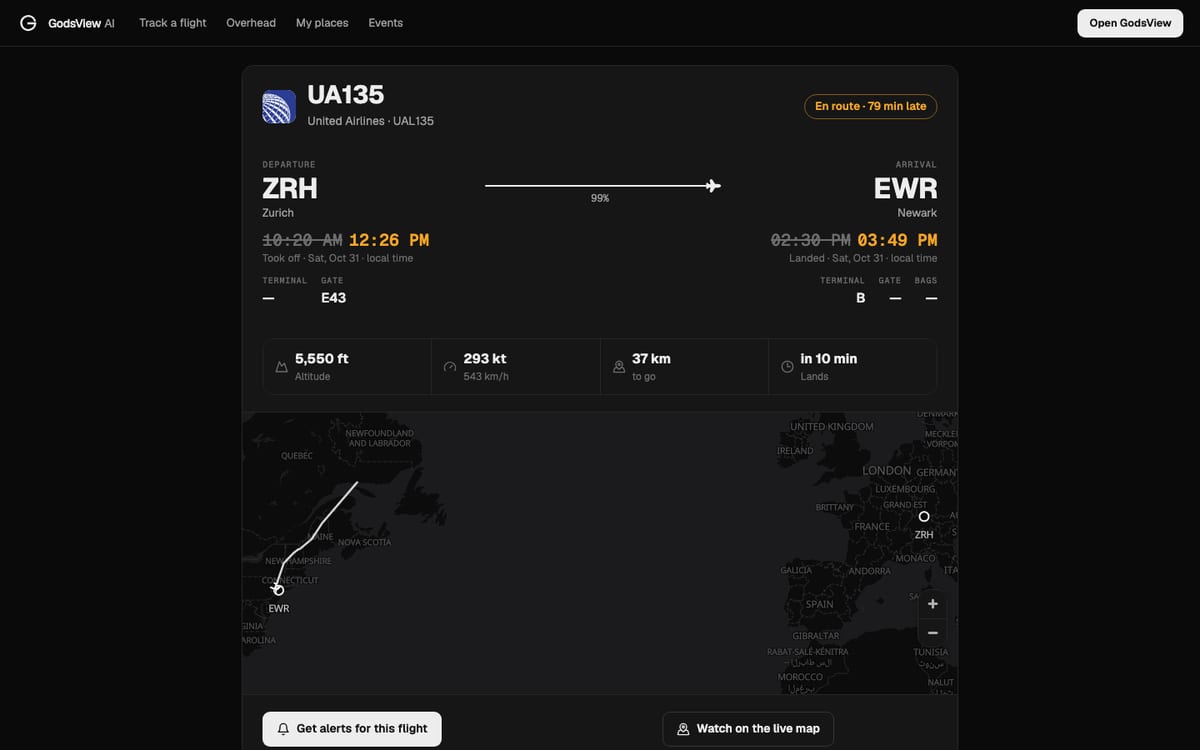
If you already have a flight number, the fastest single check is the GodsView Track a flight page, which shows the live position next to the gate and delay where schedule data exists.
Where to check flight delays: the five sources
| Source | Best for | What it cannot tell you |
|---|---|---|
| Airline flight status or app | Your flight's departure and arrival times, gate, cancellation | What is happening to other airlines or the airport as a whole |
| Airport arrivals board | Scheduled and expected times for every arrival, terminal | Why a flight is late |
| FAA NAS status (US) | Ground stops, ground delay programs, arrival and departure delays, closures | The status of one particular flight |
| Eurocontrol Public NOP (Europe) | Network situation and air traffic flow measures | Gate or passenger information |
| Live flight map | Where the aircraft actually is, its altitude and speed | Gate assignments, boarding, the reason for a delay |
Use them in that order for your own trip, and in reverse order when you are just curious about a disruption you saw on the news.
1. Check the airline's flight status first
The airline is the only source that knows its own decisions: a crew swap, an aircraft change, a delay it has already announced. Most airlines have a flight status search by flight number or route on their website, for example United's flight status page, and the same information in their app.
Apps often add details a web page does not. United, for example, says its iPhone Live Activities show the flight number, on-time status, inbound aircraft status, and estimated departure and arrival times (United). If your airline shows the inbound flight, note its number; that is the aircraft you will fly on.
When the airline status and any third-party tracker disagree about gate or departure time, go with the airline.
2. Check flight arrivals on the airport's board
If you are meeting someone, the airport's own arrivals board is the tool most people want. It lists every arrival with the scheduled and expected time, the terminal and often the baggage hall. Our SFO arrivals guide walks through one airport's board as an example.
Boards are updated from airline and airport systems, so they are only as current as those inputs. An "expected" time is still an estimate, and it can move several times during the flight.
On GodsView you can also start from an airport page, such as JFK or Toronto Pearson, which opens the live map around the field and lists the aircraft in that box. The Newark guide shows how this works at a busy hub.
3. Check US airport delays and ground stops with the FAA
When many flights to one US airport are late at once, the cause is often an FAA traffic management program rather than any single airline. The FAA's NAS status page shows them. Its user guide says the Active Airport Events section displays airport closures, ground stops, ground delay programs, arrival and departure delays and deicing, and that the site updates every minute (FAA NAS Status user guide). You can switch between local time and UTC.
Ground stop vs ground delay program
The FAA Command Center defines the two most common programs (FAA ATCSCC):
- Ground Delay Program. Used when demand at an airport is expected to exceed its acceptance rate for a lengthy period, most often because of low ceilings and visibility. Flights headed there get controlled departure times and may not leave before them. The status shows a maximum and average delay in minutes.
- Ground Stop. Used when demand will exceed the acceptance rate for a short period, to buy time for a longer-term fix, or when the airport's acceptance rate has dropped to zero. Flights headed there are held at their departure airports for the duration.
The practical point: if your destination has a ground delay program, your inbound aircraft is probably sitting at its origin, not circling near you. That is why a flight can show "delayed" on the board while nothing is visible on a map yet.
4. Check European flight delays with Eurocontrol
In Europe, Eurocontrol's Network Manager coordinates air traffic flow management. Its Network Operations Portal gives a continuously updated view of the European network, including real-time monitoring of traffic, airspace and air traffic flow and capacity management (ATFM) measures. The Public NOP is freely accessible; a protected version is for organizations involved in operations.
The public portal is built for aviation professionals, so it reads like an operations screen rather than a passenger app. It is still useful when a whole region seems to be running late: if flow measures are in place for an area your flight crosses, delays at the gate are usually the result. For your own flight, the airline remains the source.
5. Check flight arrival time against the inbound aircraft
A flight cannot leave until its aircraft arrives, and that is one of the most common reasons for delay. In the US Bureau of Transportation Statistics' national figures for September 2026, "aircraft arriving late" accounted for 8.40% of flights, ahead of National Aviation System delay at 6.70%, air carrier delay at 6.38%, weather at 0.71% and security at 0.03% (BTS).
A live map lets you check that cause yourself:
- Find your flight's aircraft. Search your flight number on the Track a flight page, or search the inbound flight's callsign on the live flight tracker. Our guide on how to track a flight explains converting a flight number into a callsign.
- See where it is. If the inbound aircraft is still on the ground several hundred miles away an hour before your departure, a delay is likely even if the board has not changed yet.
- Watch it descend. Once it is on approach to your airport, you can estimate the turnaround from the time it lands.
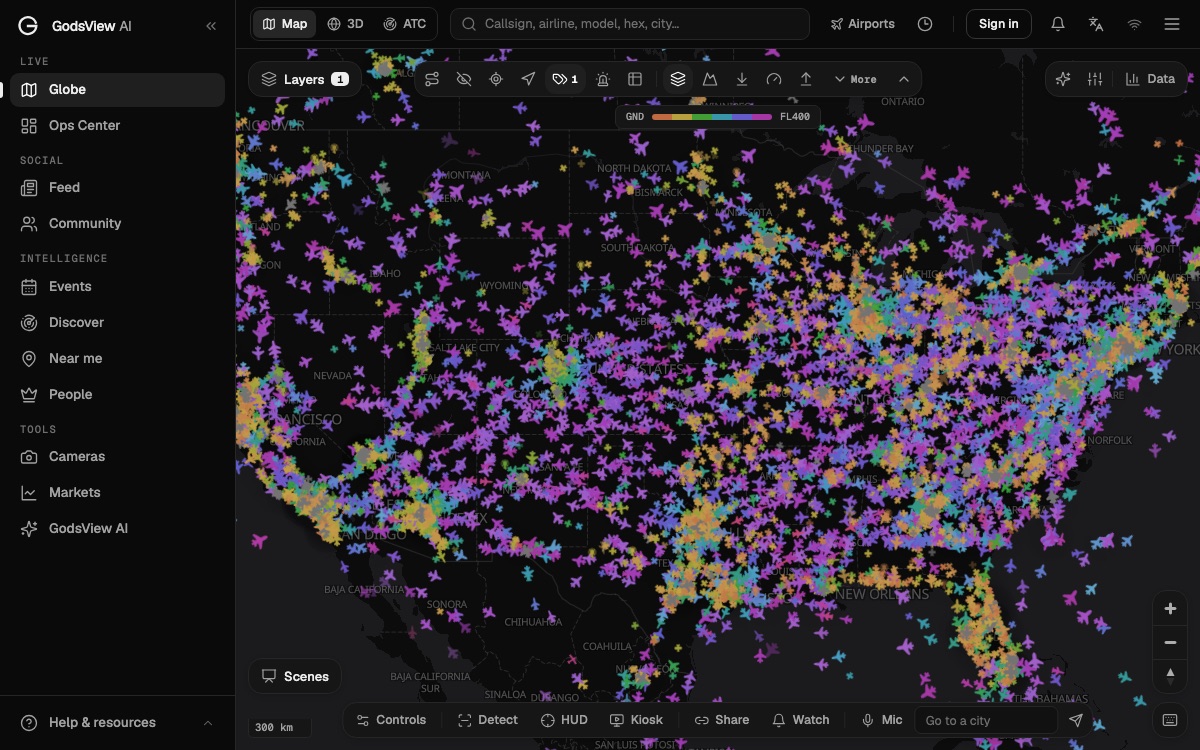
GodsView maps are built from ADS-B broadcasts. An aircraft appears when it is transmitting and a receiver hears it, so oceanic or remote stretches can show gaps, and aircraft at the gate may not appear until a nearby receiver picks them up. The ADS-B explainer covers why.
What GodsView shows for delays
Here is exactly what GodsView does and does not do for delays, so you know when to use it and when to go elsewhere.
- Track a flight page. Type a flight number to see where the plane is, its altitude and speed, the gate and delay when schedule data exists, and the landing time. No account is needed to view or share the link. When schedule data is missing, the page says so and estimates times from the aircraft's position.
- FAA airport delays layer. GodsView Plus includes an airport delays layer from the FAA NAS status feed, refreshed about every two minutes. It counts FAA traffic management programs only (ground stops, delay programs, closures); poor weather on its own is not counted as a delay. When the layer is on, a selected flight's card can show its destination airport's FAA status. It covers US airports only.
- Alerts. On a paid plan, you can follow a flight for gate change, delay, take-off and landing alerts.
- No delay history. GodsView does not keep on-time records for flight numbers. For history, use the BTS tool below.
The live map needs a free account; Plus costs $10.99 per month, and details are on the pricing page. The methodology page lists every feed and refresh interval.
How to look up a flight's delay history
If you want to know whether a flight is usually on time before you book, a flight delay history tracker is more useful than any live view. For US airlines, the Bureau of Transportation Statistics publishes airline on-time statistics with lookups by origin airport, destination airport, airline and flight number, covering departures, arrivals, cancellations and diversions. The data runs from January 1995 and comes from the 17 major US carriers that report it.
BTS counts a flight as delayed when it arrives 15 or more minutes after schedule, and when several causes apply it prorates them by the minutes each caused (BTS). That 15-minute line is the definition most "on time flight tracker" statistics use, so keep it in mind when comparing numbers.
A quick routine for flight day
- Morning: check the airline status for your flight and, if offered, the inbound flight.
- Two to three hours before: look at FAA NAS status (US) or the Eurocontrol public portal (Europe) for your departure and arrival airports.
- One hour before: find the inbound aircraft on a live map. If it has not left its previous airport, expect a delay.
- Meeting someone: use the airport arrivals board for the terminal and expected time, and watch the aircraft on the map during its descent.
Next step
The airline tells you about your flight, the airport about the gate, the FAA or Eurocontrol about the system, and a live map about the airplane. Checking them in that order explains most delays before the board catches up.
Have a flight number? Open it now and see where the plane is.
Frequently asked questions
How can I check my flight arrival time?
Use the airline's flight status page or app for the official arrival time and gate, and the airport's arrivals board for the expected time and terminal. To see where the aircraft is right now, search the flight number on a live tracker such as the GodsView Track a flight page, which shows the landing time and, where schedule data exists, the gate and delay.
How do I check if there is a ground stop at a US airport?
Open the FAA's National Airspace System status page at nasstatus.faa.gov. It lists airport closures, ground stops, ground delay programs, arrival and departure delays and deicing, and updates every minute. A ground stop means flights headed to that airport are held at their departure airports.
Where can I check flight delays in Europe?
Your airline is the source for your own flight. For the bigger picture, Eurocontrol's Public Network Operations Portal is freely accessible and shows the European network situation, including air traffic flow and capacity management measures that cause delays at the gate.
Is there a flight delay history tracker?
For US airlines, the Bureau of Transportation Statistics publishes on-time statistics from January 1995 that you can search by airline, airport and flight number. It counts a flight as delayed when it arrives 15 or more minutes late. GodsView does not keep delay history.
Why does my flight show delayed when the plane is not even here?
Often the aircraft operating your flight is still on its previous trip. In BTS national data for September 2026, a late-arriving aircraft was the largest single delay cause. Find the inbound aircraft on a live map: if it has not left its previous airport, your departure will slip too.
Does GodsView show airport delays?
GodsView Plus includes an FAA airport delays layer for US airports, built from the FAA NAS status feed and refreshed about every two minutes. It counts ground stops, delay programs and closures, not weather alone. The free Track a flight page shows gate and delay for a flight where schedule data exists.
Sources
- FAA — National Airspace System status
- FAA — NAS Status user guide (PDF)
- FAA ATCSCC — Ground Delay Program and Ground Stop definitions
- Eurocontrol — Network Operations Portal (NOP)
- BTS — Airline on-time statistics
- BTS — Airline on-time performance and causes of delay
- United — Flight status
- United — Live Activities for iPhone (May 2023)
Facts checked on against each provider's own site.