Explainer
Small Craft Advisory Meaning: Wind, Seas and Gale Warnings
There is no official size for a "small craft". If the conditions in a Small Craft Advisory would cause your boat trouble, it means you. Here is what triggers one in each part of the US, how it compares with gale and storm warnings, and how to read a marine forecast.
Key takeaways
- A Small Craft Advisory (SCA) is issued by coastal and Great Lakes National Weather Service offices when winds or seas are expected to be hazardous to small boats. The thresholds depend on the region.
- In the NWS Eastern Region, which includes Boston, the threshold is sustained winds or frequent gusts of 25 to 33 knots (20 to 25 knots on some lakes, harbors and bays) and/or seas of 4 to 7 feet or more, depending on the area.
- There is no precise definition of a small craft: the NWS says any vessel that may be adversely affected by Small Craft Advisory conditions should be considered one.
- Above the advisory come the marine warnings: Gale Warning for 34 to 47 knots, Storm Warning for 48 to 63 knots, and Hurricane Force Wind Warning for 64 knots or more, all for winds not directly tied to a tropical cyclone.
- In Canada the equivalent first step is a Strong Wind Warning, for 20 to 33 knots, issued seasonally in certain areas.
A Small Craft Advisory means the National Weather Service (NWS) expects winds or seas strong enough to be hazardous to small boats in a coastal, bay or Great Lakes forecast zone. The exact trigger depends on where you are: in the NWS Eastern Region, which includes Boston, it is typically sustained winds or frequent gusts of 25 to 33 knots and/or seas of about 4 to 7 feet or more, while in the NWS Southern Region it starts at 20 knots. If your boat would struggle in those conditions, the advisory applies to you, whatever its length.
To check the weather and alerts on land for a harbour city, open a page such as Boston weather and warnings, and see what is moving on the water on the live ship tracker.
Check Boston weather and warnings
What a Small Craft Advisory is
The NWS marine standards (NWS Instruction 10-303) define a Small Craft Advisory as "an advisory issued by coastal and Great Lakes WFOs for areas included in the Coastal Waters Forecast or Nearshore Marine Forecast products," and say that "thresholds governing the issuance of small craft advisories are specific to geographic areas."
What is a small craft? The NWS glossary answers: "There is no precise definition for small craft. Any vessel that may be adversely affected by Small Craft Advisory criteria should be considered a small craft." A 16-foot skiff, a kayak, a sailing dinghy and a loaded 30-foot cruiser can all be at risk; a large ship is not.
The NWS used to issue four versions of the advisory: for winds, for hazardous seas, for rough bar conditions, and a general one. Its coastal waters forecast instruction now says these have been consolidated into a single headline, Small Craft Advisory. Read the forecast text to see whether the problem is wind, waves, or both.
Small craft advisory thresholds by region
Each NWS region sets its own criteria. These are from NWS Instruction 10-303, checked on November 28, 2026.
| NWS region | Winds (sustained or frequent gusts) | Seas or waves |
|---|---|---|
| Eastern | 25 to 33 knots; 20 to 25 up to 33 knots on some lakes, harbors and bays | 4 to 7 feet and greater, area dependent; 4 feet on Chesapeake Bay |
| Central (Great Lakes) | 22 to 33 knots | Greater than 4 feet |
| Southern | Sustained 20 to 33 knots | Seas 7 feet or greater expected for more than 2 hours |
| Western | 21 to 33 knots | Wave heights over 10 feet, or steep waves past local thresholds |
| Alaska | 23 to 33 knots | Locally significant seas, no lower than 8 feet |
| Pacific (except Guam, Northern Marianas and American Samoa) | 25 to 33 knots | Seas 10 feet or greater |
A knot is one nautical mile per hour, about 1.15 mph, so 25 knots is about 29 mph and 33 knots about 38 mph.
The instruction also notes that an advisory headline should be included for sea state even when the wind threshold is not met. A long swell from a distant storm can earn an advisory on a day with light winds.
Below advisory level, some offices add a cautionary statement such as "Small Craft Should Exercise Caution." In the NWS Southern Region, that is for a wind forecast of 15 to 20 knots and/or seas forecast at 6 feet.
Small craft advisory vs gale, storm and hurricane force warnings
Above the advisory, NWS marine warnings are set by wind speed alone, and they are for winds not directly associated with a tropical cyclone. Tropical storms and hurricanes have their own watches and warnings.
| Alert | Sustained winds or frequent gusts | Beaufort force |
|---|---|---|
| Small Craft Advisory | About 20 to 33 knots, by region (or rough seas) | 5 to 7 |
| Gale Warning | 34 to 47 knots (39 to 54 mph) | 8 to 9 |
| Storm Warning | 48 to 63 knots (55 to 73 mph) | 10 to 11 |
| Hurricane Force Wind Warning | 64 knots (74 mph) or more | 12 |
Each warning has a matching watch (Gale Watch, Storm Watch, Hurricane Force Wind Watch) for when the event is likely but its timing or location is still uncertain. The NWS advice for a Hurricane Force Wind Warning is simple: vessels should be secure in port.
There is also the Special Marine Warning, the marine version of a severe thunderstorm warning. NWS Instruction 10-303 defines it as a warning of short-duration hazards, usually two hours or less, with thunderstorm winds or gusts of 34 knots or more, hail of 3/4 inch or more, or waterspouts. It is issued for a specific area, often with only minutes of notice.
What the wind actually does to the sea: the Beaufort scale
The Beaufort scale, published by the NWS, links wind speed to what you see on the water. The bands that matter for small craft:
- Force 5, fresh breeze, 17 to 21 knots: moderate waves, many whitecaps.
- Force 6, strong breeze, 22 to 27 knots: large waves begin to form.
- Force 7, near gale, 28 to 33 knots: foam blown in streaks.
- Force 8, gale, 34 to 40 knots: edges of crests begin to break into spindrift.
- Force 9, severe gale, 41 to 47 knots: high waves and dense streaks of foam.
- Force 10, storm, 48 to 55 knots: very high waves with long overhanging crests.
So the Small Craft Advisory range sits mostly in forces 6 and 7: large waves forming, whitecaps everywhere and foam blowing off the crests.
What to do under a Small Craft Advisory
The advisory is not a ban, but it is a strong signal. Before you go:
- Read the full marine forecast for your zone, not just the headline. Look at wind speed, gusts, wave height and period, and timing.
- Compare it with your boat and your experience. The same advisory can be manageable for a large, well-crewed boat and dangerous for a kayak or a small open boat.
- Watch the timing. Every advisory has a start and end time; check whether your trip falls inside it, and allow for the forecast changing.
- Prepare for worse. Everyone in life jackets, a working VHF radio, a float plan left with someone ashore, and a plan for where to shelter.
- If a Gale Warning or Special Marine Warning is issued, small boats should stay in port or head for shelter immediately.
Marine warnings in Canada
Environment and Climate Change Canada uses four marine wind warning categories, set on sustained wind, excluding gusts:
- Strong Wind Warning: 20 to 33 knots
- Gale Warning: 34 to 47 knots
- Storm Warning: 48 to 63 knots
- Hurricane Force Wind Warning: 64 knots or more
ECCC issues Strong Wind Warnings on a seasonal basis, mainly in the recreational boating season and for particular coastal and inland waters, and not in zones such as offshore areas where those winds are frequent. The season varies: on the Pacific coast it runs from March 20 to November 11. See Canada's live warnings and cities such as Halifax or Vancouver.
How to check marine conditions
For the official marine forecast and advisories, use your local NWS office's Coastal Waters or Nearshore Marine Forecast on weather.gov. GodsView adds context around it:
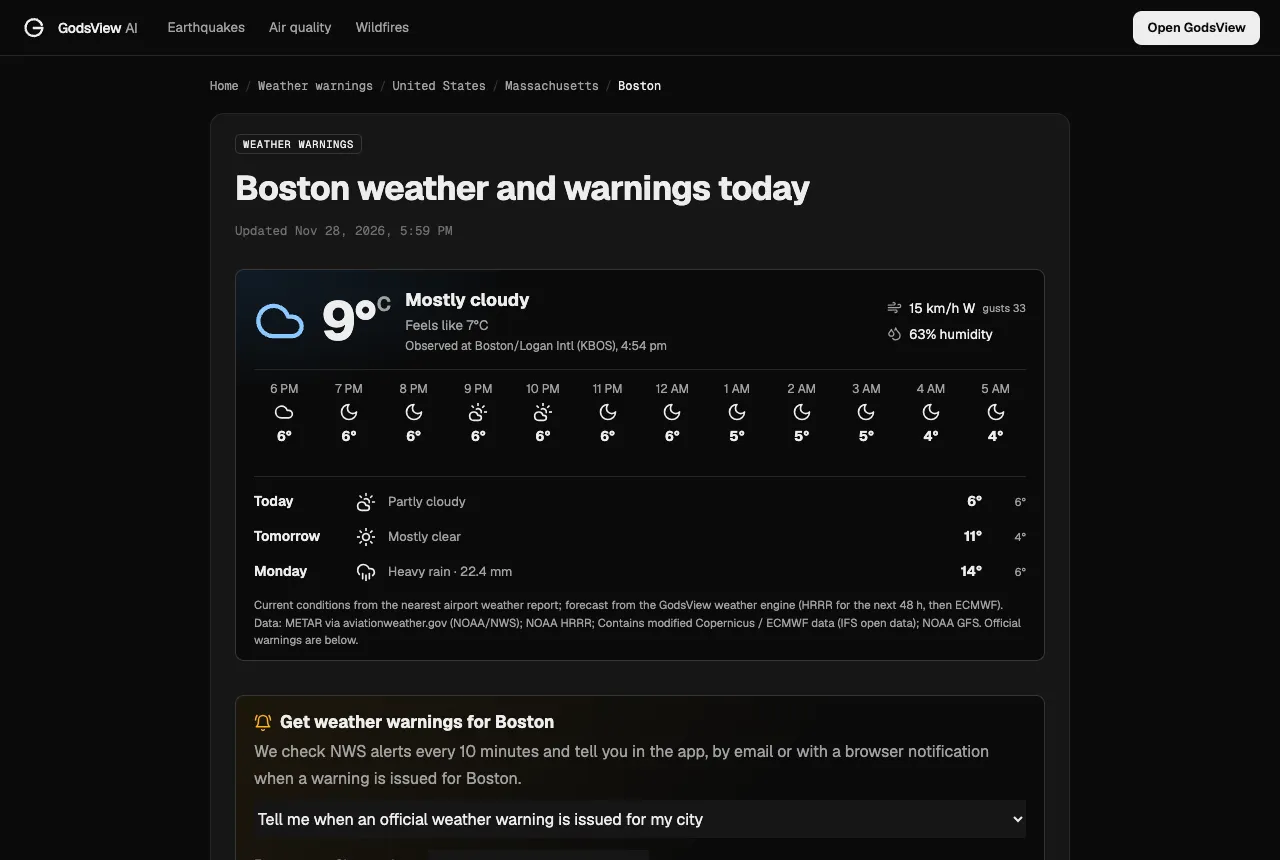
- On land: our screenshot of the live Boston page, taken on November 28, 2026, shows what a harbour city page looks like.
- Harbour cities: Boston, Seattle, Miami or Tampa show live weather, the forecast and any active NWS alert.
- Wind on the map: the live weather radar and wind layers show storms and wind across the water.
- Who is out there: the live ship tracker shows vessels by AIS. Our guide on how to track a ship explains what AIS can and cannot show.
- Cameras: the Boston live cameras page lists public cameras around the city.
- Wind on land: see our guides to the wind advisory and the high wind warning.
The short version
A Small Craft Advisory means winds of roughly 20 to 33 knots, depending on the region, or rough seas that are hazardous to small boats. Off Boston and the rest of the Eastern Region, that is typically 25 to 33 knots and/or 4 to 7 feet of seas. Above it come Gale (34 to 47 knots), Storm (48 to 63) and Hurricane Force Wind (64 and up) warnings. Read the full forecast, judge it against your boat, and stay in port when a gale or special marine warning is out.
Frequently asked questions
What wind speed is a Small Craft Advisory?
It depends on the NWS region. In the Eastern Region, which includes Boston, it is sustained winds or frequent gusts of 25 to 33 knots (lower on some lakes, harbors and bays); in the Southern Region it starts at 20 knots; on the Great Lakes it is 22 to 33 knots. Rough seas alone can also trigger one.
What size boat is a small craft?
There is no precise definition. The NWS says any vessel that may be adversely affected by Small Craft Advisory conditions should be considered a small craft.
Is it safe to go out in a Small Craft Advisory?
It depends on your boat, your experience and the exact conditions. The advisory means winds or seas hazardous to small boats are expected. Read the full forecast and timing, and stay in port if you are unsure.
What is the difference between a Small Craft Advisory and a Gale Warning?
A Gale Warning is the next step up: sustained winds or frequent gusts of 34 to 47 knots (39 to 54 mph), not directly tied to a tropical cyclone. A Storm Warning is 48 to 63 knots, and a Hurricane Force Wind Warning 64 knots or more.
What is a Special Marine Warning?
A short-duration warning, usually two hours or less, for thunderstorm winds or gusts of 34 knots or more, hail of 3/4 inch or more, or waterspouts over marine areas.
Does Canada issue Small Craft Advisories?
No. Environment and Climate Change Canada issues Strong Wind Warnings for 20 to 33 knots, seasonally in certain areas, then Gale, Storm and Hurricane Force Wind Warnings.
Sources
- NWS Instruction 10-303, Marine and Coastal Services Standards and Guidelines
- NWS Instruction 10-310, Coastal Waters Forecast (August 1, 2025)
- NWS Glossary — Small craft
- NWS Miami — Beaufort wind scale
- National Weather Service — Wind watches, warnings and advisories
- Environment and Climate Change Canada — Canadian marine warning program, chapter 1
Facts checked on against each provider's own site.