Explainer
Tropical Storm Warning Meaning: 39 to 73 mph Winds Within 36 Hours
"Only a tropical storm" is one of the most dangerous phrases in hurricane country. A tropical storm warning means damaging winds within a day and a half, and the rain and surge that come with them can be worse than the wind. Here is what it means and what to do.
Key takeaways
- A Tropical Storm Warning means sustained winds of 39 to 73 mph (34 to 63 knots) are expected somewhere in the warned area within 36 hours.
- A Tropical Storm Watch means those winds are possible within 48 hours. Both can be issued for tropical, subtropical and post-tropical cyclones, and for disturbances NHC calls Potential Tropical Cyclones.
- Tropical-storm-force winds are the point where outdoor preparations become dangerous, so emergency managers aim to finish evacuations before they arrive.
- Rainfall is not tied to a storm's wind strength. Slow and large storms bring the most rain, and flooding is the main threat for people living inland.
- A tropical storm can also bring storm surge, tornadoes and rip currents far from the centre, so read every alert in effect for your area, not only the wind warning.
A Tropical Storm Warning means the National Hurricane Center (NHC) or your local National Weather Service office expects sustained winds of 39 to 73 mph somewhere in the warned area within 36 hours. That is strong enough to bring down trees and power lines and make outdoor work dangerous, so the warning is your cue to finish preparing now. The bigger danger is often the water: heavy rain, flash flooding and storm surge can be deadly even when the wind stays below hurricane strength.
To check whether one is in effect, see GodsView's live list of Tropical Storm Warnings, and follow the storm itself on the live hurricane tracker.
Check active tropical storm warnings
What a Tropical Storm Warning means
NHC defines it as "an announcement that sustained winds of 34 to 63 knots (39 to 73 mph or 63 to 118 km/hr) are expected somewhere within the specified area within 36 hours in association with a tropical, subtropical, or post-tropical cyclone."
Three parts of that sentence matter:
- Sustained winds, the one-minute average NHC uses, not gusts. Gusts can be higher.
- Somewhere within the specified area. Not every town in the warning will feel the strongest winds.
- Within 36 hours. The clock is about when the winds start, which is why the warning often goes up when skies are still calm.
A Tropical Storm Watch uses the same wind range but means those winds are possible within 48 hours.
Tropical storm watch vs warning vs hurricane warning
| Alert | Winds | Timing | What it means for you |
|---|---|---|---|
| Tropical Storm Watch | 39 to 73 mph possible | Within 48 hours | Review your plan and supplies |
| Tropical Storm Warning | 39 to 73 mph expected | Within 36 hours | Finish preparations now |
| Hurricane Watch | 74 mph or more possible | 48 hours before tropical-storm winds | Prepare for a hurricane |
| Hurricane Warning | 74 mph or more expected | 36 hours before tropical-storm winds | Finish preparations; evacuate if ordered |
Several of these can be in effect at once for one storm, along with storm surge alerts, so read every alert for your area. Our hurricane watch vs warning guide covers the higher alerts.
What counts as a tropical storm
NHC classifies tropical cyclones by their maximum sustained winds:
- Tropical depression: 38 mph (33 knots) or less
- Tropical storm: 39 to 73 mph (34 to 63 knots)
- Hurricane: 74 mph (64 knots) or more
- Major hurricane: 111 mph (96 knots) or more, Category 3 to 5
There is also a category for systems that are not yet tropical cyclones. A Potential Tropical Cyclone is a disturbance that poses the threat of tropical storm or hurricane conditions to land within 72 hours. NHC can start advisories, and watches and warnings, before the storm has even formed, so people get the full lead time.
In the western North Pacific these storms are typhoons, and in the Indian Ocean and South Pacific they are cyclones. Our cyclone vs hurricane vs typhoon guide explains the differences.
Why a tropical storm is dangerous
Wind
NHC says tropical-storm-force winds are strong enough to be dangerous to those caught in them, and that emergency managers plan to have evacuations completed and staff sheltered before tropical-storm-force winds arrive, not hurricane-force winds. Expect falling trees and limbs, power outages and flying debris. Driving becomes risky, especially in high-profile vehicles; our high wind warning guide covers driving in strong winds.
Rain and inland flooding
NHC notes that tropical cyclones often produce widespread, torrential rains of more than 6 inches, and that flooding is the major threat from tropical cyclones for people living inland. Rainfall amounts are not directly related to the strength of the storm, but to its speed and size and the geography: slower and larger storms produce more rain, and mountains increase it. A weak, slow tropical storm can be a far bigger flood threat than a fast hurricane.
Ready.gov warns that six inches of fast-moving water can knock you down, and one foot of moving water can sweep your vehicle away. If a road is flooded, turn around. See our flash flood warning guide for what to do when one is issued.
Storm surge
Tropical storms can push water ashore too. Storm surge is a separate hazard with its own watches and warnings, which NHC issues where there is a significant risk of life-threatening surge from a tropical storm or a hurricane. Our storm surge warning guide explains how it works.
Tornadoes and rip currents
Tropical storms and hurricanes can produce tornadoes, most often in thunderstorms in the rain bands well away from the centre. Strong winds also create dangerous waves and rip currents along the coast, even far from the storm: NHC notes that in 2008, Hurricane Bertha, more than 1,000 miles offshore, caused rip currents that killed three people along the New Jersey coast.
What 39 to 73 mph feels like
The tropical storm range covers a wide span of winds. The Beaufort wind scale, as published by the National Weather Service, describes what each band does on land:
- Force 8, gale, 39 to 46 mph: breaks twigs off trees and impedes walking. This is where a tropical storm begins.
- Force 9, severe gale, 47 to 54 mph: slight structural damage occurs.
- Force 10, storm, 55 to 63 mph: trees are uprooted and there is considerable structural damage.
- Force 11, violent storm, 64 to 72 mph: widespread damage. This is the top of the tropical storm range, just below hurricane force.
So a strong tropical storm near 70 mph is a very different event from a weak one near 40 mph, even though both carry the same warning. Read the forecast wind speeds in the NHC advisory and in your local NWS office's statement, and plan for the upper end. Gusts can be stronger than the sustained wind.
How to prepare when a tropical storm warning is issued
Use the time before the wind starts. NHC publishes an Earliest Reasonable Arrival Time graphic showing when tropical-storm-force winds could begin at your location, with no more than a 1-in-10 chance of them arriving earlier. That is your deadline.
- Secure outdoor items such as furniture, grills, trash bins and decorations, which become projectiles.
- Gather supplies for every member of your household, including medication, disinfectant and pet supplies, as Ready.gov advises.
- Charge phones and power banks, and find flashlights and batteries. Outages are likely.
- Clear drains and gutters near your home so rain can run off.
- Know your evacuation zone and route. If officials issue an evacuation order, Ready.gov says to leave immediately.
- Move vehicles to higher ground if your street floods easily.
- Turn on alerts on your phone and keep a battery radio. Our guide to weather alerts in your area explains the settings.
During the storm
- Stay indoors and away from windows.
- Do not drive unless you must, and never through flooded roads.
- If a tornado warning is issued, move to an interior room on the lowest floor.
- Wait for officials to say it is safe before going out; downed power lines may be live.
After the warning ends
The danger does not end with the wind. Rivers can keep rising for days after the rain stops; NHC notes that longer-term river flooding can persist for several days after the storm. Keep watching for flood warnings and flash flood warnings, avoid flood water, and check the power outage map for restoration.
Where to see tropical storm warnings right now
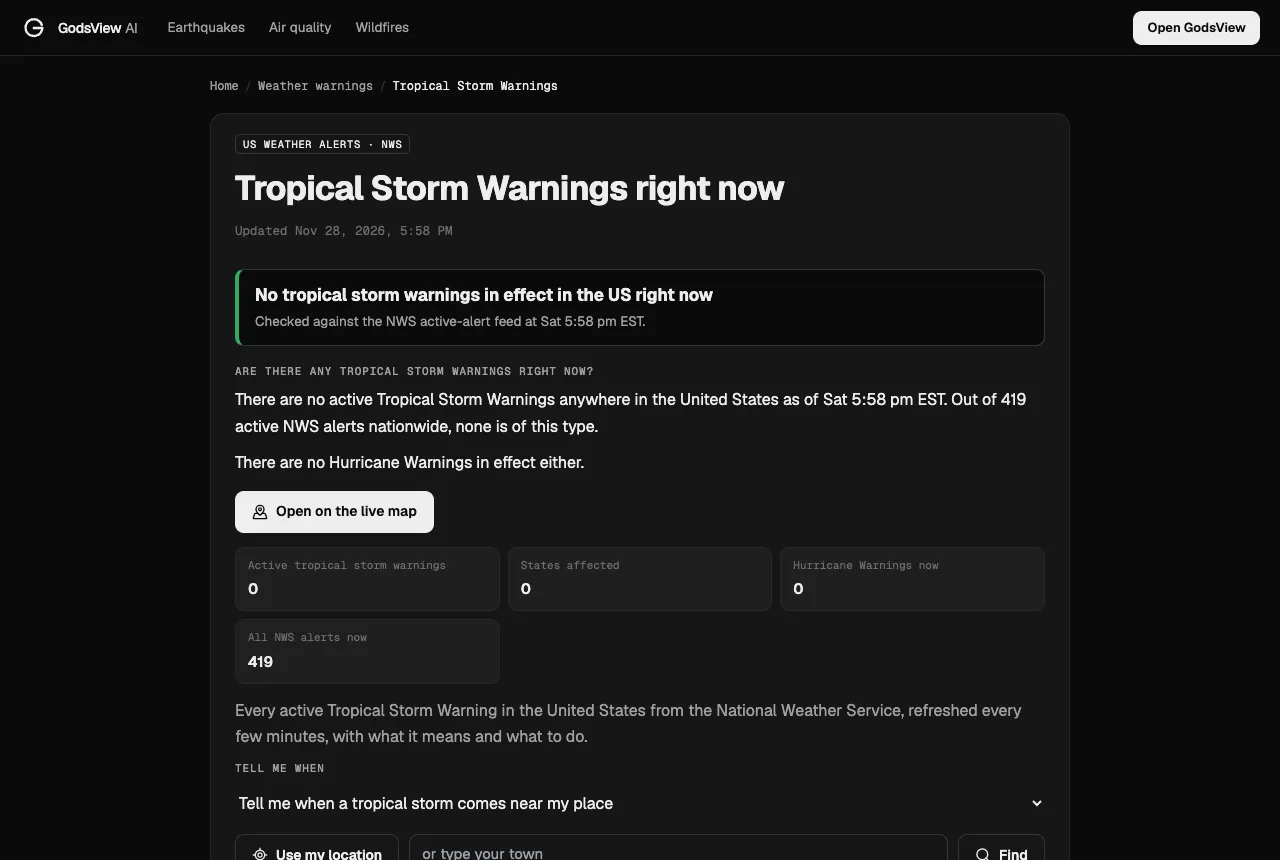
On November 28, 2026, two days before the official end of the Atlantic hurricane season on November 30, GodsView's live list showed no tropical storm warnings in effect in the US.
To check at any time:
- US warnings: the Tropical Storm Warning list and the Hurricane Warning list.
- Your city: coastal pages such as Miami, Houston, Tampa or Charleston.
- Every storm worldwide: the live hurricane tracker. Our guide on how to watch a hurricane live explains the cone, track and advisory times.
- Season dates: see when is hurricane season.
- Alerts: GodsView Plus ($10.99 a month or $99.99 a year) adds alerts for saved places.
Official NHC advisories and your local NWS office's statements are always the reference.
The short version
A Tropical Storm Warning means winds of 39 to 73 mph are expected within 36 hours. Finish preparing before the winds start, take the rain and flood threat at least as seriously as the wind, read any storm surge or tornado alerts that come with it, and never drive through flood water.
Frequently asked questions
What does a tropical storm warning mean?
It means sustained winds of 39 to 73 mph (34 to 63 knots) are expected somewhere in the warned area within 36 hours, from a tropical, subtropical or post-tropical cyclone. It is the time to finish preparations.
What is the difference between a tropical storm watch and warning?
A watch means tropical-storm-force winds are possible within 48 hours; a warning means they are expected within 36 hours.
Is a tropical storm dangerous?
Yes. Its winds can bring down trees and power lines, and its rain does not depend on wind strength: slow, large storms can cause deadly flooding. NHC says flooding is the major threat from tropical cyclones for people living inland.
What wind speed is a tropical storm?
Maximum sustained winds of 39 to 73 mph (34 to 63 knots). Below that it is a tropical depression; at 74 mph it becomes a hurricane.
What is a Potential Tropical Cyclone?
A disturbance that is not yet a tropical cyclone but threatens to bring tropical storm or hurricane conditions to land within 72 hours. NHC can issue advisories and watches or warnings for it before it forms.
Should I evacuate for a tropical storm?
Follow your local officials. Evacuations are usually ordered for storm surge and flooding, not wind alone. If you are told to leave, Ready.gov advises doing so immediately.
Sources
- National Hurricane Center — Glossary of NHC terms
- National Weather Service — Hurricane and tropical storm watches and warnings
- National Hurricane Center — Hurricane hazards
- National Hurricane Center — Tropical cyclone climatology
- National Hurricane Center — Arrival of tropical-storm-force winds graphics
- National Hurricane Center — Storm surge watch/warning graphic
- National Weather Service — Tornado watches and warnings
- NWS Miami — Beaufort wind scale
- Ready.gov — Hurricanes
Facts checked on against each provider's own site.