Explainer
PAGASA Rainfall Warnings and Typhoon Signals, Explained
A yellow, orange or red rainfall warning from PAGASA is a statement about how hard it is raining right now, measured in millimetres per hour. Here is what each colour means, how it differs from a weather advisory, and what the five typhoon wind signals tell you to do.
Key takeaways
- A PAGASA Heavy Rainfall Warning is based on rain that is falling or about to fall: yellow means about 7.5 to 15 mm in an hour, orange 15 to 30 mm, and red more than 30 mm.
- Yellow means flooding is possible in low-lying areas, orange means flooding is likely and communities should be ready to evacuate, and red means serious flooding is expected and evacuation may be needed.
- A PAGASA Weather Advisory is different: it is a forecast of total rain over the next 24 hours for whole provinces, coloured yellow for 50 to 100 mm, orange for 100 to 200 mm and red for more than 200 mm.
- Tropical Cyclone Wind Signals run from No. 1 (39 to 61 km/h winds expected within 36 hours) to No. 5 (185 km/h or more within 12 hours).
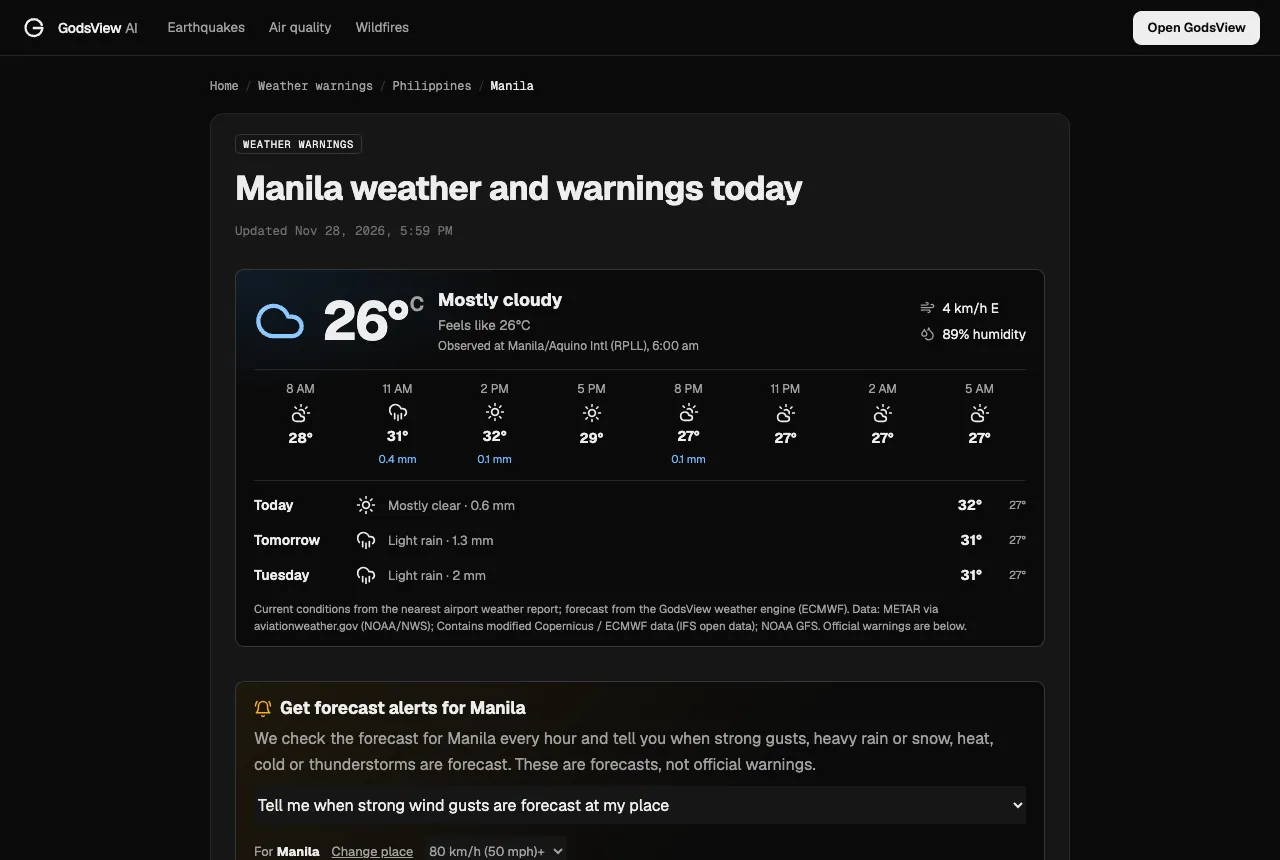
- GodsView does not carry PAGASA warnings, so its Manila page shows live weather and its own forecast flags, marked as not official; PAGASA is the reference.
A PAGASA rainfall warning tells you how hard it is raining over your area right now and how bad the flooding could get. Yellow means rain of about 7.5 to 15 millimetres in an hour, enough to flood low-lying streets. Orange means 15 to 30 millimetres in an hour, with flooding likely and communities told to be ready to evacuate. Red means more than 30 millimetres in an hour: serious flooding is expected and evacuation of low-lying areas may be needed. Typhoons are handled separately, with Tropical Cyclone Wind Signals numbered 1 to 5.
GodsView does not republish PAGASA's warnings, so for the official word always check pagasa.dost.gov.ph. What GodsView does give you for free is live weather, a forecast and our own forecast flags for cities such as Manila, Quezon City, Cebu City and Davao, plus a live map of storms and earthquakes around the islands.
The three PAGASA rainfall warning colours
PAGASA, the Philippine Atmospheric, Geophysical and Astronomical Services Administration, has used colour-coded rainfall warnings for more than a decade. The colours are tied to rainfall intensity, which is why they can change from hour to hour during a monsoon downpour.
| Colour | Rain in one hour | What it means | What to do |
|---|---|---|---|
| Yellow | About 7.5 to 15 mm | Flooding possible in low-lying areas | Monitor the weather and the next bulletin |
| Orange | About 15 to 30 mm | Flooding in low-lying areas is likely | Be alert for possible evacuation |
| Red | More than 30 mm | Serious, widespread flooding expected | Evacuation of low-lying areas may be needed; follow local officials |
Newer PAGASA bulletins also attach short action words to each colour. A PAGASA forecaster for Metro Manila described them in 2025 as Be Alert for yellow, Be Prepared for orange and Take Action for red.
Thirty millimetres in an hour does not sound like much on paper. In practice it is the kind of rain that overwhelms drains in a dense city, turns underpasses into ponds and sends creeks over their banks within an hour or two. That is why local governments watch these warnings closely when deciding on class suspensions and road closures.
Heavy Rainfall Warning vs Weather Advisory
This is where most confusion starts. PAGASA now issues two different rain products that both use yellow, orange and red, but they measure different things.
Heavy Rainfall Warning (now)
The Heavy Rainfall Warning is the real-time product. It reflects rain that is already falling or about to fall, it is issued about every three hours while the event lasts, and it is localised, often down to individual cities and municipalities. The colours follow the hourly rainfall in the table above. Regional PAGASA services issue these for their own areas, including one dedicated to Metro Manila.
Weather Advisory (next 24 hours)
The Weather Advisory is a forecast. It is issued about every six hours and looks ahead 24 hours over provinces and regions, and its colours describe the total rainfall expected, not the rate:
- Yellow: 50 to 100 mm expected over 24 hours
- Orange: 100 to 200 mm expected over 24 hours
- Red: more than 200 mm expected over 24 hours
So an "orange" rain map for your province tomorrow and an "orange rainfall warning" for your barangay this afternoon are not the same message. The advisory says a lot of rain is coming; the warning says it is pouring now. On days with a tropical cyclone or an enhanced southwest monsoon (habagat), you can see both at once.
Thunderstorm advisories
The third product is the thunderstorm advisory. PAGASA issues one when there is an indication that a thunderstorm is threatening a specific area within the next two hours. These are short-lived, local and common on summer afternoons, and they are pushed out by SMS, social media and the PAGASA website.
Tropical Cyclone Wind Signals 1 to 5
When a tropical depression, storm or typhoon threatens the country, PAGASA raises Tropical Cyclone Wind Signals (TCWS) for specific provinces and municipalities. The signal number is about the wind you should expect and how much time you have left to prepare. It does not tell you how much rain will fall; that comes from the rainfall products above.
| Signal | Winds expected | Lead time | Possible impact (PAGASA) |
|---|---|---|---|
| No. 1 | Strong winds, 39 to 61 km/h (Beaufort 6 to 7) | 36 hours | Minimal to minor damage to poorly built structures; some crop damage |
| No. 2 | Gale-force winds, 62 to 88 km/h (Beaufort 8) | 24 hours | Minor to moderate damage to light structures; local power interruptions; considerable crop damage |
| No. 3 | Storm-force winds, 89 to 117 km/h (Beaufort 9) | 18 hours | Substantial damage to poorly built structures; widespread power outages; heavy crop damage |
| No. 4 | Typhoon-force winds, 118 to 184 km/h (Beaufort 10 to 11) | 12 hours | Severe damage to most structures; near total loss of power; almost total damage to rice |
| No. 5 | Typhoon-force winds, 185 km/h or more (Beaufort 12+) | 12 hours | Severe to catastrophic damage; prolonged loss of power and other services |
The lead time matters most. Under Signal No. 1 you have about a day and a half before strong winds arrive, which is the time to stock water, charge phones and check your roof. Under Signal No. 3 the storm-force winds are expected within 18 hours, so preparations should be finished. Signals 4 and 5 give about 12 hours, and that is when local governments typically order evacuations from coastal and landslide-prone areas.
Why storms have two names
PAGASA gives a local name to every tropical cyclone that forms in or enters the Philippine Area of Responsibility (PAR), taking names from a fixed alphabetical list of Filipino-sounding names that has been in use since 1963. The same storm also has an international name from the regional typhoon committee, which is why news reports often give both. Names are retired after very destructive storms: seven were decommissioned in 2025. Our guide to cyclones, hurricanes and typhoons explains how naming works in each ocean.
What to do under each warning
The colour tells you how fast to act. Here is a plain checklist.
Yellow rainfall warning or Signal No. 1
- Check the next PAGASA bulletin and your city's social media pages.
- Avoid low-lying roads, riverbanks and underpasses that flood first.
- Charge phones and power banks and keep a flashlight ready.
Orange rainfall warning or Signal No. 2
- Move valuables, documents and appliances off the floor.
- Prepare a go-bag with water, food, medicine, IDs and cash.
- Know where your barangay's evacuation centre is and how you will get there.
- Do not wade or drive through floodwater; it can hide open manholes and strong currents.
Red rainfall warning or Signal No. 3 and above
- Follow evacuation orders from your local government at once.
- If you live near a river, a slope or the coast, leave early rather than waiting for water to reach the door.
- Stay indoors away from windows during the strongest winds, and do not go out when the wind suddenly drops: that can be the eye passing over.
- After the storm, watch for downed power lines and landslides before travelling.
How to get PAGASA warnings on your phone
PAGASA publishes its bulletins on its website and official social media pages, and thunderstorm advisories also go out by SMS. During major events, local governments relay class suspensions and evacuation orders through their own pages. Our guide to weather alerts in your area covers phone alert settings, and how to get disaster alerts near home walks through setting up several sources at once.
What GodsView shows for the Philippines
The Philippines is not one of the countries whose official warnings GodsView carries. We would rather say that plainly than show you a copied warning that might be out of date. Here is what you can use instead:
- City pages such as Manila show current conditions, the forecast and GodsView forecast flags: our own check of the forecast for strong gusts, heavy rain, thunderstorms and heat over the next 48 hours. They are clearly marked as forecasts, not official warnings, and each page links to PAGASA.
- The Philippines country page lists cities and links to the official service.
- Storm tracking: follow tropical cyclones on our hurricane and typhoon tracker and read how to watch a hurricane live.
- Earthquakes: the Philippines also has frequent quakes; see earthquakes in the Philippines or our guide to earthquakes in the Philippines today.
With GodsView Plus ($10.99 a month or $99.99 a year) you can save places and get alerts for them, but for the Philippines the warnings that count are PAGASA's.
Rainfall warning vs signal: the quick difference
People often ask whether "Signal No. 2" means more rain than an "orange warning". It doesn't work that way. The wind signal is about wind and lead time; the rainfall warning is about rain intensity right now; the weather advisory is about total rain tomorrow. A weak tropical storm can bring red rainfall warnings and deadly floods under only Signal No. 1, and the southwest monsoon can bring red rainfall warnings with no signal raised at all. Read all three together.
The short version
A yellow PAGASA rainfall warning means 7.5 to 15 mm of rain an hour and possible flooding in low areas; orange means 15 to 30 mm and be ready to evacuate; red means more than 30 mm and serious flooding. Weather advisories use the same colours for the 24-hour rain total, and wind signals 1 to 5 tell you how strong the typhoon winds will be and how many hours you have. Check PAGASA first, and use the live map to see the storm coming.
See live weather for Philippine cities
Frequently asked questions
What does an orange rainfall warning mean in the Philippines?
PAGASA issues an orange rainfall warning when rain of about 15 to 30 millimetres in an hour is falling or expected. Flooding in low-lying areas is likely, and communities are advised to be alert for possible evacuation.
What is the difference between a yellow, orange and red rainfall warning?
They are rain-rate levels. Yellow is about 7.5 to 15 mm in an hour (flooding possible), orange 15 to 30 mm (flooding likely, prepare to evacuate) and red more than 30 mm (serious flooding, evacuation may be needed).
What does Signal No. 1 mean?
Tropical Cyclone Wind Signal No. 1 means strong winds of 39 to 61 km/h are expected within 36 hours. Damage is usually minimal to minor, but it is the time to prepare, because the storm may strengthen.
Is a PAGASA weather advisory the same as a heavy rainfall warning?
No. The weather advisory is a 24-hour forecast of total rain for provinces (yellow 50 to 100 mm, orange 100 to 200 mm, red over 200 mm). The heavy rainfall warning is real time, issued about every three hours for rain falling now.
What is Signal No. 5?
The highest wind signal: typhoon-force winds of 185 km/h or more are expected within 12 hours, with severe to catastrophic damage possible. Follow evacuation orders immediately.
Does GodsView show PAGASA warnings?
No. GodsView does not carry PAGASA's warnings. Its Manila page and other Philippine city pages show live weather, a forecast and GodsView forecast flags marked as not official, with a link to PAGASA.
Sources
- PAGASA — Tropical Cyclone Wind Signals
- PAGASA — Legend of warnings, advisories and signals
- GMA News — Yellow, orange and red: PAGASA rainfall warning thresholds
- The Varsitarian — How PAGASA rainfall warnings and weather advisories work (July 2025)
- GMA News — How PAGASA names tropical cyclones (March 2026)
Facts checked on against each provider's own site.