Explainer
Japan Weather Warnings: Levels 1 to 5 and the 2026 Changes
Since May 29, 2026, Japan's rain, flood, landslide and storm surge alerts carry a level number from 2 to 5. Here is what an advisory, a warning, the new Level 4 Urgent Warning and an emergency warning mean, and when you should leave.
Key takeaways
- The Japan Meteorological Agency (JMA) issues advisories, warnings and emergency warnings. Since May 29, 2026, the alerts for heavy rain, flood, landslide and storm surge include a level number that matches the national five-level evacuation scale.
- Level 2 is an Advisory, Level 3 a Warning, Level 4 the new Urgent Warning (kiken keiho in Japanese), and Level 5 an Emergency Warning.
- Evacuate by Level 4: at Level 3 older people and others who need more time should evacuate, at Level 4 all residents in the affected area should, and Level 5 means a life-threatening situation where safe evacuation may no longer be possible.
- Advisories and warnings for other hazards, such as gale, high waves or thunderstorms, keep their usual names without a level number.
- GodsView's Tokyo and other Japan city pages show JMA's current warnings and advisories, free and without an account.
Japan weather warnings come from the Japan Meteorological Agency (JMA) in three classic grades: advisories (chuiho), warnings (keiho) and emergency warnings (tokubetsu keiho). Since May 29, 2026, the alerts for the four hazards that most often force evacuations, heavy rain, flood, landslide and storm surge, also carry a level number, and a new grade sits between warning and emergency warning: the Level 4 Urgent Warning (kiken keiho). The rule to remember is simple: evacuate by Level 4, and never wait for Level 5.
To see what JMA has in force right now, open GodsView's Tokyo weather warnings page, another city such as Osaka, Fukuoka or Sapporo, or the Japan weather warnings page.
Check Japan weather warnings now
The five levels at a glance
Japan's alert levels link JMA's weather information to the evacuation information that cities, towns and villages issue. The table combines JMA's new English names with the actions set out in the government's guidance:
| Level | JMA information (from May 29, 2026) | Municipal evacuation information | What residents should do |
|---|---|---|---|
| 1 | Early information on the chance of warnings | None | Prepare for disaster and pay attention to information |
| 2 | Level 2 Advisory | None | Check your evacuation route and shelter on a hazard map |
| 3 | Level 3 Warning | Evacuation of the Elderly, Etc. | Older people, people with disabilities and others who need more time should evacuate |
| 4 | Level 4 Urgent Warning | Evacuation Instruction | All residents in the affected area should evacuate |
| 5 | Level 5 Emergency Warning | Emergency Safety Measures | A life-threatening situation: secure your safety immediately |
Municipalities and broadcasters show each level in a colour: yellow for Level 2, red for Level 3, purple for Level 4 and black for Level 5. JMA's guidance is blunt: be sure to evacuate by Level 4, because at Level 5 safe evacuation may no longer be possible.
What changed on May 29, 2026
JMA switched to its new disaster prevention weather information on May 29, 2026, with the systems changed over on the afternoon of May 28. The aim was to make it obvious how JMA's alerts line up with the evacuation information that municipalities issue and with what residents should do. Before the change, the link between each product and the alert levels was different for different kinds of information, which the government admitted was hard to follow.
Three things changed:
- Level numbers in the names. A heavy rain warning equivalent to Alert Level 3, for example, is now announced as the "Level 3 Heavy Rain Warning".
- A new Level 4 grade. The Urgent Warning, kiken keiho in Japanese, fills the gap at Level 4. It exists for each of the four hazards: Level 4 Urgent Warning (Heavy rain), (Flood), (Landslide) and (Storm surge). The landslide alert information that municipalities used as a trigger for evacuation instructions has become the Level 4 Urgent Warning (Landslide).
- One naming pattern for all four hazards. JMA's English format is "Level N Emergency Warning / Urgent Warning / Warning / Advisory (hazard)".
| Hazard | Level 2 | Level 3 | Level 4 | Level 5 |
|---|---|---|---|---|
| Heavy rain | Advisory | Warning | Urgent Warning | Emergency Warning |
| Flood | Advisory | Warning | Urgent Warning | Emergency Warning |
| Landslide | Advisory | Warning | Urgent Warning | Emergency Warning |
| Storm surge | Advisory | Warning | Urgent Warning | Emergency Warning |
Reading the Japanese names
Japanese TV, apps and city loudspeakers use the Japanese names, so it helps to recognise the words. Each name is built from the level, the hazard and the grade:
| Japanese | Reading | English |
|---|---|---|
| 注意報 | chuiho | Advisory |
| 警報 | keiho | Warning |
| 危険警報 | kiken keiho | Urgent Warning (new Level 4 grade) |
| 特別警報 | tokubetsu keiho | Emergency Warning |
| 大雨 | oame | Heavy rain |
| 河川氾濫 / 氾濫 | kasen hanran / hanran | Flood (river flooding) |
| 土砂災害 | dosha saigai | Landslide (sediment disaster) |
| 高潮 | takashio | Storm surge |
So "レベル3大雨警報" is the Level 3 Heavy Rain Warning, "レベル4大雨危険警報" is the Level 4 Urgent Warning for heavy rain, and "レベル5氾濫特別警報" is the Level 5 Emergency Warning for river flooding. If you hear "レベル4" in any alert for your area, it is time to leave the danger zone.
Advisories, warnings and emergency warnings for other hazards
The level numbers apply only to those four hazards. JMA's other advisories, warnings and emergency warnings keep their existing English names. You will still see, for example, a Gale Advisory, a Thunderstorm Advisory or a High Waves Emergency Warning. The grades keep their order: an advisory is the lowest, a warning is more serious, and an emergency warning is the highest. For these hazards, read the alert text and follow local advice, since there is no level number to guide you.
Earthquakes and tsunamis have their own system. JMA issues earthquake early warnings, tsunami warnings and seismic intensity information separately; see our guides to tsunami watches and warnings and earthquakes in Japan today, or the live Japan earthquakes page.
When to evacuate
The level system is built around one decision: when to leave.
- At Level 3 (Warning, with "Evacuation of the Elderly, Etc." from your municipality), older people, people with disabilities and anyone who needs more time should move to safety. Everyone else should get ready.
- At Level 4 (Urgent Warning, with an "Evacuation Instruction"), everyone in the affected area should evacuate. This is the last level at which evacuation is expected to be safe.
- At Level 5 (Emergency Warning, with "Emergency Safety Measures"), your life is in danger and safe evacuation may no longer be possible. Secure your safety immediately, wherever you are.
JMA's advice at Level 2 is to check your evacuation action with a hazard map. Do that for your home, school and workplace before the rainy season and the typhoon months, not during the storm.
Gale advisories, typhoons and winter warnings
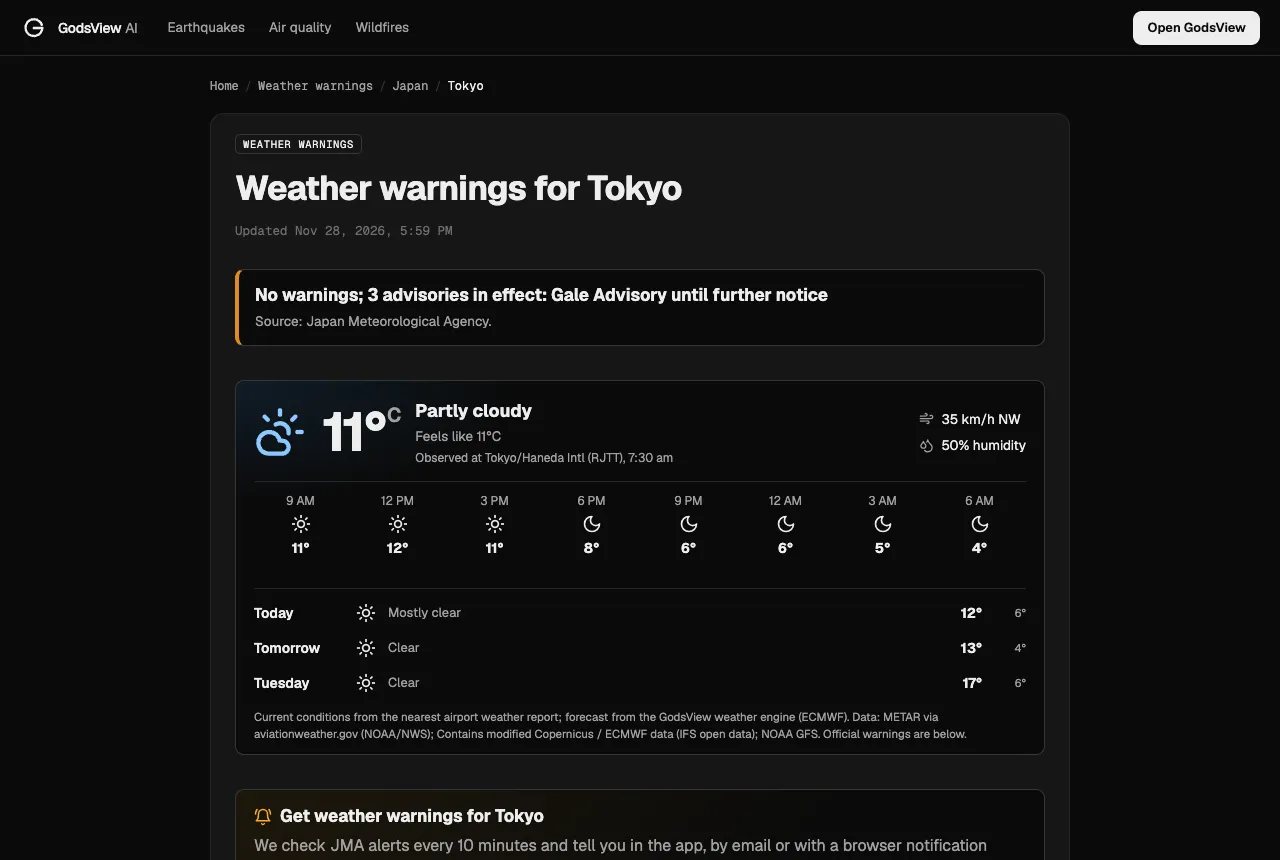
Most days with an alert in Tokyo are advisory days. On November 28, 2026, GodsView's Tokyo page showed no warnings and three JMA advisories in effect, among them a Gale Advisory until further notice. A gale advisory is a warning about strong winds; it does not carry a level number, because the levels only apply to heavy rain, flood, landslide and storm surge.
The level numbers matter most in the rainy season and the typhoon months, when heavy rain, flood, landslide and storm surge alerts are most common. To follow a typhoon's track, open the hurricane and typhoon tracker or read our explainer on cyclones, hurricanes and typhoons.
How to check JMA warnings in English
- GodsView shows JMA's current warnings and advisories for Japanese cities in English: Tokyo, Yokohama, Nagoya, Kyoto, Kobe, Hiroshima, Sendai or Naha. Each page shows the alert, its timing, live weather and the forecast.
- JMA's multilingual pages carry weather, heavy rain, high temperature, earthquake, tsunami and volcano information in more than a dozen languages, including English, Chinese, Korean, Spanish, Portuguese, Vietnamese, Thai, Tagalog, Nepali and Indonesian.
- The Safety tips app, from the Japan Tourism Agency, pushes earthquake early warnings, tsunami warnings and weather warnings to visitors in 15 languages, with evacuation flowcharts and useful phrases.
- GodsView Plus ($10.99 a month or $99.99 a year) adds alerts for saved places when an official warning is issued.
To watch rain bands approach, open the weather radar or the live map with a free account.
The short version
Japan's alert levels run from 1 to 5. Since May 29, 2026, heavy rain, flood, landslide and storm surge alerts are named with their level: Level 2 Advisory, Level 3 Warning, Level 4 Urgent Warning and Level 5 Emergency Warning. Older and less mobile people should leave at Level 3, everyone in the danger area at Level 4, and Level 5 means disaster may already be under way. Other alerts, such as a gale advisory, keep their usual names. Check your city's live page and your hazard map before the storm arrives.
Frequently asked questions
What is a Level 4 Urgent Warning in Japan?
It is the new JMA alert introduced on May 29, 2026, called kiken keiho in Japanese, for heavy rain, flood, landslide or storm surge. It matches Alert Level 4, when municipalities issue Evacuation Instructions and all residents in the affected area should evacuate.
What is the difference between an advisory and a warning in Japan?
An advisory (Level 2 for the four main water hazards) means weather could cause a disaster, so check your evacuation route and stay informed. A warning (Level 3) means a serious disaster is possible; older people and others who need more time should evacuate.
What is an emergency warning in Japan?
An emergency warning (tokubetsu keiho) is JMA's highest grade. For heavy rain, flood, landslide and storm surge it is now called the Level 5 Emergency Warning, which matches a life-threatening situation where safe evacuation may no longer be possible. Evacuate before it is issued.
When should I evacuate in Japan?
By Level 4 at the latest. At Level 3 older people and others who need more time should evacuate; at Level 4 everyone in the affected area should. At Level 5 a disaster may already be happening and safe evacuation may no longer be possible.
What does a gale advisory mean in Tokyo?
A gale advisory is a JMA advisory for strong winds. It does not carry a level number, since levels only apply to heavy rain, flood, landslide and storm surge. On November 28, 2026, GodsView showed a Gale Advisory in effect for Tokyo until further notice.
Where can I read Japan weather warnings in English?
On GodsView's Japan city pages, such as Tokyo, on JMA's multilingual pages, or in the Japan Tourism Agency's Safety tips app, which pushes warnings in 15 languages.
Sources
- JMA — English names for alert-level information (2026)
- JMA press release — New disaster prevention weather information from May 29, 2026 (Japanese)
- Cabinet Office (Bousai) — Revised disaster prevention weather information (Japanese)
- Nippon.com — Japan's new five-level disaster warning system
- JMA — Information on disaster risk reduction (alert levels and actions)
- JMA — Multilingual information
- JNTO — Safety tips app
Facts checked on against each provider's own site.