Explainer
What Air Quality Index Is Bad? AQI Numbers Explained
Your weather app says the AQI is 160. Is that bad? Should the kids play outside? Here is what each band of the scale means, why one number can hide several pollutants, and how to check yours.
Key takeaways
- On the US scale, 0 to 50 is Good and 51 to 100 is Moderate. Above 100, air quality starts to be bad for sensitive groups; above 150 it is Unhealthy for everyone.
- An AQI of 100 roughly matches the level of the short-term national air quality standard for that pollutant.
- The number you see is the worst of several pollutants. The reported AQI is the one with the highest index value.
- Since May 2024, the US scale is stricter for fine particles: Good now ends at 9.0 µg/m³ of PM2.5, down from 12.0.
- Other countries use different scales. The UK index runs from 1 to 10, so "AQI 7" means very different things in London and Los Angeles.
On the US Air Quality Index, air quality becomes bad above 100. From 101 to 150 it is "Unhealthy for Sensitive Groups", which means children, older adults and people with heart or lung disease should take it easy outdoors. From 151 to 200 it is "Unhealthy" for everyone, 201 to 300 is "Very Unhealthy", and above 300 is "Hazardous". Anything from 0 to 50 is Good, and 51 to 100 is Moderate, which is fine for most people.
So an AQI of 150 is at the top of the sensitive-groups band, and 160 has crossed into Unhealthy. This guide explains where those numbers come from, which pollutant is behind them, and how to check the air where you are.
The AQI scale, band by band
The US AQI is the Environmental Protection Agency's index for reporting daily air quality. It has six colour-coded categories (AirNow):
| AQI | Category | Colour | What AirNow says |
|---|---|---|---|
| 0 to 50 | Good | Green | Air quality is satisfactory, and air pollution poses little or no risk |
| 51 to 100 | Moderate | Yellow | Acceptable, but there may be a risk for people who are unusually sensitive |
| 101 to 150 | Unhealthy for Sensitive Groups | Orange | Members of sensitive groups may experience health effects |
| 151 to 200 | Unhealthy | Red | Some of the general public may be affected; sensitive groups more seriously |
| 201 to 300 | Very Unhealthy | Purple | Health alert: the risk of health effects is increased for everyone |
| 301 and up | Hazardous | Maroon | Health warning of emergency conditions: everyone is more likely to be affected |
The breakpoint that matters most is 100. AirNow explains that "for each pollutant an AQI value of 100 generally corresponds to an ambient air concentration that equals the level of the short-term national ambient air quality standard" (AirNow). Under 100, the air meets the standard. Over it, it doesn't.
Is AQI 150 bad? Is 160 bad?
Taking the numbers people search for most:
- AQI 50 or below. Good. Go outside.
- AQI 60 to 100. Moderate. Fine for nearly everyone. If you are unusually sensitive, you may want to shorten long, hard exercise.
- AQI 101 to 150. Bad for sensitive groups. Children and teens, older adults, pregnant people and anyone with asthma, heart or lung disease should cut back on long or heavy exertion outdoors. Everyone else is usually fine.
- AQI 151 to 200. Unhealthy. Everyone should reduce long or heavy exertion outdoors. Sensitive groups should avoid it.
- AQI 201 to 300. Very unhealthy. Everyone should avoid long or heavy exertion outdoors; sensitive groups should stay in.
- AQI 301 and up. Hazardous. Stay indoors with filtered air if you can.
Who counts as "sensitive" depends on the pollutant, and EPA's reporting rules require the pollutant-specific sensitive groups to be named for any AQI over 100 (40 CFR Part 58, Appendix G). The advice in the list above is what GodsView shows for each band on its city pages.
 to Hazardous (301 to 500), above the advice for sensitive groups.)
One number, several pollutants
The AQI is not a single measurement. EPA sets AQIs for five common pollutants: particle pollution (PM2.5 and PM10), ground-level ozone, carbon monoxide, nitrogen dioxide and sulfur dioxide (EPA). Each gets its own index value. The one you see is the worst: under EPA's rules, "the reported AQI corresponds to the pollutant with the highest calculated AQI" (40 CFR Part 58, Appendix G).
That has two practical effects:
- Different days, different culprits. The same AQI of 160 can be driven by fine particles one day and ozone another. The headline number doesn't tell you which.
- Different fixes. GodsView's advice for sensitive groups notes that a well-fitted N95 or FFP2 mask cuts particle exposure but does not filter ozone. Knowing which pollutant is high tells you whether a mask helps.
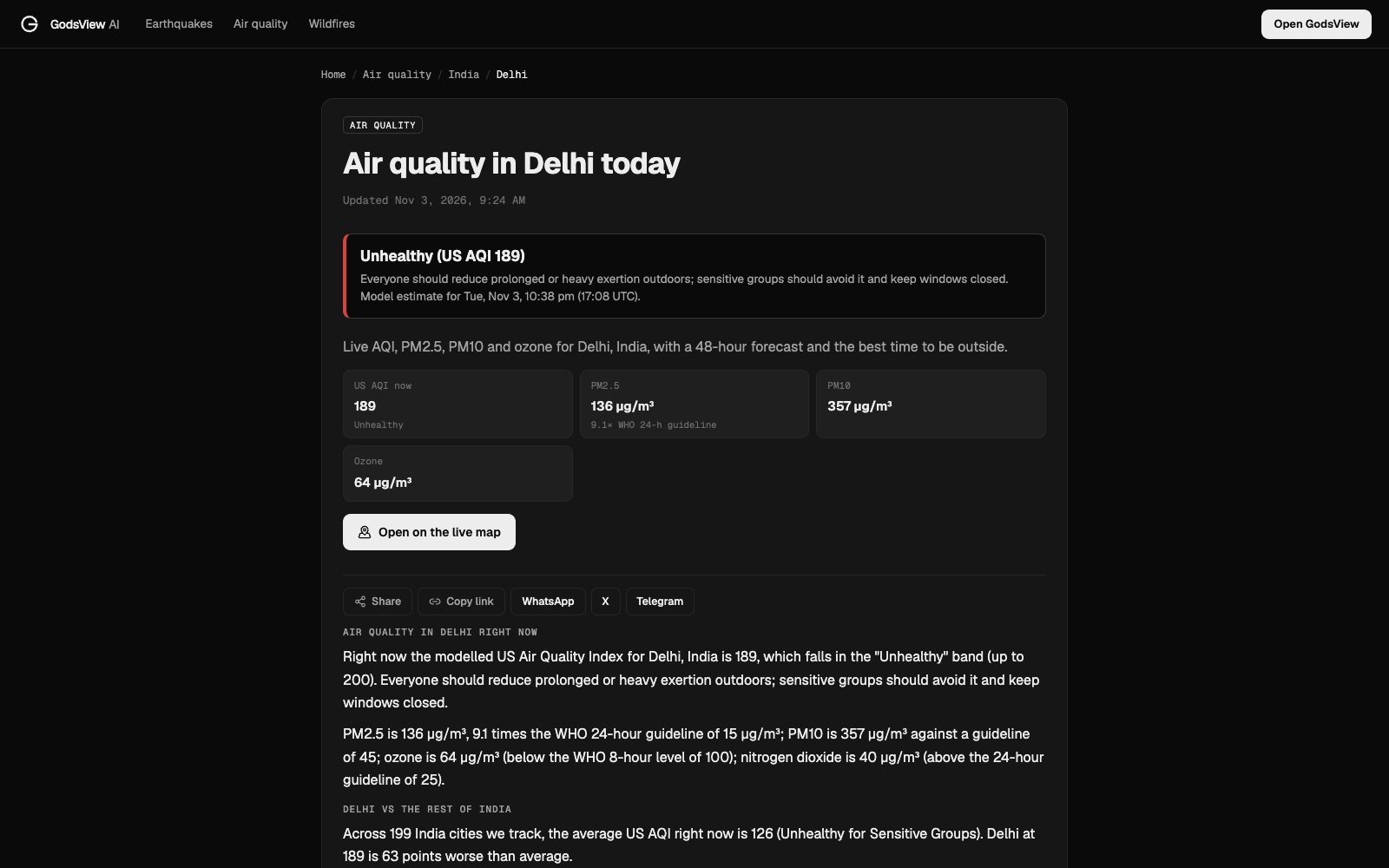
GodsView's city pages show the pollutants separately. On November 3, 2026, Delhi's page read US AQI 189, Unhealthy, with PM2.5 at 136 µg/m³ and PM10 at 357 µg/m³.
, PM2.5 136 µg/m³, PM10 357 µg/m³ and ozone 64 µg/m³, with advice for the Unhealthy band.)
What changed in 2024
In February 2024, EPA tightened the annual standard for fine particles (PM2.5) to 9.0 µg/m³ and changed several AQI breakpoints to match. The changes took effect on May 6, 2024 (EPA fact sheet):
| AQI category | PM2.5 before (µg/m³) | PM2.5 since May 2024 (µg/m³) |
|---|---|---|
| Good (0 to 50) | 0.0 to 12.0 | 0.0 to 9.0 |
| Moderate (51 to 100) | 12.1 to 35.4 | 9.1 to 35.4 |
| Unhealthy for Sensitive Groups (101 to 150) | 35.5 to 55.4 | 35.5 to 55.4 |
| Unhealthy (151 to 200) | 55.5 to 150.4 | 55.5 to 125.4 |
| Very Unhealthy (201 to 300) | 150.5 to 250.4 | 125.5 to 225.4 |
| Hazardous (301 and up) | 250.5 to 500, in two sub-ranges | 225.5 and up |
EPA says many areas "can expect to see more days in the Moderate (Code Yellow) category" because Moderate now starts at 9 µg/m³ rather than 12. It also says the change was made because of new health science, not because air was getting worse. During wildfires, the new upper breakpoints may move some days from Unhealthy to Very Unhealthy, or from Very Unhealthy to Hazardous.
So if your app shows more yellow days than it used to, that's partly the scale, not just the air.
Why your app and the news show different numbers
Two apps can show different AQIs for the same city at the same time, and both can be right. Common reasons:
- Different scales. The UK's Daily Air Quality Index runs from 1 to 10, in four bands: 1 to 3 Low, 4 to 6 Moderate, 7 to 9 High and 10 Very High (UK-AIR, Defra), and it is set by the highest of five pollutants. Other countries have their own scales too. GodsView shows the US AQI everywhere so cities can be compared on one scale.
- Different time windows. The official AQI is a daily figure. EPA's AirNow also shows a near-real-time "NowCast AQI" built from hourly monitoring data from nearly 900 areas across the US (EPA fact sheet).
- Monitor or model. A reading from a monitor down the road is a measurement. GodsView's city values are modelled by CAMS (Copernicus) and served by Open-Meteo, so they are estimates for the area around the city centre, not readings from an official monitor. Each city page compares the model with the nearest measured PM2.5 from sensor networks (Sensor.Community and OpenAQ) when one is within 25 km.
When in doubt, trust the official monitor nearest you, and use a model forecast to plan the next day or two.
How to check air quality where you are
- Open Air quality and press Air quality near me, or pick your city from the list.
- Read the answer box at the top: the band, the US AQI and the advice.
- Check the pollutant tiles to see whether PM2.5, PM10 or ozone is driving the number.
- Scroll to the 48-hour forecast and the Best time to be outside section if you are planning a run or a school trip.
- If wildfire smoke is mentioned, open the live wildfire map to see where the fires are. The NASA FIRMS guide explains the hotspots.
In the US, EPA's AirNow website and app, and the AirNow Fire and Smoke Map it runs with the US Forest Service, carry the official numbers. EPA says many state and local air agencies also publish the NowCast AQI on their own websites.
Getting a heads-up before the air turns bad
Checking every morning gets old. GodsView's My places watches the places you add and alerts on unhealthy PM2.5 readings, along with earthquakes, storms, floods and wildfires within 50 km. The disaster alerts guide covers the setup, and the alerts tutorial walks through it with screenshots.
Frequently asked questions
What air quality index is bad?
On the US scale, anything above 100 is bad for sensitive groups, and anything above 150 is Unhealthy for everyone. Above 200 is Very Unhealthy and above 300 is Hazardous.
Is an AQI of 150 bad?
150 is the top of the Unhealthy for Sensitive Groups band. Children, older adults, pregnant people and anyone with heart or lung disease should cut back on long or heavy exertion outdoors. Most healthy adults are fine.
What is a normal AQI?
There is no single normal, but 0 to 50 is Good and 51 to 100 is Moderate. Under 100 means the air meets the US short-term standard for that pollutant.
What AQI is safe for babies?
Babies and children count as a sensitive group. AirNow describes 0 to 50 as posing little or no risk; above 100, sensitive groups should limit long or heavy outdoor activity. Ask your doctor about a child with asthma or another condition.
Why does my AQI say 500?
Because the air is extremely polluted. GodsView's scale tops out at 500 and shows heavier dust or smoke as 500. Anything over 300 is already Hazardous.
Is the UK air quality index the same as the US AQI?
No. The UK Daily Air Quality Index runs from 1 to 10 in four bands: Low, Moderate, High and Very High. A UK "7" and a US "7" mean very different things.
Sources
- AirNow (EPA): AQI basics
- EPA: Final updates to the AQI for particulate matter, fact sheet (February 2024)
- 40 CFR Part 58, Appendix G: Uniform Air Quality Index and daily reporting
- UK-AIR (Defra): Daily Air Quality Index
Facts checked on against each provider's own site.