Explainer
China Weather Warnings: Blue, Yellow, Orange and Red Signals
A red rainstorm signal in a Chinese city means 100 mm of rain in three hours; a yellow heat signal means three days above 35°C. Here is what the blue, yellow, orange and red warning signals mean, with the criteria the China Meteorological Administration publishes.
Key takeaways
- China's weather warning signals use up to four colours, from blue (lowest) through yellow and orange to red (highest). Some hazards use only three colours, such as heat, fog and dust storms, which start at yellow.
- A rainstorm signal is blue for 50 mm of rain expected in 12 hours, yellow for 50 mm in 6 hours, orange for 50 mm in 3 hours and red for 100 mm in 3 hours.
- A typhoon signal goes from blue (average winds of force 6 or more within 24 hours) to red (force 12 or more within 6 hours).
- Heat signals are yellow for three days above 35°C, orange for 37°C within 24 hours and red for 40°C; fog signals are yellow below 500 m visibility, orange below 200 m and red below 50 m.
- GodsView's Beijing, Shanghai and other China city pages show official warnings carried through the WMO Severe Weather Information Centre, free.
China's weather warnings are colour-coded signals issued by meteorological offices under the China Meteorological Administration (CMA). Most hazards have four colours: blue, yellow, orange and red, from lowest to highest. Some, such as heat, fog and dust storms, have only three, starting at yellow. Each colour has a published criterion. A red rainstorm signal, for example, means 100 mm or more of rain is expected within three hours, and the guidance at red includes stopping gatherings and suspending classes and business. The higher the colour, the shorter the time before the weather hits and the stronger it will be.
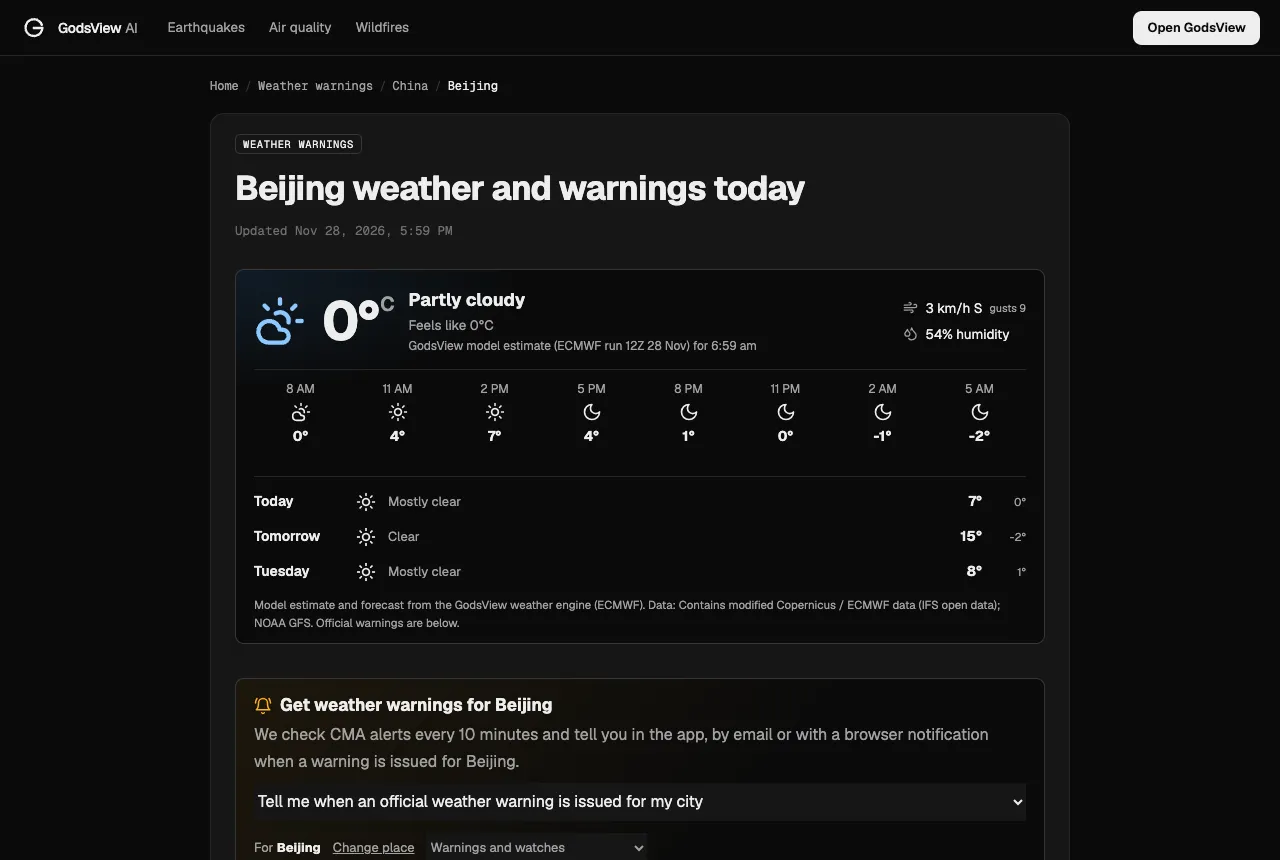
To check warnings for a Chinese city right now, open GodsView's page for Beijing, Shanghai, Guangzhou, Shenzhen or Chongqing, or the China weather warnings page.
Check China weather warnings now
How the colour system works
CMA publishes a signal for each hazard with a fixed set of colours and a defence guide for each colour. China's warning system runs at national, provincial, city and county levels, so the signal you see is usually issued by the meteorological office for your province, city or county, for its own area. CMA's National Meteorological Centre forecasts and warns for 13 types of hazardous weather: typhoons, heavy rain, severe convective weather, blizzards, cold waves, gales at sea, sandstorms, low temperatures, high temperatures, frost, ice storms, heavy fog and haze.
The pattern is the same across the signals:
- Blue (where used): the weather is expected within a longer window, typically 12 to 48 hours, at the lowest warning strength.
- Yellow: stronger or sooner.
- Orange: stronger again, often within 6 hours or less.
- Red: the most severe, often within 2 to 6 hours, with the strongest protective measures, such as stopping classes and work outside essential services.
The main warning signals and their criteria
The table summarises CMA's published criteria for the signals you are most likely to see. "Force" is the Beaufort wind scale used in China.
| Signal | Blue | Yellow | Orange | Red |
|---|---|---|---|---|
| Rainstorm (暴雨) | 50 mm or more within 12 hours | 50 mm or more within 6 hours | 50 mm or more within 3 hours | 100 mm or more within 3 hours |
| Typhoon (台风) | Average wind force 6+ or gusts force 8+ within 24 hours | Average force 8+ or gusts force 10+ within 24 hours | Average force 10+ or gusts force 12+ within 12 hours | Average force 12+ or gusts force 14+ within 6 hours |
| Gale (大风, not typhoon) | Average force 6+ or gusts 7+ within 24 hours | Average force 8+ or gusts 9+ within 12 hours | Average force 10+ or gusts 11+ within 6 hours | Average force 12+ or gusts 13+ within 6 hours |
| Cold wave (寒潮) | Minimum temperature falls 8°C+ in 48 hours to 4°C or below, wind force 5+ | Falls 10°C+ in 24 hours to 4°C or below, wind force 6+ | Falls 12°C+ in 24 hours to 0°C or below, wind force 6+ | Falls 16°C+ in 24 hours to 0°C or below, wind force 6+ |
| Blizzard (暴雪) | 4 mm+ of snow (water equivalent) in 12 hours | 6 mm+ in 12 hours | 10 mm+ in 6 hours | 15 mm+ in 6 hours |
| High temperature (高温) | Not used | Maximum 35°C+ for three days in a row | Maximum 37°C+ within 24 hours | Maximum 40°C+ within 24 hours |
| Dense fog (大雾) | Not used | Visibility below 500 m within 12 hours | Below 200 m within 6 hours | Below 50 m within 2 hours |
| Sandstorm (沙尘暴) | Not used | Sandstorm, visibility below 1,000 m, within 12 hours | Strong sandstorm, below 500 m, within 6 hours | Very strong sandstorm, below 50 m, within 6 hours |
Each criterion also applies when the weather has already reached that strength and is likely to continue. So an orange rainstorm signal can mean 50 mm is coming within three hours, or that 50 mm has already fallen in that time and the rain is not over.
Other signals
CMA also publishes signals for lightning (yellow, orange, red: from lightning possible within 6 hours to very likely within 2 hours), frost (blue, yellow, orange: ground temperatures falling below 0°C, minus 3°C and minus 5°C, for farmers), road icing (yellow, orange, red: icing on roads within 12, 6 or 2 hours when the road surface is below 0°C and precipitation falls), hail and drought. Haze is also among the hazards CMA's National Meteorological Centre forecasts and warns for; on hazy days also check the Beijing air quality page and our guide to what air quality index is bad.
What each colour asks you to do
CMA's defence guides get stricter with each colour. Using the rainstorm signal as the example:
Blue rainstorm
- Authorities prepare for heavy rain; schools and kindergartens take steps to keep children safe.
- Drivers watch for standing water and traffic jams.
- Drainage in cities, farmland and fish ponds is checked.
Yellow rainstorm
- Traffic control on roads with heavy rain and guidance around flooded sections.
- Dangerous outdoor power cut off in low-lying areas, open-air outdoor work paused, and people in dangerous places and unsafe houses moved to safety.
Orange rainstorm
- Dangerous outdoor power cut and outdoor work stopped.
- Units in danger zones suspend classes and business, with special measures for students and staff already there.
- Watch for flash floods, landslides and mudslides.
Red rainstorm
- Emergency response and rescue.
- Gatherings stopped, and classes and business suspended, except for essential services.
- Defence against flash floods, landslides and mudslides.
The typhoon guide follows the same path, from stopping outdoor group activities at blue to suspending gatherings, classes and business at orange and red. It also warns that when the centre of a typhoon passes, the wind may drop or stop for a while and then return suddenly, so stay in shelter. The fog guide goes from careful driving at yellow to strict speed control at orange and, at red, airports suspending take-offs and landings, expressways closing temporarily and ferries halting.
Typhoon, heat and fog: the signals you will see most
- Typhoons bring the strongest wind signals, and the timing matters: red means force 12 winds within 6 hours. Follow the storm on the hurricane and typhoon tracker, and see our explainer on cyclones, hurricanes and typhoons.
- Heat signals start at yellow for three days of 35°C or more. At orange, CMA advises avoiding outdoor activities during the hottest hours and shortening continuous work in high heat; at red, stopping outdoor open-air work except for essential services.
- Fog signals matter for road and air travel. If you are flying, a red fog signal at your airport can mean delays; our fog warning guide compares fog alerts around the world.
How to check China's warnings right now
GodsView reads China's official warnings through the WMO Severe Weather Information Centre, which collects warnings from national weather services, and matches them to each city:
- City pages such as Beijing, Tianjin, Wuhan, Chengdu, Hangzhou or Nanjing show any warning in force for the city, with live weather and the forecast.
- The China weather warnings page lists every major Chinese city under a warning.
For the full national picture, the National Meteorological Centre's warning page lets you filter by hazard type, colour and province. GodsView Plus ($10.99 a month or $99.99 a year) adds alerts for saved places when an official warning is issued.
Hong Kong uses a different system
Hong Kong has its own warning system, run by the Hong Kong Observatory, with numbered typhoon signals (No. 1, 3, 8, 9 and 10) and amber, red and black rainstorm warnings. A red rainstorm signal under the national criteria and a red rainstorm warning in Hong Kong are not the same thing: the national red is 100 mm in three hours, while Hong Kong's red is more than 50 mm in an hour. See our Hong Kong typhoon signals guide and the Hong Kong warnings page.
The short version
China's weather warning signals go from blue through yellow and orange to red, with three-colour signals for heat, fog and dust that start at yellow. A red rainstorm signal means 100 mm or more in three hours, a red heat signal 40°C or more, and a red fog signal visibility below 50 m. The higher the colour, the sooner and stronger the weather, and the stricter the advice, up to suspending classes and business. Check the live page for your city.
See weather warnings for Beijing
Frequently asked questions
What do blue, yellow, orange and red warnings mean in China?
They are the four colours of China's weather warning signals, from lowest to highest. Blue is the least severe and red the most severe. Each hazard has published criteria for each colour; for example, a rainstorm signal is blue for 50 mm in 12 hours and red for 100 mm in 3 hours.
What does a red rainstorm warning mean in China?
It means 100 mm or more of rain is expected within three hours, or has fallen and is likely to continue. CMA's guidance at red includes emergency response, stopping gatherings, suspending classes and business except essential services, and guarding against flash floods and landslides.
What does an orange rainstorm warning mean?
50 mm or more of rain is expected within three hours, or has already fallen with more likely. Outdoor work stops, units in danger zones suspend classes and business, and people should watch for flash floods, landslides and mudslides.
At what temperature does China issue a heat warning?
A yellow high temperature signal is issued when maximum temperatures are expected to be 35°C or more for three days in a row, orange when 37°C or more is expected within 24 hours, and red for 40°C or more within 24 hours. There is no blue heat signal.
What visibility triggers a fog warning in China?
Yellow when fog below 500 m visibility is possible within 12 hours, orange below 200 m within 6 hours, and red below 50 m within 2 hours. At red, airports may suspend flights and expressways may close temporarily.
Is a Chinese typhoon warning the same as a Hong Kong typhoon signal?
No. Mainland China uses blue, yellow, orange and red typhoon signals based on wind force and timing. Hong Kong uses the Observatory's numbered signals, such as No. 8 for sustained winds of 63 to 117 km/h. See our Hong Kong signals guide.
Sources
- China Meteorological Administration — Rainstorm warning signal (暴雨预警信号)
- China Meteorological Administration — Typhoon warning signal (台风预警信号)
- China Meteorological Administration — High temperature warning signal (高温预警信号)
- China Meteorological Administration — Dense fog warning signal (大雾预警信号)
- China Meteorological Administration — Cold wave, gale, sandstorm, blizzard, lightning, frost and road icing signals
- CMA — High-impact weather forecasting (13 hazard types)
- CMA — Early warning service
- National Meteorological Centre — Weather warnings
Facts checked on against each provider's own site.
- IMD Weather Warnings: Green, Yellow, Orange and Red Explained
- PAGASA Rainfall Warnings and Typhoon Signals, Explained
- UAE Weather Alerts: What Yellow, Orange and Red Mean
- MeteoAlarm: Yellow, Orange and Red Warnings Across Europe
- Vigilance Météo France: Yellow, Orange and Red Explained
- Mexico Weather Alerts: SMN Avisos and Hurricane Colours