Explainer
MeteoAlarm: Yellow, Orange and Red Warnings Across Europe
MeteoAlarm puts the official weather warnings of Europe on one map with one colour scale. Here is what yellow, orange and red mean, why each country still sets its own thresholds, and how to check the warnings for your trip.
Key takeaways
- MeteoAlarm is the shared warning platform of Europe's national weather services: it gathers and shows the official warnings of 38 national meteorological and hydrological services in one place.
- Yellow (Moderate) means the weather is potentially dangerous; orange (Severe) means it is dangerous, with damage and casualties likely; red (Extreme) means it is very dangerous, with major damage and threat to life over a wide area.
- The colours mean the same everywhere, but each national service sets its own thresholds: in the Netherlands, for example, KNMI issues yellow for fog below 200 metres of visibility.
- Warnings cover 14 hazard types, from wind, rain, snow and ice and thunderstorms to fog, heat, cold, coastal events, forest fire, avalanches, floods and drought.
- GodsView reads the MeteoAlarm feed and matches warnings to cities, so its country and city pages show which places are under an official warning right now, free.
MeteoAlarm is the official weather warning platform of Europe's national weather services. It collects the warnings issued by 38 national meteorological and hydrological services and shows them on one map with one colour scale. Yellow ("Moderate") means the weather is potentially dangerous; orange ("Severe") means it is dangerous, with damage and casualties likely; and red ("Extreme") means it is very dangerous, with major damage and a threat to life over a wide area. The warnings themselves still come from each country's own weather service, which sets the thresholds and stays responsible for them.
To see which European cities are under an official warning now, open GodsView's weather warnings hub, or a country page such as the Netherlands, the United Kingdom, France or Italy.
Check European weather warnings now
What the MeteoAlarm colours mean
MeteoAlarm's documentation defines three warning levels. Each comes with a colour and a severity word, which is why apps show labels like "Yellow Moderate Wind Warning".
| Colour | Severity | MeteoAlarm description | What to do |
|---|---|---|---|
| Yellow | Moderate | The weather is potentially dangerous. The phenomena forecast are not unusual, but be attentive if you take part in activities exposed to the weather | Keep informed and do not take any avoidable risks |
| Orange | Severe | The weather is dangerous. Unusual phenomena have been forecast; damage and casualties are likely to happen | Be very vigilant, keep regularly informed and follow any advice from the authorities |
| Red | Extreme | The weather is very dangerous. Exceptionally intense phenomena have been forecast; major damage and accidents are likely, in many cases with threat to life and limb, over a wide area | Follow orders and advice from the authorities under all circumstances, and be prepared for extraordinary measures |
Areas without a warning appear in green on the MeteoAlarm map. The colours are designed to be read the same way across borders, so a traveller who sees orange in Norway and orange in Italy can treat them as equally serious, even though the two services use different numbers to get there.
Why "moderate" does not mean "mild"
"Moderate" is the fixed word that goes with every yellow warning in the European format. A yellow fog, wind or snow warning is still a warning: it means the weather can cause problems for normal activities. Our yellow weather warning guide and fog warning guide explain this in more detail.
How national weather services feed MeteoAlarm
MeteoAlarm was developed for EUMETNET, the network of European national weather services, and went public in 2007. It does not forecast the weather. Each national service decides when to warn, for which area, at which level and with which text, and sends the warning in a standard format called the Common Alerting Protocol (CAP), following a shared MeteoAlarm CAP profile. MeteoAlarm then aggregates the warnings, draws them on the map, and passes them on through its feeds to national and international redistributors, such as broadcasters, apps and websites.
That has two practical effects:
- The colour is comparable, the threshold is local. Each service sets its own criteria for its own climate and infrastructure, so the same amount of snow or wind can get a different colour in different countries.
- The national service is the reference. If the national website and MeteoAlarm ever differ during an update, follow the national service, which issues the warning.
The site is available in more than 40 languages. Its 2010 redesign, which showed warnings for about 650 areas in 30 countries at the time, added a greyscale map for colour-blind users and subscription feeds.
The 14 hazard types
Every MeteoAlarm warning names one of 14 hazard types:
| Hazard | Examples of what it covers |
|---|---|
| Wind | Gales and damaging gusts |
| Snow or ice | Snowfall, freezing rain, icy roads |
| Thunderstorm | Lightning, hail, intense downpours |
| Fog | Dense fog reducing visibility |
| High temperature | Heat waves |
| Low temperature | Severe cold and frost |
| Coastal event | Storm tides and coastal flooding |
| Forest fire | High wildfire danger |
| Avalanche | Avalanche danger in mountains |
| Rain | Heavy or long-lasting rain |
| Flood | River flooding |
| Rain-flood | Flooding caused directly by rain |
| Marine hazard | Dangerous conditions at sea |
| Drought | Prolonged dry conditions |
Not every country warns for every type; avalanche warnings, for example, only make sense in mountain countries.
A real example: fog in the Netherlands
The Dutch weather service KNMI publishes clear thresholds. For fog, it issues code yellow when visibility is expected to fall below 200 metres, and code orange or red only below 10 metres, with the expected impact deciding between the two. KNMI's description of red for fog is blunt: it is very dangerous on the road because you can see almost nothing.
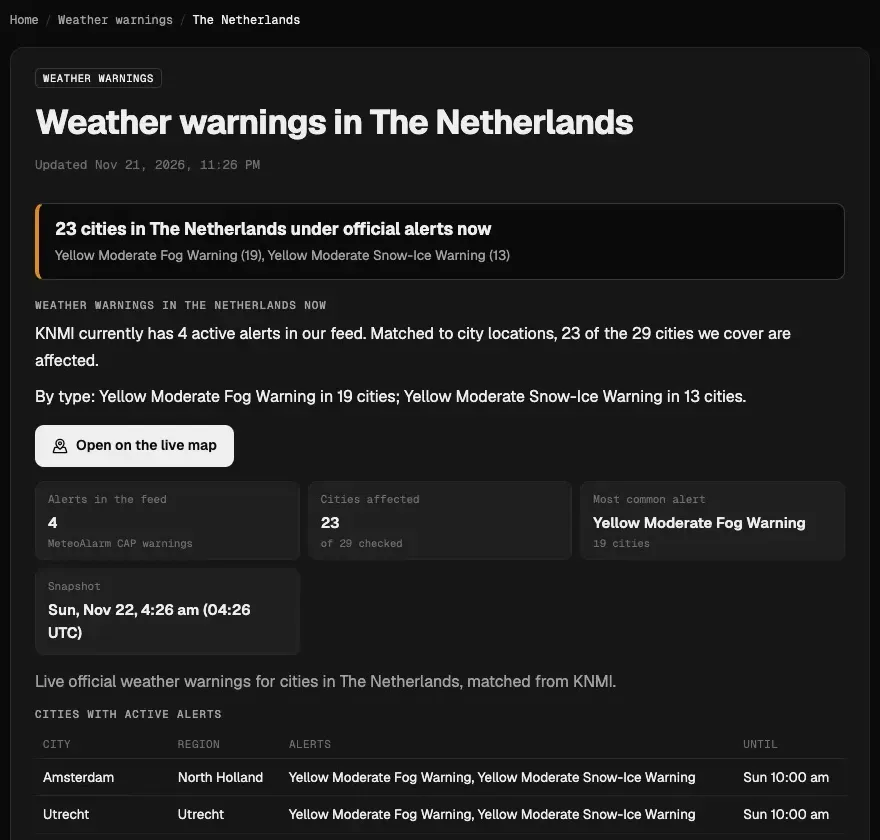
On the night of November 21 to 22, 2026, KNMI's yellow fog warning showed up in the MeteoAlarm feed as "Moderate Fog", and GodsView matched it to 19 Dutch cities:
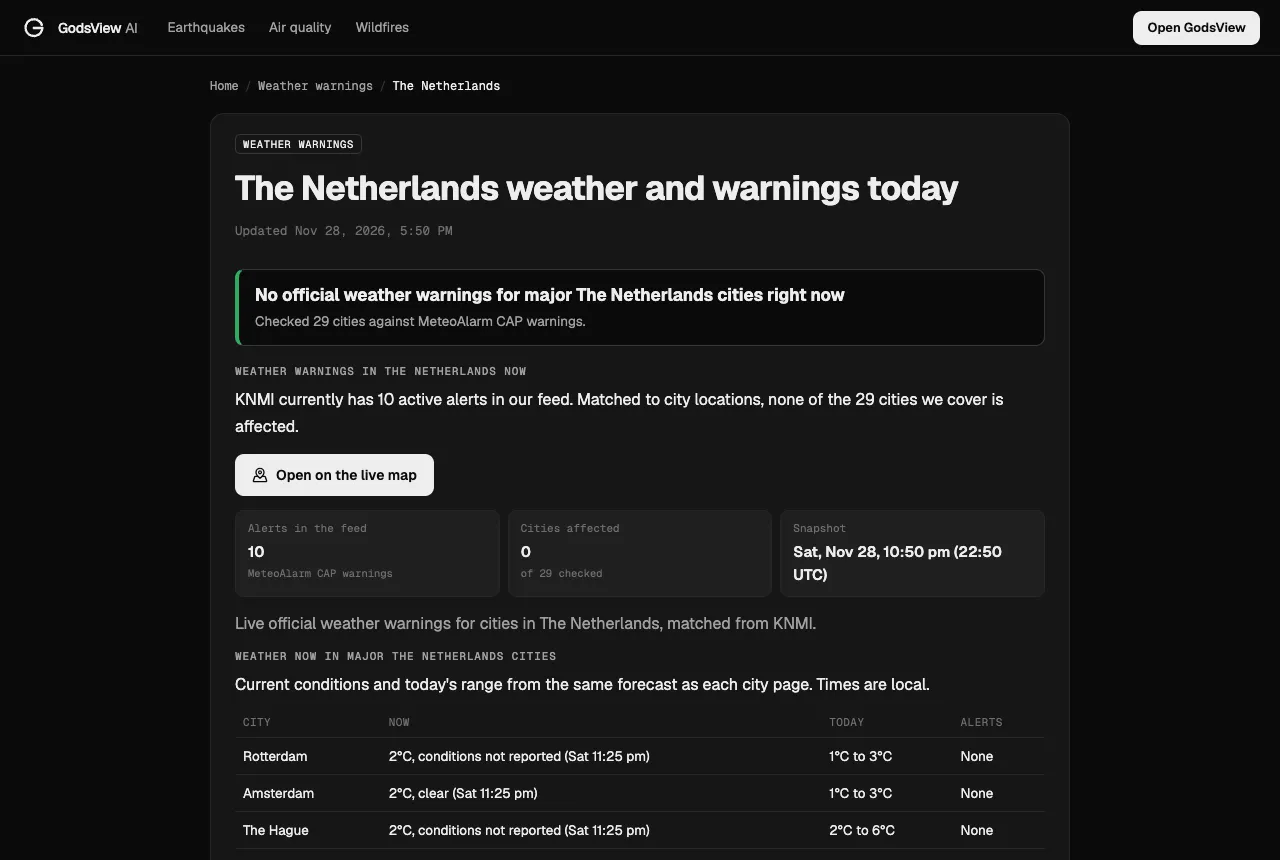
A week later the picture was quiet. On November 28, 2026, none of the 29 Dutch cities on GodsView was under a warning:
How to read a MeteoAlarm warning
A typical warning has five parts. Read all of them:
- Colour and severity: yellow Moderate, orange Severe or red Extreme.
- Hazard type: one of the 14 types above.
- Area: a region, province or county, not always your exact town.
- Valid from and until: many warnings start hours after they are issued, and some last for days.
- Description and instructions: written by the national service, often in the local language with an English version.
If you are travelling, check the warning for the place you will be at the time you will be there. A red warning for tomorrow afternoon in the mountains matters more than a yellow one today in the city you are leaving.
Checking MeteoAlarm warnings on GodsView
GodsView reads the MeteoAlarm feed and matches each warning to each city's location, so you can see at a glance which cities are affected:
- MeteoAlarm countries on GodsView: the United Kingdom, the Netherlands, Norway, Sweden, Switzerland, Iceland, Slovenia, Estonia, Latvia, Ukraine, Israel, France and Italy.
- Germany comes straight from the German weather service: see Germany's warnings and our DWD warning guide.
- Other European countries such as Austria, Poland, Finland, Greece and Czechia come through the WMO Severe Weather Information Centre.
GodsView does not yet carry every European country, so for a country not listed above, use MeteoAlarm or the national service directly. City pages such as Amsterdam, Paris, Rome, Oslo or Bern show the warning text, its timing, live weather and the forecast. GodsView Plus ($10.99 a month or $99.99 a year) can alert you when a new warning is issued for a saved place.
Before you travel in Europe
- Check the warnings for each stop on your route and for the time you will be there.
- For flights, an orange or red wind, snow or fog warning at your departure or arrival airport often means delays. Our guide to flying in bad weather explains why.
- For driving, read yellow snow or ice and fog warnings closely: even the lowest level means care is needed on the road.
- In the mountains, check the national avalanche bulletin as well as the weather warnings.
The short version
MeteoAlarm shows the official warnings of 38 European weather services on one map. Yellow (Moderate) means potentially dangerous weather, orange (Severe) dangerous weather with damage likely, and red (Extreme) very dangerous weather with a threat to life. The colours mean the same everywhere, but each country sets its own thresholds, so always read the warning text from the national service.
See weather warnings in Europe by city
Frequently asked questions
What is MeteoAlarm?
MeteoAlarm is the early warning dissemination system of Europe's national weather services. It aggregates and shows the official warnings of 38 national meteorological and hydrological services on one map with a common colour scale. It was developed for EUMETNET and went public in 2007.
What does a yellow Moderate warning mean?
In the MeteoAlarm system, yellow always carries the severity word "Moderate". It means the weather is potentially dangerous: the phenomena forecast are not unusual, but you should be attentive if you take part in activities exposed to the weather, such as driving.
What does an orange weather warning mean in Europe?
Orange (Severe) means the weather is dangerous. Unusual phenomena have been forecast and damage and casualties are likely. Be very vigilant, keep regularly informed and follow any advice given by the authorities.
What does a red weather warning mean in Europe?
Red (Extreme) means the weather is very dangerous. Exceptionally intense phenomena have been forecast, and major damage and accidents are likely, in many cases with threat to life and limb, over a wide area. Follow orders and advice from the authorities under all circumstances.
Do all European countries use the same warning thresholds?
No. The colours mean the same everywhere, but each national weather service sets its own criteria. For example, the Dutch service KNMI issues yellow for fog when visibility is expected below 200 metres.
Where can I see MeteoAlarm warnings by city?
GodsView reads the MeteoAlarm feed and matches warnings to cities. Open the weather warnings hub or a country page such as the Netherlands.
Sources
- MeteoAlarm documentation — Warnings, levels and hazard types
- MeteoAlarm — About
- KNMI — New Meteoalarm presents weather warnings in 650 European areas (2010)
- KNMI — Waarschuwingen: zicht (visibility warning criteria)
Facts checked on against each provider's own site.