Explainer
IMD Weather Warnings: Green, Yellow, Orange and Red Explained
An IMD "orange alert" for your district is not a forecast of orange skies; it is a colour-coded warning that tells you how much to prepare. Here is what each colour means, the rain and heat numbers behind the alerts, and how to get them on your phone.
Key takeaways
- The India Meteorological Department (IMD) uses four colours for its district warnings: green (no warning), yellow (watch, be aware), orange (alert, be prepared) and red (warning, take action).
- IMD describes heavy rain as 64.5 to 115.5 mm in a day, very heavy as 115.6 to 204.4 mm, and extremely heavy as more than 204.4 mm.
- A heat wave is declared in the plains when the maximum temperature reaches at least 40°C and is 4.5°C or more above normal, or when it reaches 45°C or more, with the criteria met at two or more stations in a subdivision for two consecutive days.
- For the next few hours, IMD issues district-wise and station-wise nowcasts for thunderstorms, lightning, gusty winds and heavy rain.
- Official warnings also reach phones through NDMA's SACHET system, and GodsView's city pages for Mumbai, Delhi and other Indian cities show IMD alerts carried by SACHET, free.
An IMD weather warning is a colour-coded warning from the India Meteorological Department for your district or region. There are four colours. Green means no warning. Yellow means watch and be aware: the weather could worsen and disrupt daily life. Orange means alert and be prepared: very bad weather is expected and could bring transport delays, closures and power cuts. Red means warning and take action: severe weather is expected to disrupt travel and power and is a significant risk to life.
To check active warnings for your city, open GodsView's page for Mumbai, Delhi, Chennai, Kolkata or Bengaluru, or the India weather warnings page for the whole country.
Check India weather warnings now
What IMD's green, yellow, orange and red warnings mean
IMD's district-wise warning maps use a four-step legend: No warning, Watch, Alert, Warning. The colours and what they ask of you:
| Colour | IMD label | Meaning | What to do |
|---|---|---|---|
| Green | No warning | No advisory is needed | Normal routine |
| Yellow | Watch | Be aware: bad weather possible, could worsen and disrupt daily life | Stay updated and check forecasts |
| Orange | Alert | Be prepared: very bad weather likely, with transport delays, closures and possible power cuts | Prepare, and change plans that expose you to the hazard |
| Red | Warning | Take action: severe weather will disrupt travel and power and is a significant risk to life | Follow the instructions of local authorities |
Warnings are mapped district by district, so a state can have a red warning in a few coastal districts, orange inland, and yellow elsewhere on the same day. IMD updates its warnings daily, and the colour for later days can change as the forecast firms up. IMD also says its colour-coded heat wave information is available for the next five days, in the daily bulletins and on a map-based platform at mausam.imd.gov.in.
A common mix-up is to read "orange alert" as "the second-highest alarm". In IMD's system orange means be prepared. Red does not mean panic; it means authorities and the public should take action now.
The numbers behind heavy rain warnings
Most IMD warnings during the monsoon are about rain, and the bulletins use fixed words for rainfall in 24 hours. As listed in IMD's bulletins:
| IMD term | Rainfall in 24 hours |
|---|---|
| Heavy rain | 64.5 to 115.5 mm |
| Very heavy rain | 115.6 to 204.4 mm |
| Extremely heavy rain | More than 204.4 mm |
The colour of the warning is not fixed to these numbers. A forecast of heavy rain in one district may come with a yellow warning, and very heavy rain over a city prone to waterlogging may come with orange or red, because the colour reflects the expected impact. Always read the warning for your own district before you set out.
Heat wave warnings and their criteria
From March to June, IMD's colour codes are mostly about heat. Its heat wave FAQ sets out when a heat wave is declared:
- The maximum temperature at a station must reach at least 40°C in the plains or 30°C in hilly regions.
- Based on departure from normal: a heat wave when the maximum is 4.5°C to 6.4°C above normal, and a severe heat wave when it is more than 6.4°C above normal.
- Based on the actual temperature: a heat wave when the maximum reaches 45°C or more, and a severe heat wave at 47°C or more.
- The criteria must be met at two or more stations in a meteorological subdivision for at least two consecutive days, and the heat wave is declared on the second day.
- For coastal stations, a heat wave may be described when the maximum is 4.5°C or more above normal, provided the actual maximum is 37°C or more.
IMD also tracks warm nights, declared only when the maximum stays at 40°C or more, with the minimum temperature 4.5°C to 6.4°C above normal (very warm night: more than 6.4°C above). High humidity and hot winds make heat waves worse for the body, because sweat evaporates more slowly.
In its heat bulletins, IMD spells out what the colours mean for health. In red areas there is a very high likelihood of heat illness and heat stroke in all ages, and extreme care is needed for vulnerable people. In orange areas, people exposed to the sun for a long time or doing heavy work are increasingly likely to show symptoms of heat illness, and there is a high health concern for infants, the elderly and people with chronic diseases.
Nowcasts: warnings for the next few hours
District colours cover the day. For sudden storms, IMD issues nowcasts: short-range warnings for thunderstorms, lightning, gusty winds and heavy rain that are about to hit. They are published district-wise and station-wise on mausam.imd.gov.in, including on the pages of IMD's Regional Meteorological Centre in Mumbai. If a nowcast covers your district, the storm is expected within hours, so finish outdoor work and get under cover.
IMD's official apps carry these warnings too: Mausam for forecasts and warnings, UMANG (the government services app), Meghdoot for farmers' agromet advisories, and Damini for lightning.
SACHET: official alerts on your phone
India's national alert portal is SACHET, run by the National Disaster Management Authority (NDMA). It describes itself as the first and only portal in India to publish official warnings for all disasters from authorised sources. It uses the Common Alerting Protocol (CAP), an international standard format, so that warnings from different agencies can be shared and rebroadcast quickly.
- Who sends alerts: IMD, the Central Water Commission (river floods), INCOIS (ocean and tsunami warnings), the Forest Survey of India (forest fires), NDMA and the disaster management authorities of all 36 states and union territories.
- How they reach you: SMS from the header XX-NDMAEW, the SACHET app on Android and iPhone, browser notifications and an RSS feed for media.
- Languages: 12 Indian regional languages.
Because SACHET publishes IMD's warnings as CAP alerts, apps and websites can carry the same official text. GodsView reads IMD's alerts through SACHET and matches them to each city.
How to check IMD warnings on GodsView
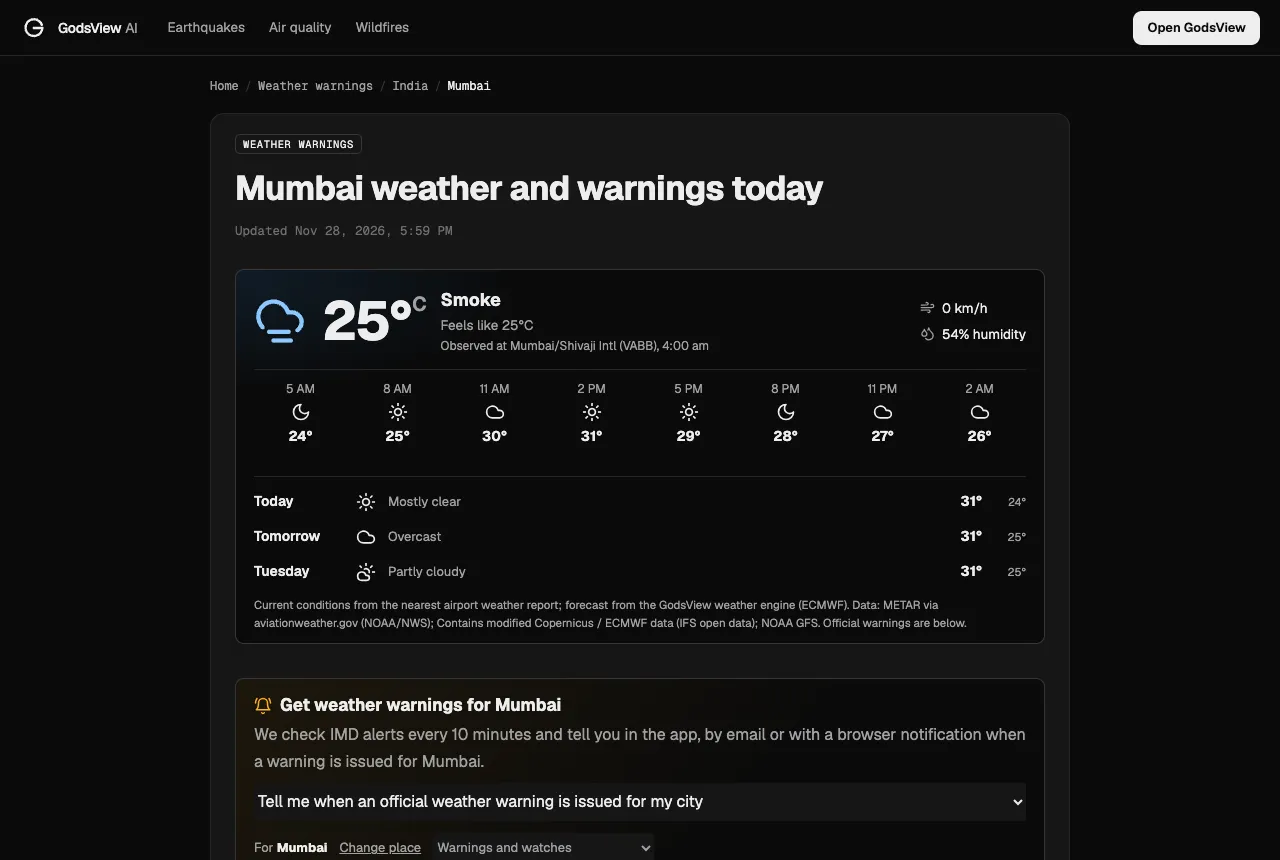
- Open a city page: Mumbai, Delhi, Hyderabad, Pune, Ahmedabad or Kolkata. Each shows any active official alert, its timing, live weather and the forecast.
- The India weather warnings page lists every major Indian city under an alert.
- The weather warnings hub finds the nearest city with "Warnings for my location".
Each city page is the quickest way to see whether an official IMD alert covers the city right now, next to the current weather and the forecast. With GodsView Plus ($10.99 a month or $99.99 a year), you can save a city and get an alert when a new official warning is issued for it.
On hot, hazy or foggy days, also check the Delhi air quality or Mumbai air quality pages, and see our guide to what air quality index is bad.
What to do for each IMD colour
Yellow (watch)
- Check the forecast morning and evening.
- Plan travel with buffer time, especially in the monsoon.
- In heat, avoid the midday sun and drink water regularly.
Orange (alert)
- Postpone travel that is not needed, especially by road through hilly or flood-prone areas.
- Keep phones charged and torches ready in case of power cuts.
- Avoid waterlogged roads and underpasses; never walk through flowing water.
- In heat, keep infants, the elderly and people with chronic illness cool and hydrated.
Red (warning)
- Take action: follow instructions from the district administration and the state disaster management authority.
- Stay indoors in a safe building during the peak of the storm or heat.
- If authorities advise evacuation from low-lying or coastal areas, move early.
The short version
IMD's colours run from green (no warning) through yellow (watch, be aware) and orange (alert, be prepared) to red (warning, take action). Heavy rain means 64.5 to 115.5 mm in a day, very heavy 115.6 to 204.4 mm, and extremely heavy more than 204.4 mm. Watch for nowcasts when storms are close, let SACHET alerts reach your phone, and check the live page for your city before you head out.
See weather warnings for my city
Frequently asked questions
What does an IMD orange alert mean?
Orange is the "Alert" level in IMD's colour code and means be prepared. Very bad weather is expected that could cause transport delays, closures and power cuts. Prepare, avoid unnecessary travel and keep checking updates.
What does an IMD red alert mean?
Red is the "Warning" level and means take action. Severe weather is expected to disrupt travel and power and poses a significant risk to life. Follow the instructions of your district administration and disaster management authority.
How much rain is "heavy rain" for IMD?
IMD calls 64.5 to 115.5 mm of rain in 24 hours heavy rain, 115.6 to 204.4 mm very heavy rain, and more than 204.4 mm extremely heavy rain.
When does IMD declare a heat wave?
In the plains, when a station reaches at least 40°C and is 4.5°C to 6.4°C above normal (more than 6.4°C is a severe heat wave), or when it reaches 45°C or more (47°C or more is severe). The criteria must be met at two or more stations in a subdivision for at least two consecutive days.
What is an IMD nowcast?
A short-range warning for the next few hours, issued district-wise and station-wise, for thunderstorms, lightning, gusty winds and heavy rain. Nowcasts are published on mausam.imd.gov.in and in IMD's apps.
How do I get official weather alerts on my phone in India?
Through NDMA's SACHET system: SMS alerts from the header XX-NDMAEW, the SACHET app and browser notifications, in 12 regional languages. IMD's Mausam app also shows warnings, and GodsView city pages such as Mumbai show the official alert for the city.
Sources
- India Meteorological Department
- IMD — FAQ on heat wave
- IMD — Press release, June 16, 2024 (rainfall terms and heat impact by colour)
- IMD — Urban Meteorological Services brochure (warning legend, nowcast)
- IMD Regional Meteorological Centre Mumbai — district-wise warnings
- NDMA — SACHET national disaster alert portal
- Drishti IAS — Colour-coded warnings by the IMD
Facts checked on against each provider's own site.