Explainer
UAE Weather Alerts: What Yellow, Orange and Red Mean
In the UAE, the National Center of Meteorology's alerts come in three colours, and most of them are for fog, dust or sudden convective rain. Here is what each colour asks of you, how fog and dust alerts work, and what the April 2024 floods taught residents.
Key takeaways
- The UAE's National Center of Meteorology (NCM) issues alerts in three colours: yellow means be aware, orange means be prepared, and red means take action because hazardous weather of exceptional severity is forecast.
- Fog causes many of the red alerts: NCM issues red and yellow fog alerts when horizontal visibility drops sharply, often below 1,000 metres in the early morning, frequently over Abu Dhabi and Al Dhafra.
- Dust and convective rain bring yellow and orange alerts: in September 2025 NCM put orange over Al Maktoum International Airport for visibility below 1,500 metres in blowing dust.
- On April 16, 2024, NCM recorded about 254 mm of rain in less than 24 hours at Khatm Al Shakla in Al Ain, the heaviest rainfall since records began in 1949.
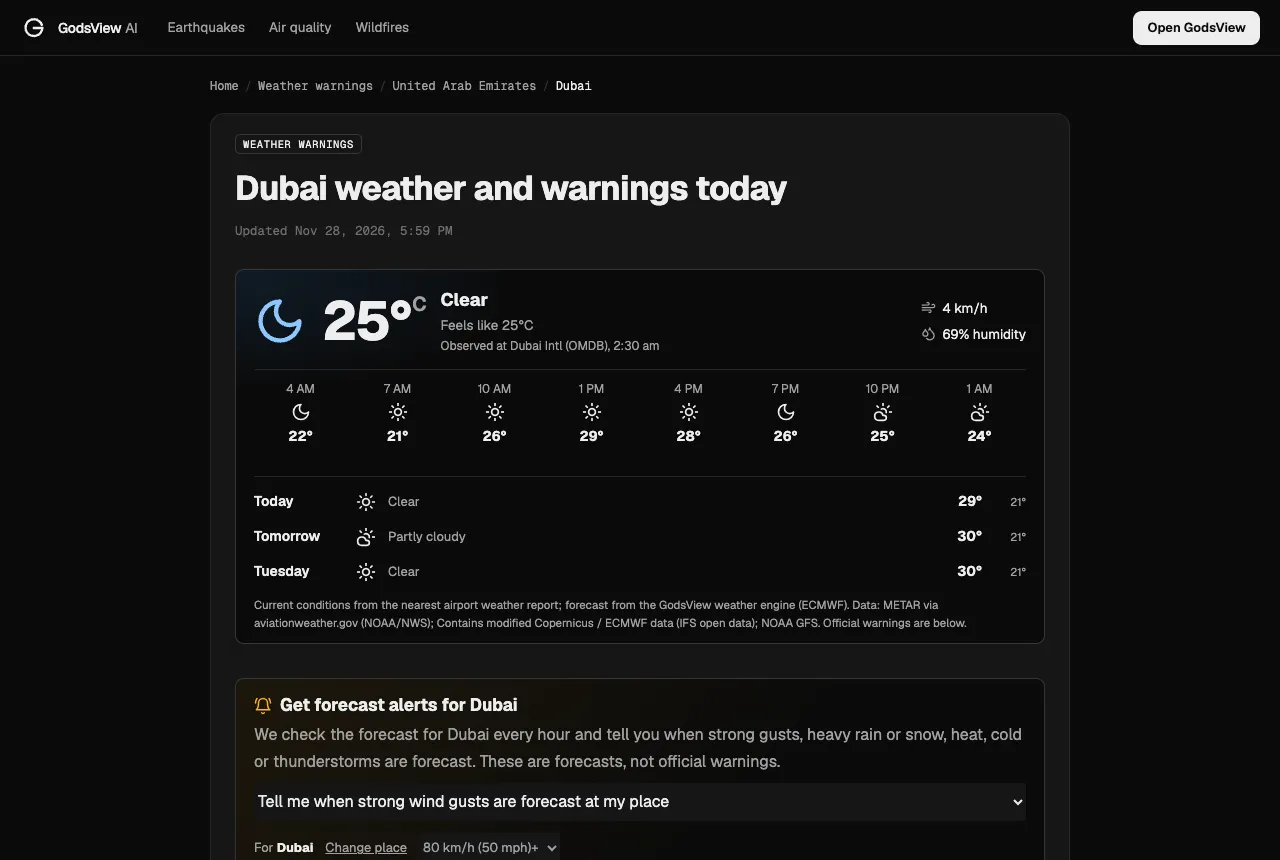
- GodsView does not carry UAE warnings; its Dubai page shows live weather and its own forecast flags, marked as not official. NCM is the reference.
A UAE weather alert is a warning from the National Center of Meteorology (NCM), and its colour tells you what to do. Yellow means be aware: be on the lookout if you are going out, for example for morning fog or blowing dust. Orange means be prepared: hazardous weather is expected, so stay alert and follow official advice. Red means take action: be extremely vigilant, because hazardous weather of exceptional severity is forecast. In practice, many red alerts in the UAE are for thick fog that cuts visibility on the roads.
GodsView does not republish NCM's alerts, so for the official word always check the NCM website or its UAE Weather app. GodsView does give you live weather, a forecast and our own forecast flags, marked as not official, for Dubai, Abu Dhabi, Sharjah, Ajman, Ras Al Khaimah and Fujairah.
The three NCM alert colours
NCM issues its weather alerts on a three-point scale, shown on its warnings map and in its app.
| Colour | NCM message | What it means | What to do |
|---|---|---|---|
| Yellow | Be aware | Potentially hazardous weather in the area; caution is required | Be on the lookout if you go out; drive with care |
| Orange | Be prepared | Hazardous weather is expected; a higher level of risk | Stay alert and comply with advice issued by the authorities |
| Red | Take action | Hazardous weather of exceptional severity is forecast | Be extremely vigilant; change plans and follow instructions |
Each alert names the hazard (fog, dust, rain, convective clouds, strong winds, rough seas) and the areas and time it covers. It is common to see different colours for different parts of the country at the same time: a red fog alert over inland Abu Dhabi and only yellow along the Dubai coast, for example.
Fog alerts: the most common red
Fog is one of the most common reasons for a red alert in the UAE, usually overnight and in the early morning. A typical case, from September 28, 2025: NCM issued red and yellow fog alerts after visibility fell below 1,000 metres in some areas, with fog expected to last until 9:30 am. Abu Dhabi Police told motorists to drive cautiously, follow the speed limits shown on electronic signboards, and stay alert to sudden changes in visibility.
That last point matters: in fog, watch the electronic signboards over the road and follow the speed limit they show. If you commute early, check NCM before you leave and allow extra time.
Driving in fog in the UAE
- Slow down and follow the electronic speed signs.
- Use low-beam headlights, not high beams, which reflect off the fog.
- Leave a much bigger gap and do not follow tail lights too closely.
- Do not stop on the hard shoulder unless you must; if you do, pull well off, switch on hazard lights and stay buckled in.
- Avoid overtaking and lane changes until visibility improves.
Our fog warning guide explains fog alerts in other countries, including Saudi Arabia and Kuwait.
Dust alerts
Blowing dust and sand bring yellow and orange alerts when winds pick up. On September 24, 2025, for instance, NCM issued:
- Yellow alerts for blowing dust with horizontal visibility below 2,000 metres over Abu Al Abyad, Dalma and Al Yasat islands; and
- Orange alerts for visibility below 1,500 metres over Al Maktoum International Airport, Al Wathba and Khalifa City, from 10:30 am to 5:30 pm.
Dust matters for health as well as for roads. On dusty days people with asthma or allergies should stay indoors where possible and keep windows closed. Check the Dubai air quality page, and see our dust storm and haboob guide for what to do if you drive into a wall of dust.
Rain and convective clouds
Rain is rare in the UAE, but when it comes it often arrives as sudden convective storms, with hail, lightning and flash floods in the mountains and wadis. On October 18, 2026, NCM issued yellow and orange alerts for convective clouds from 2 pm to 7 pm, with hail reported in Margham in Dubai and a risk of flash floods in mountain areas. NCM advised residents to stay away from flood-prone areas.
Orange and red rain alerts are the ones to plan around, especially if you live or drive near wadis, underpasses or low-lying roads.
The April 2024 floods: what they taught
On April 16, 2024, the UAE saw rainfall NCM described as an exceptional event in the country's climate history. NCM recorded about 254 mm in less than 24 hours at Khatm Al Shakla in Al Ain, the heaviest rainfall since records began in 1949.
Practical lessons from that storm:
- Take orange and red rain alerts seriously, even if the sky looks normal in the morning. Convective storms build quickly.
- Avoid underpasses and low roads in heavy rain; they fill first and fastest.
- Do not drive through floodwater. Cars can stall or float in water much shallower than it looks.
- Move cars off the street into higher parking if you live in a flood-prone area.
- Keep drains on balconies and roofs clear before a forecast storm.
- Charge phones and follow official channels (NCM, police and emirate authorities) for road closures and remote-work or school decisions.
NCM's own advice for storms is to secure loose items and check drainage before the weather arrives; to stay away from windows and avoid using electrical appliances indoors during the storm; to shelter in sturdy buildings and avoid low-lying areas if you are outside; and, when driving in heavy rain, to slow down, increase the following distance and use hazard lights.
How to get NCM alerts
- NCM website and warnings map: the official source, in Arabic and English.
- UAE Weather app: NCM's app for Android and iOS.
- Official social media from NCM and the police in each emirate, which relay road advice during fog and rain.
For general phone settings and other alert sources, see our guide to weather alerts in your area.
What GodsView shows for the UAE
The UAE is not one of the countries whose official warnings GodsView carries, and we say so plainly rather than show a copied alert that could be out of date. Here is what you can use:
- City pages: Dubai and the other emirates show current conditions, the forecast and GodsView forecast flags: our own check of the forecast for strong gusts, heavy rain, thunderstorms and heat over the next 48 hours. They are labelled as forecasts, not official warnings, and each page links to NCM.
- The UAE country page lists cities with links to the official service.
- Flights: fog and storms delay flights; see what is moving at Dubai International and Abu Dhabi, or planes over Dubai right now.
- Live cameras: check conditions on the ground with live cameras in Dubai.
GodsView Plus ($10.99 a month or $99.99 a year) adds alerts for saved places, but for UAE weather alerts, NCM is the source that counts.
The short version
NCM's yellow alert means be aware, orange means be prepared, and red means take action for hazardous weather of exceptional severity. Most red alerts are for fog with visibility dropping well below 1,000 metres, when you should slow down and follow the electronic speed signs. Dust brings yellow and orange alerts; convective rain can bring flash floods, as April 2024 showed. Check NCM before early drives and stormy afternoons.
See live weather for UAE cities
Frequently asked questions
What does a red alert mean in the UAE?
An NCM red alert means "take action": be extremely vigilant, because hazardous weather of exceptional severity is forecast. In the UAE it is most often issued for thick fog with very low visibility.
What is the difference between a yellow and an orange alert in the UAE?
Yellow means "be aware": be on the lookout if you go out. Orange means "be prepared": hazardous weather is expected, so stay alert and follow advice issued by the authorities.
Why does the UAE issue so many fog alerts?
Dense fog often forms overnight and in the early morning. NCM issues yellow and red fog alerts when visibility falls sharply, often below 1,000 metres.
How much rain fell in the UAE in April 2024?
NCM recorded about 254 mm in less than 24 hours at Khatm Al Shakla in Al Ain on April 16, 2024, the heaviest rainfall since records began in 1949.
Does GodsView show UAE weather alerts?
No. GodsView does not carry NCM's alerts. Its Dubai page and other UAE city pages show live weather, a forecast and GodsView forecast flags marked as not official, with a link to NCM.
Sources
- Gulf News — How to stay safe during rain, floods and thunderstorms (NCM alert levels)
- Gulf News — UAE issues red and yellow alerts for thick fog (September 28, 2025)
- Khaleej Times — Orange, yellow dust alerts issued (September 24, 2025)
- Gulf News — NCM issues yellow and orange alerts for convective clouds (October 18, 2026)
- Khaleej Times — UAE witnesses record-breaking rains, highest in 75 years (April 2024)
- UAE Government portal — Weather conditions and environmental status
Facts checked on against each provider's own site.