Guide
Earthquake in Turkey Today: AFAD, Kandilli and How to Check
Türkiye's networks record small quakes around the clock: on November 28, 2026, AFAD's list of the latest 100 quakes covered less than 22 hours. Here is where to check the latest one, why AFAD and Kandilli sometimes disagree, and what the big faults mean for Istanbul, İzmir and the east.
Key takeaways
- To check an earthquake in Turkey today, use AFAD, the government disaster agency that announces official magnitudes, or Kandilli Observatory's list of the latest 500 quakes. GodsView's earthquakes in Turkey page gives a quick M2.5+ list from the USGS catalogue.
- AFAD and Kandilli run separate networks and often publish slightly different magnitudes for the same quake. Under Turkish rules, basic data such as magnitude are officially announced by AFAD.
- On February 6, 2023, AFAD measured an Mw 7.7 quake at 04:17 near Pazarcık and an Mw 7.6 at 13:24 near Elbistan. The USGS says the death toll was over 57,000 by the end of March 2023.
- The USGS says the M7.8 quake (its figure) shifted nearly 354 km of the East Anatolian fault, and the M7.5 about 161 km of the Çardak fault, with offsets of up to 3 m and 9 m.
- Earthquakes cannot be predicted. The useful questions after a tremor are its magnitude, depth and distance from you, and whether aftershocks follow.
To check whether there was an earthquake in Turkey today, open AFAD (the Disaster and Emergency Management Presidency), which publishes Türkiye's official earthquake data and a list of the latest 100 quakes, or Kandilli Observatory at Boğaziçi University, which lists the latest 500. For a quick overview of larger quakes, GodsView's earthquakes in Turkey page answers yes or no for M2.5+ quakes in the last 24 hours, using the USGS catalogue, and shows the past week and year. For one city, pages such as Istanbul, İzmir or Ankara show only the quakes near you.
This guide explains which list to trust for what, why the numbers differ, how the North and East Anatolian faults work, and what changed in how people check quakes after February 2023.
See earthquakes in Turkey today
Was there an earthquake in Turkey today?
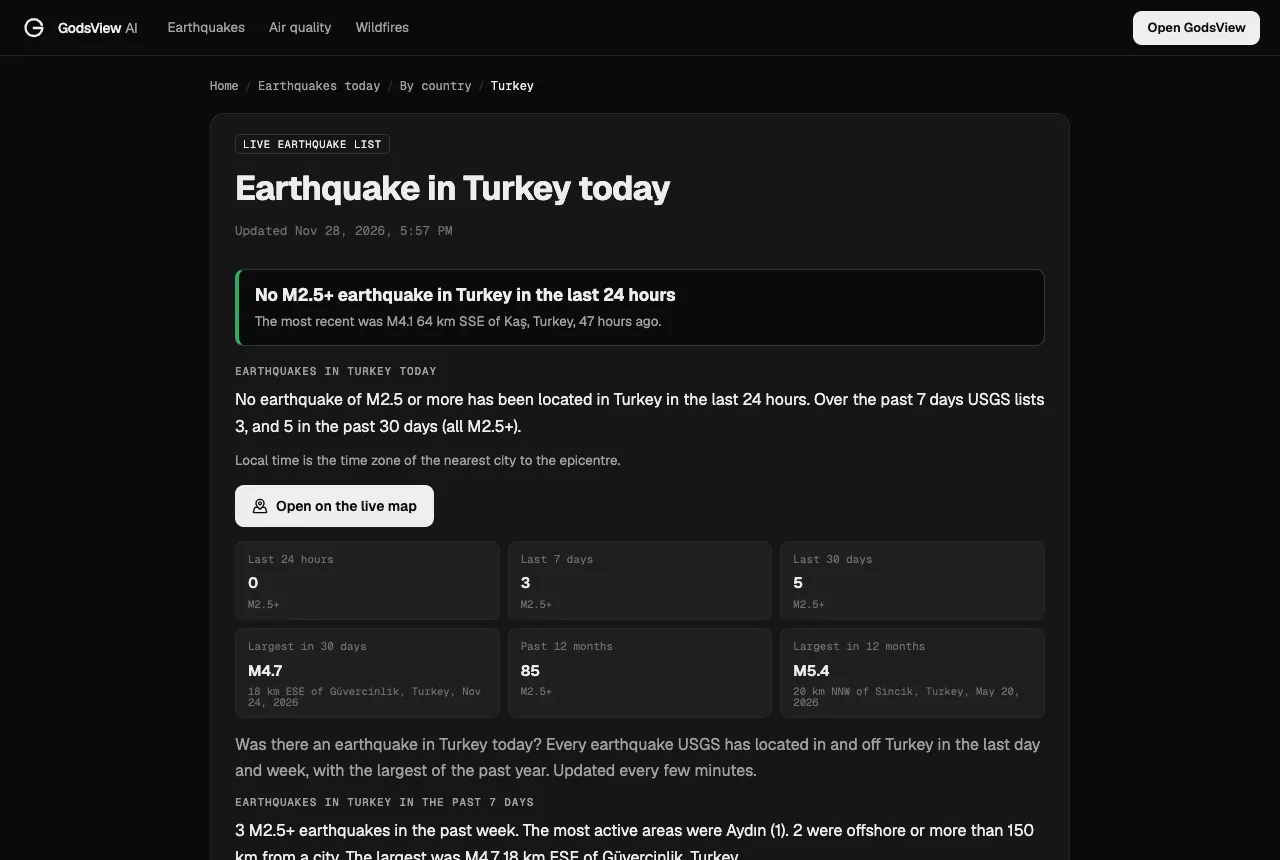
When we captured GodsView's Turkey page on November 28, 2026, its top line read "No M2.5+ earthquake in Turkey in the last 24 hours". The most recent was an M4.1 about 64 km south-southeast of Kaş, off the Mediterranean coast, 47 hours earlier.
That does not mean the ground was still. AFAD's list of the latest 100 quakes, checked in the early hours of November 29, 2026 Turkish time, went back less than 22 hours, and most were between ML 0.9 and 2.9: a cluster near Milas in Muğla, others near Bodrum in the Aegean, Varto in Muş, Göksun in Kahramanmaraş, Doğanşehir in Malatya and Sındırgı in Balıkesir. Kandilli's list showed the same small Milas tremors with its own magnitudes. Quakes this small are recorded by the dense Turkish networks but are not felt by most people and do not appear on an M2.5+ list.
So the rule of thumb:
- Felt something small? Check AFAD or Kandilli.
- Want the bigger picture (the past week, the largest quakes of the year, where they cluster)? Use the GodsView page or the live globe.
AFAD, Kandilli, USGS and GodsView compared
| Source | What it gives you | Notes |
|---|---|---|
| AFAD (deprem.afad.gov.tr) | The latest 100 quakes in Turkish time with magnitude type, magnitude, depth and location; official statements | AFAD's own report notes that basic data such as magnitude and intensity are announced to the public officially only by AFAD |
| Kandilli Observatory (koeri.boun.edu.tr) | The latest 500 quakes from its Regional Earthquake-Tsunami Monitoring Centre, with MD, ML and Mw columns | Kandilli says its automatic solutions are produced by software and have not yet been reviewed by a seismologist |
| USGS | M2.5+ quakes with depth, felt reports and impact estimates | Magnitudes can differ from AFAD and Kandilli |
| GodsView Turkey page | Yes or no for today, local time and UTC, 7, 30 and 365-day counts, busiest provinces | Built on USGS data |
Why do AFAD and Kandilli give different magnitudes?
They are separate institutions with separate seismic networks and calculation methods, and they often report different magnitude types: local magnitude (ML), duration magnitude (MD) or moment magnitude (Mw). For a small quake the difference is usually a few tenths. For large quakes, moment magnitude is the standard. In February 2023, AFAD gave Mw 7.7 and Mw 7.6 for the two main shocks, while the USGS lists M7.8 and M7.5 for the same quakes.
When figures differ, use AFAD for the official Turkish number, and look at depth and location, which matter more for how it felt where you are.
February 6, 2023: what happened and what it taught
AFAD's preliminary report gives the two main shocks as:
- 04:17:34 Turkish time, Pazarcık (Kahramanmaraş): Mw 7.7, at a depth of 8.6 km.
- 13:24:47 Turkish time, Elbistan (Kahramanmaraş): Mw 7.6, at a depth of 7 km.
The USGS FAQ on the sequence adds the scale of the ruptures. The first quake "caused shifting along nearly 354 km (220 mi) of the East Anatolian fault", with horizontal offsets of up to 3 m, and an M6.7 aftershock followed 11 minutes later. The second "ruptured roughly 161 km (100 mi) of the Çardak fault", with offsets of up to 9 m. By the end of March 2023, the USGS says, "the death toll was over 57,000".
Lessons that still shape how people check quakes in Türkiye:
- Two big quakes can come hours apart. The second struck about nine hours after the first. After a large quake, treat damaged buildings as unsafe even if the shaking has stopped.
- Long quiet does not mean safe. The USGS notes there had been no M7 or larger in the East Anatolian fault zone since 1822 and 1138.
- Nobody can predict the next one. In the USGS's words, predicting an earthquake would mean knowing the fault, the size and the exact time, "This is impossible."
- Rumours spread faster than data. In the hours after a felt quake, use AFAD for official figures rather than social media posts.
The North and East Anatolian faults
Türkiye sits where the Anatolian, Arabian, African and Eurasian plates meet. The USGS describes the 2023 epicentre as near "a triple-junction between the Anatolia, Arabia, and Africa plates", and says the East Anatolian fault "accommodates the westward extrusion of Turkey into the Aegean Sea", while the Dead Sea Transform to the south carries Arabia's northward motion. Two great faults take much of that motion:
The North Anatolian Fault
It crosses northern Türkiye. The USGS points to the M7.8 Erzincan earthquake of 1939 on this fault as the most recent event comparable in size to 2023. Farther west, the USGS catalogue lists the M7.6 earthquake near İzmit on August 17, 1999 and the M7.2 near Düzce on November 12, 1999.
The Sea of Marmara is active too: on April 23, 2025 the USGS recorded an M6.2 under the sea about 24 km southeast of Marmara Ereğlisi, west of Istanbul.
The East Anatolian Fault
This is the fault that ruptured in February 2023. Before then, the USGS says, the area around the epicentre had seen only three quakes of M6 or larger since 1970, the largest an M6.7 on January 24, 2020, all along or near the East Anatolian fault.
Western Türkiye and the Aegean
The west shakes often. The USGS catalogue lists an M7.0 off the Greek island of Samos, close to the Turkish coast, on October 30, 2020, and two quakes near Sındırgı in Balıkesir in 2025: M6.1 on August 10 and M6.0 on October 27. Small quakes near Milas, Bodrum and the Gulf of Kuşadası filled AFAD's list on November 28, 2026.
Eastern Türkiye
The M7.1 Van earthquake of October 23, 2011 struck 27 km north-northeast of Van, according to the USGS catalogue.
Earthquake today near Istanbul, İzmir and other cities
Each GodsView city page says whether an M2.5+ quake struck within 100 km in the last 24 hours, lists every quake within 150 km in the past 30 days with time, magnitude, distance and depth, and counts the past year.
| Region | City pages |
|---|---|
| Marmara | Istanbul, Bursa, İzmit, Tekirdağ, Balıkesir |
| Aegean | İzmir, Manisa, Denizli |
| Central and Mediterranean | Ankara, Antalya, Adana |
| 2023 earthquake zone | Kahramanmaraş, Antakya, Gaziantep, Malatya, Adıyaman, İskenderun |
| East | Erzincan, Elazığ, Diyarbakır, Van |
How to read an AFAD or Kandilli report
- Tarih and Saat: date and time. AFAD and Kandilli's Turkish lists use Turkish time (UTC+3); the USGS uses UTC. On February 6, 2023, AFAD's 04:17 was 01:17 UTC.
- Büyüklük (magnitude) with its type: ML (local), MD (duration) or Mw (moment). Each whole step means about 32 times more energy, according to the USGS.
- Derinlik (depth) in km. Most quakes on AFAD's list that night were about 5 to 8 km deep; shallow quakes are felt most sharply close to the epicentre.
- Yer (place): the nearest district and province, for example "Milas (Muğla)" or "Ege Denizi" (Aegean Sea).
- Çözüm niteliği on Kandilli: "İlksel" means a first, preliminary solution that may be revised.
For more on reading quake data, see how to read an earthquake map and earthquakes near me today.
What to do in an earthquake in Turkey
- During shaking: drop, take cover under a sturdy table or next to a strong piece of furniture, and hold on. Protect your head and neck.
- Do not rush to stairs or lifts while the building is shaking.
- After it stops: leave carefully if the building is damaged, take your emergency bag, and go to an open area away from buildings.
- Stay out of damaged buildings, even if a few hours pass. In 2023 the second large shock came nine hours after the first.
- Use official sources: AFAD for figures and instructions, the GodsView Turkey page or your city page to see whether aftershocks are continuing.
To be told when the ground moves near a place you care about, save it on GodsView; GodsView Plus ($10.99 a month or $99.99 a year) sends alerts for saved places, and the free live earthquake map shows every recent quake.
The short version
Türkiye shakes because the Anatolian plate is being pushed west along the North and East Anatolian faults. To check an earthquake today, use AFAD for the official figure, Kandilli for a second list, and the GodsView Turkey page for the bigger picture. Expect small differences in magnitude between them, and after a large quake, stay out of damaged buildings because a second big shock is possible.
Check today's earthquakes in Turkey
Frequently asked questions
Was there an earthquake in Turkey today?
Check AFAD's list of the latest 100 quakes or Kandilli's latest 500 for every small tremor, and GodsView's earthquakes in Turkey page for a yes or no on M2.5+ quakes in the last 24 hours with local time and depth.
Which is official, AFAD or Kandilli?
AFAD's own 2023 report states that basic earthquake data such as magnitude and intensity are announced to the public officially only by AFAD. Kandilli Observatory at Boğaziçi University runs its own network and publishes its own list, which is a useful second source.
Why do AFAD and Kandilli show different magnitudes?
They use separate networks and methods and often report different magnitude types (ML, MD or Mw). Small differences are normal. For February 6, 2023, AFAD gave Mw 7.7 and 7.6, while the USGS lists M7.8 and M7.5.
How many people died in the February 2023 earthquakes?
The USGS says that as of the end of March 2023 the death toll was over 57,000.
Is a big earthquake expected in Istanbul?
The Sea of Marmara south of Istanbul is seismically active: the USGS recorded an M6.2 there on April 23, 2025. Scientists cannot predict when or how large the next quake will be, so the advice is to prepare: secure heavy furniture, plan where to meet your family and keep an emergency bag.
What time zone are AFAD earthquake times in?
Turkish time, UTC+3. The USGS uses UTC, so subtract three hours to compare. GodsView pages show both.
Sources
- AFAD — Latest earthquakes (son 100 deprem)
- AFAD — Kahramanmaraş earthquakes preliminary evaluation report (2023)
- USGS — Frequently asked questions about the 2023 earthquakes in Türkiye
- USGS — M7.8 Pazarcık earthquake, February 6, 2023 (tectonic summary)
- USGS — Earthquake catalogue search (ComCat)
Facts checked on against each provider's own site.