Explainer
Yellow Weather Warning Meaning: What It Means Country by Country
Yellow is the most common weather warning in the world and the most misunderstood. In some countries it means "be aware", in others "possible danger", and in a few it is a watch rather than a warning. Here is what yellow means where you are, and what to do about it.
Key takeaways
- A yellow weather warning is the lowest active level in most colour-coded systems: weather that could disrupt your day or be dangerous in places, so check the details and take care.
- In the UK, a Met Office yellow warning can mean either moderate impacts that are likely, or more severe impacts that are possible but uncertain, so read the impact matrix on the warning.
- In the European MeteoAlarm system yellow is labelled "Moderate": potentially dangerous weather that is not unusual, so be attentive if you are doing anything exposed to it.
- In Canada, yellow means hazardous weather may cause moderate, localised or short-term damage, disruption or health impacts; in India, the IMD's yellow level is a 'Watch'; in Saudi Arabia, NCM's yellow means an area may be affected.
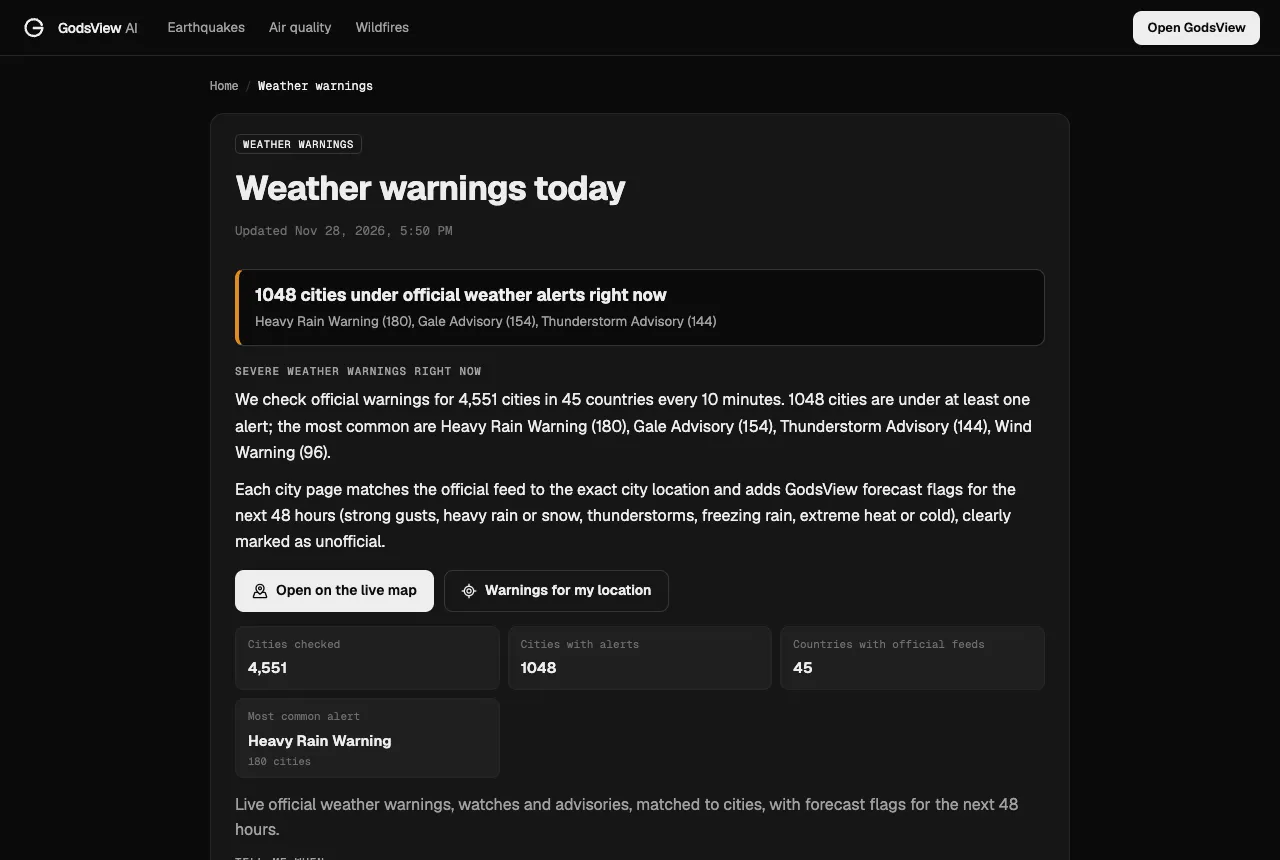
- GodsView lists official warnings by city for 45 countries, free; on November 28, 2026, 1,048 cities were under official alerts.
A yellow weather warning means your weather service expects weather that could cause some disruption or be dangerous in places: heavy rain, strong wind, snow, ice, fog, storms or heat. It is usually the lowest active level, below orange (or amber) and red. It does not mean "cancel everything", but it does mean "check the details and take care", especially if you will be driving, travelling or outdoors. The exact meaning depends on the country: in the UK it is about impact and likelihood; in Europe it carries the label "Moderate"; in India it is a "Watch".
To see which yellow warnings are active right now, open GodsView's weather warnings page: it lists official warnings by city for 45 countries, from the UK and Canada to India and Saudi Arabia, free and without an account.
See active weather warnings now
Yellow warning meaning by country
| Country or system | Yellow means | Above yellow |
|---|---|---|
| United Kingdom (Met Office) | Moderate impacts that are likely, or more severe impacts that are possible but less certain | Amber, red |
| Europe (MeteoAlarm) | "Moderate": potentially dangerous, not unusual weather; be attentive in exposed activities | Orange ("Severe"), red ("Extreme") |
| Canada (ECCC) | Hazardous weather may cause damage, disruption or health impacts; moderate, localised or short-term | Orange, red |
| France (Météo-France) | "Soyez attentifs": occasionally dangerous or very localised weather, usual for the season | Orange, red |
| Italy (civil protection) | Allerta gialla: ordinary criticality, local flooding and landslides possible | Orange, red |
| India (IMD) | Watch | Orange (Alert), red (Warning) |
| Saudi Arabia (NCM) | Possibility of an area being affected by a weather phenomenon | Orange, red |
| UAE (NCM) | Be aware: be on the lookout if you go out | Orange, red |
| Brazil (INMET) | Perigo potencial (potential danger); for rain about 20 to 30 mm an hour | Orange, red |
| Philippines (PAGASA) | Heavy rainfall of about 7.5 to 15 mm an hour; flooding possible in low-lying areas | Orange, red |
| Mexico (SIAT-CT, hurricanes) | Moderate danger; storm winds expected in about 60 to 12 hours | Orange, red |
| Kuwait (Met Department) | A yellow icon is a weather watch: conditions favour severe weather within 24 hours | Red icon (warning) |
So "yellow" is a family resemblance, not one rule. Everywhere, it is the level where you should pay attention. What changes is whether yellow is mainly about likelihood (UK), typical but hazardous weather (Europe, France), expected moderate impact (Canada) or a watch before a warning (India, Kuwait).
UK: the Met Office impact matrix
The Met Office uses impact-based warnings. Each warning is placed on a matrix of how severe the impacts could be against how likely they are, and the colour comes from where it lands. That is why a Met Office yellow warning can mean two different things:
- Moderate impacts that are likely, for example a few hours of heavy rain causing spray and slow journeys; or
- More severe impacts that are possible but uncertain, for example a storm that could bring damaging gusts if it tracks a certain way.
The Met Office's advice is to read each warning to see which case applies; the matrix with a tick on it is in the warning details. Amber means an increased likelihood of impacts that could disrupt your plans, such as travel delays, power cuts and potential risk to life. Red means dangerous weather is expected: take action now. Our Met Office warnings guide goes into more detail, and you can see current UK alerts on the London page.
Europe: "Moderate" means yellow
Most European weather services publish their warnings through MeteoAlarm, which uses the same three levels everywhere:
- Yellow, "Moderate": the weather is potentially dangerous. The forecast weather is not unusual, but be attentive if you plan activities exposed to it.
- Orange, "Severe": the weather is dangerous. Unusual weather is forecast, and damage and casualties are likely.
- Red, "Extreme": the weather is very dangerous. Exceptionally intense weather is forecast, and major damage and accidents are likely.
That is why European apps often show "Yellow Moderate Wind Warning" or "Moderate Fog". The word "moderate" is the level label, not a promise of mild weather. Our fog warning guide gives a real example, and the MeteoAlarm colours guide covers the system in full. For two big countries with their own national schemes, see France's vigilance map and Italy's allerta meteo.
Canada: a yellow advisory, watch or warning
Environment and Climate Change Canada now gives every weather alert a colour when it is issued, whether it is an advisory, a watch or a warning. Yellow means hazardous weather may cause damage, disruption or health impacts, with effects that are moderate, localised or short-term. Orange means severe weather is likely to cause significant damage or disruption, and red means very dangerous, possibly life-threatening weather that will cause extreme damage and disruption.
So in Canada a yellow alert can be an advisory, such as "Yellow Advisory - Fog", or a watch or a warning. The type (advisory, watch, warning) tells you what kind of message it is; the colour tells you how big the impact could be. See our Environment Canada alerts guide or Toronto's live alerts.
India, Saudi Arabia and the Gulf
India. The India Meteorological Department's district warning map uses four levels: green for No Warning, yellow for Watch, orange for Alert and red for Warning. So a yellow day in India is a watch: keep an eye on updates, because an Alert or Warning may follow. See Delhi's live alerts or our IMD colour codes guide.
Saudi Arabia. The National Center for Meteorology defines yellow as the possibility of an area being affected by a weather phenomenon, orange as an area being affected where caution should be taken, and red as a severe phenomenon or floods, where Civil Defense instructions must be followed. When we checked on November 28, 2026 (already the 29th in Saudi Arabia), NCM listed 33 yellow alerts across the kingdom, for light rain, dust, fog and wind. See Riyadh or our Saudi NCM guide.
UAE and Kuwait. The UAE's NCM uses yellow for "be aware", but GodsView does not carry UAE alerts; see our UAE alerts guide. In Kuwait, a yellow icon is a weather watch issued up to 24 hours ahead, and a red icon a warning; see Kuwait weather warnings.
Countries where "yellow" is about rain rate or timing
Some systems tie yellow to a specific number or time:
- Brazil (INMET): yellow, perigo potencial, for rain of about 20 to 30 mm an hour or up to 50 mm a day, or storm gusts of 40 to 60 km/h. See Brazil INMET alerts.
- Philippines (PAGASA): a yellow heavy rainfall warning means about 7.5 to 15 mm of rain an hour, with flooding possible in low-lying areas. See PAGASA warnings.
- Mexico (SIAT-CT): for hurricanes, yellow (preparación) means moderate danger, with the storm's 63 km/h winds expected in about 60 to 12 hours. See Mexico weather alerts.
Other places use different words entirely. In the US, the National Weather Service uses advisories, watches and warnings instead of colours (see weather watch vs warning); South Korea uses advisories and warnings; China and Hong Kong have their own colour signals (see China's weather alert colours and Hong Kong's typhoon signals).
Is a yellow weather warning serious?
Yellow is the lowest active level, but it is not nothing. It covers the kind of weather that still causes accidents and harm: slippery roads, fallen branches, local flooding, fog on motorways, heat for older people. How seriously to take it depends on you:
- Driving at night, cycling, hiking, sailing or working outdoors? Treat yellow as a reason to change timing or route.
- Older, very young, or with health conditions? Yellow heat or cold warnings are worth acting on.
- Staying home or in town by day? Usually it means take care and keep an eye on updates.
Yellow can also be the first step of a bigger event. A weather service can issue a yellow warning well ahead and upgrade it to orange or red as the forecast becomes clearer. Check again the evening before and the morning of.
What to do under a yellow warning
- Read the warning, not just the colour: hazard, area, start and end times.
- Check your route and plans for the hours it covers.
- Wind: secure loose objects, avoid exposed coasts and forest roads. See what is a wind advisory.
- Rain: avoid flooded roads and underpasses. See flood watch vs flood warning.
- Snow or ice: allow extra time and watch for black ice. See freeze warning vs frost advisory.
- Fog: slow down and use low beams.
- Heat: drink water, avoid midday exertion and check on neighbours.
- Keep alerts on so you hear if it is upgraded. Our guide to weather alerts in your area covers phone settings.
How to check yellow warnings right now
- By city: open the weather warnings hub, press "Warnings for my location", or pick a city.
- By country: pages such as Germany, France, Italy, China and Brazil list every city under an alert.
- Live radar: watch the rain and storms behind the warnings on the weather radar.
- Alerts for your places: GodsView Plus ($10.99 a month or $99.99 a year).
The short version
A yellow weather warning means "pay attention": weather that could disrupt plans or be dangerous in places. In the UK it can mean likely moderate impacts or possible severe ones; in Europe it is labelled "Moderate"; in Canada it means moderate, localised impacts; in India it is a Watch. Read the details, adjust plans that are exposed to the weather, and check whether it has been upgraded.
Check yellow warnings for my city
Frequently asked questions
What does a yellow weather warning mean?
It is usually the lowest active warning level: weather that could cause some disruption or be dangerous in places. Read the warning for the hazard and timing, and take care if you are driving, travelling or outdoors.
Is a yellow weather warning serious?
It is the lowest level, but it covers weather that can still cause accidents and damage, such as ice, fog, local flooding or strong gusts. It can also be upgraded to orange or red as the event nears.
What does a Met Office yellow warning mean?
A Met Office yellow warning means either moderate impacts that are likely, or more severe impacts that are possible but uncertain. The impact matrix in the warning shows which applies.
Why does my yellow warning say "Moderate"?
In the European MeteoAlarm system, every yellow warning carries the severity label "Moderate": potentially dangerous weather that is not unusual. It is the level name, not a description of mild weather.
What is the difference between a yellow and an amber or orange warning?
Orange or amber is the next level up. It means more severe weather is expected or more likely, with a real chance of damage, travel disruption and risk to life. Plans should change under orange.
Where can I see yellow weather warnings near me?
On your national weather service's site, or on GodsView's weather warnings page, which lists official warnings by city for 45 countries, free.
Sources
- Met Office — Weather warnings guide
- MeteoAlarm — warning levels documentation
- Government of Canada — Colour-coded weather alerts
- India Meteorological Department — District-wise warnings map
- Saudi National Center for Meteorology — Early warnings
- Météo-France — Pourquoi 4 couleurs ?
- Kuwait Meteorological Department — Warnings and Weather Watches
Facts checked on against each provider's own site.