Explainer
KMA Weather Warnings: Advisories vs Warnings in Korea
Korea's weather service has two levels for every hazard: an advisory (주의보) and a stronger warning (경보). Here are the exact criteria for heavy rain, snow, heat, cold, wind and typhoons, and what the emergency alert text on your phone means.
Key takeaways
- The Korea Meteorological Administration (KMA) issues two levels for each hazard: an advisory (주의보, juuibo), the lower level, and a warning (경보, gyeongbo), the higher one.
- A heavy rain advisory means 60 mm or more of rain is expected in 3 hours or 110 mm in 12 hours; a heavy rain warning means 90 mm in 3 hours or 180 mm in 12 hours.
- Heat wave advisories start when the daily maximum 'feels-like' temperature is expected to reach 33°C for at least two days, and warnings at 35°C; cold wave warnings include morning lows of -15°C or lower for two days.
- KMA also sends heavy rain emergency alert texts directly to phones when an hour's rain exceeds 50 mm and three hours exceed 90 mm, or when an hour exceeds 72 mm.
- GodsView carries KMA's official warnings via the WMO Severe Weather Information Centre and matches them to cities, free on pages such as Seoul and Busan.
A KMA weather warning is the official alert of the Korea Meteorological Administration, and it comes in two strengths. An advisory (주의보) is the first level: the weather is expected to reach a set threshold that can cause damage. A warning (경보) is the higher level: much more severe weather is expected. For heavy rain, an advisory means 60 mm in 3 hours or 110 mm in 12 hours; a warning means 90 mm in 3 hours or 180 mm in 12 hours. When rain is extreme, KMA also sends an emergency text straight to phones in the area.
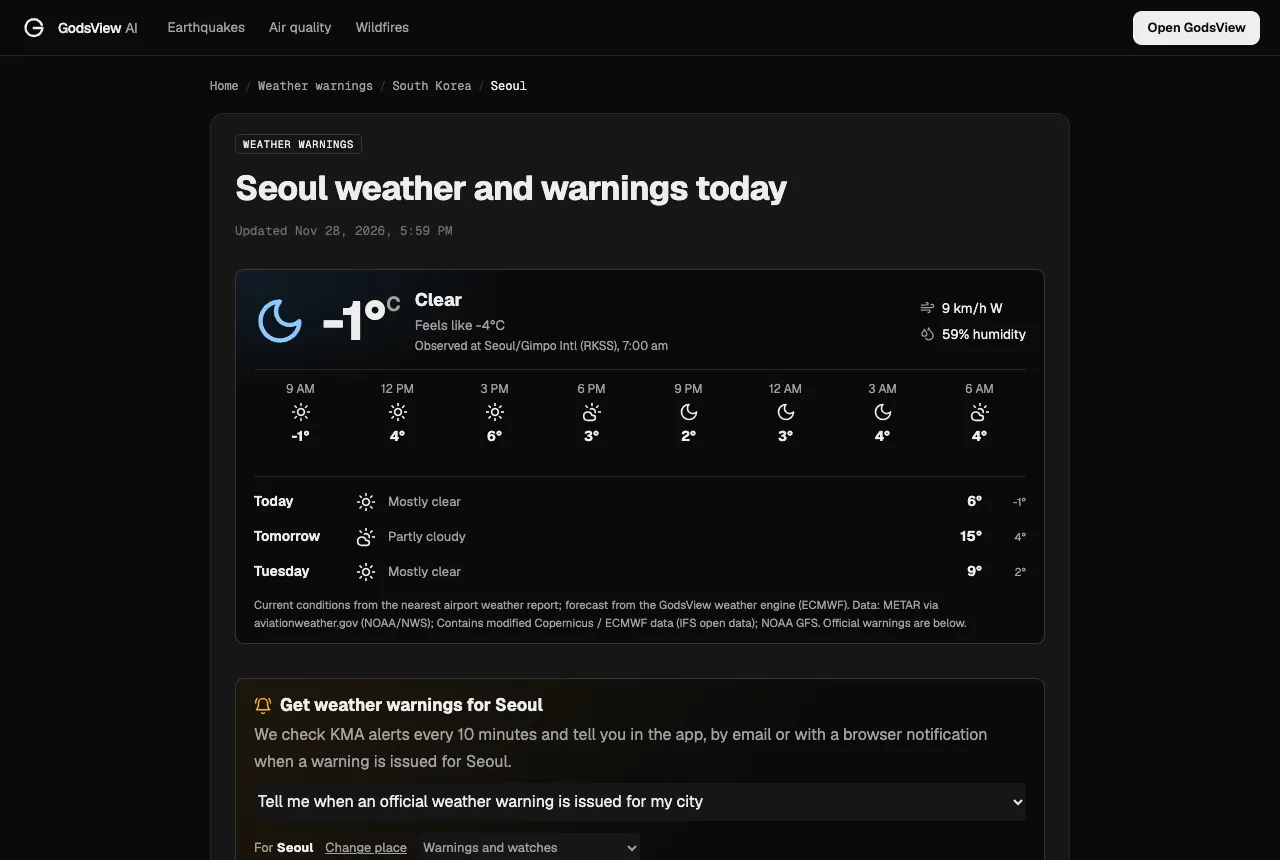
GodsView shows KMA's active advisories and warnings matched to each city, free and without an account: Seoul, Busan, Incheon, Daegu, Gwangju, Daejeon, or the full list on the South Korea weather warnings page.
Advisory vs warning: the two KMA levels
KMA calls these special weather reports (기상특보). Each hazard has its own advisory and warning criteria, so the words always come with a hazard name: 호우주의보 (heavy rain advisory), 대설경보 (heavy snow warning), 폭염주의보 (heat wave advisory), and so on.
- Advisory (주의보): the lower level. Take care, check the forecast, and adjust plans that are exposed to the weather.
- Warning (경보): the higher level. The weather is severe enough to threaten life and property over the area. Follow instructions from local authorities.
The English words can confuse visitors from the US, where a "watch" is about possibility and a "warning" means it is happening. In Korea, both levels are forecasts that the weather will reach the threshold; the difference is how severe it will be. Our weather watch vs warning guide compares the US system.
KMA criteria for every hazard
These are KMA's own criteria as published on its English site, checked on November 28, 2026.
| Hazard | Advisory (주의보) | Warning (경보) |
|---|---|---|
| Heavy rain (호우) | 60 mm or more in 3 hours, or 110 mm or more in 12 hours | 90 mm or more in 3 hours, or 180 mm or more in 12 hours |
| Heavy snow (대설) | 5 cm or more in 24 hours | 20 cm or more in 24 hours (30 cm in mountain areas) |
| Strong wind (강풍) | Sustained winds of 14 m/s or more, or gusts of 20 m/s or more (higher in mountains) | Sustained 21 m/s or more, or gusts of 26 m/s or more (higher in mountains) |
| Wind waves (풍랑, at sea) | Sustained winds of 14 m/s or more for 3+ hours, or significant wave height of 3 m or more | Sustained 21 m/s or more, or significant wave height of 5 m or more |
| Heat wave (폭염) | Daily maximum feels-like temperature of 33°C or more for at least 2 days | Daily maximum feels-like temperature of 35°C or more for at least 2 days |
| Cold wave (한파, October to April) | See below | See below |
| Dryness (건조) | Effective humidity at or below 35% for at least 2 days | Effective humidity at or below 25% for at least 2 days |
| Typhoon (태풍) | A typhoon is expected to bring wind, waves, rain or storm surge that meet the advisory criteria | Wind, waves or surge meeting warning criteria, or total rainfall of 200 mm or more |
| Asian dust (황사) | (no advisory level) | Hourly average PM10 of 800 µg/m³ or more expected to last at least 2 hours |
| Storm surge (폭풍해일) | Local thresholds based on tide and pressure | Local thresholds |
In m/s terms, 14 m/s is about 50 km/h and 21 m/s about 76 km/h.
Cold wave criteria
Cold wave reports run from October to April. An advisory is issued if any one of these is expected:
- The morning low drops by 10°C or more from the previous day to 3°C or below, and is at least 3°C below the seasonal average.
- The morning low is -12°C or lower for at least two consecutive days.
- Significant damage is expected from a rapid drop in temperature.
A warning uses the same structure with stronger numbers: a drop of 15°C or more to 3°C or below (and at least 3°C below average), or morning lows of -15°C or lower for two consecutive days, or widespread severe damage expected.
Heavy rain and the monsoon (jangma)
Heavy rain is the hazard that matters most in a Korean summer, during the rainy season (jangma) and when typhoons pass. The emergency text examples below show that a single hour can bring more than the whole 3-hour advisory amount. In a city like Seoul, low-lying streets, semi-basement homes, underground roads and stream-side paths are the first places to flood.
On an advisory day, plan around it. On a warning day:
- Stay out of underpasses, underground parking and riverside paths along the Han River and city streams; they flood quickly.
- If you live in a semi-basement (반지하), move valuables up and know how you will get out if water starts coming in.
- Avoid mountain valleys and hiking trails, where streams rise fast after heavy rain.
- Follow your district office's instructions and the emergency texts described below.
Emergency alert texts on your phone
Korean phones receive emergency disaster texts (재난문자). For the most extreme downpours, KMA sends a heavy rain emergency text directly to phones in the affected area. It goes out when:
- the rain in one hour exceeds 50 mm and the rain in three hours exceeds 90 mm, or
- the rain in one hour exceeds 72 mm.
These thresholds are much higher than the advisory levels, because the text is meant for the most dangerous, fastest-moving downpours. In 2024, 129 of these texts were sent for the Seoul metropolitan area and the North Gyeongsang and South Jeolla regions. The first one of 2025 went out on May 16 to Onam-eup in Namyangju, Gyeonggi Province, after 74 mm of rain fell there in one hour.
If you get one, treat it as a sign that flooding may start within minutes: move to higher ground or a higher floor, and do not drive into water. For general phone alert settings, see our guide to weather alerts in your area.
Typhoons, heat and cold
Typhoons
A typhoon advisory means the typhoon is expected to bring wind, waves, rain or surge that meet the advisory criteria for those hazards. A typhoon warning means it will bring wind, waves or surge at warning level, or 200 mm or more of total rain. Follow the storm on our hurricane and typhoon tracker, and see cyclone vs hurricane vs typhoon for how typhoons compare.
Heat waves
Korean heat wave reports use a feels-like temperature, which accounts for humidity, not just the thermometer. An advisory means 33°C feels-like for two days, a warning 35°C feels-like for two days. Drink water, avoid outdoor work in the afternoon, and check on older neighbours. Our heat index guide explains why humidity makes heat more dangerous.
Cold waves
A cold wave warning at -15°C morning lows means frozen pipes, icy roads and real frostbite risk. Wear layers and cover your face and hands; see our wind chill guide.
Asian dust and air quality
KMA issues an Asian dust (황사) warning when hourly average PM10 is expected to reach 800 µg/m³ or more for at least two hours. There is no advisory level for dust in KMA's table. On dusty spring days, check the Seoul air quality page, and read our PM2.5 vs PM10 guide to understand the numbers.
Checking Korean warnings on GodsView
GodsView reads KMA's official warnings, which reach the WMO Severe Weather Information Centre in the international CAP format, and matches each one to a city's exact location. Each city page shows the warning, its end time, live weather and a forecast. You can also:
- See every city under an alert on the South Korea page.
- Press "Warnings for my location" on the weather warnings hub.
- Watch rain bands come in on the weather radar.
- Check recent earthquakes in South Korea.
GodsView Plus ($10.99 a month or $99.99 a year) adds alerts for places you save. The official source is always KMA (weather.go.kr) and the emergency texts on your phone.
The short version
In Korea, an advisory (주의보) is the lower level and a warning (경보) the higher one, each with exact KMA numbers: 60 mm in 3 hours for a heavy rain advisory and 90 mm for a warning; 33°C and 35°C feels-like for heat; -12°C and -15°C morning lows for two days for cold. When rain passes 50 mm in an hour and 90 mm in three, KMA texts your phone directly. Treat that text as a reason to act now.
See South Korea weather warnings
Frequently asked questions
What is the difference between a KMA advisory and a warning?
They are two strengths of the same alert. An advisory (주의보) is the lower level; a warning (경보) is the higher one, for more severe weather. For heavy rain, an advisory is 60 mm in 3 hours or 110 mm in 12 hours, and a warning 90 mm in 3 hours or 180 mm in 12 hours.
What is the criteria for a heavy rain advisory in Korea?
KMA issues a heavy rain advisory (호우주의보) when 60 mm or more of rain is expected in 3 hours, or 110 mm or more in 12 hours.
When does KMA send a heavy rain emergency text?
When an hour's rain exceeds 50 mm and three hours exceed 90 mm, or when an hour's rain exceeds 72 mm. KMA sends these texts directly to phones in the affected area.
What temperature is a heat wave warning in Korea?
A heat wave advisory is issued when the daily maximum 'feels-like' temperature is expected to reach 33°C or more for at least two days; a warning at 35°C or more for at least two days.
What is a cold wave warning in Korea?
Issued from October to April when the morning low is expected to drop 15°C or more to 3°C or below (and at least 3°C below average), or stay at -15°C or lower for two days, or when severe damage is expected from a sudden drop.
Where can I see KMA warnings in English?
On KMA's English site, or on GodsView's South Korea weather warnings page, which shows official warnings matched to each city in English, free.
Sources
- Korea Meteorological Administration — Advisory and warning criteria
- Asia Economy — First heavy rain emergency alert text of 2025 (May 16, 2025)
- WMO Severe Weather Information Centre
Facts checked on against each provider's own site.