How-to
Private Jet Tracker: How to Track Private Flights Live
Business jets broadcast their position like any airliner, but the owner can hide a lot of what sits behind the dot. Here is how private flights appear on a live map, why some never do, and where the line on privacy sits.
Key takeaways
- A private jet shows on a live map the same way an airliner does: it broadcasts ADS-B, and a receiver on the ground hears it. In US airspace where ADS-B Out is required, it must transmit at all times.
- Private planes usually broadcast their registration or a charter operator's code as the call sign, so you search the tail number, the hex code or the operator code rather than a flight number.
- The FAA's LADD program filters an aircraft from FAA data sent to tracking sites, but it does not touch over-the-air broadcasts that independent receivers pick up.
- The FAA's PIA program gives an aircraft a temporary ICAO address that is not linked to the owner in the registry, and it needs a third-party call sign.
- A position shows an aircraft, not a person. Track planes, not people: do not use any tracker to follow, expose or confront someone.
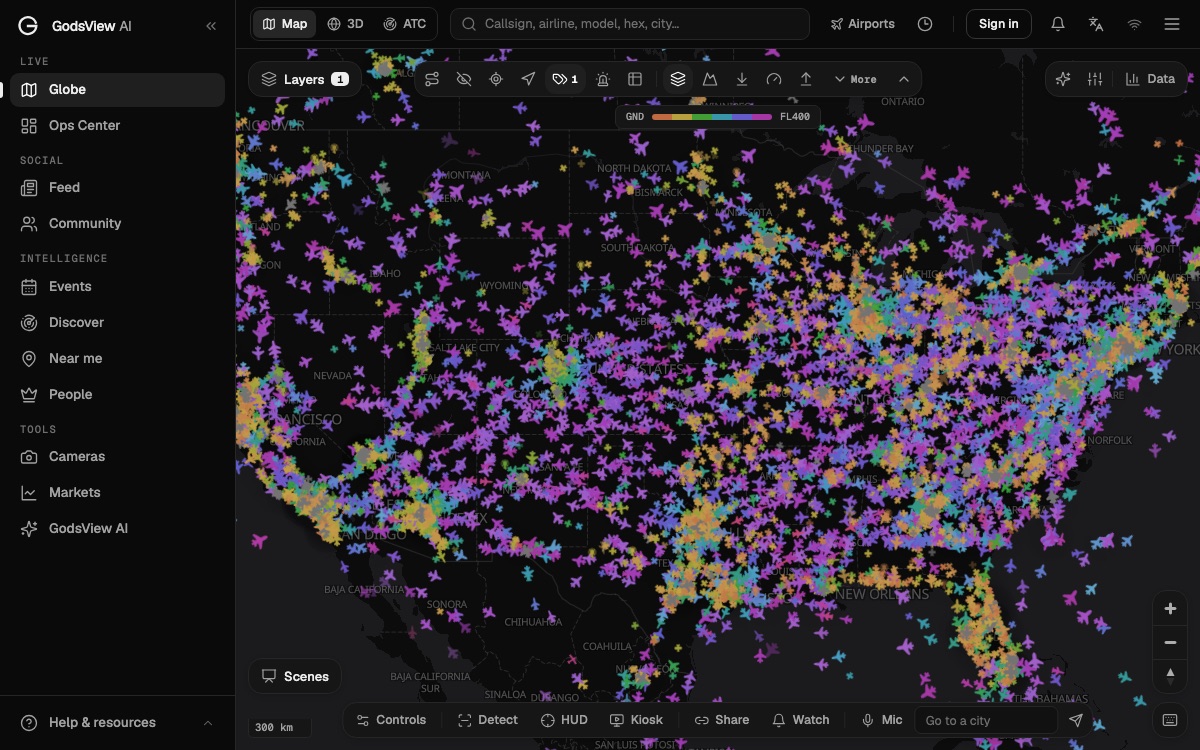
A private jet tracker is a live flight map that shows business jets and private planes alongside airliners. To track a private flight, search the aircraft's registration (its tail number), its six-character hex code or the charter operator's call sign on a live map such as the GodsView live flight tracker. If the jet is broadcasting ADS-B and a receiver is within range, you will see its position, altitude, speed and type.
What you often won't see is who owns it or who is on board. US owners can ask the FAA to limit how their flights are shown, swap the aircraft's broadcast address for a temporary one, and keep their name out of the public registry. This guide explains how private jets appear on a flight tracker, why many look anonymous or vanish, what a charter flight tracker can and can't tell you, and why we draw a firm line at following people.
Search a tail number on the live map
How private jets show up on a flight tracker
There is no separate private jet network. A private plane tracker reads the same broadcasts as any other flight map. A business jet with ADS-B Out broadcasts its position, altitude, speed and identity, and volunteer receivers on the ground pass those messages to tracking networks. Our explainer on how ADS-B flight tracking works covers the radio side.
In the United States, the rule that matters is 14 CFR 91.225. It requires ADS-B Out in Class A airspace, the high-level airspace, and in other busy airspace such as Class B and C and the 30-nautical-mile rings around major airports. Paragraph (f) says the equipment must be in transmit mode at all times in that airspace, with limited exceptions for sensitive government missions or when air traffic control says otherwise (14 CFR 91.225). So an owner can't simply switch the transponder off to hide a flight in that airspace.
In Canada, NAV CANADA's ADS-B Out mandate has applied in Class A airspace since August 10, 2023 and in Class B airspace since May 16, 2024. It will reach Class C, D and E airspace no sooner than 2028 (NAV CANADA).
The practical result: if you want to track private flights over North America, a jet at cruising altitude is usually easy to see on a map. Coverage is thinner at low altitude, over oceans and in remote areas, because ground receivers need line of sight.
What a private flight looks like on the map
The biggest difference from an airliner is the call sign. Your ticket says UA135; a private jet has no ticket. What it broadcasts depends on who operates it.
| What you see as the call sign | Who it usually is | What to search |
|---|---|---|
| A registration, such as an N-number in the US | A privately operated aircraft flying under its own tail number | The registration or the hex code |
| A three-letter operator code plus digits | A charter, fractional or management company with an ICAO designator | The operator code to list its fleet in the air |
| A code that matches no registry entry | Often an aircraft using a third-party call sign, as PIA requires | The hex code, while the flight lasts |
| No call sign at all | The crew left the field blank, or the tracker only has the hex code | The hex code |
Some real operator codes from the FAA's list of ICAO designators (FAA JO 7340.2, chapter 3):
| Operator | ICAO code | Spoken telephony |
|---|---|---|
| NetJets Aviation, Inc. | EJA | EXECJET |
| Flexjet LLC | LXJ | FLEXJET |
| VistaJet Ltd (Malta) | VJT | VISTA JET |
| Wheels Up Private Jets | WUP | UP JET |
When a pilot uses the registration, the FAA's Aeronautical Information Manual says the type or maker can replace the "N", as in "Bonanza Six Five Five Golf". Air taxi or other commercial operators without an FAA-authorized call sign put the word "Tango" in front of their identification (FAA AIM 4-2-4). On the map those spoken words disappear and you see only the code. For the full picture of call sign formats, read what a flight call sign is.
How to track a private plane live, step by step
- Get the identifier. For a charter you are booked on, ask the operator for the tail number. For a plane you saw at an airfield, the registration is painted on the side.
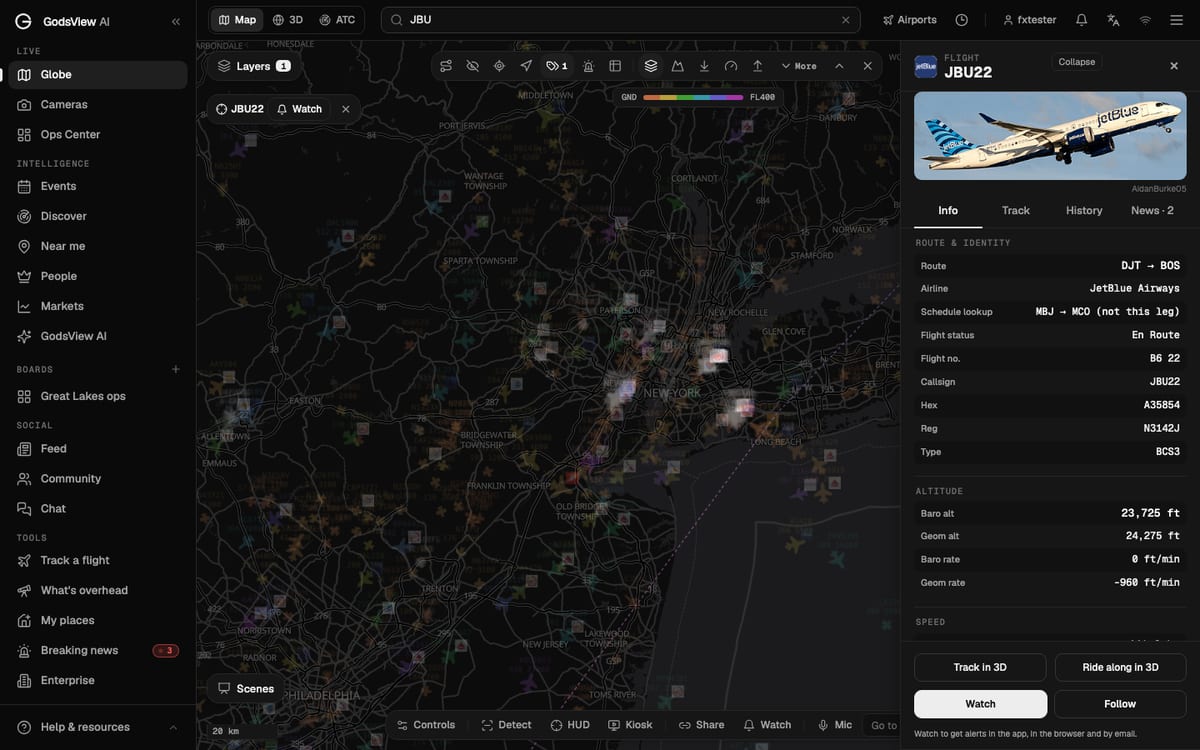
- Search it. Type the registration, hex code or call sign into the search box on the live flight tracker or the globe. GodsView's flight search matches all three, and an exact match comes first.
- Open the flight card. Click the aircraft to see the call sign, hex code, registration, type, altitude and speed.
- Check the flags. If the data source marks the aircraft as using a privacy program, the card shows a PIA or LADD badge.
- Keep the hex code. The call sign can change from flight to flight. The hex code stays with the airframe unless the owner uses PIA, so it is the best way to find the same aircraft again.
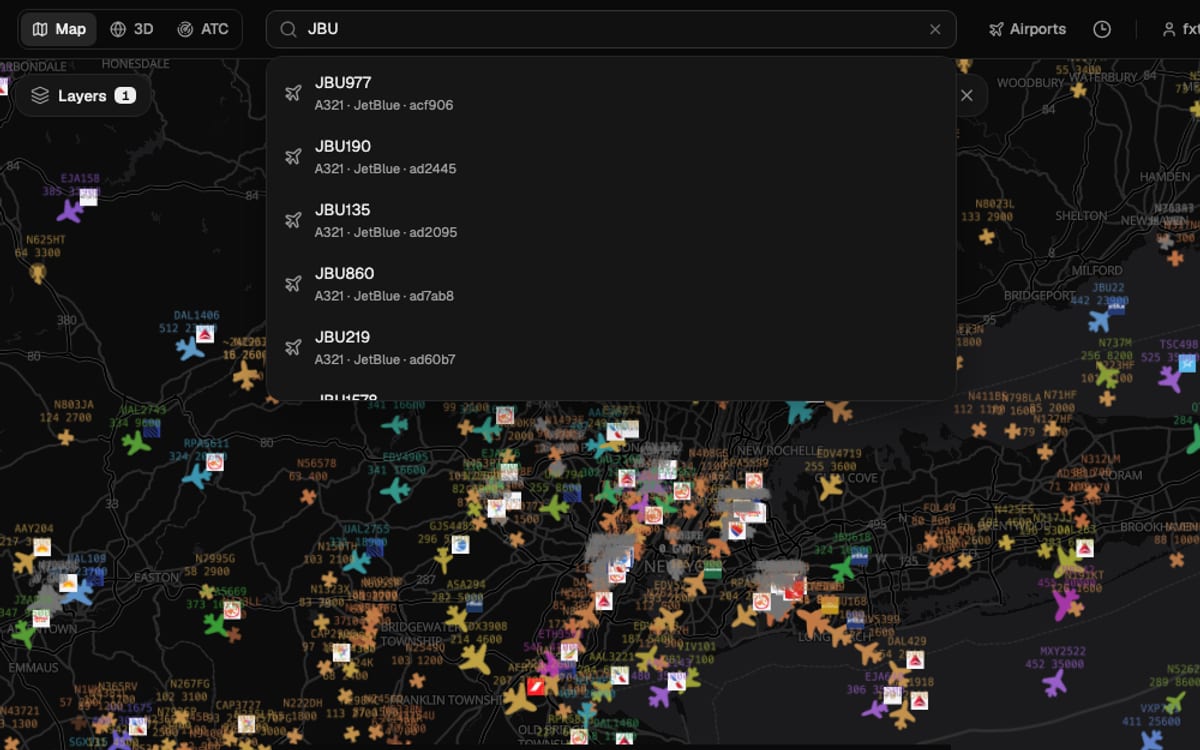
If you only want to know what jet just flew over your house, skip the search. What's overhead lists every broadcasting aircraft within 60 km of you, closest first, and the planes over city pages do the same for a city.
Why some private jets are hidden or anonymous
If a private jet flight tracker shows a dot with no name, or no dot at all, one of these is usually the reason.
LADD: Limiting Aircraft Data Displayed
LADD is the FAA program that implements Section 803 of the FAA Reauthorization Act of 2024. It lets owners have their flight data filtered from the FAA's SWIM data feed, or filtered from public display by websites that take part in the program. Vendors that subscribe to FAA SWIM feeds are bound by a data access agreement to filter LADD participants from public display. Owners choose FAA Source (no FAA flight data goes to outside vendors) or Subscriber Level (vendors get the data but show it only where the owner asks). The FAA applies changes on the first Thursday of each month (FAA LADD).
The limit is in the name of the feed. NBAA, the business aviation association, notes that LADD "only addresses the use of data through FAA data systems" and that third-party sources can capture ICAO addresses directly from ADS-B Out transmissions. It also says participating vendors must not display historical data for an aircraft while it is on the LADD list (NBAA). LADD replaced an older program called BARR, the Block Aircraft Registry Request.
PIA: Privacy ICAO Address
Every ADS-B aircraft broadcasts a unique ICAO address, the hex code, which normally links straight to its registration. PIA lets an eligible owner request an alternate, temporary ICAO address "which will not be assigned to the owner in the Civil Aircraft Registry". To qualify, the aircraft must be US-registered, 1090 MHz ADS-B equipped, use a third-party call sign and fly in US-managed flight information regions. The FAA can still identify the aircraft and operator for security requests from the Department of Defense, Homeland Security or law enforcement. Flights that leave US airspace, such as New York to London, must use the permanent address (FAA PIA).
PIA doesn't hide the aircraft. It hides the link between the dot and the owner. NBAA recommends using both LADD and PIA for the most privacy.
Withheld registry details
The FAA's aircraft registry lets anyone look up an N-number. The same page says the FAA has a procedure under 49 U.S.C. 44114(b) by which private aircraft owners can ask for personally identifiable information, such as names and addresses, to be withheld from broad display on a public FAA website (FAA registry). Many jets are also registered to a trust, a bank or a company, so even a visible owner name may not tell you much.
No broadcast, or out of range
Outside mandated airspace, a light private plane may not carry ADS-B Out at all. Some carry a Mode S transponder that networks can only locate by multilateration when several receivers hear it. And over oceans and remote land, a jet can broadcast perfectly and still drop off the map because no receiver is close enough.
| Reason | What the tracker shows |
|---|---|
| LADD, on an FAA-fed site | Nothing, or a blocked entry |
| LADD, on a receiver-fed site | The position, often marked as LADD |
| PIA | A position under a hex code that does not match the registry |
| Registry details withheld | A registration, but no owner name on the FAA site |
| No ADS-B Out | Nothing, or an approximate position from multilateration |
| Out of receiver range | The track stops, then resumes later |
How GodsView handles private flights
GodsView shows aircraft positions from community ADS-B networks, so it sees what those receivers hear. When the data marks an aircraft as using PIA or LADD, the flight card carries a badge, and the city pages say so in plain words: the aircraft "uses a privacy programme (PIA or LADD), so the owner asked for the identity to be hidden; the position is still shown." The flight card has no owner field: it shows the aircraft, not the people behind it.
What GodsView does for private flights is the same as for any flight: search by registration, hex code or call sign, a flight card with altitude, speed and type, city pages for planes over a city and airport pages such as Toronto Pearson. Viewing is free, and alerts when a watched aircraft appears, takes off or lands are part of GodsView Plus on the pricing page. The same map is in the iPhone app and on Android.
What a charter flight tracker can and can't tell you
A charter flight tracker is most useful when the flight is yours. If you are meeting a charter, ask the operator for the tail number and follow the aircraft to the airport. You'll see where it is, how high and how fast it is going. Some things the map can't give you:
- The schedule. Private flights have no published timetable. Origin and destination on a tracker are often guesses based on where the flight started, and repositioning legs with no passengers look the same as passenger flights.
- Who is on board. A registration identifies an aircraft. It doesn't name passengers, and the registered owner is often a leasing or management company.
- Delays and gates. There is no airport departure board for most private flights. The operator or the FBO, the private terminal that handles the aircraft, is the only reliable source.
- The full history. Coverage gaps, privacy programs and changing call signs leave holes in any track.
For airline flights, which do have schedules, see how to track a flight.
Celebrity private jet trackers and the privacy line
Search for a celebrity private jet tracker and you'll find accounts that claim to follow famous people's planes. Be careful with what they really show. A live position is an aircraft broadcasting; it does not confirm who is on board. Jets are sold, leased, chartered out and flown empty to their next pickup. A plane linked to a name in one news story can be carrying someone else entirely.
There is also a line we don't cross, and we suggest you don't either:
- Track aircraft, not people. Following an airliner through a storm or a charter you are waiting for is fine. Using a tracker to find or follow a named private person is not something this guide will help with.
- Respect privacy programs. If an aircraft uses LADD or PIA, the owner has asked not to be identified. Don't try to unmask it by combining other data.
- Never use flight data to confront anyone. Turning up at an arrival point, or posting someone's movements to pressure them, can be unlawful in many places.
Our guide to whether flight tracking is legal covers the law in the US, EU and UK in more depth. Government and military jets are their own story, covered in military aircraft tracking explained.
The short version: tracking a private jet
A private jet appears on a live map when it broadcasts ADS-B and a receiver can hear it. Search the registration, hex code or operator call sign, not a flight number. If the dot has no owner, or the hex code doesn't match the registry, the owner is probably using the FAA's LADD or PIA programs, and that choice deserves respect. Use the tracker for aircraft you have a reason to follow, such as your own charter or the jet you just heard overhead.
Start with the tail number on the live flight tracker, or open What's overhead to see what is flying near you right now.
Frequently asked questions
Can you track a private jet live?
Often, yes. A private jet that broadcasts ADS-B and is within range of a receiver appears on live maps like any other aircraft. Search its registration, hex code or operator call sign on the live flight tracker. Some owners use FAA privacy programs that hide the identity or filter the flight from FAA-fed sites.
Why can I not find a private jet on a flight tracker?
It may be filtered under the FAA LADD program on a site that uses FAA data, broadcasting under a temporary PIA address that does not match its registration, flying without ADS-B Out where it is not required, or out of range of ground receivers, for example over the ocean.
What is the FAA LADD program?
LADD (Limiting Aircraft Data Displayed) lets US owners have their flight data filtered from the FAA SWIM feed, or from public display by participating tracking sites. It does not stop the aircraft's own ADS-B broadcasts, which independent receivers can still hear.
What does PIA mean on a flight tracker?
PIA is the FAA's Privacy ICAO Address program. The aircraft broadcasts a temporary ICAO address that is not assigned to the owner in the Civil Aircraft Registry, together with a third-party call sign. The position is still visible, but the link to the owner is not.
How do I track a charter flight?
Ask the charter operator for the aircraft's tail number, then search it on a live map. Many charter and fractional operators also broadcast their own three-letter code, such as EJA for NetJets or LXJ for Flexjet, followed by digits.
Do celebrity private jet trackers show who is on board?
No. They show an aircraft that has been linked to a name. Jets are sold, leased, chartered and flown empty, so a position never confirms who is aboard. Treat any name linked to a jet as unconfirmed.
Sources
- FAA: Limiting Aircraft Data Displayed (LADD)
- FAA: ADS-B Privacy ICAO Address (PIA) program
- NBAA: Limiting Aircraft Data Displayed (LADD)
- FAA Registry: Aircraft inquiry and withholding of owner information (49 U.S.C. 44114(b))
- 14 CFR 91.225: ADS-B Out equipment and use (LII)
- NAV CANADA: ADS-B performance requirements and mandate timeline
- FAA JO 7340.2, chapter 3: ICAO three-letter designators and telephony
- FAA Aeronautical Information Manual 4-2-4: Aircraft call signs
Facts checked on against each provider's own site.