How-to
How to Track a Plane by Tail Number: Registry, Hex and Live Map
The letters and numbers painted on a plane identify the airframe, not the trip. Here is how registrations and hex codes fit together, how to look one up, how to find the aircraft on a live map, and why some aircraft never show.
Key takeaways
- A tail number is the aircraft's registration, such as N12345 in the US or G-ABCD in the UK. The prefix tells you the country of registration.
- Live maps identify aircraft by their ICAO 24-bit address, a six-character hex code. In the US, the FAA registry shows the hex code for each N-number.
- On GodsView, the live map search matches registrations and hex codes for aircraft in the live feed. If the registration is missing from the feed, search the hex code.
- A plane only appears while it is broadcasting and within receiver range. A parked aircraft will not show.
- US owners can limit public display through the FAA LADD program or fly with a temporary Privacy ICAO Address, so some private jets cannot be followed by tail number.
To track a plane by tail number, type the registration into the search box of a live flight map. If the aircraft is flying and within receiver range, it comes up and the map flies to it. If the registration search finds nothing, look the tail number up in the national aircraft register to get its six-character hex code, and search that instead. In the US, the FAA registry shows the hex code for every N-number.
That covers most cases. The rest of this guide explains what a tail number is, how it differs from the hex code a tracker actually uses, where to look up registrations in the US, Canada and the UK, and why some private jets cannot be followed by tail number at all.
If you have a ticket and a flight number instead, start with how to track a flight, which covers flight numbers and callsigns.
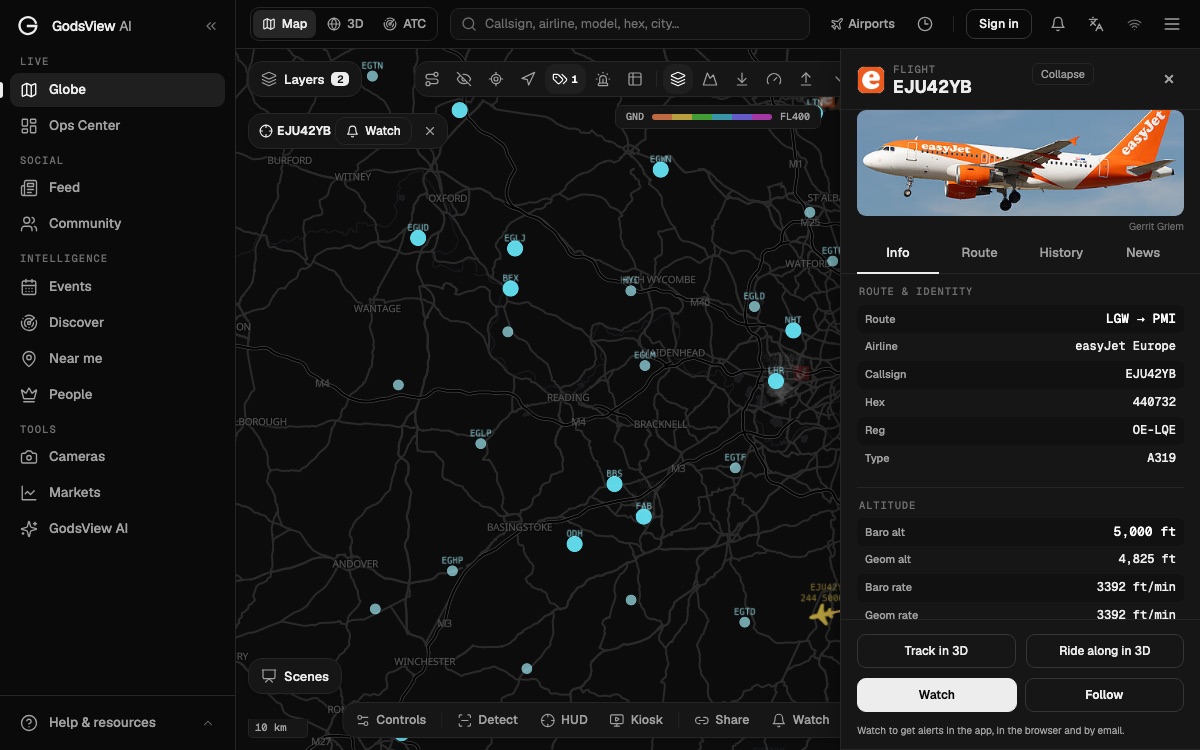
Search a tail number on the live map
What is a tail number?
A tail number is the aircraft's registration: the mark painted on the outside of every civil aircraft, much like a car's licence plate. The requirement comes from the 1944 Chicago Convention, and ICAO sets the rules for the marks in Annex 7. A registration is a country prefix followed by a suffix of one to five characters, according to Wikipedia's summary of aircraft registration.
The prefix tells you where the aircraft is registered, not where it is flying. A few common ones:
| Country | Prefix | Where to look it up |
|---|---|---|
| United States | N (N12345, N123AZ) | FAA aircraft inquiry |
| Canada | C-F, C-G or C-I | Canadian Civil Aircraft Register |
| United Kingdom | G- | UK CAA G-INFO |
| Germany | D- | National register |
| France | F- | National register |
| Australia | VH- | National register |
| India | VT- | National register |
| Japan | JA | National register |
| United Arab Emirates | A6- | National register |
| China | B- | National register |
How US N-numbers are formed
The FAA's rules for forming an N-number allow up to five characters after the N:
- one to five numbers (N12345)
- one to four numbers and one letter (N1234Z)
- one to three numbers and two letters (N123AZ)
The letters I and O are not used, so they can't be confused with one and zero. An N-number can't start with zero, and N1 through N99 are reserved for FAA internal use. If a tail number breaks these rules, you have probably misread it.
Registrations can change
An aircraft can be re-registered during its life. When it moves to another country's register, for example after a sale abroad, it gets a new registration. An airliner can carry several tail numbers over its life, so old photos and records may show a different mark.
Tail number vs ICAO hex code
Trackers don't receive the paint on the tail. They receive radio messages from the transponder, and each message carries the aircraft's ICAO 24-bit address, usually written as six hexadecimal characters. There are 16,777,214 possible addresses, and an aircraft gets one when it is registered, according to Wikipedia's article on transponder modes. The same article gives the example of NASA's Shuttle Carrier Aircraft N905NA, whose address is AC82EC in hex and 53101354 in octal.
| Identifier | Example | What it identifies | Where you see it |
|---|---|---|---|
| Registration (tail number) | N905NA | The airframe, on one country's register | Painted on the aircraft; registry records |
| ICAO 24-bit address (hex) | AC82EC | The transponder setting for that registration | Every ADS-B and Mode S message |
| Callsign | An airline code plus a number | The flight being operated | Air traffic control and most map labels |
The hex code is what a live map keys on, because it comes straight from the transponder. The registration is usually added by matching the hex code against an aircraft database, so a tracker can only show it when its data source includes it. Our explainer on what a flight call sign is covers the third identifier, and how ADS-B flight tracking works shows where each field sits in the message.
How to look up a tail number in the FAA registry
For any N-number, the FAA's aircraft inquiry is the official source.
- Open the FAA aircraft inquiry and choose N-Number Inquiry. The same page also searches by serial number, name, make and model, engine, dealer and location.
- Type the registration.
- Read the result. It shows the aircraft's manufacturer, model, serial number and registration status, and two fields that matter for tracking: Mode S Code (base 8 / Oct) and Mode S Code (Base 16 / Hex). The hex value is what you search on a live map.
The FAA notes on the same page that private owners can ask for certain personal details, such as names and addresses, to be withheld from display. Registry data is updated each federal working day.
Outside the US, the Canadian register lets you search by mark (without the C- prefix), model, serial number or owner, and the UK CAA runs the G-INFO register. Most other countries publish a national register, though the hex code is not always shown.
How to track a plane by tail number on a live map
Here is the routine on GodsView, our live map. The same steps work on most ADS-B trackers.
- Open the map. Go to the live flight tracker or the 3D globe.
- Search the registration. The search box takes callsigns, airline names, aircraft models, registrations and hex codes. Type the tail number with or without the dash: G-ABCD and GABCD both match.
- If nothing comes up, search the hex code. GodsView's aircraft come from the OpenSky Network, adsb.lol and adsb.fi. Some of those records carry a registration and some don't, so a hex search is the reliable fallback.
- Open the flight card. Click the aircraft to see its callsign, hex code, registration, type, altitude and speed.
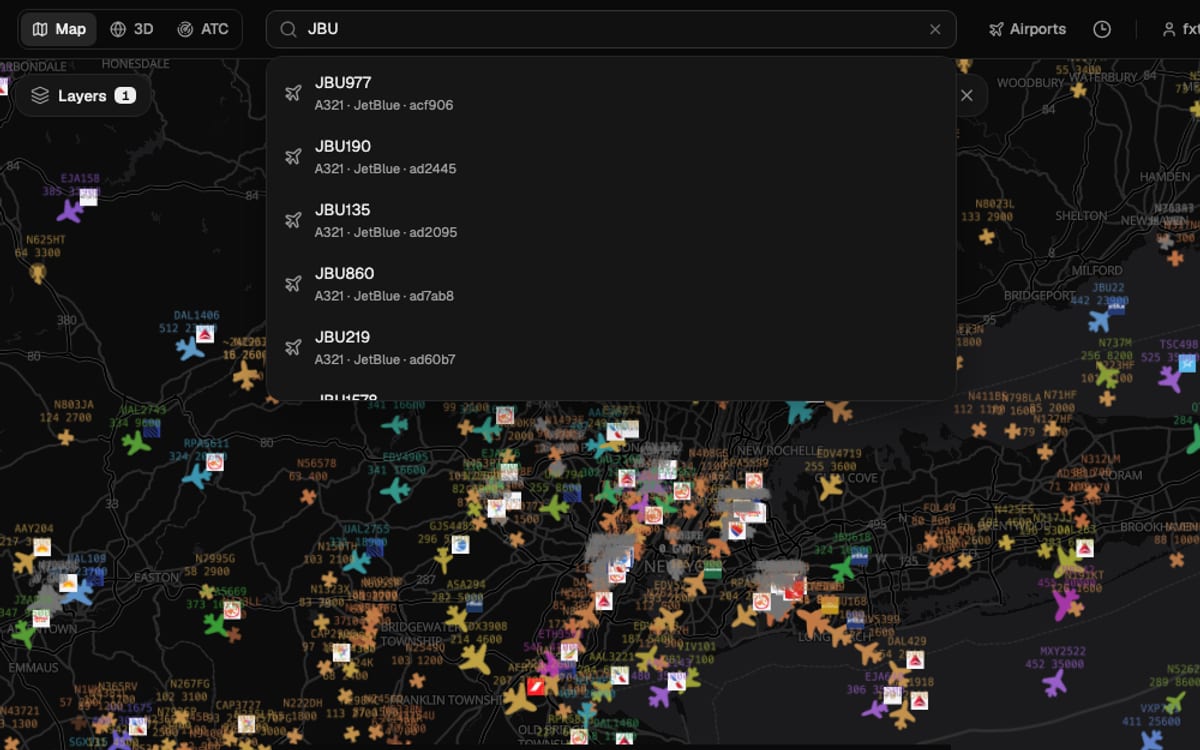
Search only covers aircraft in the live feed right now. If the plane is parked, or flying somewhere with no receiver nearby, no tracker can show its live position. Once you have found it, you can replay its track from adsb.lol traces at 1x to 40x speed.
To follow one airframe over many flights, GodsView Plus adds aircraft watchlists with takeoff, landing and signal-lost alerts, delivered in the app, by browser push or by email. Plus costs $10.99 a month or $99.99 a year as of November 2026; see pricing. The Track a flight page is built for flight numbers, so use the map search for tail numbers.
Open the 3D globe and search a hex code
When the plane isn't flying
A live map can't tell you where a parked aircraft is or where it went last week. For past flights by registration, services with history are the better tail number tracker. FlightAware's site offers a private flight (tail number) search and says its app tracks charter, private and general aviation aircraft. AirNav Radar's plans page lists aircraft flight history, including registration and times, for 7 days on its free plan. Our best flight tracker app comparison covers the history each app keeps.
Private plane tracker by tail number: what you won't see
Searching a private jet's tail number often finds nothing, even when the aircraft is flying. The two main reasons are FAA privacy programs.
LADD: hiding FAA flight data
The FAA's Limiting Aircraft Data Displayed (LADD) program lets aircraft owners or their representatives have their flight data filtered from the FAA's SWIM data feed, or from public display by flight tracking websites that take part. The FAA says vendors who subscribe to SWIM data are bound by an agreement to filter LADD aircraft from public display. Owners can limit data at the FAA source, limit it at subscriber level so that only vendors they arrange tracking with show it, or unblock. Changes take effect on the first Thursday of each month.
LADD does not change what the aircraft broadcasts. A community ADS-B network that relies on its own receivers rather than FAA data may still show the aircraft.
PIA: a temporary hex code
The FAA's Privacy ICAO Address (PIA) program goes further. An eligible owner gets an alternate, temporary ICAO address that is not assigned to the owner in the civil aircraft registry. The aircraft still broadcasts ADS-B, and off-the-shelf receivers still hear it, but the hex code no longer matches the tail number in public records.
| LADD | PIA | |
|---|---|---|
| What it limits | FAA data feed and participating tracking websites | The link between the broadcast hex code and the registry |
| Changes the ADS-B broadcast? | No | Yes, a different ICAO address |
| Who is eligible | Aircraft owners or authorized representatives | US-registered, 1090 MHz ADS-B, third-party call sign, US-managed airspace |
| How often | Processed monthly | A new address can be requested 20 days after the last one |
PIA aircraft must use a third-party call sign and must switch back to their registered address for flights that leave US airspace, according to the FAA. So for a PIA aircraft inside the US, searching its tail number or its registry hex code will not find it.
Track a jet by tail number, not a person
A tail number identifies an aircraft, not a passenger. Owners lease, charter and sell aircraft, and the person on board is often not the registered owner. These programs exist because tracking an aircraft can expose its operator's movements, and the FAA cites that privacy concern for PIA.
Use tail number tracking for aircraft, such as an inbound charter, a historic plane, an aircraft you photographed, or the airliner that will operate your next flight. Don't use it to follow a specific private individual. Rules on flight tracking vary by country; see is flight and ship tracking legal.
Why can't I find a plane by its tail number?
- It isn't flying. Live maps show broadcasting aircraft only.
- No receiver nearby. Over oceans, deserts and mountains, coverage thins.
- The feed has no registration for it. Search the hex code from the registry instead.
- The registration changed. An aircraft sold to another country gets a new mark and usually a new hex code.
- LADD or PIA. The owner has limited display or flies with a temporary hex code.
- Military or government aircraft. Many don't broadcast, or are filtered. See military aircraft tracking explained.
Start with the registry, then the map
Tracking a plane by tail number takes two steps. Look the registration up in the national register to get its hex code; for N-numbers, the FAA aircraft inquiry shows it in seconds. Then search the registration or the hex code on a live map while the aircraft is flying. If you only want to know what is above you right now, the what's overhead view lists nearby aircraft with their identifiers.
Frequently asked questions
Can you track a plane by its tail number?
Yes, while it is flying and within receiver range. Type the registration into a live map such as the GodsView live flight tracker. If it doesn't come up, look the registration up in the national register to get its six-character hex code and search that. A parked aircraft won't show on any live map.
What is the difference between a tail number and a hex code?
The tail number is the registration painted on the aircraft, such as N905NA. The hex code is the ICAO 24-bit address its transponder broadcasts, such as AC82EC for that aircraft. Live maps receive the hex code; the registration is matched from a database.
How do I find an aircraft's hex code from its N-number?
Search the N-number on the FAA aircraft inquiry at registry.faa.gov. The result lists the Mode S code in octal and in hexadecimal. The hex value is the one to search on a live flight map.
Why can't I track a private jet by tail number?
Its owner may use the FAA LADD program, which filters its data from the FAA feed and from participating tracking websites, or the Privacy ICAO Address program, which gives it a temporary hex code that isn't linked to its registration in public records. It may also simply be on the ground or out of receiver range.
What do tail number prefixes mean?
The prefix shows the country of registration: N for the United States, C- for Canada, G- for the United Kingdom, D- for Germany, F- for France, VH- for Australia, VT- for India, JA for Japan, A6- for the UAE and B- for China. It does not tell you where the aircraft is flying.
Can I see where a plane flew before?
Not from a live map alone. GodsView can replay the track of an aircraft you find on the map. For flights by registration over past days, FlightAware and AirNav Radar keep aircraft flight history, with longer history on paid plans.
Sources
- FAA — Aircraft registry inquiry
- FAA — Forming an N-number
- FAA — Limiting Aircraft Data Displayed (LADD)
- FAA — ADS-B Privacy ICAO Address (PIA) program
- Wikipedia — Aircraft registration
- Wikipedia — Aviation transponder interrogation modes (ICAO 24-bit address)
- Transport Canada — Canadian Civil Aircraft Register quick search
- UK Civil Aviation Authority — G-INFO aircraft register
- FlightAware — Mobile app and tail number search
- AirNav Radar — Subscription plans and flight history
Facts checked on against each provider's own site.