Sky guide
Quadrantid Meteor Shower 2027: Short Peak, Dark Sky, Where to Look
The Quadrantids can match the best showers of the year, but only for a few hours. In 2027 the Moon is out of the way and the peak lands before dawn in Europe. Here is the timing, who is favoured, and how to catch a shower that rewards good planning.
Key takeaways
- The Quadrantids are active from December 28, 2026 to January 12, 2027. The International Meteor Organization (IMO) puts the 2027 maximum on January 4 at about 03:25 UTC, with an uncertainty of roughly 2.5 hours.
- The peak is short: high rates last only a few hours, so where you live decides how much of it you see. The American Meteor Society says the 2027 peak favours Europe and western Asia.
- Moonlight is not a problem in 2027: the peak falls shortly before New Moon, and the AMS gives the Moon as an 18 percent waning crescent on the night of January 3 to 4.
- The IMO gives a zenithal hourly rate of 80 that can vary from about 60 to 200; under real dark skies the AMS expects around 25 meteors an hour on average.
- The radiant lies in northern Boötes, near the handle of the Big Dipper, and is best seen from the Northern Hemisphere in the hours before dawn.
The Quadrantid meteor shower 2027 peaks on January 4 at about 03:25 UTC, according to the International Meteor Organization, with almost no moonlight. The catch is the shape of the peak: the Quadrantids are strong for only a few hours, so the best plan is to watch in the pre-dawn hours of January 4 if you are in Europe or western Asia, and in the late night and pre-dawn hours of January 3 to 4 elsewhere in the Northern Hemisphere. Face north-east, find a dark sky and give it at least an hour.
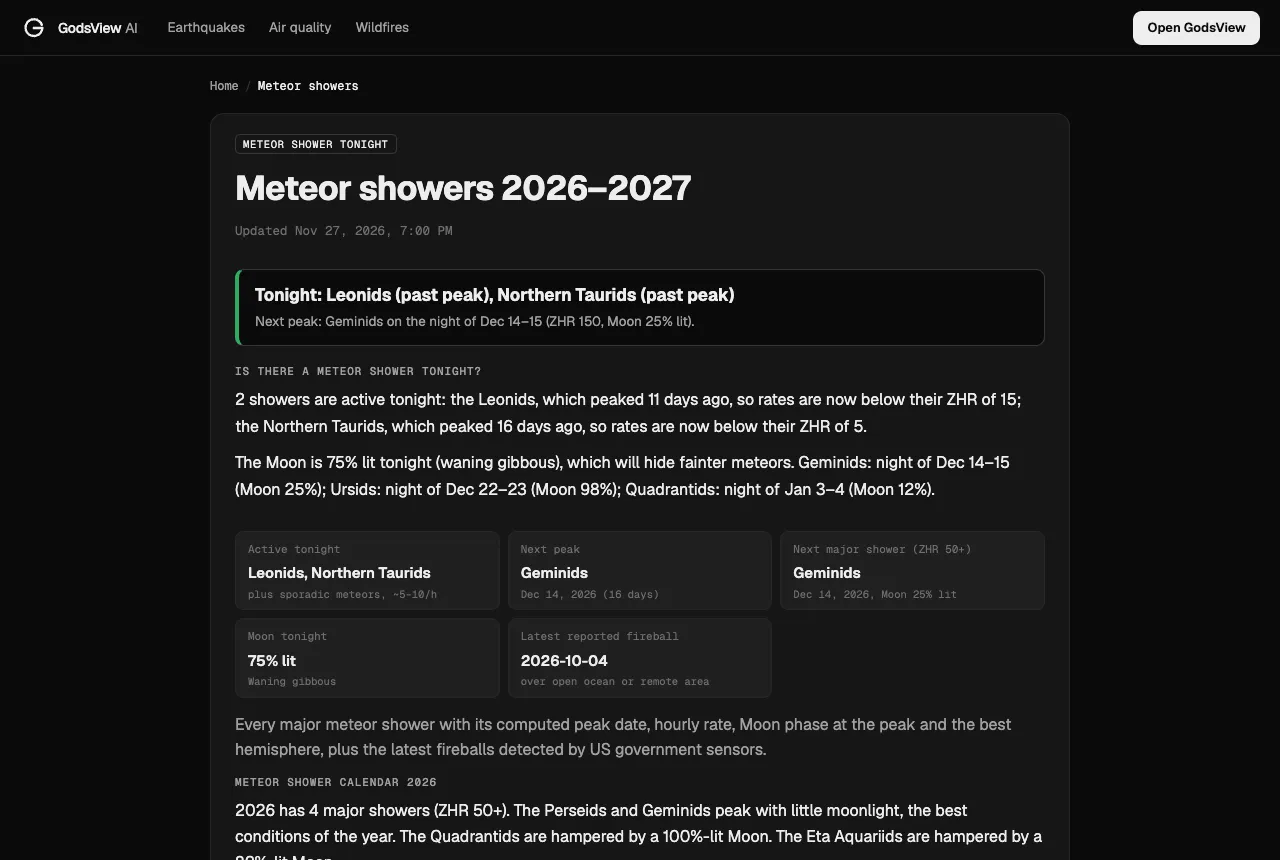
The GodsView Quadrantids page shows the peak in UTC, the Moon phase and how high the radiant gets at your latitude, and the meteor showers calendar shows what is active tonight.
See the Quadrantids 2027 forecast
Quadrantids 2027 at a glance
| Item | Quadrantids 2027 |
|---|---|
| Active period | December 28, 2026 to January 12, 2027 |
| Maximum | January 4, 2027, about 03:25 UTC (solar longitude 283.15°) |
| Peak timing uncertainty | About 2.5 hours either way (IMO) |
| Best night | January 3 to 4 |
| Zenithal hourly rate (ZHR) | 80, can vary from about 60 to 200 (IMO) |
| Typical rate under dark skies | About 25 an hour on average (AMS) |
| Moon | Waning crescent, about 18% lit, shortly before New Moon |
| Radiant | Northern Boötes, near the Big Dipper's handle (RA 230°, Dec +49°) |
| Meteor speed | 41 km/s |
| Parent body | Asteroid 2003 EH1 |
Why the Quadrantid peak is so short
Most showers build up and fade over a day or two. The Quadrantids do not. NASA explains that the stream of particles is thin and Earth crosses it at a steep angle, so the peak lasts "only a few hours". The AMS puts the strong part at about six hours and says that is why a shower with "potential to be the strongest" of the year usually falls short in practice.
The IMO notes that the timing itself is uncertain by about 0.1 degree of solar longitude, which is about 2.5 hours, because observations of recent returns have gaps. Peak rates have also varied: the IMO says the highest rates in 2022, 2023 and 2025 were at the low end of the range, while 2024 and 2026 were close to average. For 2027, the IMO adds that modelling by Vaubaillon suggests the stream is slightly shifted toward the Sun, "which might cause enhanced activity". Treat that as a possibility, not a forecast of a storm.
Who is best placed in 2027
The maximum at about 03:25 UTC on January 4 lands at very different local times:
- United Kingdom and Ireland: about 03:25 GMT. Ideal: deep night, radiant climbing.
- Central Europe: about 04:25 local time. Ideal, in the pre-dawn hours.
- Eastern Europe and Turkey: about 05:25 to 06:25. Good until twilight begins.
- US East Coast: about 10:25 p.m. EST on January 3. The radiant is low in the north at that hour, so rates are lower, but the hours after midnight still catch the tail of the peak.
- US West Coast: about 7:25 p.m. PST on January 3, early evening with the radiant low. West Coast observers will mostly see the declining side, after midnight.
- South and East Asia: the peak falls in daylight, so the nights before and after see lower rates.
That is why the AMS says the 2027 peak favours Europe and western Asia. North Americans should still watch, but should expect fewer meteors than Europeans.
The Quadrantids are also mainly a Northern Hemisphere shower: the radiant sits high in the northern sky, at a declination of about +49 degrees, so it barely rises, if at all, from mid-southern latitudes.
Where to look
The Quadrantids take their name from Quadrans Muralis, an old constellation created by the French astronomer Jérôme Lalande in 1795. NASA notes that it was left out when the International Astronomical Union set the modern constellation list in 1922. The radiant now lies in northern Boötes, between Boötes and Draco, near the end of the Big Dipper's handle.
- Find the Big Dipper. In the early-morning hours of January it is high in the north-east. Follow the curve of its handle; the radiant lies just beyond it.
- Then look away from it. As with any shower, meteors appear all over the sky. Look about halfway up, 40 to 60 degrees away from the radiant, to see longer trails.
- Best hours: after midnight until dawn. The radiant is low in the evening and climbs through the night, so more meteors appear in the hours before dawn.
The GodsView Quadrantids page includes a table of the radiant's height at 10 p.m. and 4 a.m. for different latitudes, which is the quickest way to see whether your location is in a good position.
The Moon and the weather in 2027
Moon: excellent. The IMO describes the 2027 Quadrantid peak as "shortly before New Moon" and says conditions "are perfect concerning the moonlight". The AMS gives an 18 percent waning crescent on January 3 to 4. A thin waning crescent rises only in the early morning hours and gives little light, so it will barely interfere.
Weather: the usual problem. The AMS lists poor early-January weather as the other reason the Quadrantids are under-observed. Winter cloud, snow and bitter cold make this the hardest of the major showers to catch. Check the cloud forecast a day ahead and be ready to drive to clearer skies if you can.
How many meteors to expect
The IMO's ZHR of 80 is the theoretical rate for one observer with the radiant overhead under a perfectly dark sky. NASA quotes 60 to 200 an hour "during peak conditions", which matches the IMO's range of past ZHRs. Real counts are lower: the AMS gives an average hourly rate of about 25 under dark skies.
What makes the Quadrantids special is their fireballs. NASA says the shower is known for bright fireballs that come from larger particles and can persist longer than ordinary meteors. The IMO notes that bright fireballs have been seen even a few days after the peak, and that the 5 to 7 days after the maximum remain good for observing. If you catch a very bright one, our fireball meteor guide explains what to note and how to report it.
Where the Quadrantids come from
The parent body is asteroid 2003 EH1, discovered on March 6, 2003 by the Lowell Observatory Near-Earth Object Search (LONEOS). NASA says the astronomer Peter Jenniskens identified it as the source of the shower. It is small, about two miles (3 km) across, and like the Geminids' parent 3200 Phaethon, it may be a "dead comet" or a "rock comet".
How to watch on a cold January night
- Set an alarm, not a late night. In Europe the hours between about 2 a.m. and the start of twilight are the ones that matter. Elsewhere, start after midnight.
- Dress for freezing temperatures. You will be still for an hour or more. Insulated boots, layers, a hat and a sleeping bag or blanket help a lot.
- Go dark. Get away from streetlights. Let your eyes adapt and keep your phone screen dim or off.
- Lie back. A reclining chair lets you see the most sky without a sore neck.
- Skip the telescope. Meteors are fast and spread over the sky; binoculars and telescopes only narrow your view.
- Use the satellites as a warm-up. In the evening you may see the International Space Station or other satellites cross; our satellites tonight guide explains how to tell them apart from meteors.
Check the Quadrantids live
- Shower details: peak time, Moon phase and radiant height at Quadrantids.
- What is active tonight: the meteor showers calendar, which also lists recent fireballs from NASA JPL's CNEOS data.
- Before the Quadrantids: the Geminids peak on December 14, 2026 under a thin crescent Moon; see our Geminids 2026 guide. For general tips, see meteor shower tonight.
The short version
The 2027 Quadrantids peak around 03:25 UTC on January 4, with an uncertainty of a couple of hours, under an almost moonless sky. Europe and western Asia are best placed, with the peak in the pre-dawn hours. Elsewhere in the Northern Hemisphere, watch after midnight on January 3 to 4. Look north-east toward the handle of the Big Dipper, then take in the whole sky, and stay out long enough for the short burst of activity to reach you.
Open the meteor shower calendar
Frequently asked questions
When is the Quadrantid meteor shower 2027?
The Quadrantids are active from December 28, 2026 to January 12, 2027. The International Meteor Organization puts the maximum on January 4, 2027 at about 03:25 UTC, so the night of January 3 to 4 is the one to watch.
Why is the Quadrantid peak so short?
NASA explains that the stream of particles is thin and Earth crosses it at a steep angle, so the peak lasts only a few hours. The American Meteor Society puts the strong part at about six hours.
Where should I look for the Quadrantids?
Find the Big Dipper in the north-east before dawn. The radiant lies just beyond the end of its handle, in northern Boötes. Then look at a wide area of sky about halfway up, rather than straight at the radiant.
Can you see the Quadrantids from the Southern Hemisphere?
Hardly. The radiant is far north in the sky (declination about +49 degrees), so it stays low or below the horizon from most of the Southern Hemisphere. It is a Northern Hemisphere shower.
Will the Moon interfere with the Quadrantids in 2027?
No. The 2027 peak falls shortly before New Moon; the American Meteor Society gives an 18 percent waning crescent, a thin Moon that rises only in the early morning hours.
What is the parent of the Quadrantids?
Asteroid 2003 EH1, discovered on March 6, 2003 by the LONEOS survey at Lowell Observatory. It may be a dead comet or a "rock comet".
Sources
- International Meteor Organization — 2027 Meteor Shower Calendar (PDF)
- American Meteor Society — Meteor Shower Calendar 2026-2027
- NASA — Quadrantids
- American Meteor Society — Major meteor showers
Facts checked on against each provider's own site.