Sky guide
How to Spot Satellites Tonight With the Naked Eye
On any clear evening you can see satellites without a telescope: steady points of light gliding across the stars, then fading out in mid-sky. Here is when to look, how to tell them from aircraft, and how to catch the space station and a Starlink train.
Key takeaways
- Satellites are visible because they reflect sunlight, so the best time to look is the first hours after dusk and the hours before dawn, when the ground is dark but satellites overhead are still in sunshine.
- A satellite looks like a steady star moving smoothly across the sky; unlike a plane, it has no flashing lights and does not change direction.
- NASA says the International Space Station is best seen within a few hours of sunset or sunrise and looks like a very bright star moving fast; its Spot the Station app sends pass alerts.
- Satellites often fade out in mid-sky because they pass into Earth's shadow, which is why most satellite watching ends a few hours after dark.
- Newly launched Starlink satellites can appear as a line of dots for a short time after launch; at their operating height SpaceX aims for them to be invisible to the naked eye.
To see satellites tonight, go outside as twilight fades after sunset (or before sunrise), let your eyes adjust to the dark, and watch for a steady point of light moving smoothly across the stars. It will not blink or change direction, and it may suddenly fade away in mid-sky as it enters Earth's shadow. Satellites shine only by reflected sunlight, so they are easiest to see in the hours after dusk and before dawn, when the ground is dark but the satellite is still lit. The International Space Station is the brightest; NASA's Spot the Station service gives its exact pass times for your location.
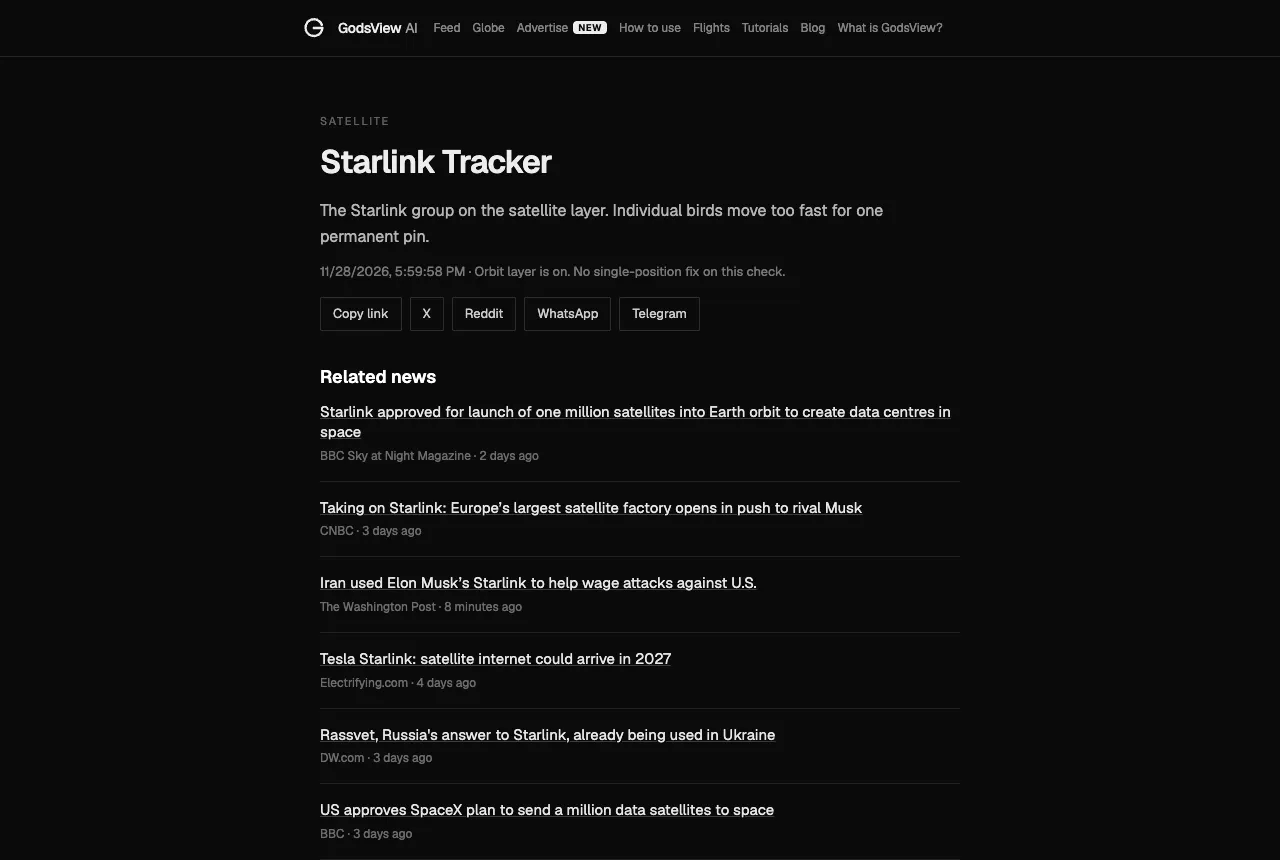
GodsView shows where satellites are right now on a 3D globe: the Starlink tracker for the Starlink group, the ISS page for the space station, and the live satellite tracker for the wider catalogue.
Why you can see satellites at all
Satellites have no lights of their own. You see them because sunlight bounces off their solar panels and bodies toward you. The University of Alaska Fairbanks Geophysical Institute sums up the two conditions you need: the satellite must be in sunlight, and there must be no sunshine on the lower atmosphere near you, so your sky is dark.
That happens during twilight and the first part of the night:
| Sun below your horizon | Name | What it means for satellite watching |
|---|---|---|
| 0 to 6 degrees | Civil twilight | Sky still too bright for most satellites |
| 6 to 12 degrees | Nautical twilight | Good: sky darkening, low satellites still lit |
| 12 to 18 degrees | Astronomical twilight | Very good: dark sky, many satellites still lit |
| More than 18 degrees | Night | Only higher satellites stay in sunlight |
The Geophysical Institute notes that only a very high satellite, above about 400 km, might still be seen during full night, once the Sun is more than 18 degrees down. SpaceX says the same thing from the operator's side: satellites "typically are visible when they are just over the dark side of the terminator", in the first several hours of night and before dawn, and higher satellites stay lit deeper into the night.
Best time to look tonight
- Evening: from the time the first stars appear, through nautical and astronomical twilight and the first few hours of night. This is the easiest window for most people.
- Morning: the same window in reverse, ending as dawn brightens.
- Middle of the night: few satellites, because most low-orbit satellites are in Earth's shadow. Summer nights at high latitudes are the exception, because the Sun is never far below the horizon.
Check your local sunset time and plan to be outside, somewhere away from bright lights, as twilight deepens.
How to tell a satellite from a plane, a star or a meteor
| What you see | Satellite | Aircraft | Meteor |
|---|---|---|---|
| Light | Steady, no blinking | Flashing red, green or white lights | A brief streak |
| Movement | Smooth, straight line | Can turn, often lower and slower-looking | Very fast |
| Duration | A few minutes, or until it fades into shadow | Can stay in view for a long time | Usually under a second to a few seconds |
| Sound | None | Engine noise near airports | None (rare exceptions for big fireballs) |
NASA describes the space station as looking "similar to an airplane or a very bright star moving across the night sky, except it does not have flashing lights or change direction." It also moves much faster than a plane: about 17,500 mph, compared with about 600 mph for an airliner.
If something is blinking, it is almost certainly an aircraft. To check, open what's overhead, which shows the planes near your location right now. For a bright streak that lasts a second or two, see our guide to fireball meteors.
How to see the International Space Station
The ISS is the easiest satellite to see and often one of the brightest objects in the sky.
- Get pass times. NASA's Spot the Station website and app list upcoming passes for your location and can send alerts. NASA says the station is best seen "within a few hours before or after sunrise or sunset".
- Read the pass details. NASA's listings give the time, how long the station stays above the horizon, where it appears and disappears, and its maximum height in degrees, where 0 is the horizon and 90 is straight overhead.
- Use your fist. NASA's tip: a closed fist held at arm's length covers about 10 degrees of sky. A pass with a maximum height of 40 degrees is four fists above the horizon.
- Be on time. Visible passes last a few minutes. Be outside a couple of minutes early and look toward the direction where it appears.
NASA notes that the station's orbit is inclined 51.6 degrees, so people far north, such as in parts of Alaska, may miss some passes. The GodsView ISS tracker shows where the station is now and where it is heading; our guide to tracking the ISS in real time goes further.
How to see Starlink satellites
Starlink satellites are numerous but, at their working height, hard to see. SpaceX says its goal is for its second-generation satellites to be "invisible to the naked eye" while they are on station, using measures such as low-reflectivity black paint, mirror films and angling their solar arrays away from observers.
They are visible in a few phases, according to SpaceX:
- Right after launch, during the first several orbits, while they deploy antennas and solar arrays.
- During orbit raising, when they climb from the low insertion orbit and cannot angle their solar arrays away.
- During manoeuvres and at the end of life, while they lower their orbits before burning up on reentry.
That is when you may see the famous Starlink train: a line of moving dots following each other across the sky. It is most likely in the day or two after a Starlink launch, in the evening or before dawn, when the train passes over you. Check the space launch tracker for recent Starlink launches, and see how to see Starlink satellites tonight for more.
What happened to satellite flares?
For years, skywatchers chased Iridium flares: brief, very bright glints caused, in AGI's words, by a passing satellite "reflecting sunlight toward the Earth". The original Iridium satellites produced them because of their distinctive design. Those satellites have been replaced by the Iridium NEXT constellation, whose different design does not produce the same effect. Iridium deorbited the last satellite from its original constellation in December 2019 and marked it with a webcast called the "Final Flarewell" on December 5, 2019.
You can still see short glints from other satellites, but nothing as predictable as the old Iridium flares.
Why satellites fade out in mid-sky
A satellite that suddenly dims and vanishes before reaching the horizon has not exploded. It has moved into Earth's shadow. You are watching from the dark side of the planet, and the satellite has crossed from sunlight into the part of space that Earth blocks from the Sun. The Geophysical Institute describes satellites disappearing as they pass into the shadow as orbital geometry changes. Later in the evening, more of the sky lies in shadow, so passes get shorter and rarer.
The reverse happens before dawn: a satellite can appear out of nowhere as it moves out of the shadow into sunlight.
Tips for a good night of satellite spotting
- Go dark. A park or field away from streetlights shows many more satellites than a city centre.
- Let your eyes adapt. Give it time and keep your phone screen dim.
- Lie back and scan. Satellites can cross anywhere. Relax your gaze and watch for movement.
- No equipment needed. Binoculars can help you follow one you have already found, but your eyes are the best tool for spotting them.
- Use a map to identify what you saw. Note the time and direction, then compare with the live satellite tracker, which computes positions from public orbital elements. Our explainer on how satellite tracking works covers how those predictions are made.
- Make a night of it. In December, the Geminid meteor shower peaks on December 14, 2026, and a satellite-filled evening sky is a good warm-up.
The short version
Look up in the first hours after dusk or before dawn, from somewhere dark. A steady, non-blinking light gliding smoothly across the stars is a satellite. The ISS is the brightest, with pass times from NASA's Spot the Station. Starlink trains show up for a short time after launches, and any satellite fades out when it enters Earth's shadow.
Frequently asked questions
What time can you see satellites at night?
Mainly in the first couple of hours after sunset and before sunrise. Satellites shine by reflected sunlight, so they are visible when your sky is dark but they are still in sunlight. In the middle of the night most low satellites are in Earth's shadow.
How can I tell a satellite from a plane?
A satellite is a steady point of light moving smoothly in a straight line. A plane has flashing coloured lights and can change direction. NASA says the space station looks like a very bright star moving across the sky, without flashing lights.
Why did the satellite disappear in the middle of the sky?
It moved into Earth's shadow. Once sunlight no longer reaches it, it has nothing to reflect, so it fades out even though it keeps moving.
How do I find out when the ISS is visible?
Use NASA's Spot the Station website or app, which lists passes for your location with time, duration and maximum height, and can send alerts. The GodsView ISS tracker shows where the station is now.
Can you still see Iridium flares?
No. Iridium flares came from the original Iridium satellites, which were replaced by the Iridium NEXT constellation. Iridium deorbited the last original satellite in December 2019.
Why do I see a line of lights moving across the sky?
That is most likely a Starlink train: newly launched Starlink satellites travelling in a line before they spread out and climb to their operating orbit. They are brightest in the days after launch.
Sources
- NASA — Spot the Station
- University of Alaska Fairbanks Geophysical Institute — Seeing satellites
- SpaceX — Brightness mitigation best practices for satellite operators (PDF)
- SpacePolicyOnline — Final Flarewell to the original Iridium system (December 5, 2019)
- AGI — Saying #flarewell to Iridium flares
Facts checked on against each provider's own site.